
Unveiling the Secrets: The Six Non-Negotiable Elements of Superior Puffed Snacks
The irresistible allure of a perfectly puffed snack—be it a cheese ball, a veggie straw, or a classic cheese curl—lies in that definitive, satisfying crunch. To the consumer, it’s a simple pleasure. Puffed snack food making machine To the food scientist and process engineer, it is the culmination of a precise, high-stakes ballet of physics, chemistry, and engineering. Achieving a snack that is consistently light, crispy, flavorful, and shelf-stable is far from accidental. It is a rigorous process where each step is a critical link in a chain; one weak link, and the product fails.
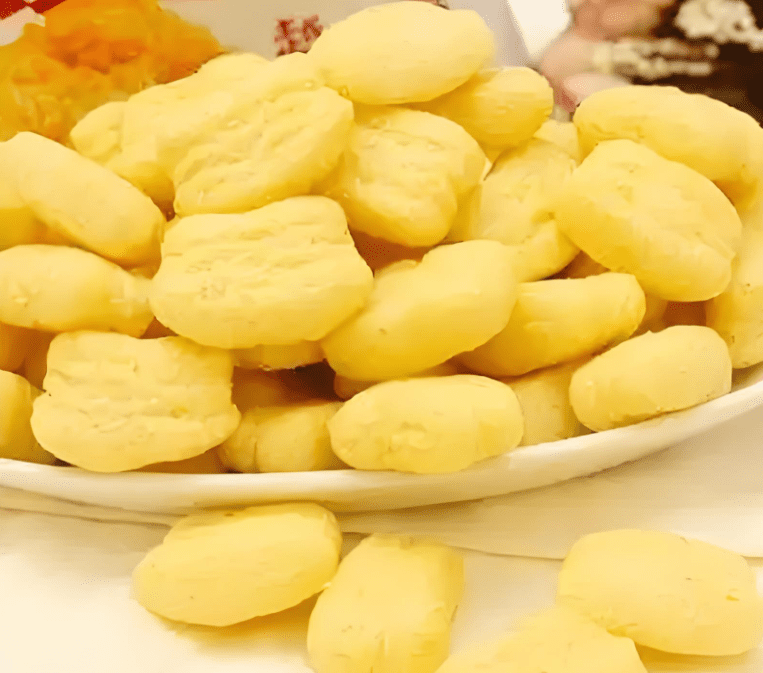
Moving beyond basic recipes, this article delves into the core industrial principles that separate an amateurish attempt from a commercial masterpiece. Puffed snack food making machine Here are the six essential elements that define the creation of a superior puffed snack.
Element 1: The Raw Material Foundation – The Science of Starch Selection and Matrix
The heart of all puffed snacks is the puffing phenomenon itself, which is fundamentally dependent on the behavior of starch. The choice of raw materials is the first and most crucial determinant of success.
- The Starch Dichotomy: Not all starches are created equal. The two primary types, amylose (a linear molecule) and amylopectin (a branched molecule),Puffed snack food making machine behave differently under heat and pressure. Starches high in amylopectin, such as those from potatoes, tapioca, and rice, are the heroes of puffed snacks. Their branched structure allows them to form a flexible, viscous gel when cooked with water. This gel can trap steam and expand dramatically upon pressure release, creating a vast network of air cells that results in a light, airy, and highly expanded product. In contrast, high-amylose starches (like those in some legumes) create a rigid, dense structure that offers poor expansion and a hard, crunchy mouthfeel.
- The Protein and Fiber Balancing Act: Other components in the raw material mix play a supporting but critical role. Proteins, such as gluten from wheat, can provide a reinforcing network that gives the puffed structure strength and coherence, preventing it from collapsing. However, too much protein creates a tough, leathery matrix that inhibits expansion. Similarly, dietary fiber can disrupt the continuous starch matrix, leading to a weaker, more brittle structure and less volumetric puffing. The goal is a precise formula where starch is the undisputed star, with protein and fiber playing carefully measured supporting roles.
- The Goldilocks Zone of Moisture: The initial moisture content of the raw mix is non-negotiable. Typically ranging from 12% to 18%, this water is the “working fluid” of the puffing process. If the mix is too dry, starch gelatinization is incomplete, resulting in a dense, poorly puffed product with a gritty texture. If it’s too wet, the excess water requires too much energy to vaporize, leading to soggy, uneven expansion and a tough, glassy texture.
The Insider’s Secret: Top-tier manufacturers don’t just use “cornmeal” or “potato flour.” Puffed snack food making machine They use specific, functionally defined blends of high-amylopectin starches, engineered to deliver maximum expansion and a delicate, melt-in-the-mouth crispiness.
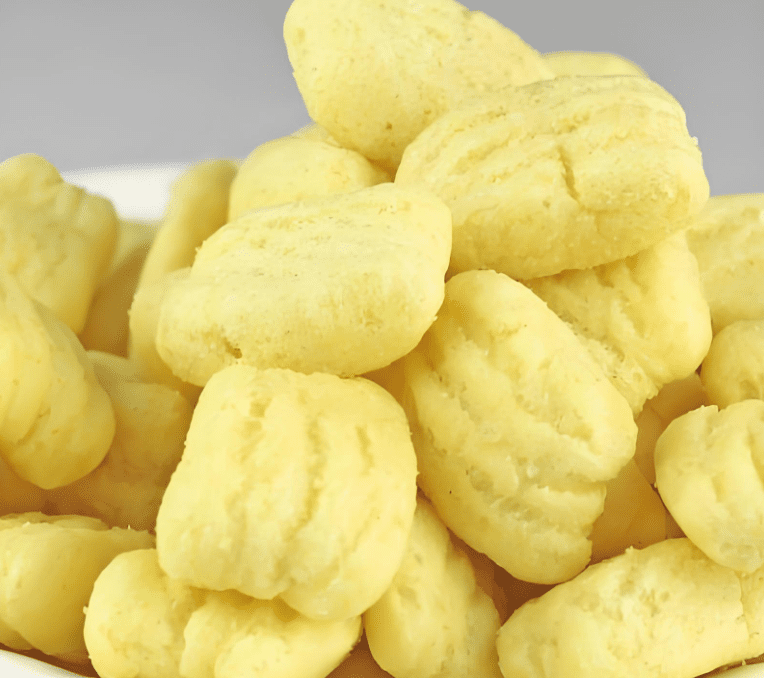
Element 2: The Mixing & Hydration Phase – Achieving Perfection Through Homogeneity
The process of mixing the dry ingredients with water is deceptively simple. The objective is not just to combine them, but to create a perfectly homogeneous mass with a uniform moisture distribution and protein development (if applicable).
- Shear and Time: The intensity (shear) and duration of mixing are critical parameters. Under-mixing leads to pockets of dry flour and uneven hydration, which will cause inconsistent expansion, resulting in some pieces being dense and others being blistered and fragile. Over-mixing, especially with protein-containing flours, can over-develop the gluten network, making the dough too tough and elastic to expand properly. It can also cause excessive starch damage and unwanted temperature rise.
- The Crucial “Aging” or “Tempering” Step: After initial mixing, the dough is often allowed to rest in a controlled environment. This “aging” period is vital. It allows water to fully and equally hydrate every starch granule and protein molecule throughout the mass. This equilibration ensures uniform rheological properties, meaning the dough will flow and react to heat and pressure in a consistent and predictable manner inside the extruder, leading to a uniform cell structure in the final product.
The Insider’s Secret: Inconsistent mixing is a primary cause of product failure. State-of-the-art manufacturing relies on computer-controlled mixers that replicate the exact shear, time, and temperature for every single batch, followed by a dedicated tempering silo to ensure hydration perfection.
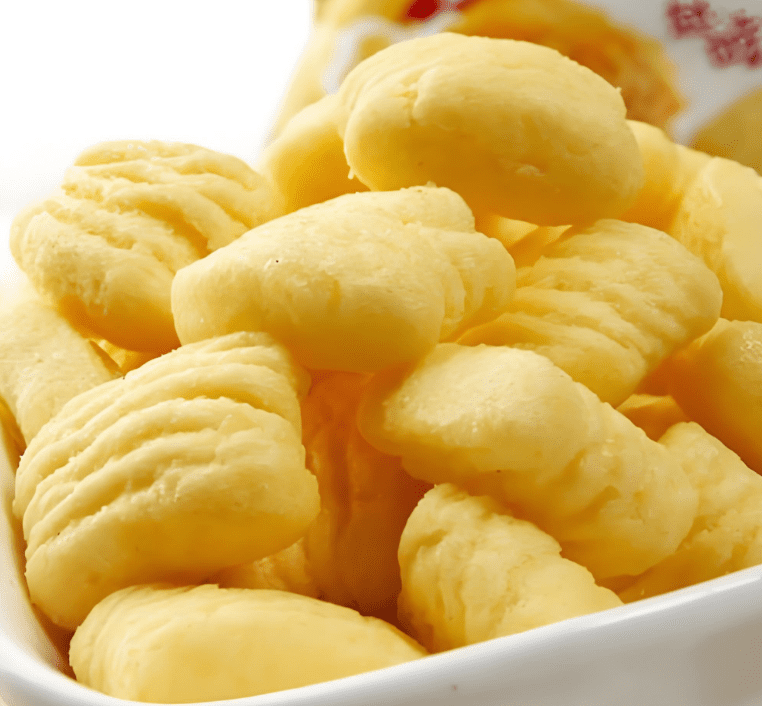
Element 3: The Cooking & Shearing Stage – Precision Energy Input in the Extruder
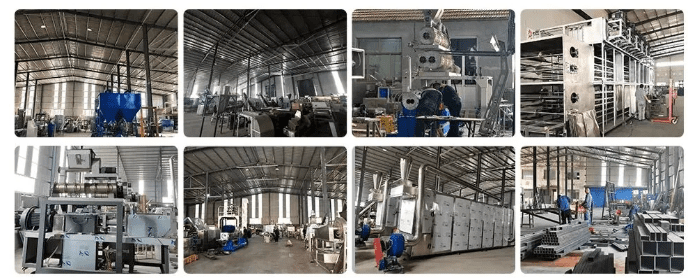
This is the transformative stage where the raw dough is converted into a superheated, plasticized mass ready to explode. Puffed snack food making machine This primarily happens within the barrel of a twin-screw extruder, a marvel of food engineering.
- The Trio of Transformation: Heat, Pressure, and Shear: Inside the extruder, the dough is subjected to a combination of:
- Conductive Heat: Applied from the heated barrel walls.
- Mechanical Shear: Generated by the intermeshing, co-rotating screws kneading and stretching the dough.
- Intense Pressure: Built up as the screws convey the material towards a restrictive die.
This combination cooks the dough completely, fully gelatinizing the starch and denaturing the proteins, transforming it into a homogeneous, viscous melt. The water is superheated but remains liquid due to the high pressure.
- The Role of Specific Mechanical Energy (SME): This is a key monitored parameter in extrusion. SME quantifies the mechanical energy input per unit mass of product. Controlling SME is essential. Too low, and the starch is under-cooked, leading to poor expansion; too high, and the product can become over-processed, leading offtastes and excessive browning.
- Die Design Dictates Form: The die at the end of the extruder barrel is not just a hole; it’s a precision tool. The shape, land length, and opening size of the die not only create the product’s shape (rings, stars, tubes) but also control the final pressure drop, which directly influences the texture and expansion ratio.
The Insider’s Secret: The most skilled operators are masters of the extruder’s “recipe”: screw speed, barrel temperature profile, and feed rate. They fine-tune these variables to achieve the perfect SME and melt consistency for the specific product formula.
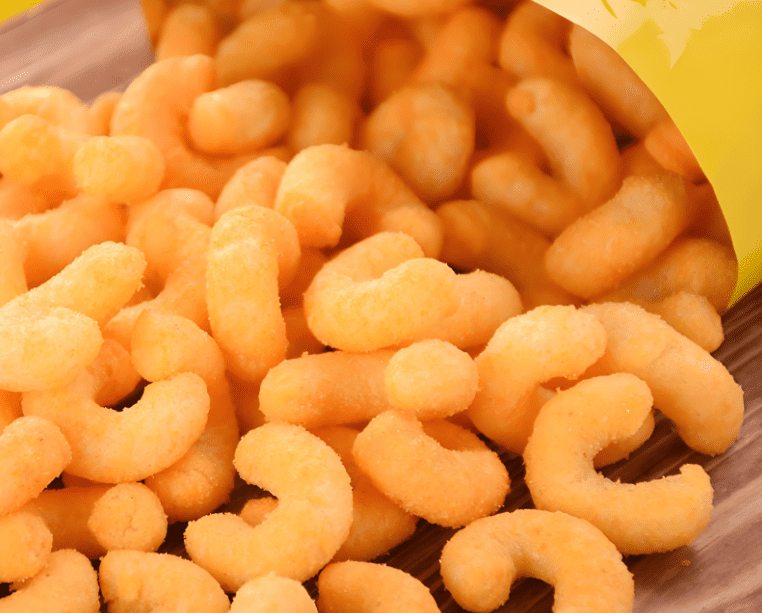
Element 4: The Puffing Moment & Drying – The Art of Controlled Expansion and Structure-Setting
The moment the superheated melt exits the die, the magic happens. The instantaneous pressure drop from dozens of atmospheres to ambient pressure causes the superheated water to flash into steam.
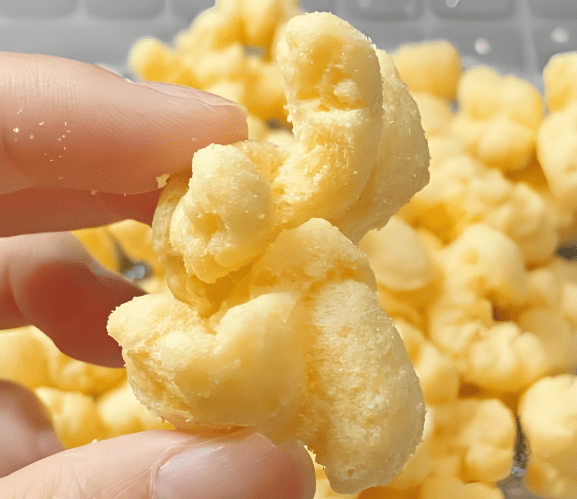
- The “Flash” and Structure Formation: This rapid vaporization (flash) expands the viscoelastic starch melt by hundreds of times its original volume, creating a foam. The steam cells inflate, forming the characteristic porous, spongy structure. The rate of pressure release and the rheology of the melt determine the size and uniformity of these air cells. A well-formulated and processed melt will produce a fine, uniform, honeycomb-like structure.
- The Critical Post-Expansion Dryer: After expansion, the product’s moisture content is still too high for crispiness and shelf stability. It moves immediately to a multi-pass dryer, where it is subjected to a stream of hot air. This step is not just about removing water; it’s about setting the structure. The heat causes the starch to retrograde and crystallize, “locking” the puffed structure in place and transforming it from a soft, malleable foam into a rigid, brittle, and crispy solid. The drying curve—temperature and humidity over time—must be carefully controlled to avoid case-hardening (a hard shell trapping moisture inside) or over-drying, which makes the product brittle and fragile.
The Insider’s Secret: The journey from the die face to the dryer must be incredibly gentle. The newly puffed product is exceptionally fragile, and any impact can collapse its delicate structure, leading to deformed or dense pieces.
Element 5: The Flavor Application – Mastering the Science of Adhesion
A perfectly puffed but bland product is a commercial failure.Puffed snack food making machine The application of oils and seasonings is a science of surface chemistry and physics.
- The Vital Role of the Oil Spray: The dry, porous puffed base first enters a rotating drum where it is misted with liquid oil (vegetable, sunflower, or coconut). This step is critical for three reasons:
- A Binding Agent: The oil acts as a sticky surface to which dry seasoning powders can adhere.
- A Mouthfeel Enhancer: It provides a richer, less dusty mouthfeel and a pleasing sheen.
- A Moisture Barrier: It helps to slightly hydrophobic the surface, slowing down moisture uptake from the air.
- The Seasoning Drum: Immediately after oiling, the product enters a second drum where the dry seasoning blend is applied. The rotation of the drum ensures an even, uniform coating on every piece. The efficiency of this process—maximizing adherence while minimizing waste (“seasoning fall-through”)—is a key cost and quality factor.
- Layered Flavor Systems: For complex flavors, a slurry of oil, powder, and sometimes even liquid flavors can be applied, creating a more integrated and intense taste experience that doesn’t dust off easily.
The Insider’s Secret: The oil-to-powder ratio is meticulously calculated. Too little oil, and the seasoning falls off; too much oil, and the product becomes greasy, prone to rancidity, and the seasoning can clump. Precision is everything.
Element 6: The Protective Packaging – The Final Guardian of Freshness
Without a final, robust line of defense, all the previous effort is wasted. The primary enemies of a puffed snack are moisture, oxygen, light, and physical damage.
- High-Barrier Materials: Modern puffed snack packaging is a marvel of material science, typically using a multi-layer laminate film. A common structure is BOPP (biaxially oriented polypropylene) for printability and strength, laminated to a metalized film (like VMCPP) that provides an excellent barrier against oxygen and light. This prevents the oxidation of fats (rancidity) and the fading of colors.
- Nitrogen Flushing – The Invisible Shield: Before the bag is sealed, the air inside is evacuated and replaced with pure nitrogen gas. As an inert gas, nitrogen does not support oxidation. This “nitrogen flush” creates a protective atmosphere inside the bag, which is why the bags feel pillow-like. It is the single most important factor in preserving the product’s freshness and preventing staleness during its shelf life.
- Physical Integrity: The packaging material must also provide mechanical strength to protect the fragile puffed pieces from being crushed during transportation and handling. The gas inside the bag also acts as a cushion.
The Insider’s Secret: The Oxygen Transmission Rate (OTR) and Water Vapor Transmission Rate (WVTR) of the packaging film are rigorously tested. Puffed snack food making machine Any tiny leak, pinhole, or imperfect seal will allow the enemies in, leading to a stale, soft, or rancid product that betrays the consumer’s trust.
The creation of a superior puffed snack is a symphony of precision, where food science and process engineering are in perfect harmony. From the molecular architecture of the chosen starch to the inert gas that fills the final bag, each of these six elements is a non-negotiable pillar of quality. The next time you enjoy the light, crispy, and flavorful perfection of a well-made puffed snack, remember the immense technological journey and relentless attention to detail that made that simple “crunch” possible.