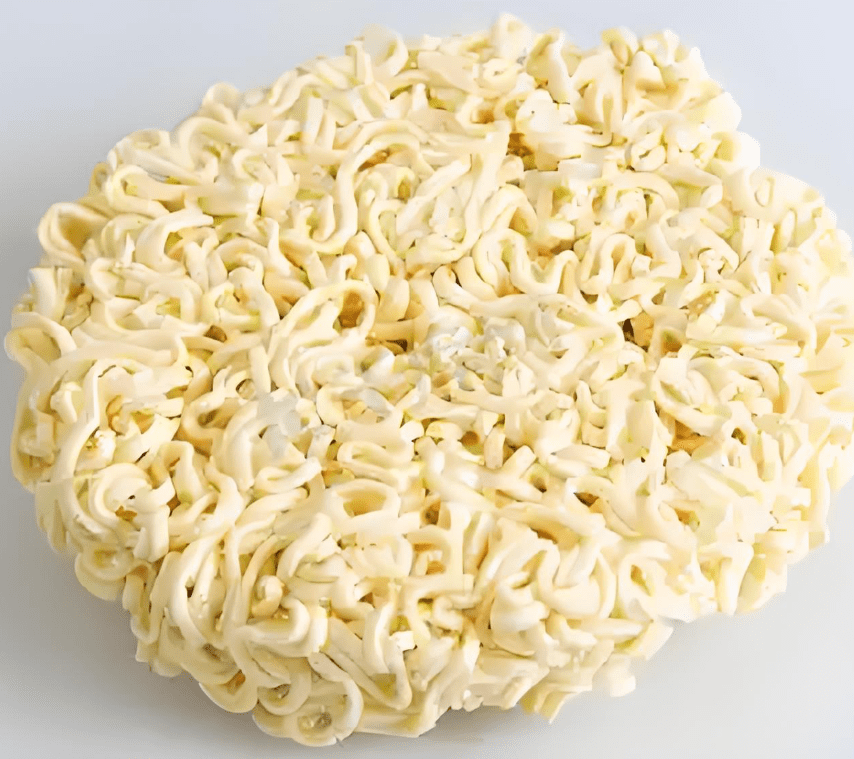
In the bustling landscape of instant foods, the mini fried instant noodle block—often weighing between 30 to 70 grams—stands as a testament to precision engineering and food science. Far from being a mere scaled-down version of its standard counterpart, its creation is a delicate ballet of physics, chemistry, and mechanical ingenuity. This article unveils the sophisticated, often overlooked, manufacturing secrets behind this ubiquitous snack.
Part 1: The Core Challenge – Why “Small” is Not “Simple”
Scaling down presents unique, counter-intuitive challenges:
- The Geometry Problem: Halving the linear dimensions reduces the volume and mass by a factor of eight. This dramatically increases the surface-area-to-volume ratio, which critically affects heat and mass transfer during frying and drying.
- Structural Integrity: A smaller, thinner block must maintain enough mechanical strength to survive packaging, transportation, and handling without crumbling, yet remain porous enough for rapid rehydration.
- Consistency is King: Producing tens of thousands of perfectly identical mini blocks per hour requires unprecedented control over every variable, from dough viscosity to oil temperature gradients.
Part 2: Deconstructing the Process: A Step-by-Step Revelation
Stage 1: Formula Re-engineering – The Foundation
The journey begins not on the production line, but in the lab. The flour blend for mini noodles often has a slightly higher protein content to strengthen the delicate noodle matrix. The water-to-flour ratio and the composition of the alkaline salt solution (kansui) are meticulously calibrated. Too much alkali makes the noodles too firm and slow to rehydrate; too little makes them too fragile. For mini blocks, the balance leans towards achieving a robust yet open structure that hydrates in 2-3 minutes.
Stage 2: Precision Sheeting & Ultra-Thin Calendering
The dough is not just rolled flat; it undergoes progressive reduction. Through a series of 5 to 7 pairs of precisely spaced rollers, the dough sheet is gradually thinned to a final gauge of 0.8mm to 1.2mm—thinner than standard noodles. This ultra-thin sheet is crucial for the final texture. Each roller pair runs at a synchronously increasing speed, stretching the gluten network align, creating strength and elasticity without tearing. Laser sensors constantly monitor thickness, with feedback loops making micro-adjustments to roll gaps in real-time.

Stage 3: The Art of the Wave
The iconic wave is functional, not just aesthetic. As the thin sheet is slit into strands, it passes over a reciprocating “wave former.” For mini noodles, the wave pattern is tighter and more uniform. This serves multiple purposes:
- It creates a larger surface area for subsequent steaming and frying.
- It introduces structural “spring” that helps the block retain its shape after compression.
- It creates tiny channels for oil and steam to penetrate uniformly during frying.
Stage 4: Targeted Gelatinization in the Steam Tunnel
The waved noodles enter a saturated steam tunnel (95-105°C). Here, instant noodle factory machine the magic of starch gelatinization occurs: water molecules penetrate starch granules, causing them to swell and lose their crystalline structure. For mini noodles, the steaming time and humidity profile are carefully tuned. The goal is to achieve near-complete surface gelatinization while keeping the core slightly less gelatinized. This gradient is vital—it allows the noodle strands to bind together during molding without becoming a gummy mass, and it sets the stage for the explosive “puffing” effect during frying.

Stage 5: The Heart of Mini Production – Micro-Molding
This is the most distinctive stage. The steamed noodle mat is portioned into a precision mold cavity. A servo-electric or hydraulic press applies controlled pressure (5-20 kN) for a precise “dwell time” (fractions of a second). This is not just compacting; it’s a carefully orchestrated deformation:
- Pressure: Too high, and the noodle strands fuse, blocking pores and leading to a hard, slow-cooking block. Too low, and the block disintegrates.
- Dwell Time: Allows for stress relaxation in the noodles, preventing spring-back and ensuring the block holds its exact shape and density (~0.4 g/cm³).
- The mold itself, often coated with a non-stick material like PTFE, is engineered for quick release and minimal product adhesion.
Stage 6: The Thermodynamic Drama – Flash Frying
The molded blocks ride a mesh conveyor through a multi-zone frying bath of hot oil (typically palm olein at 150-170°C). instant noodle factory machine This 60-120 second journey is a rapid-fire exchange of heat and mass:
- Instantaneous Heat Transfer: The hot oil instantly heats the noodle surface to well above water’s boiling point.
- Moisture Flash-Off: The internal water superheats and vaporizes explosively, rushing outwards. This creates the essential porous, honeycomb-like structure. The specific wave pattern and molding density dictate the path of these steam tunnels.
- Starch and Protein Set: The intense heat rapidly dehydrates and sets the gelatinized starch and denatured gluten network, “locking in” the expanded, crispy structure.
- Controlled Oil Uptake: Oil does not simply “soak in.” It primarily coats the newly created internal pores and surface as the water vapor escapes—a process called “capillary penetration.” The oil content (15-25%) is controlled by the initial moisture, frying temperature profile, and pore structure.
The Mini-Block Advantage: Their smaller mass and higher surface area allow for faster, more uniform heat penetration. instant noodle factory machine This enables processors to use a slightly lower temperature or shorter time to achieve the same moisture reduction (down to 3-5%), potentially minimizing unwanted oil breakdown and acrylamide formation.
Stage 7: The Silent Crucial Phase – Stabilization
Exiting the fryer at over 180°C, the blocks are fragile and pliable. instant noodle factory machine They undergo controlled cooling in two stages:
- Ambient Cooling: On a long conveyor, residual internal heat equilibrates, and steam continues to dissipate slowly.
- Conditioned Cooling: In a tunnel with dehumidified air (~20-25°C, 50% RH), the blocks are brought to room temperature. This step is critical to prevent condensation inside the final packaging, which would lead to sogginess and microbial growth.
Part 3: The Invisible Guardians – Oil Management & Process Control
- Oil is a Living Ingredient: The frying oil is constantly monitored and managed. Automated systems filter out carbonized particles, top up with fresh oil, and monitor chemical markers of degradation (Free Fatty Acids, polar compounds). Maintaining oil quality is paramount for taste, shelf-life, and food safety.
- The Digital Brain: A central PLC (Programmable Logic Controller) governs the entire line. It synchronizes the speed of dozens of motors, maintains temperatures within 1-2°C, and adjusts parameters in real-time based on sensor feedback. Modern lines use AI algorithms to predict optimal settings for different flour batches or ambient humidity.
The production of a mini fried instant noodle is a remarkable convergence of culinary tradition and high-tech manufacturing. instant noodle factory machine What appears as a simple, compact snack is in reality the product of meticulously controlled transformations—where water turns to steam, starch granules swell and set, and a pliable dough is forged into a shelf-stable, instantly edible form. Each step, from the width of a cutting blade to the dwell time of a press, is a calculated variable in the formula for achieving the perfect bite-sized crunch. This hidden world of precise engineering is what ultimately delivers the consistent, convenient, and satisfying experience found in every mini noodle block.