
The Geometry of Appetite: A Comprehensive Guide to Engineering Multi-Shaped Dog Food
In the multi-billion dollar global pet food industry,dog food machine the humble kibble is far more than a mere vessel for nutrition. It is a product of sophisticated engineering, a marketing tool, and an object of behavioral enrichment for our canine companions. While the average consumer may see a simple, brown, bone-shaped pellet, the reality is that the shape of dog food is a critical variable meticulously designed and controlled through a complex interplay of food science, mechanical engineering, and animal behaviorism. The ability to produce a diverse array of shapes—from classic bones and stars to intricate hearts and paw prints—is not a whimsical afterthought; it is a fundamental aspect of product differentiation and functional design.
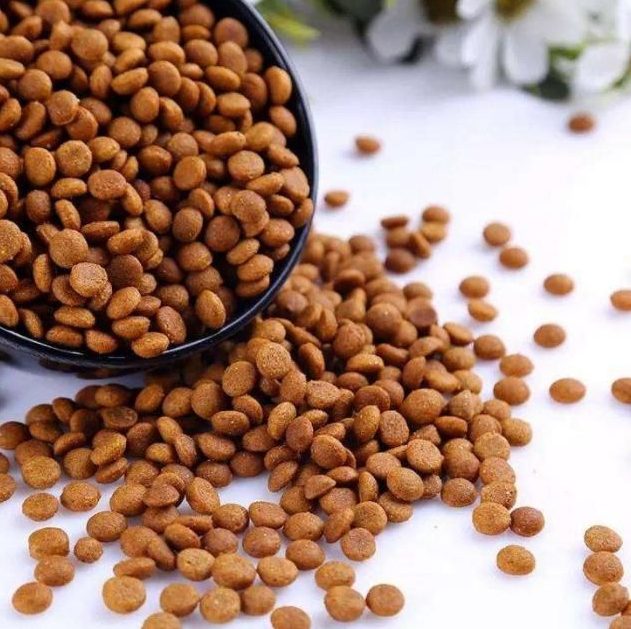
This extensive exploration delves into the multifaceted world of multi-shaped dog food production. We will move beyond the “what” to the “how” and “why,” examining the raw material science that makes shaping possible, the machinery that brings these forms to life, dog food machine the behavioral psychology that dictates their success, and the practical considerations that guide their application. Understanding this process reveals that the shape of a kibble is a deliberate and calculated feature, influencing everything from a dog’s dental health to its mealtime engagement and an owner’s purchasing decision.
I. The Foundation: The Functional Rationale Behind Kibble Shape
Before embarking on the “how,” it is imperative to establish the “why.” The functional rationale for shape diversification is built upon several key pillars that extend far beyond simple aesthetics.
1.1. Palatability and Consumption Dynamics:
The physical form of a kibble directly influences how a dog interacts with it.
- Ease of Prehension: The size and shape must be appropriate for the target breed’s muzzle and jaw. A Great Dane will struggle with a tiny, star-shaped kibble, just as a Chihuahua will be intimidated by a large, dense cylinder. Shapes are often designed to be easily picked up from a bowl.
- Texture and Mouthfeel: The surface geometry of the kibble affects the textural experience. A kibble with multiple protrusions, like a star or a twisted knot, will feel different in a dog’s mouth than a smooth sphere. This variation in texture can influence palatability and the perceived “fun” of eating.
- Crunch and Sound: The audible “crunch” of a kibble is a satisfying sensory feedback for many dogs and is reassuring for owners. The density and structure of the shape, determined during manufacturing, control the acoustic properties of the bite.
1.2. Dental Health and Mechanical Cleaning:
One of the most significant functional claims for specific kibble shapes is dental health.
- Plaque and Tartar Reduction: The concept is that a kibble’s shape can encourage a more thorough chewing action, providing a mechanical scraping effect on the teeth. Shapes that are larger, more irregular, or have a specific texture are designed to penetrate deeper into the crevices between teeth, unlike small, round kibbles that might be swallowed whole.
- Chewing Time: Shapes that are more complex or denser may require more chewing time, which increases saliva production. Saliva helps to neutralize acids and wash away food particles, contributing to oral hygiene. A kibble that shatters upon first bite is less effective for dental care than one that is designed to be scrubbed across the tooth surface.
1.3. Digestive Health and Satiety:
The physical form of the kibble can influence the digestive process.
- Eating Speed: Dogs that gulp their food are prone to digestive issues like bloat and regurgitation. Larger, more intricate shapes can physically slow down the rate of consumption, as the dog must manipulate the kibble in its mouth before swallowing. This promotes better digestion and can enhance the feeling of satiety.
- Gastric Processing: The density and porosity of a kibble affect how quickly it breaks down in the stomach. A highly porous, expanded kibble will absorb gastric juices and soften rapidly, while a denser, less-expanded shape may take longer to break down, potentially providing a more sustained release of energy.
1.4. Market Differentiation and Owner Psychology:
The visual appeal of dog food is almost exclusively for the human purchaser.
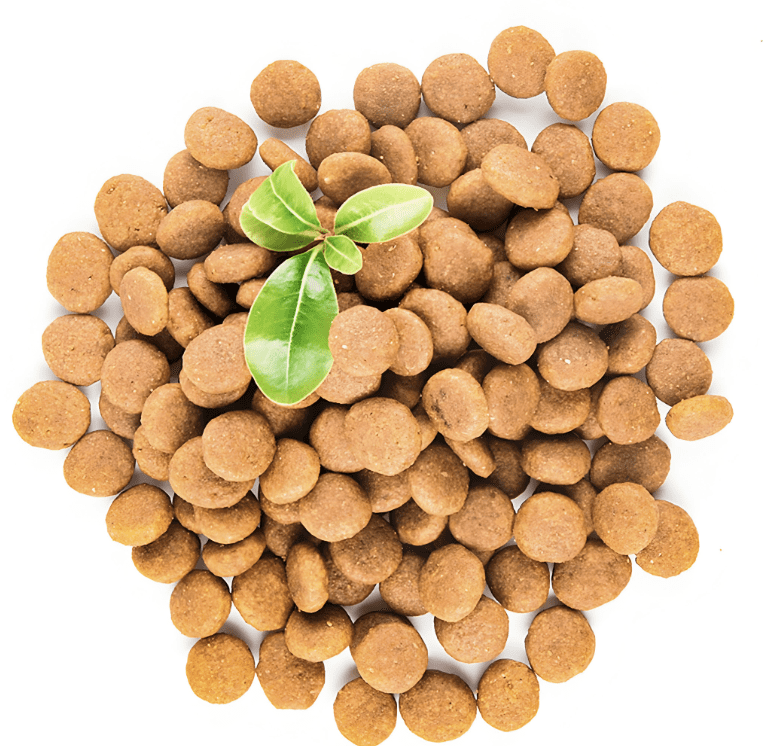
- Brand Identity: A unique kibble shape can become a powerful brand identifier. For example, a brand might use a distinctive paw print or bone shape that is instantly recognizable on the shelf.
- Perceived Value and Quality: Intricate shapes can create a perception of higher quality, craftsmanship, and specialized formulation in the mind of the consumer. A “gourmet” or “specialized” diet is often signaled by a non-standard kibble shape.
- Life Stage and Breed-Specific Marketing: The use of shapes is central to marketing diets tailored to specific breeds or life stages. A small, X-shaped kibble for a toy breed puppy is designed to be easy to chew, while a large, robust, O-shaped kibble for a giant breed adult is marketed for its dental benefits and appropriate size.
1.5. Functional Carrier for Additives:
The kibble’s structure can be engineered to serve as a delivery system.
- Fat and Flavor Coating: The surface area of the kibble determines how much post-extrusion coating (palatants) it can hold. A shape with a high surface-area-to-volume ratio, like a star or a multi-lobed design, can hold more fat and flavoring, enhancing palatability.
- Hollow Centers and Infusions: Some advanced manufacturing techniques allow for the creation of kibbles with hollow centers, which can be filled with a paste, powder, or liquid supplement, creating a “burst” of flavor or nutrition.
In summary, the shape of dog food is a multi-functional attribute. dog food machine It is a carefully considered element that impacts the dog’s health, behavior, and enjoyment, while simultaneously serving as a critical tool for brand positioning and consumer engagement in a competitive marketplace.
II. The Raw Material Palette: Ingredients as the Building Blocks of Form
The physical properties of the final kibble shape are inextricably linked to the biochemical composition of the raw ingredients. The formulator is a sculptor, and the recipe is the blueprint that dictates the properties of their clay.
2.1. The Starch Matrix: The Primary Architectural Binder
Starch, derived from grains like corn, wheat, and rice, or from “grain-free” sources like potatoes, tapioca, and peas, is the most critical component for creating structural integrity and complex shapes. During the cooking extrusion process, starch undergoes a transformation known as gelatinization.
- The Gelatinization Process: When starch granules are heated in the presence of water, they absorb moisture, swell, and eventually rupture. The long-chain starch polymers (amylose and amylopectin) leach out into the surrounding water, forming a viscous, plastic-like gel.
- The Role in Shaping: This gelatinized starch matrix is the primary binder that gives the kibble its structure. Upon cooling and drying, this gel sets into a solid, porous matrix that holds the kibble together. The degree of gelatinization is crucial:
- High Starch, High Gelatinization: Produces a highly expanded, low-density, and crisp product. This is ideal for creating light, floating kibbles and shapes that require a high degree of expansion to achieve fine details.
- Low Starch, Low Gelatinization: Results in a denser, harder, less-expanded product. This is desirable for dental chews or kibbles where a slow eating speed is the goal.
2.2. Protein Functionality: The Reinforcing Scaffold
Proteins from animal meals (e.g., chicken meal, fish meal) and plant sources (e.g., soy, corn gluten) also contribute to the kibble’s structure.
- Denaturation: When proteins are subjected to heat and shear during extrusion, they unfold, or denature. These denatured proteins can then form a cross-linked network that reinforces the starch matrix, adding strength and durability to the kibble.
- Elasticity: Certain proteins, like wheat gluten, are prized for their viscoelastic properties. Gluten acts as a powerful natural binder, providing elasticity to the dough, which allows it to be pushed through complex die shapes without tearing and helps the kibble maintain its intricate form after expansion.
2.3. The Lipid (Fat) Influence: A Necessary Compromise
Fats and oils are essential for energy, palatability, and skin/coat health, but they play a complex and often limiting role in shaping.
- Internal Lubrication: Fats act as an internal lubricant in the extrusion dough. High levels of internal fat (>10-12%) can interfere with starch gelatinization and protein binding by coating the starch and protein particles, preventing them from forming a strong, continuous matrix. This can result in a soft, crumbly kibble that cannot hold a complex shape.
- The Solution: Post-Extrusion Coating: This is why the majority of fat in high-performance, multi-shaped diets is applied after extrusion. This process allows for the creation of a strong, complex shape first, which is then infused with liquid fat and flavor palatants in a coating drum. The porous, expanded kibble acts like a sponge, absorbing the oil.
2.4. Fiber and Fillers: Modulating Density and Texture
Ingredients like cellulose, peanut hulls, and beet pulp add bulk and fiber.
- Density Control: Fiber can increase the density of the kibble, promoting a sinking characteristic and a harder texture.
- Structural Challenge: However, excessive fiber can make the extrudate brittle and difficult to bind, limiting the complexity of shapes that can be achieved without the kibble breaking during processing or handling.
2.5. Moisture Content: The Plasticizer
The amount of water added during the conditioning phase is a critical control parameter. It acts as a plasticizer, making the starch-protein matrix pliable and flowable. Too little moisture, and the dough is dry and crumbly, unable to form a continuous stream through the die. Too much moisture, and the dough becomes too sticky and soft, losing its defined shape upon exit from the die and leading to “clumping” in the dryer.
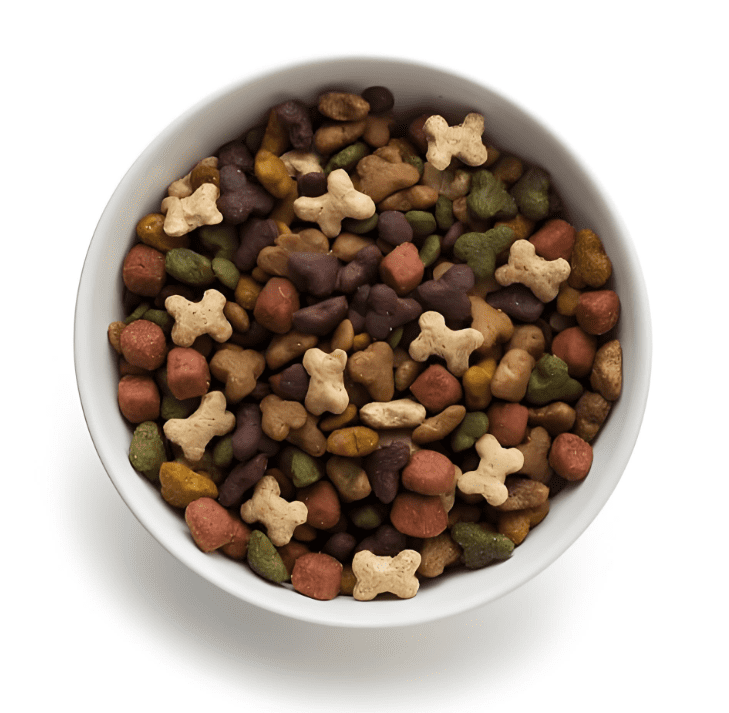
In summary, the formulation is a delicate balancing act. Creating a durable, intricate, paw-print-shaped kibble requires a recipe rich in gelatinizable starch and functional proteins, with careful management of internal fat, fiber, and moisture levels.
III. The Machinery of Creation: The Cooking Extrusion Process
This is the core of the process, where the ingredient mash is transformed into defined, functional shapes. The dominant technology for producing virtually all dry, multi-shaped dog food is cooking extrusion. This is a continuous, high-temperature, short-time process that cooks and shapes the product simultaneously.
3.1. Pre-Processing: Preparation for Transformation
- Grinding: All solid ingredients are first ground into a fine, uniform powder (the “mash”). This is critical for two reasons: it increases the surface area for water and heat penetration, and it ensures a homogenous mixture, preventing nutrient “hot spots” and ensuring consistent texture and expansion in the final product.
- Mixing: The ground macro-ingredients are blended with the micro-ingredient premixes (vitamins, minerals, etc.) in large, horizontal ribbon mixers. This must be a highly precise operation to achieve a perfectly uniform distribution.
3.2. Conditioning: The Prelude to Cooking
The dry mash is fed into a “conditioning” chamber, where it is met with live steam and hot water. This step hydrates the particles and begins the thermal cooking process.
- Objectives: Conditioning elevates the mash temperature (typically to 80-95°C / 175-203°F), initiates starch gelatinization, and makes the mash pliable, reducing the mechanical energy required in the extruder.
3.3. The Extruder: The Heart of the Matter
The conditioned mash is conveyed into the extruder barrel, a long, hardened steel cylinder containing a single or twin screw. The screw(s) rotate, conveying, mixing, compressing, shearing, and cooking the material under high pressure and temperature. The process inside can be broken down into zones:
- Feed Zone: The moist, warm mash enters the extruder.
- Compression and Cooking Zone: The screw design compresses the material. The combination of intense mechanical shear from the screws and high temperature from external steam jackets and direct steam injection cooks the mixture thoroughly. The starch fully gelatinizes, and the proteins denature, creating a viscous, plasticized dough often referred to as the “melt.”
- Metering Zone: The cooked dough is pushed under immense pressure (20-40 atmospheres) towards the die plate at the end of the barrel.
3.4. The Die and Cutter: Where Shape is Born
This is the most critical point for shape determination. The die plate is a thick, metal disk with precisely machined holes. The geometry of these holes defines the two-dimensional profile of the kibble.
- Die Hole Design:
- Simple Shapes (Cylinders, Ovals): Achieved with simple round or oval holes.
- Complex Shapes (Bones, Stars, Paw Prints): The die holes are machined into the desired shape. Creating a sharp, detailed bone shape requires a die with a bone-shaped orifice. dog food machine The precision of this machining is paramount; any imperfection will be replicated in every piece of kibble.
- Hollow Shapes (O’s, Rings): Created using a die with a central “pin” or “mandrel” inside each hole. As the dough is forced through the annular gap, it forms a tube. When cut, surface tension often pulls it into a ring or O-shape.
The Cutter Assembly: Located just millimeters from the outer face of the die plate is a rotating assembly of blades. The speed of this cutter is a primary determinant of the kibble’s length and three-dimensional form.
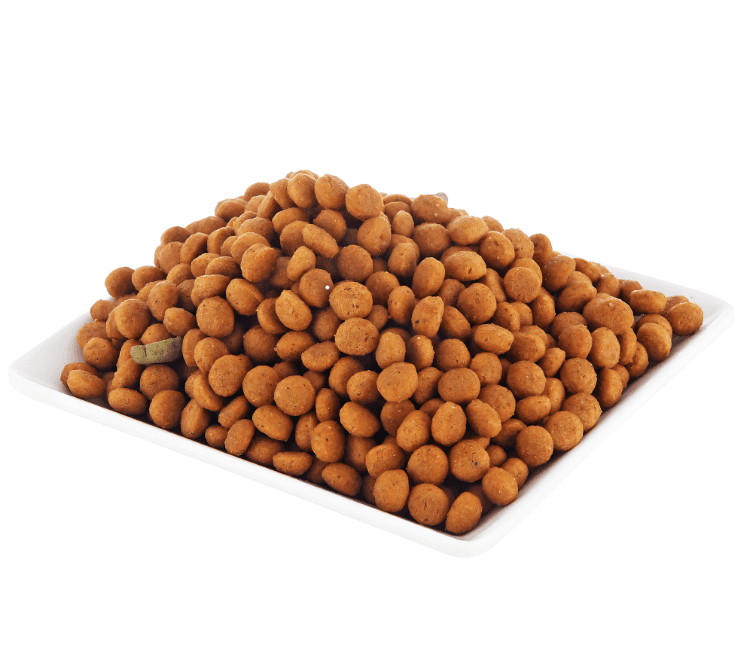
- Fast Cutter Speed: Produces thin, disc-like kibbles.
- Slow Cutter Speed: Allows more dough to extrude before being cut, resulting in longer kibbles.
- Controlled Expansion: As the superheated, pressurized dough exits the die into ambient air pressure, the trapped water instantly flashes into steam, causing the kibble to expand dramatically. The cutter speed must be synchronized with this expansion. For a shape like a star, the goal is for it to expand after being cut but while it’s still soft enough for surface tension to smooth the edges, preventing a ragged, “torn” appearance.
3.5. Controlling Buoyancy and Density in Shaped Kibbles
Buoyancy is not inherently a function of shape, but of density. Density is controlled during extrusion:
- Expanded, Low-Density Kibbles: High mechanical shear, high temperature, and a high-starch formula create intense superheating, leading to greater expansion and a lighter, often floating, kibble.
- Dense, Hard Kibbles: Lower shear, less steam, and a formula higher in protein and fat or lower in starch will inhibit expansion, creating a denser, sinking kibble that is often harder and more durable.
3.6. Post-Extrusion Processing: Drying, Coating, and Cooling
- Drying: The newly extruded kibbles are soft and moist (~25-30% moisture). They are conveyed through a multi-pass dryer where hot air (100-150°C / 212-300°F) reduces the moisture content to below 10% for shelf-stability. The drying profile must be controlled to prevent “case hardening,” which can trap moisture and lead to mold.
- Coating: The dry, porous kibbles are tumbled in a coating drum, where liquid fats, digest, and flavor palatants are sprayed on. The intricate shapes, with their high surface area, are excellent at retaining this coating.
- Cooling: Finally, the kibbles are cooled to ambient temperature to prevent spoilage in the bag before being packaged.
IV. Alternative Methods for Specialized Shapes and Textures
While extrusion is the dominant method, other technologies are used to create specific product types.
4.1. Baking:
Similar to the process for making crackers or biscuits, baked dog food is produced in long, continuous ovens. A dough is prepared, sheeted, and then cut into shapes using a rotary cutter before being baked. This method uses lower temperatures over a longer time, resulting in a denser, harder kibble with a different texture and aroma. The shapes are often simpler (e.g., bones, circles) due to the limitations of the cutting process.
4.2. Injection Molding for Semi-Moist Foods:
Semi-moist foods, which have a moisture content between 15-30%, often use a technology similar to plastic injection molding. A cooked slurry is injected under pressure into molds to create very precise, three-dimensional shapes (like meat patties, burgers, or cartoon characters). dog food machine These products require humectants like sugar, propylene glycol, or salts to control water activity and prevent spoilage.
V. Quality Control: Ensuring Shape Consistency and Integrity
Producing millions of identical shapes consistently is a major challenge. Quality control is integrated throughout the process.
- In-Process Checks: Operators constantly monitor the extruder for temperature and pressure. Kibbles are regularly sampled to check for size, shape fidelity, and color.
- Durability Testing: Kibbles are subjected to tumbling tests to ensure they can withstand packaging and transportation without breaking into excessive “fines” (dust).
- Screening: The final product is passed over screens to remove any undersized or broken pieces, ensuring a uniform product in the bag.
VI. The Future of Form: Innovations in Kibble Design
The field of kibble geometry is continuously evolving.
- Multi-Textured Kibbles: Combining different shapes and textures within a single bag to provide a varied sensory experience.
- Composites: Creating a kibble with a core and shell of different compositions or colors, requiring co-extrusion technology.
- Shapes for Specific Health Conditions: Designing shapes that encourage even slower eating, promote specific chewing actions for jaw health, or are easier for older dogs with dental issues to consume.
- Advanced Simulation: Using computational fluid dynamics (CFD) to model the flow of dough through dies, allowing for the digital design and testing of new shapes before costly physical prototyping.
The production of multi-shaped dog food is a testament to the sophisticated interplay of nutrition, engineering, and marketing. dog food machine The simple bone-shaped kibble is not a simple product. It is the result of a deliberate and complex process that begins with a carefully balanced recipe and culminates in a high-precision mechanical transformation. The shape is a functional tool that impacts a dog’s health, well-being, and enjoyment, while simultaneously serving as a powerful symbol of brand identity and value in the eyes of the consumer. The next time you pour a cup of uniquely shaped kibble into your dog’s bowl, consider the immense journey of science and engineering required to create each and every piece—a journey designed to nourish both the body and the spirit of our canine companions.