
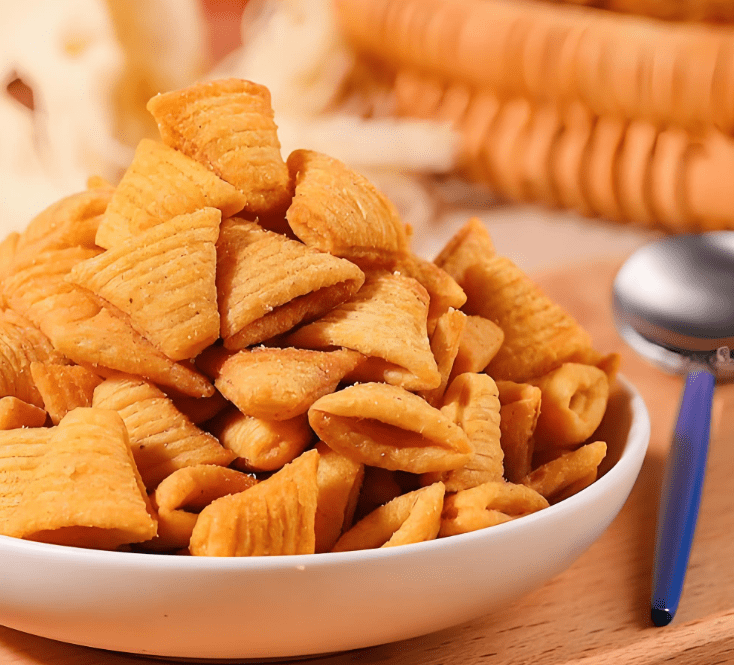
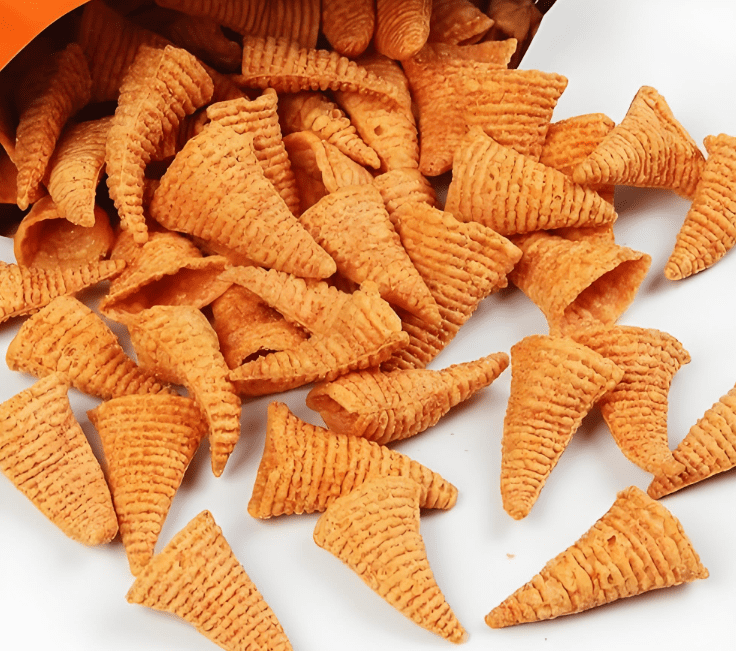
Bugles, the famous cone-shaped corn snacks, are popular among consumers because of their unique appearance, crispy texture, and delicious flavor. Their distinctive cone shape and crunchy mouthfeel make them different from traditional potato chips and other extruded snacks.
But how are Bugles made? What raw materials are used, and what machines are required during production? In fact, manufacturing cone-shaped corn snacks involves several important processes, including raw material preparation, mixing, extrusion, shaping, drying, frying or baking, seasoning, and packaging.
This article explores the complete processing process of Bugles-style corn snacks and explains the key technologies behind their production.
1. Raw Materials Used in Bugles Production
The quality of raw materials directly affects the final product’s flavor, texture, appearance, and production efficiency.
The main ingredients used in Bugles-style snacks include:
Corn flour: Corn flour is the primary ingredient. It provides the characteristic corn flavor and forms the basic structure of the snack.
Corn starch: Corn starch helps regulate the texture and expansion characteristics of the product.
Wheat flour: Some formulations use wheat flour to adjust dough properties and improve processing performance.
Water: Water is added to achieve the appropriate moisture content for extrusion and shaping.
Vegetable oil: Oil may be used during frying or as a carrier for seasoning.
Seasonings: Salt, cheese powder, barbecue seasoning, chili powder, and other flavoring ingredients can be added to create different product varieties.
The ingredient ratios should be adjusted according to the desired expansion rate, cone shape, crispness, and flavor.
2. Raw Material Mixing
After preparing the ingredients, the next step is mixing.
Corn flour, starch, wheat flour, and other dry ingredients are weighed according to the formulation and transferred into a mixing machine.
Water is then added gradually while the machine operates. The purpose is to distribute moisture evenly throughout the mixture.
Proper mixing is important for several reasons:
- Ensures consistent moisture distribution.
- Prevents dry ingredients from forming lumps.
- Improves the stability of the extrusion process.
- Helps produce snacks with consistent texture and expansion.
The mixture should have uniform moisture content before entering the extruder. Excessive or insufficient moisture can negatively affect product expansion and shaping.
3. Extrusion and Cone Shaping
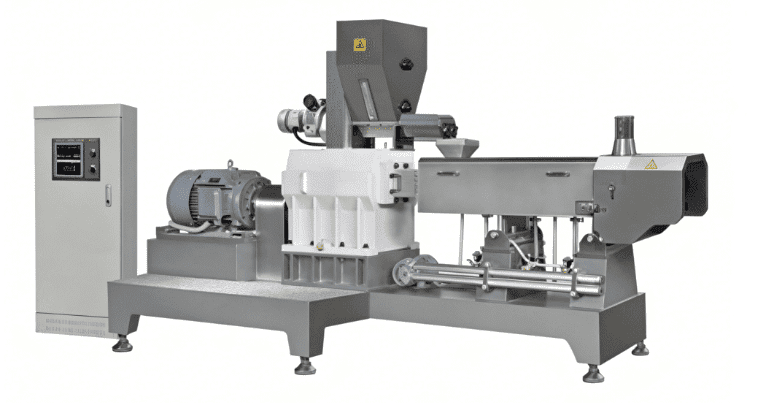
Extrusion is one of the most important stages in Bugles-style corn snack production.
The prepared mixture is fed into a food extruder, where rotating screws transport, compress, mix, and cook the material under controlled temperature and pressure conditions.
During extrusion, several physical and chemical changes occur:
- Starch absorbs water and gelatinizes.
- Mechanical energy and heat help cook the mixture.
- The material becomes a continuous plasticized mass.
- Pressure and temperature are controlled to achieve the required processing characteristics.
The cooked material is then pushed through specially designed forming dies to create cone-shaped products.
For Bugles-style snacks, the forming system must produce consistent dimensions, wall thickness, and cone geometry.
The die design and forming method are particularly important because they determine the product’s final appearance.
Manufacturers may use specialized extrusion and forming systems to produce hollow or cone-shaped snacks.
4. Cutting and Initial Shaping
After extrusion, the continuous material is divided into individual pieces through a cutting and forming system.
The cutting mechanism controls product length, while the forming equipment helps maintain the characteristic cone shape.
During this stage, manufacturers need to pay attention to:
- Product length and diameter.
- Cone opening and tip shape.
- Wall thickness.
- Surface smoothness.
- Consistency between individual pieces.
If the cutting speed does not match the extrusion speed, products may become deformed or uneven.
Stable equipment operation is essential for maintaining product consistency.
5. Drying the Extruded Corn Snacks
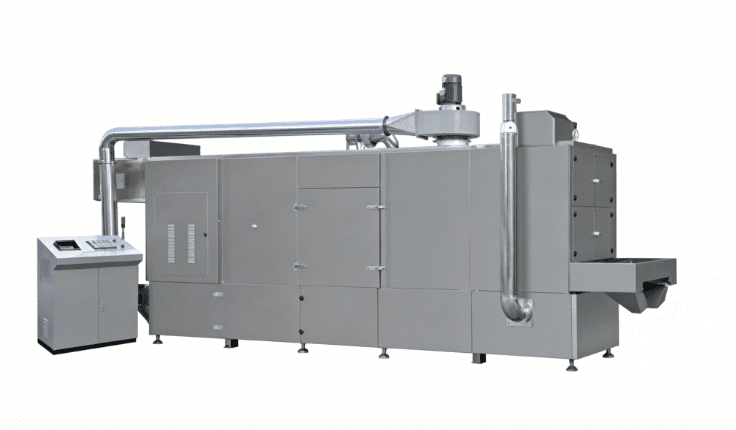
After shaping, the products generally need to undergo controlled drying.
Freshly extruded corn snacks contain relatively high moisture. If they enter the next processing stage without sufficient moisture control, their texture and structure may be inconsistent.
A continuous belt dryer is commonly used in industrial snack production.
Hot air circulates through the product layer, gradually removing excess moisture.
The main purposes of drying include:
- Reducing moisture content.
- Stabilizing product structure.
- Improving processing consistency.
- Preparing products for subsequent frying or baking.
Drying temperature, airflow, residence time, and product thickness should be adjusted according to the formulation and equipment configuration.
Overdrying may cause excessive hardness, while insufficient drying may result in poor texture and unstable final quality.
6. Frying or Baking
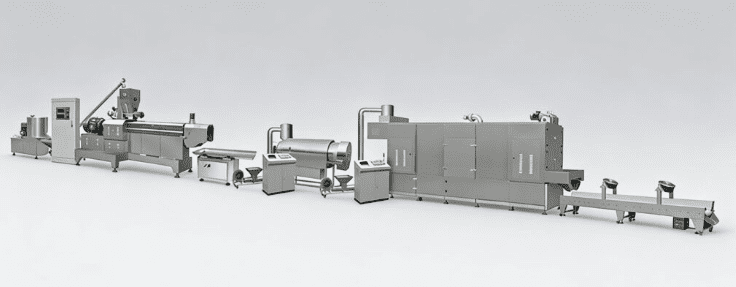
Frying or baking is another important stage in producing crispy cone-shaped corn snacks.
The specific method depends on the manufacturer’s product formulation and desired texture.
Frying process
In a fried production process, the dried or partially dried products enter a continuous frying machine.
Hot oil transfers heat to the product, rapidly reducing its moisture content and creating a crispy internal structure.
Important frying parameters include:
- Oil temperature.
- Frying time.
- Oil circulation.
- Product feeding speed.
- Oil quality and filtration.
Excessively high temperatures may cause the surface to darken too quickly, while insufficient frying may produce an oily or insufficiently crispy product.
Baking process
Some manufacturers may choose hot-air baking instead of frying.
Baking reduces the product’s moisture content and creates a crispy texture without requiring deep-frying.
Compared with frying, baking can help reduce the amount of added oil, depending on the formulation and processing method.
The final choice should be based on the desired flavor, texture, production costs, and market positioning.
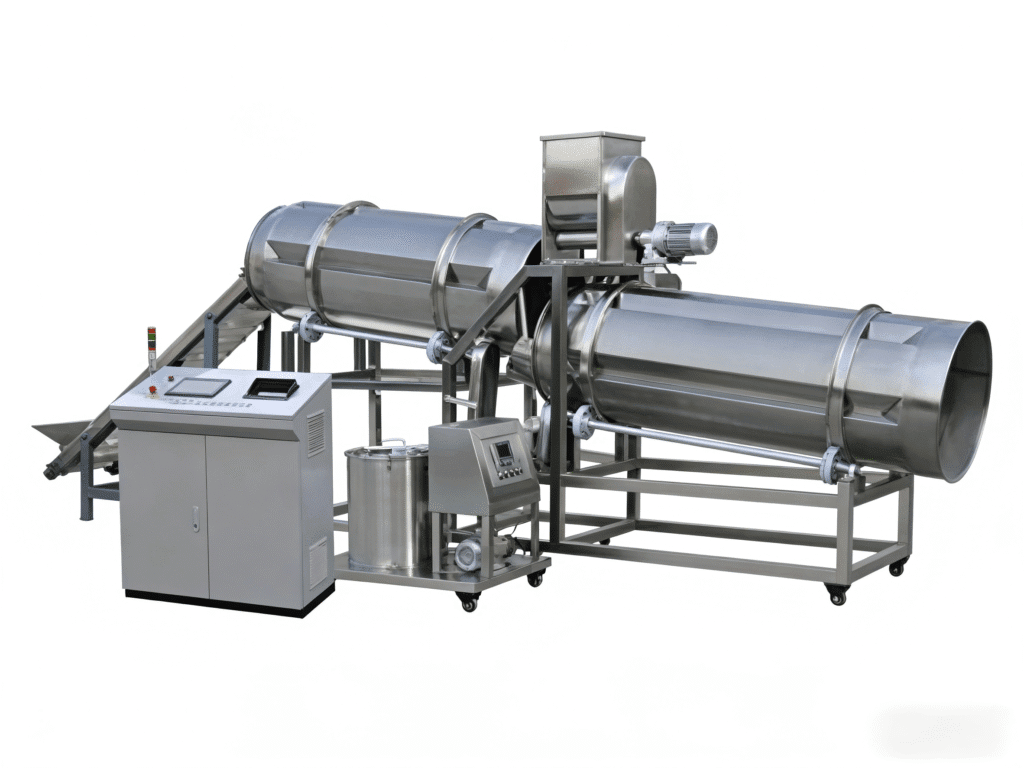
7. Seasoning the Finished Snacks
After frying or baking, the snacks enter the seasoning stage.
This is where different flavors are created.
A rotating seasoning drum is commonly used to distribute seasoning powder evenly across the product surface.
Typical seasoning ingredients include:
- Salt and pepper.
- Cheese powder.
- Barbecue seasoning.
- Spicy chili powder.
- Sour cream and onion seasoning.
- Tomato flavoring.
For better seasoning adhesion, a controlled amount of edible oil or seasoning liquid may be applied before adding the powder.
The seasoning machine should provide gentle but effective mixing to prevent the cone-shaped snacks from breaking.
Uniform seasoning is important for ensuring that every snack has a consistent taste.
8. Cooling and Quality Inspection
After seasoning, the snacks should be cooled before packaging.
If hot snacks are packaged immediately, residual heat may cause condensation inside the packaging, negatively affecting crispness and shelf life.
A cooling conveyor allows the products to reach a suitable packaging temperature.
Manufacturers should also conduct quality inspections during this stage.
Important inspection indicators include:
- Appearance and cone shape.
- Product size and weight.
- Moisture content.
- Texture and crispness.
- Seasoning uniformity.
- Color and flavor.
- Foreign material contamination.
Metal detection and other appropriate food safety controls should also be incorporated into the production line.
9. Automatic Packaging
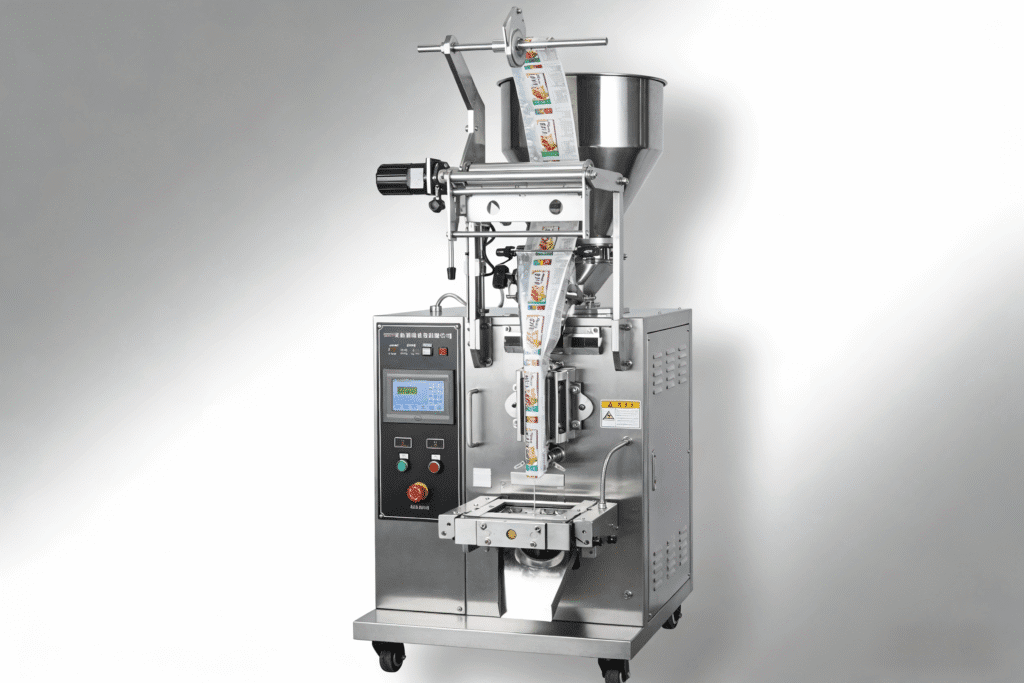
Packaging is the final stage of Bugles-style corn snack production.
An automatic weighing and packaging machine can weigh the finished snacks, fill the packaging bags, and seal them.
Because these snacks are lightweight and fragile, the packaging system should minimize product breakage during conveying, weighing, and filling.
Suitable packaging materials should provide effective moisture and oxygen barriers to help preserve freshness and crispness.
Nitrogen flushing can also be used to reduce oxygen inside the package and help protect the product during storage.
The packaging process generally includes:
- Automatic product weighing.
- Product filling.
- Bag forming.
- Heat sealing.
- Date and batch coding.
- Finished product inspection.
After packaging, the finished products can be transferred to warehouses for storage and distribution.
10. What Equipment Is Needed for a Bugles-Style Corn Snack Production Line?
7
To establish a commercial cone-shaped corn snack production line, manufacturers need to select equipment according to production capacity, product formulation, and processing technology.
The main equipment generally includes:
| Equipment | Main Function |
|---|---|
| Raw material mixer | Mixes flour, starch, and water |
| Food extruder | Cooks and processes the mixture |
| Forming and cutting system | Creates the cone-shaped snacks |
| Continuous dryer | Controls product moisture |
| Frying machine or baking oven | Develops crispy texture |
| Seasoning machine | Applies flavoring ingredients |
| Cooling conveyor | Cools finished snacks |
| Packaging machine | Weighs and packages products |
The equipment configuration may vary depending on whether the manufacturer chooses a fried or baked production process.
For businesses planning to manufacture different types of extruded snacks, a flexible production line with interchangeable dies and forming systems can provide greater product variety.
11. Key Factors for Producing High-Quality Bugles-Style Snacks
Producing cone-shaped corn snacks with consistent quality requires more than simply purchasing suitable equipment. Manufacturers must also control several important processing parameters.
1. Raw material formulation
The proportions of corn flour, starch, and other ingredients influence expansion, crispness, and product structure. A suitable formulation should be established through repeated production trials.
2. Moisture control
Moisture content affects dough plasticity, extrusion performance, and final texture. It must be controlled throughout mixing, extrusion, and drying.
3. Extrusion parameters
Screw speed, barrel temperature, pressure, and feeding rate influence starch gelatinization and product structure.
4. Forming accuracy
The forming system must maintain consistent cone dimensions and wall thickness. This is especially important for products with distinctive shapes.
5. Frying or baking conditions
Temperature and processing time determine the final moisture content, color, and crispness.
6. Seasoning quality
Seasoning should adhere evenly without overpowering the natural corn flavor.
7. Packaging protection
Proper sealing and moisture-barrier materials help maintain product quality during transportation and storage.
Conclusion
The production of Bugles-style corn snacks involves a series of interconnected processing stages, from raw material preparation and mixing to extrusion, cone shaping, drying, frying or baking, seasoning, cooling, and packaging.
Among these stages, extrusion and forming are particularly important because they determine the distinctive cone shape and internal structure of the finished products.
For manufacturers planning to enter the extruded snack industry, understanding the complete production process is essential for selecting suitable machinery, developing product formulations, controlling production costs, and improving product quality.
With appropriate equipment, stable processing parameters, and effective quality management, manufacturers can produce a wide range of crispy cone-shaped corn snacks with different flavors, sizes, and textures to meet changing market demands.


