
Introduction
Filled rice crackers are popular snack products known for their crispy outer shells and delicious fillings. Depending on the product design, the filling may be sweet, savory, creamy, nutty, chocolate-flavored, or made from other specially formulated ingredients. The combination of a crunchy rice-based shell and a flavorful center creates a distinctive eating experience.
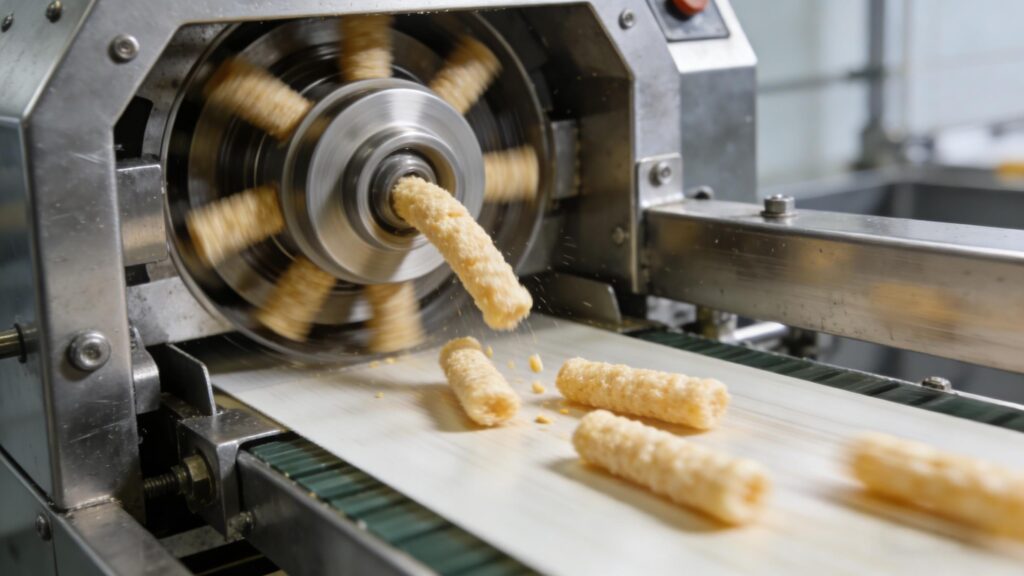
Behind every filled rice cracker is a carefully designed manufacturing process that combines raw material preparation, rice dough processing, extrusion or forming, filling injection, baking or frying, seasoning, cooling, and automated packaging.
In this article, we will explain the complete production process of filled rice crackers, introduce the main machines used on an industrial production line, and discuss the key factors that affect product quality and production efficiency.
1. Raw Material Preparation
The first step in manufacturing filled rice crackers is selecting suitable raw materials for both the outer shell and the inner filling.
Ingredients for the outer shell
The outer shell is generally made from rice flour, rice-based ingredients, or a combination of cereal flours and starches. Depending on the desired texture and production method, other ingredients may be added.
Common ingredients include:
- Rice flour or rice-based raw materials
- Corn starch, tapioca starch, or other suitable starches
- Water
- Salt and sugar
- Edible oil, when required by the formulation
- Food-grade processing aids or other permitted ingredients, where appropriate
The ingredient formula determines the shell’s strength, expansion characteristics, crispness, and ability to retain the filling.
Ingredients for the filling
The filling depends on the target market and product design. Common options include:
- Chocolate or cocoa-based filling
- Peanut, sesame, or other nut-based paste
- Sweet cream or milk-flavored filling
- Cheese-flavored filling
- Savory seasoning paste
- Fruit-flavored or other specialty filling
The filling must have suitable viscosity, thermal stability, and flow properties. If it is too thin, it may leak from the shell. If it is too thick, the filling machine may struggle to pump it consistently.
Before production, all ingredients should be inspected, weighed, and prepared according to the approved formulation.

2. Mixing and Preparing the Rice Dough
After weighing, the rice flour and other dry ingredients are transferred to a mixer.
Water is added gradually while the ingredients are mixed to form a uniform dough or processing mixture. The amount of water must be carefully controlled because moisture strongly affects the dough’s plasticity, forming performance, and final texture.
Depending on the production method, the mixture may be conditioned before entering the forming or extrusion equipment.
A consistent dough helps prevent problems such as uneven expansion, cracking, irregular shapes, and inconsistent shell thickness.
For industrial production, automatic weighing and batching systems can improve formulation accuracy and reduce human error.
3. Preparing the Filling
While the rice dough is being prepared, the filling is produced separately.
For a chocolate filling, for example, the ingredients may be blended and heated under controlled conditions to achieve the required consistency. For a nut-based filling, the ingredients may be ground and mixed into a smooth paste. Savory fillings may require blending oils, seasonings, powders, and other suitable ingredients.
The filling preparation process generally includes:
- Weighing the ingredients according to the formula.
- Mixing or grinding the ingredients until uniform.
- Heating or cooling when required by the formulation.
- Adjusting viscosity to suit the filling equipment.
- Holding the filling under appropriate temperature and hygiene conditions before use.
The filling should remain stable during production and should not separate excessively, block the filling nozzle, or damage the rice shell.
Food safety requirements must be considered carefully, particularly for fillings containing milk, nuts, eggs, or other ingredients that may require specific allergen controls.
4. Forming the Outer Rice Shell
Forming the outer shell is one of the most important stages in producing filled rice crackers.
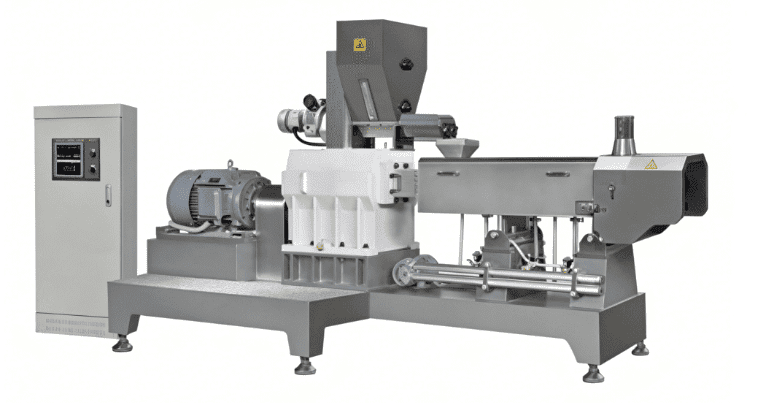
The specific equipment depends on the product design. Some products use extrusion-based forming systems, while others use specialized molding, co-extrusion, or shell-forming equipment.
In a typical extrusion-based process, the prepared rice mixture is fed into a forming machine. The material is conveyed through the machine and shaped through a specially designed die.
The forming system must produce a continuous or individual shell with controlled dimensions and sufficient structural strength.
For filled products, the shell design must also accommodate the filling mechanism. Depending on the machine configuration, the shell may be formed around the filling during co-extrusion, or the shell may be shaped first and filled in a separate operation.
Important parameters include:
- Dough moisture content
- Material temperature
- Extrusion pressure and screw speed, where applicable
- Die design and opening dimensions
- Shell thickness
- Forming speed
These factors influence the shell’s uniformity, strength, and ability to retain the filling during subsequent processing.
5. Filling Injection and Product Sealing
Once the outer shell has been formed, the filling is introduced into the product.
There are two common approaches to manufacturing filled rice crackers.
Method A: Co-extrusion
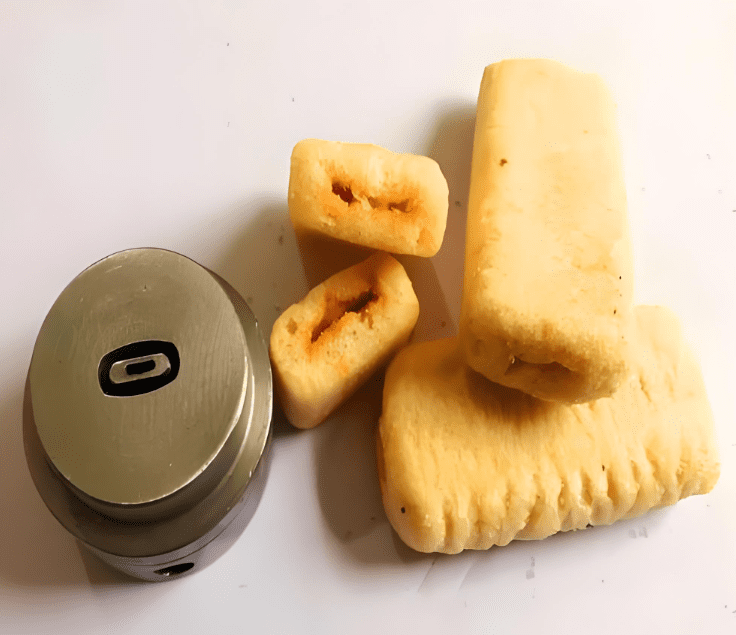
In a co-extrusion system, the rice-based outer material and the filling are delivered through separate channels within a specialized forming die.
The machine forms the outer shell and deposits the filling at the same time. The combined material emerges as a filled strand or shaped product, which is then cut into individual pieces.
This method can provide high production efficiency and consistent filling distribution when the formulation and equipment are properly matched.
However, the filling must have suitable flow properties, and the shell must remain stable during forming and cutting.
Method B: Forming first and filling afterward
In this method, the outer rice shell is formed separately. The filling is then injected through a nozzle into a suitable opening or cavity.
The opening is sealed using a compatible forming or sealing mechanism, depending on the product design.
This method may be appropriate for certain molded or hollow rice-based products, but it requires careful control to prevent leakage and ensure that the filling remains enclosed.
Key quality requirements
Regardless of the method, manufacturers must control the filling quantity, shell thickness, sealing integrity, and product dimensions.
If the filling amount is too high, the shell may rupture. If the filling amount is too low, the product may not deliver the intended eating experience.
The filling should be distributed consistently, and the shell should remain intact during handling and cooking.
6. Cutting and Shaping
After forming and filling, the product is divided into individual pieces.
A cutting mechanism may use rotary blades, synchronized cutters, or another suitable cutting system, depending on the product’s shape and the forming method.
The cutting equipment must operate in coordination with the extrusion or forming speed to prevent deformation and filling leakage.
At this stage, manufacturers check the product’s dimensions, shape, and filling distribution.
Damaged or poorly formed pieces should be identified and removed according to the factory’s quality-control procedures.
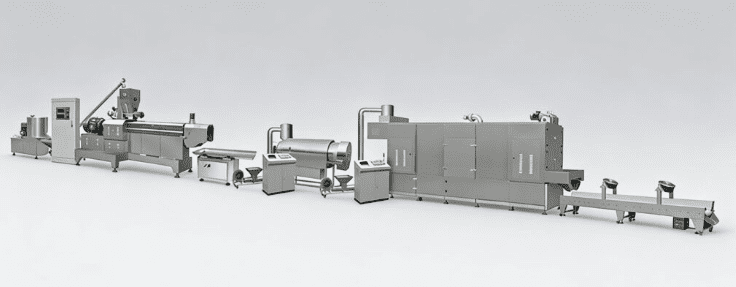
7. Baking, Drying, or Frying
The next stage develops the final texture of the rice cracker.
The appropriate process depends on the formulation, shell structure, and filling characteristics.
Baking
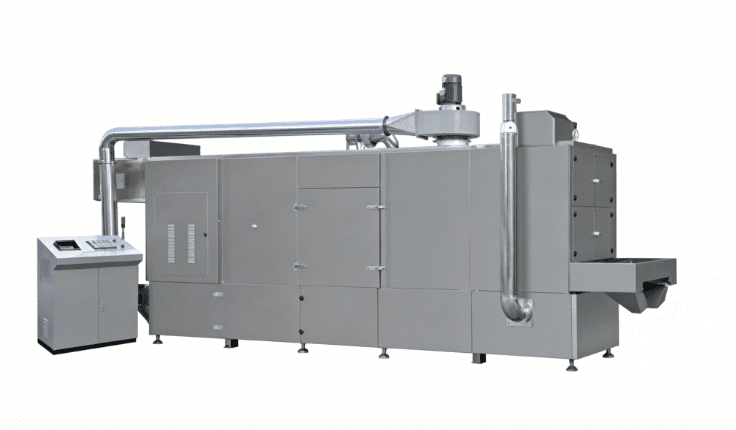
Baking is used when the product formulation and structure are suitable for oven processing. The products pass through a controlled heating zone, where heat helps set the structure and remove moisture.
Temperature, residence time, and airflow must be adjusted to obtain the desired crispness without burning the shell or damaging the filling.
Drying
Some products require a drying stage to reduce moisture before or after another thermal process.
Controlled drying helps improve crispness and can contribute to storage stability. The drying conditions must be appropriate for both the shell and the filling.
Frying
Certain rice-based snacks are fried in edible oil to achieve a crisp texture and characteristic flavor.
Frying conditions, including oil temperature and residence time, affect color, texture, oil absorption, and product consistency.
Not every filled rice cracker can be processed using the same method. For example, a filling that melts easily may require a different production sequence or a formulation designed to withstand the selected thermal process.
Therefore, the shell and filling must be developed together rather than optimized independently.
8. Cooling and Texture Stabilization
After baking, drying, or frying, the products must be cooled under controlled conditions.
Cooling allows the product temperature to decrease before further handling and packaging. It also helps prevent condensation from forming inside the package.
For filled rice crackers, cooling is especially important because the filling may remain softer or warmer than the outer shell immediately after processing.
If the product is packaged while it is too hot, moisture may accumulate inside the package and reduce crispness.
A properly designed cooling conveyor provides adequate airflow and residence time while minimizing contamination and physical damage.
The finished product should reach the specified temperature and moisture conditions before entering the packaging area.
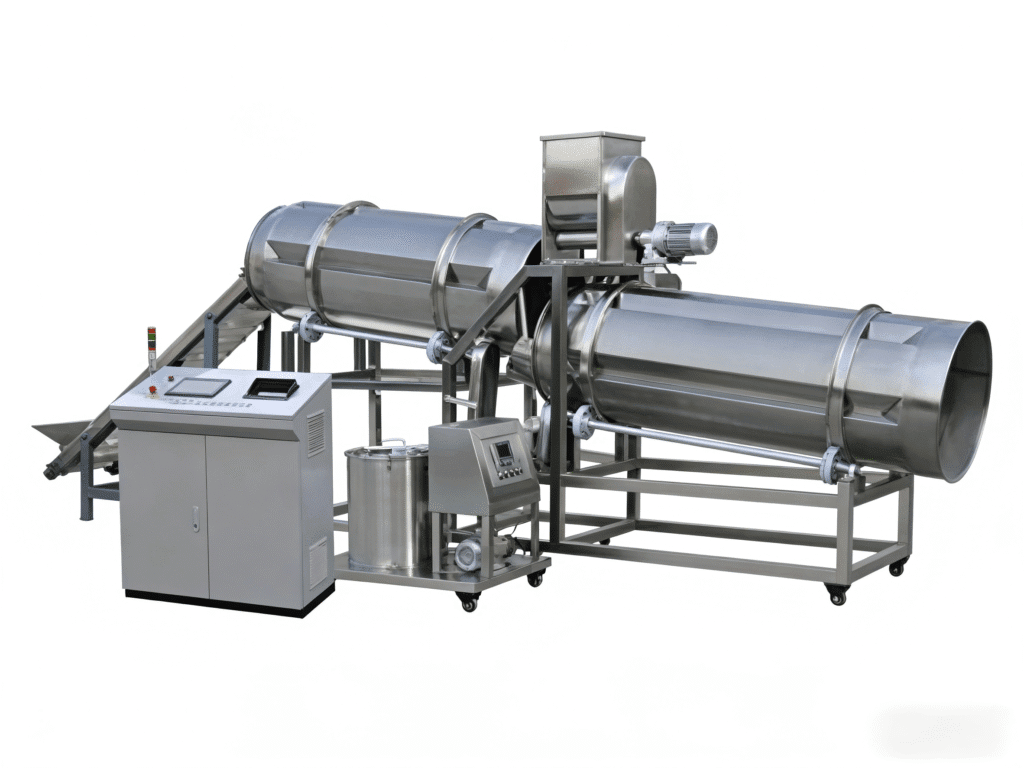
9. Seasoning and Surface Coating
Depending on the product design, seasoning or surface coating may be applied before or after the main thermal process.
Savory rice crackers may receive salt, cheese flavoring, barbecue seasoning, seaweed powder, or other flavor blends. Sweet products may receive sugar-based coatings, cocoa powder, or other suitable ingredients.
A seasoning drum, spraying system, or coating machine can help distribute ingredients evenly over the surface.
The coating process must be compatible with the product’s texture and filling. Excessive oil or moisture from the coating can soften the shell, while uneven seasoning can lead to inconsistent flavor.
For products with delicate fillings, the seasoning stage should be designed to minimize mechanical damage.
10. Quality Control and Food Safety Inspection
Quality control is essential throughout the entire manufacturing process, not just at the end of the production line.
Typical inspection procedures include:
Raw material inspection: Checking ingredient identity, quality, moisture, and compliance with purchasing specifications.
Shell quality inspection: Evaluating dimensions, thickness, color, expansion, and structural integrity.
Filling control: Checking filling weight, consistency, distribution, and leakage.
Texture testing: Assessing crispness and identifying products that are too hard, too soft, or structurally defective.
Moisture analysis: Verifying that the finished product meets its established moisture specification.
Foreign material control: Applying suitable sieving, metal detection, X-ray inspection, or other validated controls where appropriate.
Microbiological and shelf-life verification: Establishing suitable testing and storage studies based on the product formulation, process, and packaging system.
Factories should implement appropriate hygiene procedures, allergen management, traceability, and a hazard analysis and critical control point system or equivalent food-safety management program.
The filling deserves particular attention. Depending on its composition, it may introduce additional microbiological, allergen, or oxidation risks that need to be addressed through formulation, ingredient handling, processing, and packaging controls.
11. Automatic Weighing and Packaging
Once the products have passed quality inspection, they are transferred to the packaging line.
A typical packaging system may include:
- A feeding conveyor that delivers the products to the packaging area.
- An automatic weighing or counting system.
- A packaging machine that forms or opens the package.
- A filling mechanism that loads the correct quantity.
- A heat-sealing system that closes the package.
- A date-coding and batch-identification system.
- A finished-product inspection station.
Packaging materials should provide sufficient protection against moisture and oxygen, depending on the product’s sensitivity and intended shelf life.
Because the outer shell must remain crispy, moisture-barrier performance is particularly important. If the filling contains oils or fats, oxidation control may also be important.
The finished packages should be checked for correct weight, seal integrity, coding, and labeling before being placed into cartons for storage and transportation.
12. Storage and Distribution
After packaging, finished products are stored in a clean, dry environment under the conditions specified for the product.
High humidity can cause the rice shell to absorb moisture and lose its crispness. Excessive heat may also affect the quality of certain fillings, especially those containing fats, chocolate, or dairy ingredients.
Products should be protected from physical damage during transportation because cracks in the outer shell may expose the filling or compromise the product’s appearance.
A suitable packaging design, validated shelf life, and appropriate storage conditions help maintain product quality until it reaches the consumer.
13. Main Machines Required for a Filled Rice Cracker Production Line
The equipment configuration depends on the product type, production capacity, filling material, and selected processing method.
A typical production line may include the following equipment:
| Equipment | Main Function |
|---|---|
| Flour sifter | Removes lumps and unwanted particles |
| Automatic weighing system | Measures ingredients accurately |
| Dough mixer | Mixes rice flour, water, and other ingredients |
| Filling mixer or grinder | Prepares a uniform filling |
| Filling temperature-control system | Maintains suitable filling conditions |
| Extruder or forming machine | Shapes the outer shell |
| Co-extrusion or injection system | Introduces filling into the shell |
| Cutting machine | Separates the product into individual pieces |
| Baking oven, dryer, or fryer | Develops the required texture |
| Cooling conveyor | Cools the finished products |
| Seasoning or coating machine | Applies surface flavoring |
| Automatic inspection system | Checks selected product characteristics |
| Weighing and packaging machine | Measures and packages finished snacks |
Not every factory needs all of these machines. Some products require integrated co-extrusion equipment, while others use separate shell-forming and filling stations. The equipment should be selected only after the product structure and process flow have been defined.
14. Common Production Problems and Their Solutions
Even with automated equipment, manufacturers may encounter several production challenges.
Problem 1: Filling leakage
Possible causes include excessive filling pressure, unsuitable filling viscosity, insufficient shell thickness, or poor sealing.
Possible solutions include adjusting the filling formula, optimizing injection pressure, improving shell geometry, and checking the sealing mechanism.
Problem 2: Cracked outer shells
Possible causes include unsuitable dough moisture, uneven shell thickness, excessive mechanical stress, or overly aggressive thermal processing.
Possible solutions include improving dough consistency, stabilizing the forming process, and adjusting the heating profile.
Problem 3: Uneven filling distribution
Possible causes include unstable filling flow, inconsistent pumping, or poor synchronization between the shell-forming and filling systems.
Possible solutions include stabilizing filling temperature and viscosity, calibrating the dosing system, and synchronizing the machine speeds.
Problem 4: Soft or insufficiently crispy products
Possible causes include excessive final moisture, inadequate thermal processing, or moisture absorption during storage.
Possible solutions include optimizing drying or baking conditions, improving cooling, and selecting packaging with appropriate moisture-barrier properties.
Problem 5: Inconsistent product weight
Possible causes include variations in shell dimensions, unstable filling flow, or inaccurate cutting and dosing.
Possible solutions include monitoring the forming system, calibrating the filling pump, and improving automatic weight control.
The most effective solution is to identify the root cause through systematic testing rather than adjusting multiple production parameters at random.
Conclusion
The manufacturing of filled rice crackers is a coordinated process that combines rice-based ingredient preparation, shell forming, filling preparation, co-extrusion or injection, cutting, thermal processing, cooling, seasoning, inspection, and packaging.
The complete production sequence can be summarized as follows:
Raw Material Preparation → Rice Dough Mixing → Filling Preparation → Shell Forming → Filling and Sealing → Cutting → Baking, Drying, or Frying → Cooling → Seasoning → Quality Inspection → Automatic Packaging → Storage and Distribution.
The most important factors affecting product quality are shell strength, filling viscosity, filling quantity, thermal stability, final moisture content, seasoning consistency, and packaging performance.
For manufacturers planning to develop a filled rice cracker product, the first step should be to determine the product’s shape, filling type, target texture, and required production capacity. These decisions will determine the appropriate processing method, machine configuration, and factory layout.
With the right formulation, suitable equipment, and well-controlled production conditions, manufacturers can produce filled rice crackers with consistent quality, attractive appearance, satisfying crunch, and reliable shelf life.
Clarify the Main Production RouteAdd a Step-by-Step Process Flow


