
I. Executive Summary and Introduction
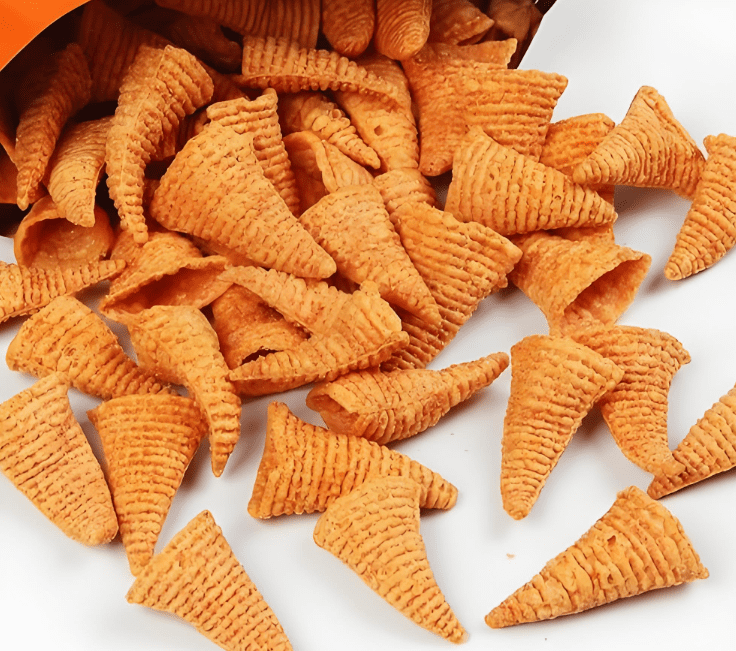
The global snack food market is experiencing robust growth, driven by increasing demand for convenience foods, busy lifestyles, and the globalization of tastes . Extruded snacks, particularly cheese-flavored corn puffs (exemplified by products like Cheetos), represent a significant and profitable segment within this industry. These products are characterized by their light, airy texture, intense flavoring, and widespread consumer appeal across demographics .
This guide provides a comprehensive roadmap for entrepreneurs and investors looking to enter this market by establishing a manufacturing plant. We will cover market analysis, technology selection, financial planning, operational setup, and risk management. While the iconic “Cheetos” brand is owned by PepsiCo—which recently invested US$200 million in an Indonesian factory—the market for private label and regional brands remains wide open due to high demand and the scalability of production technology .
II. Market Analysis and Opportunity
Before breaking ground, a thorough understanding of the market landscape is essential. The snack food sector is not homogeneous; success lies in identifying specific niches and trends.
A. Global Market Drivers
Several macro-trends are fueling the expansion of the extruded snack market:
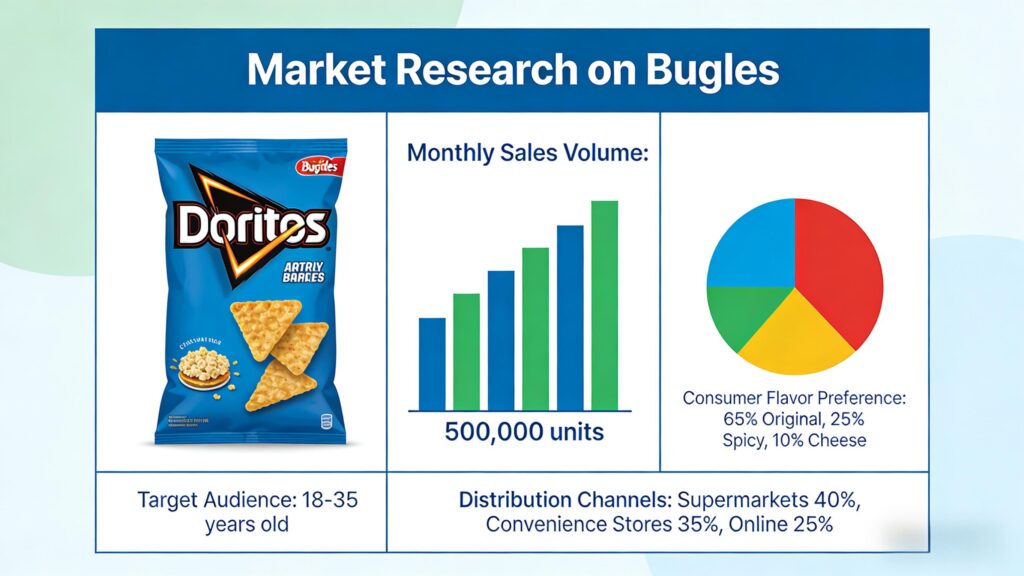
- Convenience Culture: Increasingly hectic lifestyles have shifted consumer eating habits from traditional sit-down meals to on-the-go snacking .
- Flavor Innovation: Consumers are seeking exotic and bold flavor profiles. While cheese remains the staple for these snacks, there is growing demand for variants like spicy chili, barbecue, steak, and international flavors .
- Health-Conscious Shifts: There is a rising segment demanding healthier alternatives. This includes snacks made with natural ingredients, reduced fat (baked vs. fried), gluten-free formulations (using corn or rice), and clean-label products free from artificial additives .
- Retail Expansion: The proliferation of supermarkets, hypermarkets, convenience stores, and especially e-commerce platforms has made snack products more accessible than ever. Direct-to-consumer (DTC) brands are also emerging as a significant sales channel .
B. Competitive Landscape
The market is typically bifurcated:
- Tier 1: Multinational Brands (PepsiCo/Frito-Lay): These players dominate with massive marketing budgets and established distribution networks. Competing directly on brand recognition is costly and difficult. For instance, PepsiCo’s new factory in Indonesia highlights the scale of investment required to compete at a global brand level .
- Tier 2: Private Label and Regional Players: This is the most accessible entry point for new investors. Supermarkets and smaller retail chains are constantly seeking high-quality, lower-cost private-label alternatives to the big brands. There is also a growing market for artisanal or “better-for-you” extruded snacks made with unique grains (like sorghum or lentils) or organic ingredients .
C. Opportunity Identification
Your investment strategy should target the gap in the market. Rather than trying to out-Cheetos Cheetos, focus on:
- Private Label Manufacturing: Offering B2B services to retailers who want their own brand of cheese puffs.
- Niche Formulations: Creating a product with a unique selling proposition, such as “high-protein,” “vegetable-infused,” or “baked not fried” .
- Regional Authenticity: Developing flavors that cater specifically to local palates in your target market, which global brands may overlook.
III. Pre-Investment Phase: Planning and Feasibility
A. Business Plan Development
A detailed business plan is your foundational document. It should outline:
- Executive Summary: A snapshot of your business vision.
- Company Description: Your mission, legal structure (LLC, Corporation, etc.), and the specific problem your product solves.
- Market Analysis: Detailed research on your target demographic, competitor analysis, and market size .
- Product Line: Description of your initial product (e.g., “Crunchy Cheese Corn Puffs”) and a roadmap for future variants (e.g., “Jalapeno Puffs,” “Peanut Puffs”) .
- Marketing and Sales Strategy: How you will reach customers (B2B vs. B2C, distribution channels, pricing strategy).
- Financial Plan: Projected income statements, cash flow statements, and balance sheets for the first 3-5 years .
B. Feasibility Study
Conduct a feasibility study to assess the viability of your project. This covers:
- Technical Feasibility: Do you have access to the required technology and technical expertise? .
- Financial Feasibility: An in-depth analysis of initial capital costs, operating expenses, and projected returns (ROI, NPV, Payback period) .
- Market Feasibility: Is there enough demand to support your projected production volume?
IV. Regulatory Compliance and Certifications
Navigating the legal landscape is critical for a food business. Non-compliance can lead to shutdowns, fines, and loss of consumer trust. While regulations vary by country, the principles are universal.
A. Business Registration and Licenses
- Register your business entity.
- Obtain a general business operating license.
- Secure a factory license from local industrial authorities .
B. Food Safety Certifications
These are non-negotiable for accessing retail markets.
- HACCP (Hazard Analysis Critical Control Point): This is the international gold standard. It requires you to identify and control biological, chemical, and physical hazards throughout the production process .
- FSSC 22000 / ISO 22000: Globally recognized food safety management system certifications.
- Local Regulatory Approvals: In the US, this is FDA compliance; in India, it is FSSAI licensing; in the UK, it is compliance with the Food Standards Agency . For example, in India, the license type (Basic, State, Central) depends on your business’s turnover .
C. Other Clearances
- Environmental Clearances: Required to manage waste, emissions, and water discharge. Your plant design should incorporate effluent treatment plants .
- GST/Tax Registration: Necessary for tax compliance and interstate sales .
- Labor Licenses: Compliance with local labor laws and factory acts.
V. Location, Infrastructure, and Plant Layout
A. Site Selection Criteria
Choosing the right location is a strategic decision with long-term implications. Consider the following factors, as demonstrated by major players like Mars when choosing their plant location in Topeka, Kansas :
- Proximity to Raw Materials: Being close to sources of corn, cornmeal, and oils significantly reduces inbound freight costs .
- Logistics and Transportation: Access to major highways, railways, and shipping ports is vital for both receiving raw materials and shipping finished goods. A “flat piece of property” near rail and roadways is ideal .
- Utilities: Reliable supply of three-phase electricity, natural gas (for dryers and heaters), and high-volume water is essential .
- Labor Pool: Access to a workforce with the necessary skills for operating food processing machinery.
- Community and Incentives: Some regions offer tax breaks or incentives to attract manufacturing businesses, as seen with Mars in Kansas .
B. Infrastructure Requirements
- Land: For a standard medium-to-large scale plant, you may require a significant footprint. The Mars chocolate plant, for example, was built on 150 acres, though a snack line will require less space .
- Building: A weather-tight facility with proper insulation, climate control, and sanitary design. Costs for civil construction and utilities can account for 40-50% of initial capital .
- Utilities Setup: Installation of boilers, air compressors, HVAC systems, and wastewater treatment facilities .
C. Plant Layout and Design
The layout must ensure a unidirectional flow of materials to prevent cross-contamination: from Raw Material Reception → Storage → Production → Packaging → Warehouse → Dispatch .
- Sanitary Design: Use of stainless steel equipment, smooth walls and floors for easy cleaning, and suspended tanks/piping to eliminate hard-to-clean areas on the floor .
- Segregation: Raw material areas must be physically separated from finished product areas. Allergen handling (like milk powder in cheese seasoning) requires separate, controlled zones .
- Space for Expansion: Design the facility with future growth in mind. Using non-load-bearing exterior walls, as Mars did, allows for easier expansion later .
VI. Technology and Machinery
The production of extruded snacks is a continuous, highly automated process. Your choice of machinery will define your product quality and production efficiency.
A. The Production Process
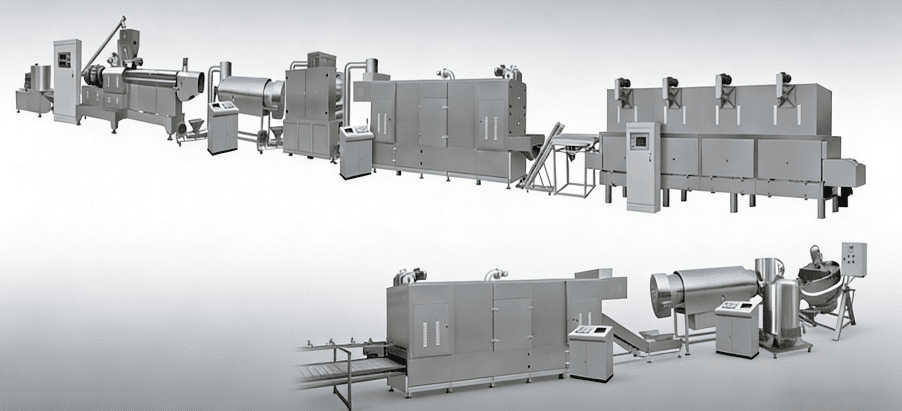
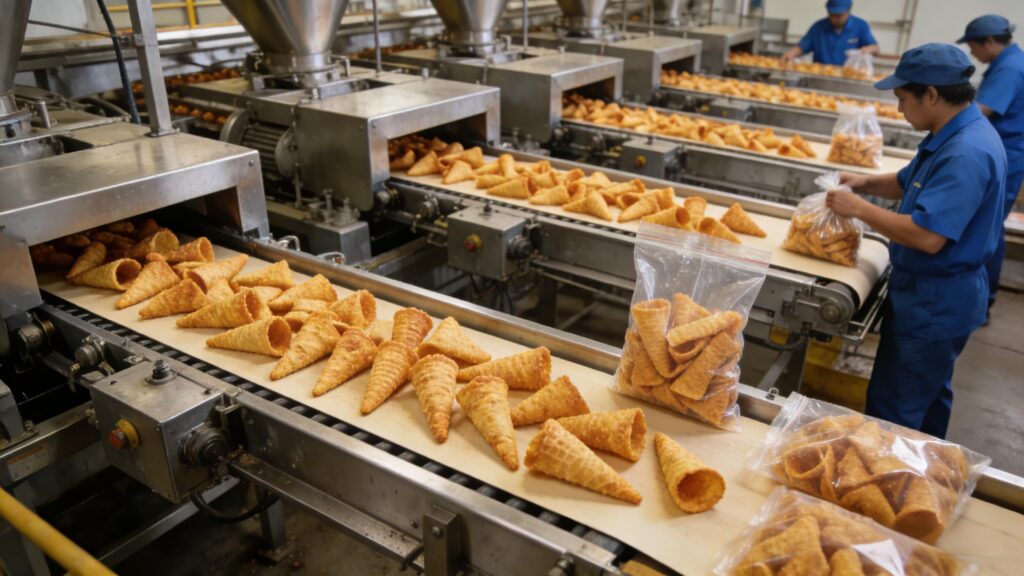
- Raw Material Handling and Mixing: Corn grits (or a blend of corn, rice, wheat, and other grains) are conveyed from silos or super sacks to mixers, where they are pre-conditioned with water and steam to achieve optimal moisture content for extrusion .
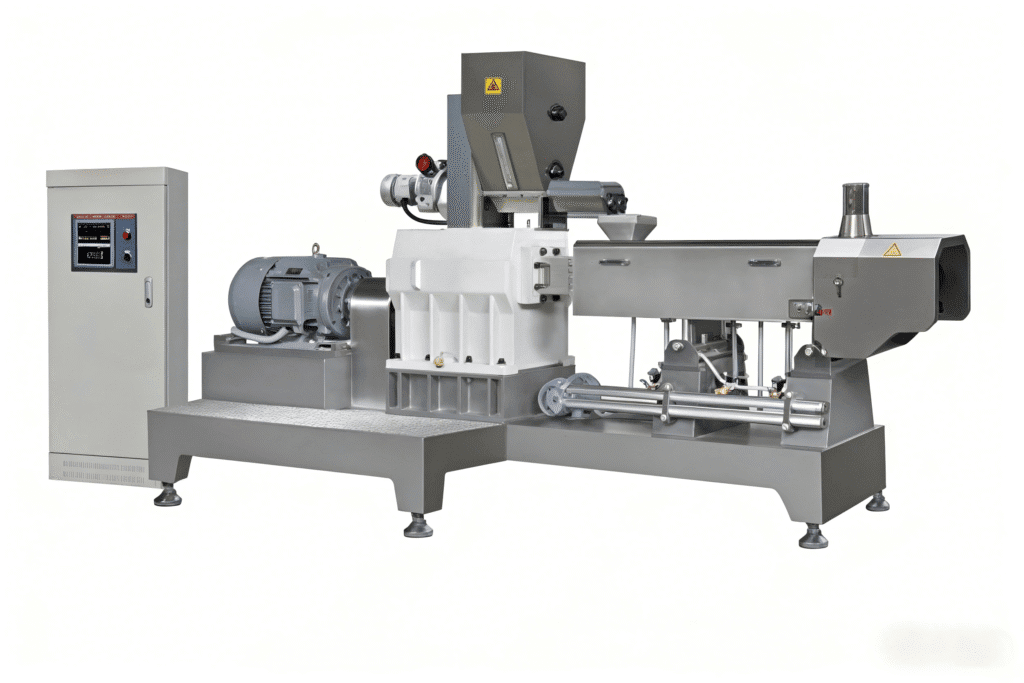
- Extrusion: This is the heart of the process. The raw material is fed into a cooker-extruder. Inside a barrel, a rotating screw generates high pressure and friction heat, cooking the mixture into a molten dough. As the dough is forced through a die (a metal plate with a specific shape—like a “curl” or “ball”), the sudden drop in pressure causes it to expand or “puff” instantly .
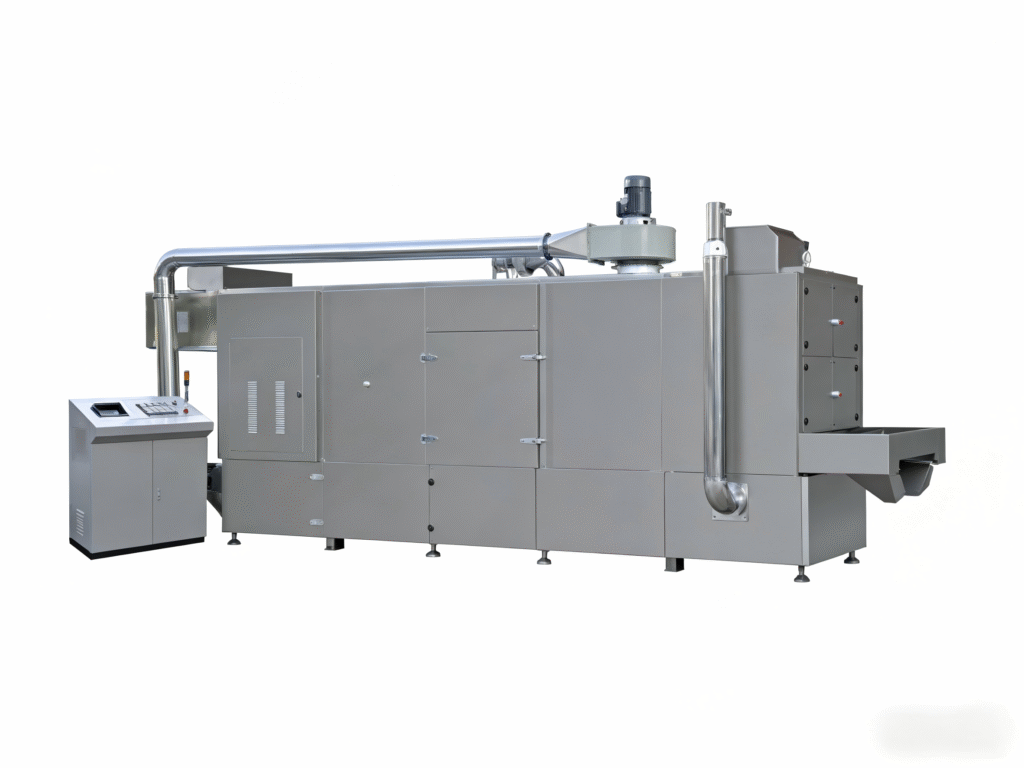
- Drying and Toasting: The puffed snacks have a high moisture content and are too soft. They pass through a long, multi-zone dryer to achieve the desired crunchy texture and stable shelf life .
- Flavoring Application: The dried base pellets are conveyed to a rotating seasoning drum. Liquid oils are sprayed onto the snacks to act as an adhesive, followed by a dusting of powdered cheese and flavor mixtures .
- Cooling and Packaging: The flavored snacks are cooled to room temperature on a cooling conveyor before being fed into a packaging machine to prevent condensation in the bags .
B. Machinery Sourcing and Costs
China is a global hub for food processing machinery, particularly in regions like Henan and Shandong, which offer vertically integrated ecosystems for suppliers .
- Extruder Systems: These are the core investment. Suppliers like Jinan FLD Machinery and Shandong Light M&E Co. offer lines specifically for Cheetos-style snacks. Prices for a complete automatic line can range from $4,000 to $45,000 USD depending on capacity and automation level .
- Supporting Equipment: Dryers, seasoning drums, mixers, and conveyors.
- Automation: Look for systems with PLC (Programmable Logic Controller) interfaces to precisely control temperature, screw speed, and feed rate, ensuring consistent product quality .
C. Technical Validation
Before purchasing, conduct due diligence:
- Request factory walkthrough videos showing the line in operation.
- Ask for test batches produced with your specific recipe and die shape.
- Verify throughput claims (kg/h) and utility consumption (kW, m³/h gas) .
- Ensure voltage and frequency compatibility with your local grid.
| Equipment Type | Function | Estimated Cost (USD) | Sourcing Hub |
|---|---|---|---|
| Extruder (Core Unit) | Cooks and puffs corn grits | $7,000 – $45,000 | Shandong, China |
| Full Auto Line | Extruder, dryer, seasoning, etc. | $4,000 – $8,000 | Jinan, China |
| Packaging Machine | Vertical form-fill-seal for bags | $10,000 – $50,000 | Global / China |
VII. Raw Materials and Supply Chain Management
Consistent product quality depends on a reliable supply of high-quality raw materials.
A. Primary Ingredients
- Corn Grits (or Meal): The primary bulk ingredient. It must be of consistent particle size and quality. Sourcing directly from mills or local farmers (via FPOs) can reduce costs .
- Vegetable Oils: Used both in the extrusion process (sometimes) and as an adhesive for seasonings. High-quality, high-stability oils (like palm olein or sunflower oil) are essential for shelf life.
- Seasoning: This is your “secret sauce.” It typically includes cheese powder, salt, sugar, monosodium glutamate (MSG), whey, and natural or artificial flavors. Work with a specialized food seasoning company to develop a proprietary blend .
B. Packaging Materials
- Primary Packaging: Flexible films (metalized films, foils, or laminates) that provide a moisture and oxygen barrier to maintain crispness. Your machinery supplier must match the packaging machine to the film type .
- Secondary Packaging: Corrugated cartons for shipping bulk quantities to retailers .
C. Inventory Management
- Maintain a safety stock of at least 2-4 weeks of raw materials to buffer against supply chain disruptions.
- Implement a First-In, First-Out (FIFO) system to ensure ingredient freshness.
- Budget for working capital to cover 3-6 months of raw material, labor, and operational costs .
VIII. Financial Planning and Cost Estimation
A. Capital Expenditure (CapEx) – Initial Investment
This is the total cost to get the plant from an idea to a ready-to-operate state.
- Land and Building: 40-50% of initial capital. This includes site development, construction, and utilities installation .
- Plant Machinery: 30-35% of initial capital. This includes the cost of equipment, import duties, shipping, installation, and commissioning .
- Miscellaneous Fixed Assets: Office equipment, laboratory equipment, material handling equipment (forklifts), and initial spare parts inventory.
B. Operational Expenditure (OpEx) – Running Costs
These are the recurring costs of production.
- Raw Materials: The largest variable cost, fluctuating with commodity markets.
- Utilities: Electricity, water, natural gas, and fuel for boilers.
- Labor: Salaries for operators, technicians, quality control staff, and administrative personnel .
- Packaging: Costs for both primary and secondary packaging.
- Maintenance: Regular upkeep of machinery to prevent downtime.
- Logistics: Inbound and outbound freight costs .
C. Revenue and Profitability Projections
- Pricing Strategy: Your pricing must cover your OpEx, contribute to recovering your CapEx, and generate a profit, while remaining competitive against private label and branded alternatives. Finished snack unit costs can range from $0.22 to $1.50 depending on packaging and quality .
- Break-Even Analysis: Determine the production volume at which total revenue equals total costs. This is a critical milestone for investors.
- Projected Returns: Industry reports suggest that well-planned snack food plants can achieve healthy profit margins, but this depends heavily on scale, efficiency, and market positioning .
IX. Manpower and Operations
A. Staffing Requirements
- Management: Plant Manager, Production Manager, Quality Assurance Manager, Supply Chain Manager, Sales Manager.
- Production: Shift Supervisors, Machine Operators, Material Handlers.
- Quality Control: Lab Technicians to test raw materials, in-process checks, and finished product analysis (moisture, texture, flavor, microbial safety) .
- Maintenance: Electricians, Fitters, and Mechanics.
- Admin & Sales: Accountants, HR, and Sales Representatives.
- For a small to medium plant, you might start with 15-30 employees .
B. Training and Quality Systems
- Implement rigorous training programs on GMP (Good Manufacturing Practices), hygiene, and SOPs (Standard Operating Procedures).
- Establish a Food Safety Management System (FSMS) to document and control all processes .
- Conduct regular internal and external audits.
X. Risk Analysis and Mitigation
| Risk Category | Specific Risk | Mitigation Strategy |
|---|---|---|
| Market Risk | Intense competition from established brands. | Focus on private label, unique flavors, or “better-for-you” positioning . |
| Supply Chain | Fluctuation in corn or oil prices. | Establish long-term contracts with suppliers; hedge commodity prices where possible . |
| Operational Risk | Machinery breakdown causing downtime. | Implement a preventive maintenance schedule; keep an inventory of critical spare parts . |
| Food Safety Risk | Contamination (physical, chemical, biological). | Strict HACCP plan, regular testing, supplier approval programs, and employee training . |
| Regulatory Risk | Changes in food laws or import tariffs. | Stay informed via industry associations; ensure legal counsel is up-to-date. |
| Quality Inconsistency | Variation in taste or texture between batches. | Invest in automation; rigorously test raw materials; document all process parameters . |
XI. Conclusion
Investing in a cheese-flavored extruded snack manufacturing plant is a significant but potentially rewarding venture. The global appetite for convenient, flavorful snacks continues to grow. Success does not require you to beat PepsiCo at its own game. Instead, a savvy investor will find opportunity in agility—offering private label services, catering to local tastes, or innovating with healthier formulations that the large, slow-moving corporations struggle to adopt.
The key takeaways for a successful investment are:
- Start with the Market: Don’t build a plant and then look for customers. Secure interest from retailers or have a clear DTC brand strategy first.
- Invest in Quality and Safety: A food safety incident can end your business overnight. Spend the money on good sanitary design, proper certifications (HACCP), and a competent QC team .
- Choose Technology Wisely: Balance upfront cost with reliability, energy efficiency, and after-sales support. Chinese machinery offers a cost-effective entry point, but requires diligent technical validation .
- Plan for the Long Term: Build a flexible plant that can handle different flavors and product shapes. The snack market evolves quickly, and your ability to adapt is your greatest competitive advantage.
By following this comprehensive guide and conducting detailed, location-specific feasibility studies, you can navigate the complexities of the food industry and build a profitable and sustainable manufacturing enterprise.If you want know more about bugles making machine , you can contact me .
Faq
1.Will you help us with the installation ?
Yes , We will send engineers to install and debug the equipment, and assist in training your staff.
2.Are you a factory or trading company?
We are a factory.
3.What certificate do you have?
We have ISO and CE certificate.
4.How long is the warranty period?
All of our machines have one year warranty.
5.What’s the main market of your company?
Our customers all over the world.
6.How much production capacity of your company one year?
This depends on your needs.