Single-Screw vs. Twin-Screw Extruders: A Detailed Comparison
In the world of industrial food processing, plastics manufacturing, and animal feed production, the extruder is a cornerstone of modern manufacturing. At its heart, an extruder is a machine that forces material through a specifically shaped die to create a continuous profile or to cook and transform ingredients. While several configurations exist, the two most common types are the single-screw extruder and the twin-screw extruder.
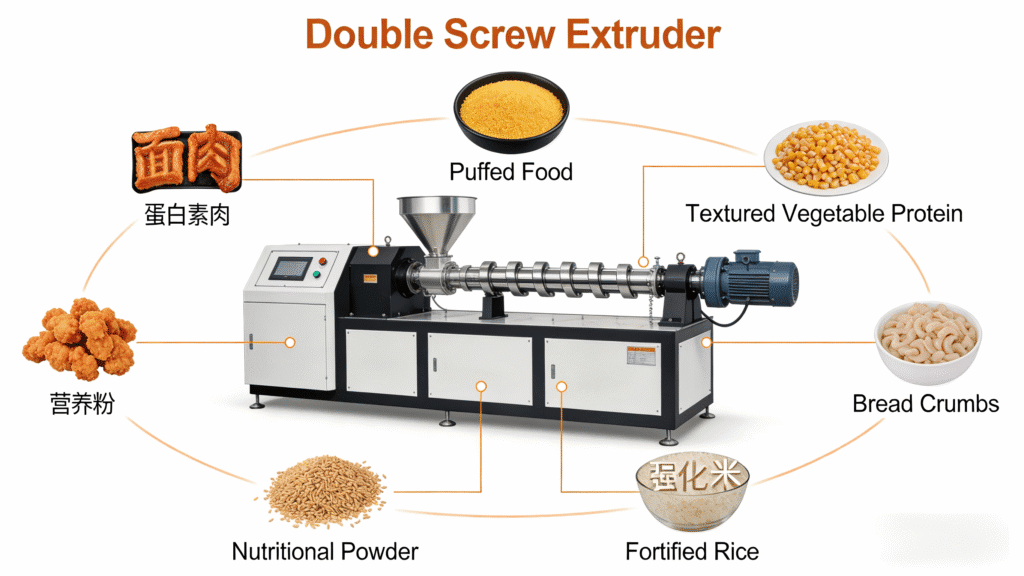
Though they share the same fundamental goal—to transport, compress, melt, and shape materials—their mechanisms, capabilities, and ideal applications differ significantly. Choosing the right one is critical for efficiency, product quality, and profitability. This article explores the key differences between these two workhorses of industry.
The Basic Principle: How They Work
Before diving into the differences, it’s helpful to understand their basic operation. Both machines consist of a few core components:
- The Hopper: Where raw material is fed into the machine.
- The Barrel: A heated cylindrical chamber that houses the screw(s).
- The Screw(s): A rotating mechanism that conveys and processes the material.
- The Die: The shaped opening at the end of the barrel that forms the final product.
The material is fed into the barrel, where it is conveyed forward by the rotating screw(s). As it travels, it is subjected to heat from the barrel and intense mechanical shear from the screw, which cooks, melts, and plasticizes it. Finally, it is forced through the die, where it expands and takes its final shape.
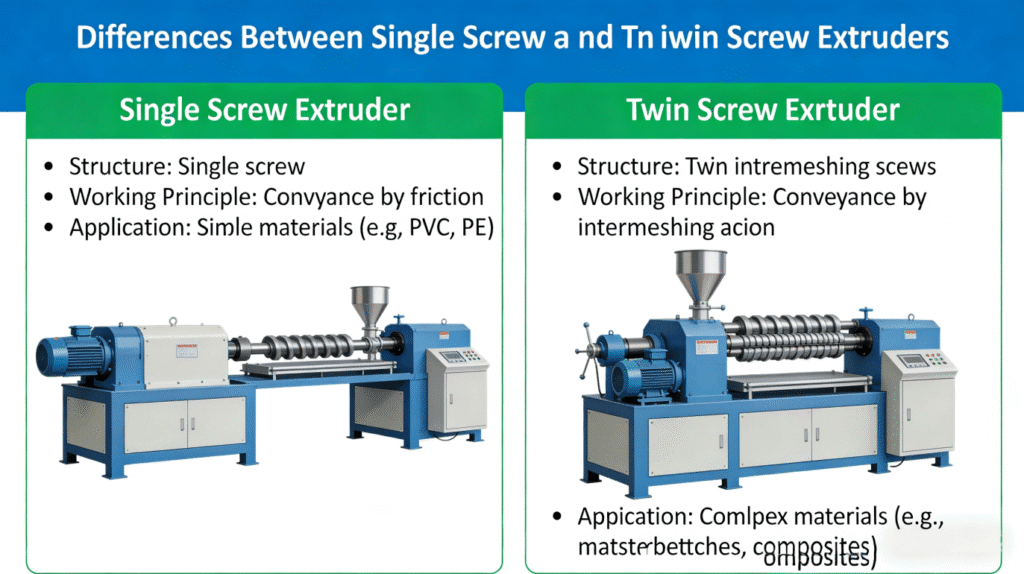
Head-to-Head: Single-Screw vs. Twin-Screw
The fundamental difference lies in the screw configuration, which dictates nearly every other aspect of their performance.
| Feature | Single-Screw Extruder | Twin-Screw Extruder |
|---|---|---|
| Screw Configuration | One screw rotates within a barrel. The screw typically has a constant pitch and depth. | Two screws rotate within a figure-8 shaped barrel. They can be co-rotating (same direction) or counter-rotating (opposite directions), and can be intermeshing or non-intermeshing. |
| Transport Mechanism | Drag Flow. The material is dragged forward by friction against the barrel wall and the screw surface. This makes it highly dependent on the material’s properties, like its coefficient of friction. | Positive Displacement. The intermeshing screws create a sealed C-shaped chamber that forces the material forward. This is a much more efficient and predictable conveying mechanism, largely independent of material properties. |
| Mixing Capability | Limited. Mixing relies primarily on shear and diffusion. It is effective for simple mixing but struggles with materials that have very different viscosities or require a high degree of dispersion. | Excellent. Twin screws offer superior distributive (spreading) and dispersive (breaking down particles) mixing. The intermeshing action allows for complex screw configurations with kneading blocks and mixing elements that can be tailored for specific mixing tasks. |
| Self-Wiping Ability | None. Material can stick and accumulate on the screw and barrel, leading to potential degradation and longer downtime for cleaning. | Excellent. In co-rotating, intermeshing designs, the flight of one screw constantly cleans the root of the other. This “self-wiping” action minimizes material hold-up, reduces residence time, and makes cleaning much faster. |
| Control over Process | Less Control. Residence time and shear rate are largely dictated by the screw speed. There is limited ability to independently control different process zones (feeding, compression, metering). | High Control. The modular screw and barrel design allows for precise control. Different zones can be dedicated to feeding, conveying, melting, mixing, venting, and pressurization. This allows for fine-tuning of the process. |
| Feeding | Best suited for free-flowing, dry granular materials. Sticky, oily, or very fine powders can cause “surging” or bridging in the hopper, leading to unstable output. | Can handle a wide variety of feedstocks, including powders, liquids, and sticky materials. Positive displacement conveying allows for stable processing of difficult-to-feed recipes. |
Operational Advantages and Disadvantages
Single-Screw Extruder
- Advantages:
- Lower Cost: Significantly less expensive to purchase and maintain.
- Simple Operation: Easier to understand, operate, and troubleshoot.
- High Pressure: Capable of generating very high pressures at the die, which is essential for certain applications.
- Proven Technology: A robust and reliable workhorse for straightforward tasks.
- Disadvantages:
- Poor Mixing: Not suitable for complex recipes requiring intense mixing.
- Sensitive to Feed: Performance can be erratic with variations in ingredient particle size, moisture, or fat content.
- Difficult to Clean: Requires significant downtime for cleaning to prevent product contamination and degradation.
- Limited Process Control: Offers less flexibility to modify the process for different products.
Twin-Screw Extruder
- Advantages:
- Superior Mixing & Flexibility: Can handle complex recipes and create a wider range of products, from highly expanded snacks to dense meat analogues.
- Consistent Output: Positive displacement conveying ensures a stable and uniform flow, regardless of feed variations.
- Versatile Feeding: Can process a wide variety of ingredients, including those that are wet, sticky, or oily.
- Easy to Clean: The self-wiping feature and modular design allow for quick product changeovers.
- Tailored Process: The modular design allows for precise control over each stage of the extrusion process.
- Disadvantages:
- High Cost: Much more expensive in terms of initial capital investment and maintenance.
- Complex Operation: Requires more skilled operators and a deeper understanding of the machine’s mechanics.
- Lower Maximum Pressure: While still significant, they generally don’t achieve the same die pressures as single-screw extruders.
Applications: Choosing the Right Tool for the Job
The choice between a single-screw and twin-screw extruder often comes down to the complexity of the task.
- Typical Single-Screw Applications:
- Simple Pasta and Breadings: Straightforward mixing and forming of simple doughs.
- Pelletized Animal Feed: Basic cooking and shaping of feed for livestock and pets.
- Plastic Pipes and Profiles: Simple melting and forming of commodity plastics.
- Rice and Corn Puffs: Simple expansion products.
- Typical Twin-Screw Applications:
- High-Quality Pet Food and Aquatic Feed: Requires precise cooking, high fat incorporation, and uniform density.
- Texturized Vegetable Protein (TVP): Needs intense mixing and shearing to create a meat-like fibrous structure.
- Breakfast Cereals and Snacks: For complex shapes, multiple ingredient streams, and controlled expansion.
- Confectionery and Chocolate: Gentle handling and efficient mixing of temperature-sensitive materials like chocolate and candy masses.
- Reactive Extrusion: Using the extruder as a continuous chemical reactor.
Conclusion
In summary, the choice between a single-screw and a twin-screw extruder is a fundamental decision based on your product and process requirements.
- The single-screw extruder is the cost-effective, reliable workhorse for simple, high-volume applications with forgiving ingredients.
- The twin-screw extruder is the versatile, high-performance solution for complex recipes, demanding mixing requirements, and applications where maximum flexibility and control are paramount.
While the initial investment for a twin-screw system is significantly higher, its ability to produce novel products, handle difficult ingredients, and offer rapid changeovers often justifies the cost in today’s competitive and specialized markets.If you are interested in the extruder machine , you can contact me , i will give you good advice and solutions .
1.Will you help us with the installation ?
Yes , We will send engineers to install and debug the equipment, and assist in training your staff.
2.Are you a factory or trading company?
We are a factory.
3.What certificate do you have?
We have ISO and CE certificate.
4.How long is the warranty period?
All of our machines have one year warranty.
5.What’s the main market of your company?
Our customers all over the world.
6.How much production capacity of your company one year?
This depends on your needs.