
1. Introduction
Extruded breakfast cereals have become increasingly popular among consumers because of their convenience, attractive shapes, crispy textures, and diverse flavors. Products such as corn flakes, cereal rings, chocolate cereal balls, puffed rice, and other ready-to-eat breakfast cereals are widely available in supermarkets around the world.
But have you ever wondered how these delicious breakfast cereals are manufactured? Behind their attractive appearance and crispy texture is a carefully controlled industrial production process involving raw material preparation, mixing, extrusion, shaping, drying, baking, and flavoring.
Extrusion technology plays a particularly important role in modern breakfast cereal manufacturing. It allows manufacturers to produce cereals in different shapes, sizes, textures, and nutritional formulations while maintaining consistent product quality.
This article reveals the complete processing technology of extruded breakfast cereals, explains the function of each production stage, and introduces the essential equipment needed to establish an efficient breakfast cereal production line.

2. What Are Extruded Breakfast Cereals?
Extruded breakfast cereals are ready-to-eat cereal products manufactured by processing grain-based ingredients under controlled temperature, moisture, pressure, and mechanical shear conditions.
Common raw materials include corn flour, rice flour, wheat flour, oats, sorghum, and other cereal ingredients. Depending on the desired nutritional profile and product characteristics, manufacturers may also add sugar, salt, vegetable oils, milk powder, cocoa powder, vitamins, minerals, and other functional ingredients.
During extrusion, the raw material mixture passes through an extruder barrel and is subjected to heat, pressure, and mechanical energy. When the material exits through the die, the sudden pressure reduction can cause moisture to expand into steam, creating a porous structure.
This expansion is responsible for the light, cereal extrusion crispy texture commonly found in many puffed breakfast cereals.
Different formulations, extrusion conditions, and shaping methods allow manufacturers to produce a wide range of breakfast cereal products.
3. Main Raw Materials Used in Breakfast Cereal Production
The quality of the raw materials directly affects the nutritional value, appearance, texture, and processing performance of breakfast cereals.
3.1 Corn Flour
Corn flour is one of the most commonly used ingredients in extruded breakfast cereal manufacturing. It provides starch, contributes to product expansion, and gives cereals their characteristic yellow color and mild corn flavor.
Corn-based formulations are particularly suitable for producing cereal balls, rings, puffs, and other expanded breakfast products.
3.2 Rice Flour
Rice flour provides a relatively mild flavor and can contribute to a light, breakfast cereal machine crispy texture. It is frequently combined with corn flour or wheat flour to adjust product expansion and texture.
3.3 Wheat Flour
Wheat flour contributes starch and protein, influencing dough structure and processing characteristics. Its proportion needs to be controlled because excessive gluten development may affect expansion and product crispness.
3.4 Oats and Other Whole Grains
Oats, barley, sorghum, and other whole grains can increase dietary fiber and improve the nutritional profile of breakfast cereals.
However, their inclusion levels must be carefully adjusted to maintain stable extrusion performance and desirable product texture.
3.5 Sugar, Salt, and Functional Ingredients
Sugar and salt improve flavor, while cocoa powder, milk powder, and flavoring ingredients provide additional taste variations.
Vitamins and minerals may also be incorporated to produce fortified breakfast cereals. Their addition requires attention to processing stability, especially when heat-sensitive nutrients are involved.
4. The Complete Extruded Breakfast Cereal Processing Process
The manufacturing process of extruded breakfast cereals generally consists of the following stages:
Raw Material Preparation → Ingredient Mixing → Conditioning → Extrusion → Cutting and Shaping → Drying or Baking → Flavoring and Coating → Cooling → Packaging
Each stage plays an important role in determining the final product quality.
Step 1: Raw Material Preparation
The first step is preparing and inspecting all raw materials.
Manufacturers need to check the moisture content, particle size, cereal extrusion freshness, and quality of incoming ingredients. Raw materials should be free from foreign materials, mold, and other contaminants.
If whole grains are used, they may need to be cleaned, ground, and screened before entering the production process.
A flour sifter can remove oversized particles and impurities, helping ensure a uniform particle size.
Consistent raw material quality is essential because differences in flour particle size and moisture content can influence mixing, extrusion, and final product expansion.
Step 2: Ingredient Mixing
After preparation, different ingredients are accurately weighed according to the product formulation.
The ingredients are then transferred into a mixer, breakfast cereal machine where they are blended until a uniform mixture is obtained.
Water is added according to the formulation and the requirements of the extrusion process. The purpose is to achieve suitable moisture content so that the material can be processed smoothly inside the extruder.
The mixing process should ensure that starch, flour, sugar, salt, and other ingredients are evenly distributed.
Poor mixing may result in inconsistent product color, flavor, density, and expansion.
Step 3: Conditioning
Conditioning is an important step in many breakfast cereal production processes.
The mixed ingredients are transferred into a conditioning system, where moisture and temperature are adjusted before extrusion.
During conditioning, water is distributed more evenly throughout the material, allowing the starch granules to absorb moisture.
Proper conditioning helps improve extrusion stability, reduce unnecessary mechanical stress, and achieve more consistent product expansion.
The required conditioning time, temperature, and moisture content depend on the formulation and the type of extruder being used.
Step 4: Extrusion
Extrusion is the core stage of extruded breakfast cereal manufacturing.
The conditioned mixture enters a food extruder, where rotating screws transport, compress, mix, and process the material.
As the ingredients move through the barrel, they are exposed to controlled heating, pressure, and mechanical shear.
These conditions cause starch gelatinization and other physical and chemical changes that transform the raw material into a plasticized mass.
When the material passes through the extrusion die, the sudden pressure drop causes moisture to flash into steam. This creates an expanded, porous structure.
The extruder’s screw configuration, rotation speed, barrel temperature, feeding rate, moisture content, and die design all influence the final product.
Depending on the desired cereal type, manufacturers can use single-screw or twin-screw extrusion equipment.
Twin-screw extruders provide greater flexibility in mixing and processing different formulations, making them suitable for a wide range of breakfast cereal products.
Step 5: Cutting and Shaping
After extrusion, the material passes through a specially designed die to obtain the required shape.
A rotary cutter or other cutting device can divide the continuously extruded material into individual pieces.
By changing the die opening and cutting system, manufacturers can produce different breakfast cereal shapes, including:
- Cereal balls: Small spherical or rounded products.
- Cereal rings: Ring-shaped cereals with a hollow center.
- Cereal tubes: Hollow cylindrical products.
- Puffed cereal pillows: Lightweight products with a hollow or filled structure.
- Cereal stars: Star-shaped breakfast products.
- Puffed sticks: Long, narrow, crispy cereal pieces.
The shape and size of the products should remain consistent to ensure uniform drying, coating, and packaging.
Step 6: Drying or Baking
Freshly extruded cereals usually contain more moisture than finished products. Therefore, drying is necessary to reduce moisture content and develop the desired crispy texture.
A continuous belt dryer is commonly used in industrial breakfast cereal production lines.
The cereal pieces move through different drying zones, where temperature, airflow, and drying time are carefully controlled.
The drying process should remove excess moisture without causing excessive browning, deformation, or burning.
Some breakfast cereal products also undergo an additional baking or toasting process to develop a stronger roasted flavor and improve crispness.
The final moisture content and water activity should meet the product’s specifications and food safety requirements.
Step 7: Flavoring and Coating
Once the cereals have been dried, they can enter the seasoning and coating stage.
This process gives breakfast cereals their characteristic flavor and improves their appearance.
Common flavoring options include:
- Chocolate flavor
- Honey flavor
- Strawberry flavor
- Vanilla flavor
- Cinnamon flavor
- Milk flavor
- Caramel flavor
A seasoning drum or coating machine can be used to distribute liquid or powdered ingredients evenly over the cereal surface.
For products requiring a sweet coating, manufacturers may spray sugar syrup, honey-based mixtures, or chocolate coatings onto the cereal pieces.
The amount of coating material must be controlled carefully. Excessive coating may cause products to become sticky, while insufficient coating may result in weak flavor.
After coating, an additional drying or cooling stage may be required, depending on the coating formulation.
Step 8: Cooling
Before packaging, the finished cereals should be cooled to an appropriate temperature.
Cooling helps stabilize the product structure, prevents condensation inside packaging, and reduces the risk of moisture-related quality problems.
A cooling conveyor or cooling system can be used to lower the product temperature evenly.
Products should be protected from excessive environmental humidity during this stage because extruded cereals readily absorb moisture from the surrounding air.
Step 9: Packaging
Packaging is the final stage of breakfast cereal manufacturing.
Finished cereals are usually transferred to an automatic weighing and packaging machine.
Common packaging options include plastic bags, stand-up pouches, laminated film packages, and cardboard boxes with moisture-resistant inner bags.
Because breakfast cereals are sensitive to moisture and oxygen, packaging materials should provide suitable moisture barriers and protection against environmental contamination.
Nitrogen flushing may also be used when appropriate to help protect product quality.
Accurate weighing, reliable sealing, clear labeling, and appropriate storage conditions are important for maintaining product quality during distribution.
5. What Equipment Is Needed for an Extruded Breakfast Cereal Production Line?
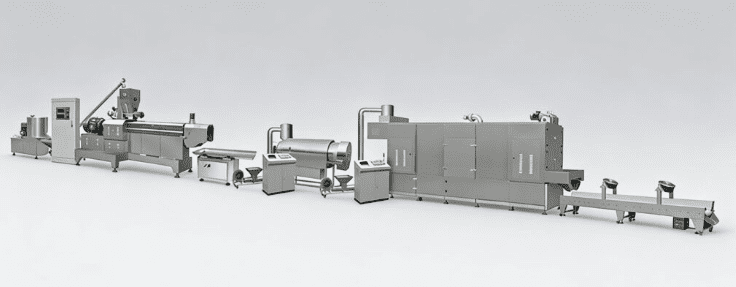
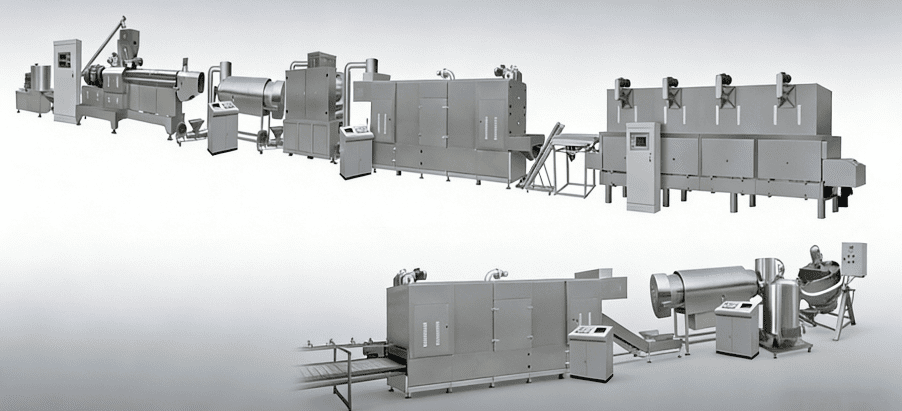
A complete breakfast cereal production line consists of several machines that work together to transform raw materials into finished products.
The main equipment includes:
| Equipment | Main Function |
|---|---|
| Flour Sifter | Removes impurities and oversized particles |
| Mixing Machine | Blends raw materials and water |
| Conditioning System | Adjusts moisture and temperature |
| Food Extruder | Processes and expands cereal materials |
| Cutting Machine | Cuts products into the required shapes |
| Continuous Dryer | Reduces product moisture |
| Baking Machine | Develops roasted flavor and texture |
| Seasoning Machine | Applies flavoring ingredients |
| Cooling Conveyor | Cools finished cereal products |
| Packaging Machine | Weighs and packs finished products |
The actual equipment configuration depends on the product type, production capacity, raw material formulation, and required automation level.
For example, a production line designed for cereal balls may require a different die and cutting arrangement from a line producing cereal rings or puffed cereal pillows.
6. Key Factors Affecting the Quality of Extruded Breakfast Cereals
Producing high-quality breakfast cereals requires more than simply selecting suitable machinery. Several processing factors must be carefully controlled.
6.1 Raw Material Formulation
Different grains have different starch, protein, fiber, and moisture characteristics.
The ratio of corn flour, rice flour, wheat flour, and other ingredients influences expansion, hardness, color, and flavor.
Manufacturers should develop formulations according to the desired product characteristics.
6.2 Moisture Content
Moisture content is one of the most important factors affecting extrusion performance.
If the moisture level is too low, the material may become difficult to process and expansion may be limited.
If moisture is too high, the extruded products may have excessive density or require longer drying times.
Therefore, moisture levels should be adjusted according to the raw materials and extrusion conditions.
6.3 Extrusion Temperature
Temperature affects starch gelatinization, material viscosity, and product expansion.
Insufficient heating may lead to incomplete starch transformation, while excessive heating can cause undesirable color changes, flavor deterioration, or nutrient losses.
A suitable temperature profile should be established for each formulation.
6.4 Screw Speed and Feeding Rate
Screw speed and feeding rate influence material residence time, pressure, and mechanical energy input.
Unstable feeding may lead to inconsistent product shapes and densities.
Manufacturers should maintain stable feeding and optimize screw speed according to the characteristics of the raw materials.
6.5 Drying Conditions
Drying temperature, airflow, and processing time directly influence final moisture content and crispness.
Uneven drying can result in products with inconsistent texture and storage stability.
A properly designed drying system should provide uniform heat distribution and sufficient moisture removal.
6.6 Seasoning Uniformity
Seasoning quality determines the flavor consistency of the finished breakfast cereals.
The seasoning machine should distribute coating materials evenly without damaging the fragile cereal pieces.
Proper control of coating temperature, spraying rate, and drum rotation helps improve product consistency.
7. How to Produce Different Types of Extruded Breakfast Cereals
One of the biggest advantages of extrusion technology is its ability to manufacture products with different shapes, textures, and flavors.
7.1 Puffed Corn Cereals
Puffed corn cereals are generally produced using corn flour or corn-based formulations.
After mixing and extrusion, the material expands rapidly when it exits the die, creating lightweight and crispy products.
Different dies can be used to manufacture balls, tubes, stars, and other shapes.
7.2 Chocolate Cereal Balls
Chocolate cereal balls can be produced using a cocoa-containing formulation or by applying a chocolate coating after extrusion.
The finished products usually have a crispy center and a distinctive chocolate flavor.
7.3 Cereal Rings
Cereal rings are produced using specially designed extrusion dies.
The material is extruded into a hollow or ring-like shape and then cut into individual pieces.
Proper die design and cutting control are important for maintaining uniform ring size and shape.
7.4 Puffed Rice Cereals
Puffed rice cereals use rice flour or other rice-based ingredients as the primary raw material.
Extrusion conditions are adjusted to achieve a light structure and crispy texture.
Rice-based cereals can also be combined with corn, oats, cocoa, and other ingredients to create different product varieties.
8. Advantages of Using Extrusion Technology for Breakfast Cereal Manufacturing
Extrusion technology has become an important solution for modern breakfast cereal production because of its flexibility and processing efficiency.
1. Wide Product Variety
Manufacturers can produce different shapes, sizes, flavors, and textures by changing formulations, dies, and processing parameters.
2. High Production Efficiency
Continuous extrusion systems support large-scale production and reduce the need for manual processing.
3. Flexible Raw Material Selection
Corn, rice, wheat, oats, and other grain ingredients can be used in different combinations.
4. Consistent Product Quality
Automated feeding, extrusion, drying, and seasoning systems help improve production consistency.
5. Easy Process Integration
Extruders can be integrated with mixers, dryers, coating machines, cooling conveyors, and packaging systems to create a complete production line.
6. Opportunities for Product Innovation
Manufacturers can develop high-fiber, multigrain, fortified, and reduced-sugar cereal products according to market demand.
9. Common Problems in Extruded Breakfast Cereal Production and Their Solutions
Even with modern production equipment, manufacturers may encounter various processing problems.
| Common Problem | Possible Cause | Suggested Solution |
|---|---|---|
| Poor product expansion | Incorrect moisture or extrusion conditions | Adjust moisture, temperature, and screw speed |
| Uneven product size | Unstable feeding or cutting | Check the feeding system and cutter |
| Hard product texture | Insufficient expansion or excessive drying | Optimize extrusion and drying conditions |
| Sticky cereal surfaces | Excessive moisture or coating material | Adjust drying and coating parameters |
| Uneven color | Inconsistent mixing or heating | Improve ingredient mixing and temperature control |
| Low crispness | Excessive final moisture | Optimize drying and packaging conditions |
| Product deformation | Incorrect cutting or insufficient structure development | Adjust die design and processing parameters |
When problems occur, manufacturers should identify the underlying cause instead of making random adjustments to multiple machine settings.
Recording production parameters and testing samples regularly can help improve process stability.
10. How to Establish a Successful Breakfast Cereal Manufacturing Factory
For entrepreneurs planning to enter the breakfast cereal industry, choosing suitable equipment is only one part of the investment process.
Several important factors should be considered before starting production.
10.1 Conduct Market Research
First, identify the target market and understand consumer preferences.
Consider whether the factory will produce traditional corn flakes, puffed cereal balls, chocolate cereal products, multigrain cereals, or other breakfast products.
Different products may require different formulations, processing equipment, and packaging solutions.
10.2 Determine Production Capacity
Production capacity should be selected according to expected market demand, investment budget, and future expansion plans.
A small production line may be suitable for new businesses, while larger factories may require fully automated continuous production systems.
10.3 Select Suitable Processing Equipment
Choose machinery according to the product type, processing technology, and desired production output.
The extruder is particularly important because its processing performance directly affects product expansion and texture.
It is also necessary to consider the compatibility of auxiliary equipment, including mixers, dryers, seasoning machines, and packaging systems.
10.4 Design the Factory Layout
A reasonable factory layout should follow the production sequence, from raw material storage to finished product packaging.
Separate raw material handling, processing, cooling, and packaging areas where necessary.
The factory should also provide suitable water, electricity, ventilation, drainage, and sanitation facilities.
10.5 Establish Quality Control Procedures
Food safety and product consistency should be priorities throughout manufacturing.
Factories should establish procedures for raw material inspection, production monitoring, equipment cleaning, finished product testing, and traceability.
Applicable food safety regulations and labeling requirements must also be followed in the target market.
11. Conclusion
The processing technology of extruded breakfast cereals combines raw material preparation, ingredient mixing, conditioning, extrusion, shaping, drying, seasoning, cooling, and packaging.
Among these stages, extrusion is the central processing step because it determines the expansion structure, density, and basic texture of the finished cereal products.
With suitable formulations, properly configured equipment, and carefully controlled processing parameters, manufacturers can produce a wide variety of crispy, attractive, and convenient breakfast cereals.
For businesses planning to enter the breakfast cereal market, investing in an appropriate production line and developing a stable manufacturing process are essential steps toward long-term success.
As consumer demand for convenient and diversified breakfast products continues to evolve, extrusion technology will remain an important tool for developing innovative cereal products and improving manufacturing efficiency.


