
The quality of instant noodles—whether fried or non-fried—is determined long before the dough enters the mixer or the noodle block hits the fryer. Instant noodle making machine Raw material selection is the single most critical factor influencing noodle texture, color, flavor, shelf life, and production efficiency. Poor ingredients cannot be fixed by better machinery.

This article explains how to choose each key ingredient for superior instant noodles.
The 6 Essential Raw Materials for Instant Noodles
| Ingredient | Primary Function | Quality Impact |
|---|---|---|
| Flour | Structure and texture | The most important ingredient |
| Water | Hydration and gluten formation | Affects dough handling and shelf life |
| Alkaline salts (Kansui) | Color, flavor, and firmness | Creates the signature yellow color and chewy texture |
| Salt (NaCl) | Flavor and gluten strengthening | Controls fermentation and enhances taste |
| Oil (for frying) | Dehydration and texture | Determines crispiness, flavor, and shelf stability |
| Starches & Additives | Texture modification and shelf life | Improves smoothness, reduces oil absorption |
1. Flour Selection: The Backbone of Noodle Structure
Flour contributes approximately 70–75% of the noodle’s dry weight. Instant noodle making machine Choosing the right wheat flour is non-negotiable.

What to Look For:
| Parameter | Ideal Range | Why It Matters |
|---|---|---|
| Protein content | 9–11% (medium to high) | Too low → noodles become soft and mushy; too high → noodles are tough and hard |
| Gluten quality | Medium-strong | Good gluten forms a continuous network that traps water and gives chewiness |
| Ash content | 0.40–0.55% | Low ash → white, clean noodles; high ash → grayish color and off-flavor |
| Falling number | 300–400 seconds | Indicates enzyme activity; too low → sticky noodles; too high → poor expansion |
| Starch damage | 5–8% | Moderate damage improves water absorption; excessive damage causes stickiness |
Best Flour Types for Instant Noodles:
- Hard red winter wheat (USA, Canada) – High protein, good for chewy noodles
- Australian standard white (ASW) – Balanced protein, widely used in Asia
- High-gluten flour (11–13% protein) – Often blended with lower-protein flour to achieve the target
Practical Tip:
If you cannot find ideal flour, blend two flours. For example:
- 70% medium-protein flour (9–10%) + 30% high-protein flour (12–13%) = ~10% final protein.
What to Avoid:
- Flour made from sprouted wheat (high enzyme activity)
- Bleached flour (affects color and flavor)
- Old or improperly stored flour (rancidity, insects, mold)
2. Water Quality: The Silent Influencer
Water makes up 30–35% of the dough weight. Its quality directly affects dough formation and final noodle texture.
What to Look For:
| Parameter | Ideal Range | Why It Matters |
|---|---|---|
| pH | 6.5–7.5 | Too acidic → weak gluten; too alkaline → bitter taste (but note: alkaline salts will raise pH) |
| Total hardness (as CaCO₃) | 50–150 ppm | Too soft → sticky dough; too hard → slow hydration, tough noodles |
| Iron / Manganese | < 0.1 ppm | Causes discoloration and off-flavors |
| Chlorine | < 1 ppm | High chlorine damages gluten structure |
| Microbial count | < 100 CFU/mL | Prevents premature spoilage |
Practical Tip:
Utilização filtered or softened water if your tap water is very hard (>200 ppm). Adding calcium sulfate (gypsum) can adjust hardness if water is too soft.
What to Avoid:
- Chlorinated municipal water without dechlorination
- Water with visible sediment or odor
- Distilled or deionized water (too aggressive, causes sticky dough)
3. Alkaline Salts (Kansui): The Signature Ingredient
Kansui (also called jian shui or lye water) is a solution of sodium carbonate (Na₂CO₃) and potassium carbonate (K₂CO₃). It is what makes instant noodles yellow, springy, and slightly slippery.
What to Look For:
| Componente | Typical Ratio | Function |
|---|---|---|
| Sodium carbonate (Na₂CO₃) | 60–80% | Increases pH, strengthens gluten, creates yellow color |
| Potassium carbonate (K₂CO₃) | 20–40% | Improves chewiness, adds a mild flavor |
| Phosphates (optional) | 0.1–0.3% (of flour weight) | Improves water retention, reduces oil absorption |
How Much to Use:
- Typical dosage: 0.5–1.5% of flour weight (as dry powder)
- Too little: Noodles are pale, soft, and lack “bite”
- Too much: Bitter, soapy taste; yellow color becomes unnaturally bright
Forms of Kansui:
| Form | Pros | Cons |
|---|---|---|
| Powdered mix | Easy to weigh, stable shelf life | Requires complete dissolution before use |
| Liquid solution | Ready to use, consistent | More expensive to ship (water weight) |
| DIY (baked baking soda) | Cheap, available | Inconsistent strength, requires testing |
Practical Tip:
To make your own kansui: Spread baking soda on a baking tray and bake at 150°C (300°F) for 1 hour. This converts sodium bicarbonate to sodium carbonate.
What to Avoid:
- Using baking soda (sodium bicarbonate) alone without heat treatment (it is too weak)
- Using food-grade lye (NaOH) — too dangerous for small-scale production
4. Salt (Sodium Chloride): More Than Just Flavor
Salt strengthens the gluten network, controls enzyme activity, and adds taste.
What to Look For:
- Purity: >99% NaCl (food grade)
- Particle size: Fine (powdered) for even dissolution
- Additives: Avoid iodized salt (iodine can affect color); non-iodized fine salt is best
How Much to Use:
- Typical dosage: 1–2% of flour weight
- Effect: Improves dough elasticity and extends shelf life (by reducing water activity)
What to Avoid:
- Coarse or rock salt (does not dissolve evenly)
- Salt with anti-caking agents (can cause off-flavors)
5. Oil Selection for Frying (Fried Instant Noodles Only)
If you are producing fried instant noodles, the frying oil is both a cooking medium and an ingredient absorbed into the final product.
What to Look For:
| Property | Ideal Value | Why It Matters |
|---|---|---|
| Smoke point | >200°C (390°F) | Prevents burning and toxic compound formation |
| Saturated fat content | 25–40% | Provides stability; too low → oil oxidizes quickly |
| Monounsaturated fat | 40–60% | Good for flavor and texture |
| Polyunsaturated fat | <15% | Low is better (PUFAs oxidize rapidly at frying temperatures) |
| Free fatty acids (FFA) | <0.1% | High FFA reduces smoke point and causes off-flavors |
Best Oils for Frying Instant Noodles:
| Oil Type | Pros | Cons |
|---|---|---|
| Palm olein | Most stable, affordable, neutral flavor | Environmental concerns, solid at room temperature in cold climates |
| High-oleic sunflower oil | Good stability, light flavor | More expensive than palm |
| Canola oil (high-oleic) | Low saturated fat, good stability | Can develop fishy off-flavors if overheated |
| Coconut oil | Very stable, long fry life | Distinct coconut flavor (may not suit all markets) |
Practical Tip:
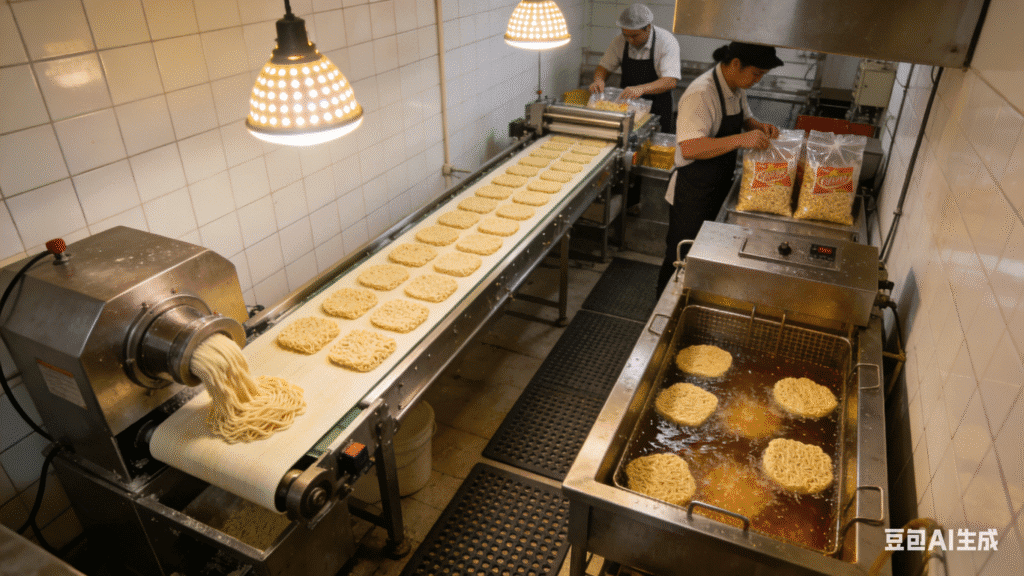
Palm olein (liquid fraction of palm oil) is the industry standard for good reason: it resists oxidation, has a high smoke point, and is widely available. Instant noodle making machine For small-scale production, start with refined, bleached, deodorized (RBD) palm olein.
What to Avoid:
- Soybean oil (high in PUFAs → rapid degradation)
- Corn oil (similar stability issues)
- Used or recycled oil of unknown quality
- Oils with added antioxidants like TBHQ (allowed but check local regulations)
6. Starches and Additives: Fine-Tuning Performance
While optional, small amounts of starches or modified ingredients can dramatically improve noodle quality.
Common Additives for Instant Noodles:
| Additive | Typical Dosage (% of flour) | Benefit |
|---|---|---|
| Potato starch | 2–5% | Increases smoothness and transparency |
| Tapioca starch | 2–5% | Improves elasticity and “snap” |
| Modified corn starch | 1–3% | Reduces oil absorption during frying |
| Guar gum | 0.1–0.3% | Improves water retention and texture |
| Sodium tripolyphosphate (STPP) | 0.1–0.3% | Enhances water binding, reduces cooking loss |
| Vitamin E (tocopherols) | 0.02–0.05% | Natural antioxidant for frying oil |
| TBHQ (synthetic) | 0.01–0.02% | Powerful antioxidant (check local legality) |
Practical Tip for Beginners:
Start with just flour + water + kansui + salt. Master the basics before adding starches or gums. Once consistent, add 2% potato starch to see immediate improvement in noodle smoothness.
What to Avoid:
- Exceeding maximum legal limits for food additives (check your country’s regulations)
- Using additives without proper scales (0.1% differences matter)
Summary: The Ideal Raw Material “Shopping List”
| Ingredient | Specification | Approximate Cost Factor |
|---|---|---|
| Flour | 10% protein, 0.45% ash, falling number 350 | $$$ |
| Water | pH 7.0, hardness 80 ppm, no chlorine | $ |
| Kansui | 70% Na₂CO₃ + 30% K₂CO₃ powder | $$ |
| Salt | Fine, non-iodized, >99% purity | $ |
| Frying oil | RBD palm olein, smoke point >220°C | $$ |
| Potato starch | Food grade, fine powder | $$ |
| Guar gum | Food grade, 200 mesh | $$$ |
Quick Troubleshooting: Ingredient-Related Problems
| Problem | Likely Cause | Solution |
|---|---|---|
| Noodles are too soft after cooking | Low protein flour | Increase protein to 10–11% |
| Noodles are hard and tough | Too much kansui or too much protein | Reduce kansui to 0.8% or blend flour |
| Noodles are gray or brown | High ash flour or iron in water | Switch to low-ash flour, filter water |
| Noodles stick together | Too much water or low salt | Reduce water by 1–2%, increase salt to 1.5% |
| Short shelf life (rancidity) | Poor oil quality or high PUFAs | Switch to palm olein, add antioxidants |
| Uneven yellow color | Uneven kansui mixing | Dissolve kansui in water before adding to flour |
Conclusion
Selecting raw materials for instant noodles is a balancing act. Flour quality is king, but water, kansui, salt, and oil each play essential supporting roles. For a successful product:
- Start with a consistent, medium-protein flour (9–11% protein, low ash).
- Use clean, moderately hard water (50–150 ppm).
- Add the correct amount of kansui (0.8–1.2% of flour weight) for signature yellow color and chewiness.
- Fry in stable, high-smoke-point oil (palm olein is the industry standard).
- Test small batches before scaling up.
Remember: Even the best equipment cannot compensate for poor ingredients. Invest time in sourcing and testing your raw materials—it will directly determine whether your instant noodles are merely acceptable or truly exceptional. If you are interested in the Instant noodle making machine you can contact me , i will give you good advice and solutions .
1.Will you help us with the installation ?
Yes , We will send engineers to install and debug the equipment, and assist in training your staff.
2.Are you a factory or trading company?
We are a factory.
3.What certificate do you have?
We have ISO and CE certificate.
4.How long is the warranty period?
All of our machines have one year warranty.
5.What’s the main market of your company?
Our customers all over the world.
6.How much production capacity of your company one year?
This depends on your needs.