
Moisture content is arguably the most critical quality parameter in breakfast corn flake manufacturing. It directly influences the product’s texture (crispness), flavor, density, shelf stability, and microbial safety. Precise moisture control is maintained not at a single point, how corn flakes are made but throughout the entire production process. Here is a detailed breakdown of how moisture is controlled at each key stage.

1. Ingredient Input Control (Starting Point)
Control begins with raw materials. The moisture content of the corn grits/meal is standardized upon receipt and storage. Variations are accounted for in recipe formulation. how corn flakes are made The amount of water, syrup, and steam added in the initial mixing and cooking stages is precisely metered to achieve a consistent starting moisture for the cooking process, typically resulting in a cooked mass with moisture around 28-32%.
2. Post-Cooking Drying & Tempering (Primary Moisture Reduction)
After cooking and delumping, the moist aggregates are dried in a controlled manner. This step, often in a rotating drum dryer or fluidized bed dryer, is not about creating crispness but about achieving a uniform, workable internal texture.
- Target: Reduce moisture from ~30% to a precise 18-22%. This “tempered” moisture level is vital for the next step.
- Control: Dryer temperature, airflow, and residence time are tightly regulated. Online moisture sensors (e.g., Near-Infrared – NIR) provide real-time feedback to adjust dryer parameters automatically. Samples are also taken for loss-on-drying (LOD) laboratory tests to calibrate and verify online systems.
- Why it’s Critical: If the pieces are too wet, they will stick to the flaking rolls and produce misshapen, thick flakes. If they are too dry, they will shatter during flaking and produce excessive fines.
3. Flaking (Mechanical Stabilization)
The flaking rolls themselves act as a moisture control point. The pressure exerted densifies the piece and creates a more uniform moisture profile across the flake. While minimal moisture is lost here, the process prepares the flake’s structure for efficient moisture removal in the final stage.

4. Toasting/Drying (Final Moisture Stabilization & Crispness Development)
This is the most critical step for establishing final product moisture. The flakes pass through a multi-zone oven (drum or conveyor).
- Process: Hot air (typically 260-320°C / 500-610°F) rapidly vaporizes the remaining internal water. The short residence time (60-120 seconds) “sets” the starch structure, creating porosity and crispness.
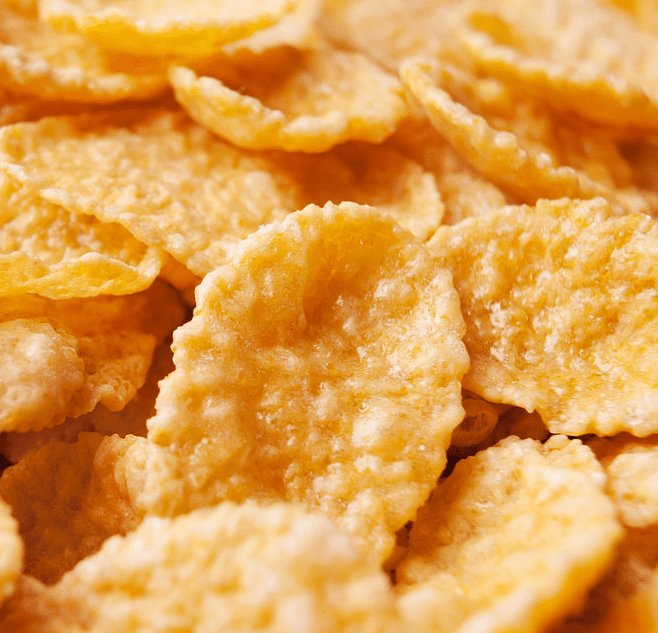
- Target Final Moisture: The industry standard target is typically between 1.5% and 3.0% moisture by weight. This extremely low level is essential for the desired glass-like crispness.
- Control: Precise control of oven temperature profile, airflow velocity, and residence time (belt speed) is paramount. Real-time, non-contact moisture sensors (NIR) positioned at the oven exit provide instant data. This feedback loop allows for automatic adjustment of oven settings to maintain the target moisture within a tight tolerance (e.g., ±0.3%).
5. Coating & Cooling (Moisture Guarding)
After toasting, flakes are highly hygroscopic (water-attracting).
- Cooling: Flakes are conveyed through a cooling tunnel with dehumidified air. This rapidly brings the flake temperature down to ambient levels, preventing condensation and moisture pickup from the air, which would immediately soften the product.
- Coating: If a sweetener or vitamin spray is applied, it is a minimal, controlled mist. The syrup solids are calculated as part of the final product composition, and their low water content is managed by the residual heat of the flake, which causes it to flash off.
6. Packaging (The Ultimate Moisture Barrier)
Packaging is the final and most crucial defense against moisture regain.
- Immediate Packaging: Flakes are packaged within minutes of cooling.
- Barrier Materials: The inner liner is a high-moisture-barrier film, often a metallized polypropylene or wax-lined material with a very low Water Vapor Transmission Rate (WVTR).
- Modified Atmosphere Packaging (MAP): The bag is flushed with dry nitrogen gas before sealing. This inert gas displaces oxygen (preventing oxidation/rancidity) and, critically, removes moist air from the package headspace.
- Seal Integrity: The hermetic seal of the bag is rigorously tested to prevent any ingress of humid ambient air.
Quality Assurance & Laboratory Verification
While online sensors provide process control, offline lab analysis is essential for validation:
- Loss-on-Drying (LOD): The primary method. how corn flakes are made A sample is weighed, dried in a forced-air oven at a standard temperature (e.g., 105°C) for a set time, and re-weighed. The weight loss is calculated as moisture content.
- Karl Fischer Titration: A more precise chemical method used to measure very low moisture levels and to calibrate other methods.
- Sensory & Textural Analysis: Trained panels and texture analyzers (measuring snap force) regularly test finished product to correlate instrumental moisture readings with the crucial consumer attribute of crispness.
Effective moisture control in corn flake production is not a single operation but a holistic, system-wide philosophy. It requires:
- Precision in every processing step from mixing to packaging.
- Monitoring with real-time sensors and laboratory backup.
- Barrier Protection through optimal packaging.
- Consistency to ensure every box meets the expected sensory standard of delightful crispness from the first bowl to the last.
Failure to control moisture within the narrow target range results in products that are either too soft and chewy (high moisture) or too hard, brittle, and lacking flavor (low moisture), leading directly to consumer rejection.