
1. Introduction
Fried instant noodles are one of the most popular convenience food products in the global food industry. Thanks to their affordable prices, convenient preparation methods, long shelf life, and diverse flavors, they have become an important part of everyday diets in many countries. From supermarkets and convenience stores to online shopping platforms and small retail shops, fried instant noodles maintain a strong market presence.
With the development of the global food processing industry, consumer lifestyles are changing rapidly. People increasingly prefer foods that are easy to prepare, affordable, and suitable for busy schedules. These changes create considerable opportunities for fried instant noodle manufacturers.
Although the instant noodle industry faces challenges such as changing dietary preferences, raw material price fluctuations, and increasing competition, fried instant noodles still have significant development potential. For entrepreneurs planning to enter the food processing industry, investing in a fried instant noodle production business may be an attractive opportunity.
This article explores the current market prospects of fried instant noodles, major industry trends, consumer demand, business opportunities, and the future development direction of the industry.
2. Current Market Demand for Fried Instant Noodles
The demand for instant noodles remains strong in many parts of the world. In particular, countries in Asia have established mature instant noodle consumption habits. Fried instant noodles are widely accepted because they are inexpensive, easy to store, and quick to prepare.
Several factors support their continued market demand.
2.1 Busy Lifestyles Increase Demand for Convenience Foods
Modern consumers often have busy working schedules and limited time for cooking. Students, office workers, travelers, and people living alone frequently choose instant noodles as a convenient meal.
Fried instant noodles can generally be prepared within several minutes by adding hot water or cooking them briefly, depending on the product type. This convenience makes them suitable for breakfast, lunch, dinner, and late-night snacks.
As urbanization and fast-paced lifestyles continue to develop, demand for convenient food products is expected to remain an important market driver.
2.2 Affordable Prices Attract Price-Sensitive Consumers
Compared with many ready-to-eat meals and restaurant foods, fried instant noodles are relatively inexpensive. This makes them attractive to consumers with different income levels.
In developing markets, affordability is particularly important. Consumers often look for products that provide sufficient portions at reasonable prices.
Manufacturers can therefore target different market segments by developing budget-friendly products, standard retail products, and premium instant noodle varieties.
2.3 Strong Consumption Habits Support Market Stability
In many countries, instant noodles have become an established food category. Consumers are familiar with their preparation methods and flavors, and many people purchase them regularly.
This established consumption habit provides a stable foundation for manufacturers. Instead of introducing an entirely unfamiliar product, businesses can enter an existing market and differentiate their products through flavor, packaging, quality, and pricing.
3. Regional Market Opportunities
Different regions have different consumption habits, purchasing power, and flavor preferences. Understanding these differences can help manufacturers select suitable target markets.
3.1 Asia: The Largest Consumption Market
Asia is the most important market for instant noodles. Countries such as China, Indonesia, India, Vietnam, Japan, South Korea, and Thailand have large consumer populations and well-established instant noodle industries.
According to the World Instant Noodles Association, global instant noodle demand reached approximately 124.21 billion servings in 2025. China and Hong Kong accounted for 43.27 billion servings, followed by Indonesia with 14.54 billion and India with 9.60 billion servings. These figures demonstrate the enormous consumption potential of Asian markets. @Press+1
For fried instant noodle manufacturers, Asia offers opportunities in several areas:
- Developing affordable products for mass-market consumers.
- Introducing spicy, seafood, beef, chicken, and vegetable flavors.
- Producing different noodle shapes and thicknesses.
- Supplying supermarkets, convenience stores, wholesalers, and food distributors.
- Developing customized products for local markets.
3.2 Africa: A Market with Development Potential
Africa is another promising region for instant noodle manufacturers. Population growth, urbanization, and the expansion of modern retail channels are creating opportunities for convenient packaged foods.
Countries such as Nigeria have already developed substantial instant noodle consumption markets. Affordable products are particularly attractive to students, young workers, and families.
For manufacturers entering African markets, price competitiveness is important. Producing fried instant noodles with reliable quality, reasonable packaging costs, and familiar flavors can help businesses establish a competitive position.

3.3 Europe and North America: Opportunities for Product Innovation
European and North American consumers have diverse food preferences. Instant noodles are increasingly available through supermarkets, Asian food stores, online platforms, and convenience retailers.
Compared with traditional mass-market products, premium instant noodles may offer better opportunities in these regions.
Manufacturers can explore:
- Korean-style spicy instant noodles.
- Japanese-style ramen products.
- Authentic Asian regional flavors.
- Premium seafood and meat flavors.
- Vegetarian and plant-based varieties.
- Convenient cup and bowl packaging.
These products can help manufacturers reach consumers who are willing to pay more for distinctive flavors and convenient meal experiences.
4. Major Trends Influencing the Fried Instant Noodle Market
The market is not simply expanding in terms of production volume. Consumer expectations are also changing, encouraging manufacturers to improve their products and production technologies.
4.1 Flavor Innovation and Product Diversification
Flavor is one of the most important factors influencing instant noodle purchasing decisions.
Traditional chicken, beef, and vegetable flavors remain popular, but consumers are increasingly interested in new and distinctive taste experiences.
Manufacturers can develop products featuring:
- Hot and spicy flavors.
- Seafood and shrimp flavors.
- Korean kimchi flavors.
- Black pepper beef flavors.
- Tomato and vegetable flavors.
- Curry and cheese flavors.
- Regional specialty flavors.
In addition to seasoning innovation, manufacturers can produce different noodle shapes, thicknesses, and textures.
For example, some consumers prefer thin noodles that rehydrate quickly, while others prefer thicker noodles with a stronger chewing texture.
Developing multiple product varieties allows manufacturers to reach different consumer groups and reduce dependence on a single product.
4.2 Healthier Instant Noodle Products
Health awareness is becoming an important factor in the food industry.
Traditional fried instant noodles are popular because frying creates a porous structure that allows noodles to rehydrate quickly and provides their characteristic flavor and texture. However, the frying process also increases the fat content of the finished product.
As a result, some consumers are paying more attention to oil content, sodium levels, nutritional composition, and ingredient quality.
Manufacturers can respond by:
- Optimizing frying temperatures and frying times.
- Selecting suitable edible oils.
- Improving oil removal after frying.
- Developing reduced-sodium seasoning packets.
- Adding vegetables and other nutritional ingredients.
- Exploring whole-grain and fortified noodle formulations.
It is important to maintain the familiar taste and texture while improving nutritional characteristics. This balance will be an important competitive advantage in the future.
4.3 Premium Instant Noodles Are Creating New Opportunities
The instant noodle market is no longer limited to inexpensive products.
Some consumers are willing to pay higher prices for better ingredients, richer seasonings, larger portions, and more distinctive flavors.
Premium fried instant noodles may include:
- High-quality wheat flour.
- Specially formulated seasoning powders.
- Dried vegetables and meat ingredients.
- Rich soup bases.
- Improved noodle texture.
- Attractive packaging.
Manufacturers can establish different product lines to serve budget-conscious consumers and premium customers simultaneously.
4.4 E-Commerce Is Expanding Sales Channels
Online shopping has changed the way consumers purchase packaged foods.
Fried instant noodles are lightweight, relatively easy to store, and suitable for multi-pack packaging. These characteristics make them appropriate for online retail.
Manufacturers can sell their products through e-commerce platforms, social media stores, brand websites, and online wholesale channels.
Online sales also provide opportunities to introduce new flavors, test consumer reactions, and build brand awareness without relying entirely on traditional retail distributors.
5. Business Opportunities for Fried Instant Noodle Manufacturers
With stable global consumption and changing consumer preferences, manufacturers can explore several business opportunities.
5.1 Establishing a Small Fried Instant Noodle Factory
Starting a small fried instant noodle processing factory can be an option for entrepreneurs who want to enter the convenience food industry.
Compared with building a large-scale industrial facility, a small production line generally requires less initial investment and can be expanded according to market demand.
Before establishing a factory, investors should consider:
- Local market demand and target customers.
- Production capacity and factory size.
- Raw material supply and purchasing costs.
- Equipment investment and installation.
- Food safety regulations and production licenses.
- Packaging design and distribution channels.
- Operating costs and expected profit margins.
A practical approach is to begin with a manageable production capacity, test the local market, and gradually increase output after establishing stable sales channels.

5.2 Developing Customized Fried Instant Noodles
Not every market needs the same type of instant noodles.
Some wholesalers may want low-cost products, while supermarkets may prefer attractive packaging and premium flavors. Restaurants and food-service businesses may require larger packages or specially designed noodle blocks.
Manufacturers can offer customized services, including:
- Different noodle block sizes.
- Customized seasoning formulas.
- Different levels of spiciness.
- Private-label packaging.
- Customized product weights.
- Different frying and drying specifications.
This approach can help factories establish long-term relationships with distributors and business customers.
5.3 Supplying International Markets
Exporting fried instant noodles can create additional business opportunities.
Manufacturers in countries with established food processing industries may supply overseas distributors, importers, wholesalers, and supermarket chains.
However, international trade requires careful attention to food safety standards, ingredient labeling, packaging requirements, product shelf life, and import regulations.
Understanding the target country’s consumer preferences is equally important. A product that sells well in one country may not necessarily be successful in another.
6. What Equipment Is Needed to Produce Fried Instant Noodles?
The development of the fried instant noodle market also creates opportunities for food machinery manufacturers and processing equipment suppliers.
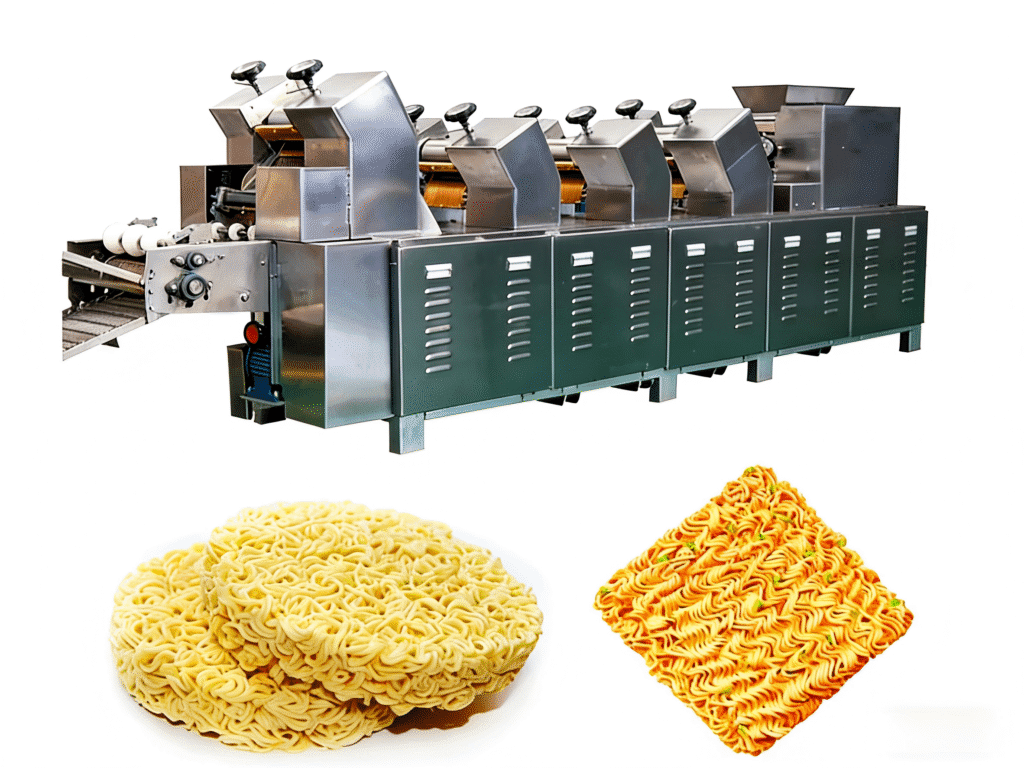
A complete fried instant noodle production line generally consists of several processing machines. Each machine performs a specific function to ensure consistent product quality and production efficiency.
9
The main equipment includes:
| Equipment | Main function |
|---|---|
| Flour mixer | Mixes wheat flour, water, salt, and other ingredients. |
| Dough resting equipment | Allows the dough to develop suitable properties. |
| Dough sheeting machine | Rolls dough into sheets with uniform thickness. |
| Noodle cutting machine | Cuts dough sheets into noodle strands. |
| Steaming machine | Gelatinizes the noodles before frying. |
| Noodle forming machine | Forms noodles into the required block shape. |
| Frying machine | Removes moisture and creates the characteristic fried noodle structure. |
| Cooling conveyor | Cools fried noodle blocks before packaging. |
| Seasoning and packaging equipment | Packs noodle blocks and seasoning ingredients. |
A well-designed production line can improve production efficiency, reduce manual labor, and maintain consistent product quality.
For investors, choosing appropriate machinery should be based on production capacity, factory space, energy consumption, automation requirements, and budget.
Small factories may choose semi-automatic equipment to control initial investment, while large manufacturers can consider fully automatic production lines to increase output and reduce operating costs.
7. Challenges Facing the Fried Instant Noodle Industry
Although the market has considerable potential, manufacturers should not overlook the challenges associated with producing and selling fried instant noodles.
7.1 Increasing Raw Material Costs
Wheat flour, edible oil, seasoning ingredients, packaging materials, electricity, and fuel are important production expenses.
Fluctuations in the prices of these materials can directly affect manufacturing costs and profit margins.
To manage this challenge, manufacturers should establish reliable supplier relationships, improve raw material purchasing strategies, and reduce unnecessary waste during production.
7.2 Intense Market Competition
The instant noodle market includes many established international brands and regional manufacturers.
New businesses may face difficulties competing with companies that already have strong brand recognition, extensive distribution networks, and large-scale production capabilities.
Small manufacturers should avoid competing only through low prices. Instead, they can focus on regional flavors, customized products, flexible production, and reliable product quality.
7.3 Food Safety and Quality Control
Food safety is essential for every instant noodle manufacturer.
During production, businesses must control raw material quality, processing temperatures, frying oil conditions, moisture content, packaging hygiene, and finished product storage.
Frying oil management deserves particular attention. Excessive oil temperature, prolonged use, and poor oil filtration can negatively affect product quality.
Factories should establish standardized operating procedures and conduct regular quality inspections to ensure that products meet applicable food safety requirements.
7.4 Changing Consumer Preferences
Some consumers are reducing their consumption of high-fat and high-sodium foods.
This trend creates pressure on traditional fried instant noodle products.
According to research on instant noodle technology, air-dried noodles provide a lower-fat alternative, while fried noodles retain advantages in their characteristic texture, flavor, and rehydration properties. Manufacturers therefore need to balance traditional product characteristics with changing nutritional expectations. ScienceDirect+1
8. Future Development Directions of Fried Instant Noodles
Looking ahead, the fried instant noodle industry is likely to develop in several important directions.
8.1 More Automated Production Lines
Automation will become increasingly important for manufacturers seeking higher production efficiency.
Modern production equipment can integrate dough mixing, rolling, cutting, steaming, frying, cooling, and packaging processes.
Automated temperature controls, production monitoring systems, and oil filtration equipment can help improve consistency and reduce dependence on manual operations.
For factories with growing production demand, investing in automation can improve long-term operational efficiency.
8.2 Improved Frying Technology
Frying is one of the most important stages in instant noodle manufacturing.
The frying process determines moisture removal, product structure, oil absorption, color, and final texture.
Future equipment development will focus on more accurate temperature control, uniform heat distribution, efficient oil circulation, and improved oil filtration.
Manufacturers will also pay greater attention to reducing energy consumption and maintaining stable frying conditions.
8.3 More Diverse Product Forms
Traditional rectangular noodle blocks will continue to be important, but product diversification can create additional opportunities.
Manufacturers may develop:
- Round instant noodle blocks.
- Curly instant noodles.
- Small snack-sized noodle portions.
- Large family-sized noodle packages.
- Different noodle thicknesses and textures.
- Specially designed noodles for cup packaging.
Different product formats can help brands reach more consumer groups and expand their sales opportunities.
8.4 Sustainable Production and Packaging
Environmental protection is becoming an important consideration in food manufacturing.
Fried instant noodle factories can explore energy-efficient frying systems, heat recovery technologies, better oil management, reduced packaging waste, and recyclable packaging materials where suitable.
These improvements can help reduce production costs while supporting more sustainable manufacturing practices.
8.5 A Combination of Traditional Taste and Modern Nutrition
Consumers do not necessarily want to sacrifice taste for healthier food.
Therefore, manufacturers should focus on improving nutritional characteristics without losing the familiar flavor and texture of fried instant noodles.
Potential developments include improved seasoning formulas, reduced-sodium products, fortified ingredients, and carefully optimized oil content.
Companies that successfully combine convenience, taste, affordability, and improved nutritional profiles may gain stronger market competitiveness.
9. Is It Worth Investing in a Fried Instant Noodle Factory Now?
For entrepreneurs considering entering the food processing industry, fried instant noodles remain a business opportunity worth evaluating.
The overall instant noodle market has a positive long-term outlook. Grand View Research estimates that the global instant noodle market will grow from approximately USD 57.3 billion in 2025 to USD 85.6 billion by 2035, representing an estimated compound annual growth rate of 4.1%. However, this forecast covers the broader instant noodle category rather than fried instant noodles alone. 大视野研究
Investors should consider several factors before making a decision.
First, choose the right target market. Conduct market research to understand local consumption habits, competitor products, pricing levels, and distribution channels.
Second, select suitable production equipment. The production line should match the expected output and available investment budget. Avoid purchasing excessive equipment before confirming market demand.
Third, develop competitive products. Differentiate products through flavor, noodle texture, packaging, and product positioning.
Fourth, establish reliable sales channels. Build relationships with supermarkets, wholesalers, distributors, convenience stores, and online retailers.
Finally, control production costs. Efficient equipment, stable raw material supplies, proper oil management, and standardized production procedures are essential for maintaining profitability.
Starting with a small or medium-sized production line and gradually expanding capacity can be a practical strategy for new investors.
10. Conclusion
The market prospects for fried instant noodles remain promising, supported by global demand for affordable convenience foods, established consumer habits, expanding retail channels, and continuous product innovation.
Asia continues to represent the industry’s most important consumption region, while Africa, Europe, and North America also provide opportunities for manufacturers with suitable products and marketing strategies.
Nevertheless, the industry is becoming more competitive. Consumers increasingly expect better flavors, improved nutritional characteristics, attractive packaging, and consistent product quality.
For manufacturers, future success will depend not only on increasing production capacity but also on developing innovative products, improving manufacturing technology, controlling costs, and understanding consumer demand.
For entrepreneurs planning to enter the food processing industry, investing in a fried instant noodle production line can be a worthwhile opportunity, provided that they conduct sufficient market research and prepare a realistic business plan.
The key to success is to combine reliable production equipment, competitive product quality, and effective market development.
Market data and further reading:


