
1. Introduction
With the continuous development of the pet food industry, dog food products are becoming increasingly diverse. In addition to nutritional value and ingredient quality, product appearance and shape have become important factors influencing consumer purchasing decisions. Traditional dog food is usually produced in small round or oval pellets, but modern manufacturing technology allows manufacturers to produce dog food in many different shapes, including bones, stars, hearts, rings, squares, triangles, and other customized designs.
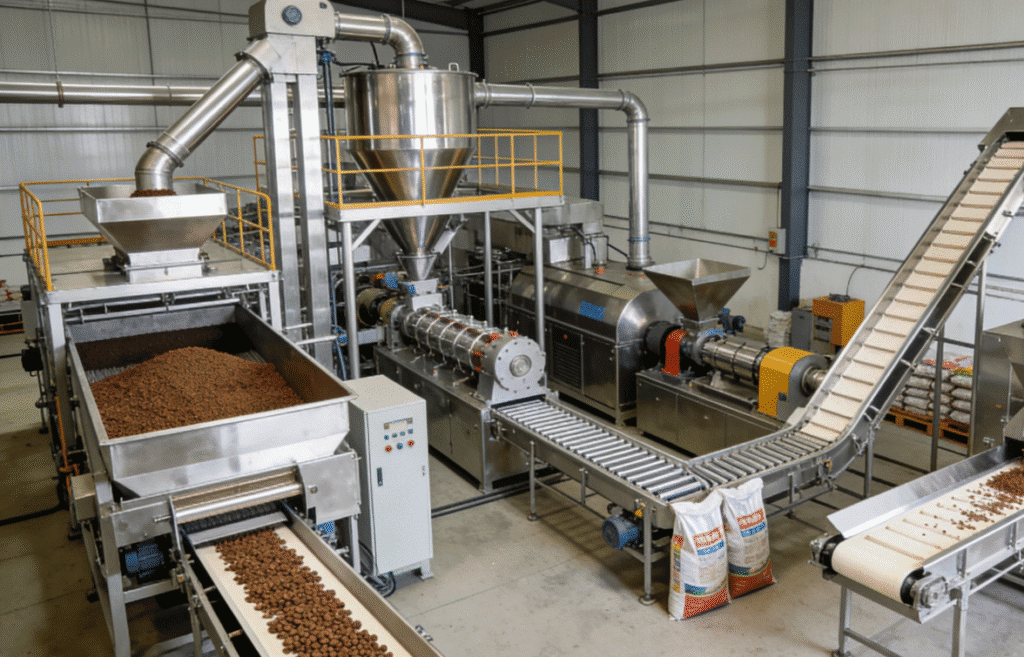
Different shapes can make dog food more attractive to pet owners and provide opportunities for product differentiation. Some shapes are also designed to accommodate different dog sizes, feeding habits, and product applications.
So, how can manufacturers produce dog food in different shapes? What machines are needed, and how should the production process be controlled?
This article explains the main shaping technologies, equipment, and production considerations for manufacturing dog food in various shapes.
2. Common Shapes of Dog Food
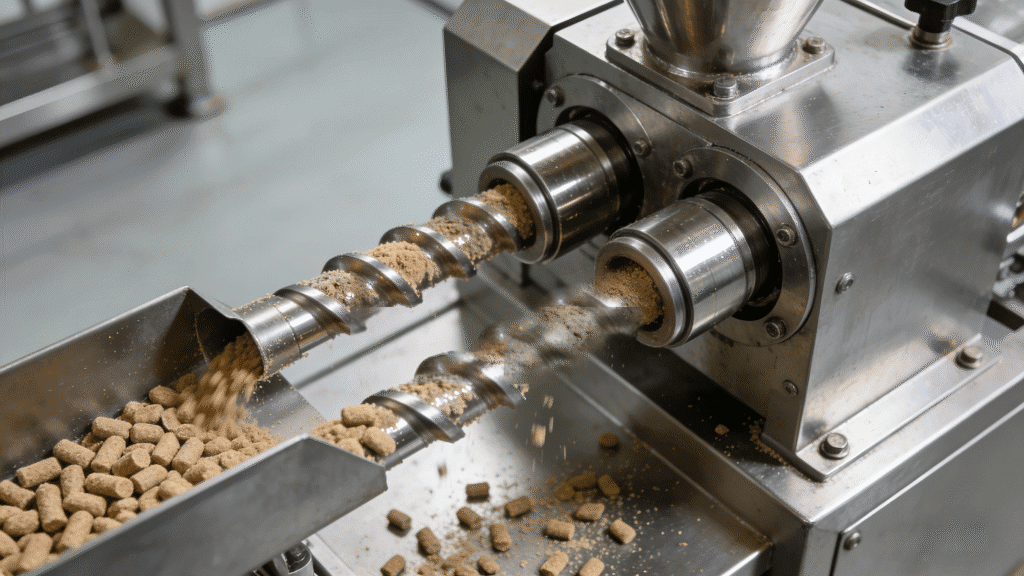
Before choosing production equipment, manufacturers should understand the common shapes available in the market.
2.1 Round Dog Food
Round kibble is one of the most common forms of dry dog food. Its simple shape makes it relatively easy to manufacture, transport, and package.
Round dog food is usually produced through extrusion. The extruded material passes through a die and is cut into small pieces by rotating blades.
2.2 Bone-Shaped Dog Food
Bone-shaped dog food is popular in the pet food market because its appearance resembles a real bone.
This shape is commonly used for dog biscuits and treats. Manufacturers can produce it using specialized molds or forming machines.
2.3 Star-Shaped Dog Food
Star-shaped dog food has an attractive appearance and can help manufacturers distinguish their products from conventional kibble.
Specially designed extrusion dies or molding equipment can be used to produce this shape.
2.4 Ring-Shaped Dog Food
Ring-shaped dog food features a hollow center and a distinctive appearance.
The shape can be produced using specially designed extrusion dies. Manufacturers need to control dough expansion and cutting conditions to maintain a consistent hollow structure.
2.5 Square and Rectangular Dog Food
Square and rectangular kibble is relatively simple to manufacture using suitable dies and cutting systems.
These shapes are often used in dry dog food and mixed-kibble products.
2.6 Customized Shapes
In addition to conventional shapes, manufacturers can develop customized products according to market demand.
Examples include:
- Heart-shaped dog food
- Star-shaped dog food
- Triangle-shaped kibble
- Flower-shaped dog food
- Small pillow-shaped kibble
- Multi-colored combination shapes
Customized shapes can help brands develop recognizable product identities and attract specific consumer groups.
3. How Does the Dog Food Extrusion Process Create Different Shapes?
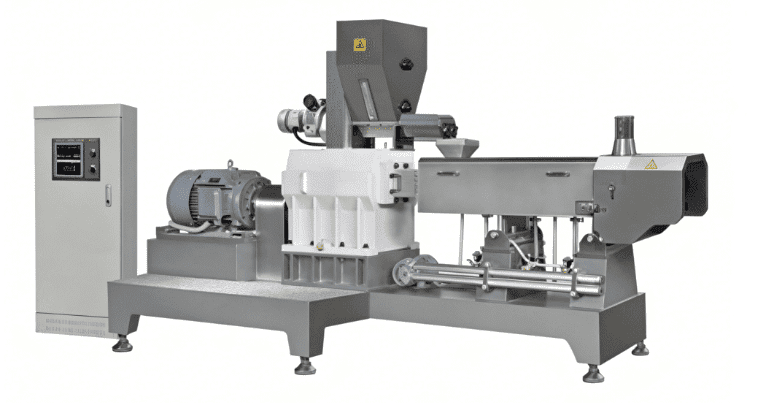
Extrusion is one of the most widely used technologies for producing different shapes of dry dog food.
The basic principle is to mix powdered raw materials with water and steam, then process the mixture under controlled temperature, pressure, and mechanical shear inside an extruder.
The cooked material is forced through a specially designed die. As it exits the die, a cutting system cuts it into individual pieces.
By changing the die design and cutting conditions, manufacturers can produce dog food in different shapes and sizes.
Main Factors Affecting Dog Food Shape
1. Die Design
The die is one of the most important components affecting the final shape of dog food.
Different die openings create different product cross-sections. For example:
- Circular openings produce round or cylindrical products.
- Square openings produce square or rectangular products.
- Specially shaped openings produce customized cross-sections.
- Multi-opening dies can increase production output.
For more complex three-dimensional shapes, additional forming or molding equipment may be required.
2. Cutting Blade Design
The cutting blade determines the length of extruded dog food.
By adjusting blade speed and the distance between cutting edges, manufacturers can produce short, long, or relatively uniform pieces.
The cutting speed should be coordinated with extrusion output to prevent irregular shapes.
3. Raw Material Formula
The raw material formula affects dough viscosity, expansion, hardness, and structural stability.
Ingredients such as starch, protein, fat, and fiber influence the extrusion process.
A suitable formulation helps maintain the desired shape after extrusion and drying.
4. Moisture Content
Moisture content influences material flow and expansion inside the extruder.
If the moisture content is too high or too low, the finished product may have inconsistent dimensions or an undesirable structure.
Therefore, manufacturers need to adjust water and steam addition according to the formula and equipment requirements.
5. Extrusion Temperature and Pressure
Temperature and pressure influence cooking, expansion, and product structure.
Unstable processing conditions can result in irregular shapes, excessive expansion, or product deformation.
Consistent operating conditions are essential for producing uniform dog food.
4. Main Processing Steps for Producing Different Shapes of Dog Food
Although different dog food shapes may require different dies or forming equipment, the basic production process for extruded dry dog food is generally similar.
Step 1: Raw Material Preparation
First, manufacturers need to select suitable ingredients according to the nutritional requirements of the finished product.
Common ingredients include:
- Corn and wheat
- Rice and other cereals
- Chicken meal
- Fish meal
- Meat and animal protein ingredients
- Vegetable protein
- Oils and fats
- Vitamins and minerals
- Other functional nutritional ingredients
The quality of raw materials directly affects the nutritional composition, processing performance, and final quality of dog food.
Step 2: Grinding
\
The selected raw materials are fed into a grinder and processed into particles of a suitable size.
Uniform particle size helps improve mixing efficiency and supports stable extrusion.
Manufacturers should select appropriate grinding screens according to the formulation and production requirements.
Step 3: Mixing

After grinding, different ingredients are transferred into a mixing machine.
The mixer combines the raw materials according to the predetermined formula.
Uniform mixing is important because it ensures that each piece of dog food contains the intended proportions of ingredients and nutrients.
Step 4: Conditioning
Before extrusion, the mixed materials enter a conditioning system.
Steam and water are added to adjust the temperature and moisture content of the mixture.
Proper conditioning improves material processing performance and supports more consistent cooking inside the extruder.
Step 5: Extrusion and Shaping
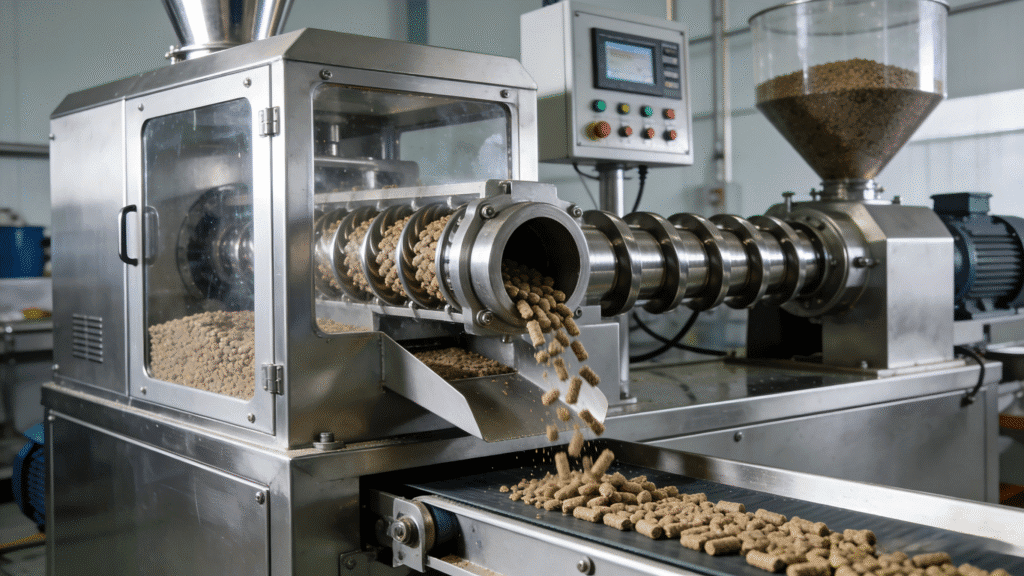
This is the most important stage for producing different dog food shapes.
The conditioned mixture enters the extruder, where it is cooked under controlled conditions.
The material is then forced through a specially designed die. A cutting blade positioned near the die outlet cuts the extruded material into individual pieces.
To produce different shapes, manufacturers can replace the die or adjust the forming equipment.
For example, a circular die can produce round kibble, while specially designed dies can create stars, rings, and other cross-sectional shapes.
Step 6: Drying
Freshly extruded dog food generally contains more moisture than the finished product should have.
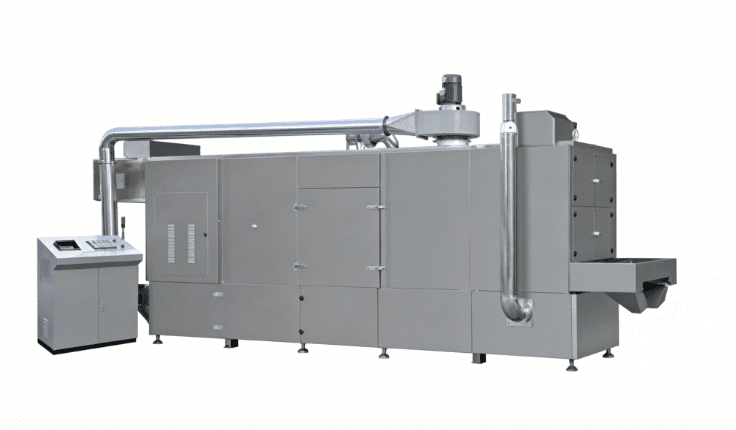
Therefore, it needs to pass through a drying system to remove excess moisture.
Drying temperature, airflow, residence time, and product loading must be carefully controlled.
Uneven drying can cause inconsistent hardness, cracking, deformation, or poor storage stability.
Step 7: Coating and Flavoring
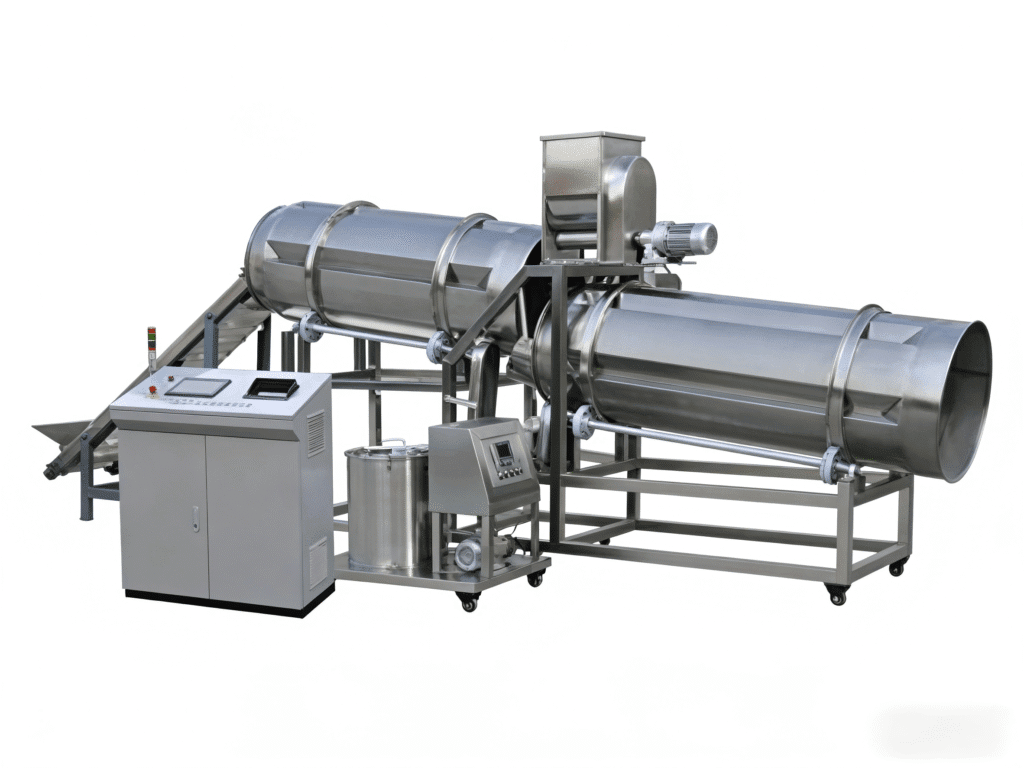
After drying, the dog food can enter a coating machine.
Oils, fats, palatants, and selected nutritional ingredients may be applied to improve flavor and palatability.
The coating process should be uniform to ensure consistent product quality.
Step 8: Cooling and Packaging
Before packaging, the finished dog food should be cooled to an appropriate temperature.
This helps prevent condensation inside packaging and protects product quality.
Finally, the products are weighed and packed using automatic packaging equipment.
5. How to Produce Special-Shaped Dog Food
If manufacturers want to produce more distinctive dog food shapes, they need to select appropriate forming technologies.
5.1 Using Customized Extrusion Dies
Customized extrusion dies are a practical solution for producing many types of dry dog food.
Manufacturers can design different die openings according to their product requirements.
The main advantages include:
- Easy replacement of dies.
- Flexible product design.
- Compatibility with suitable extrusion systems.
- Ability to produce different cross-sectional shapes.
- Suitable for continuous industrial production.
However, the die design must match the material characteristics and extrusion equipment.
5.2 Using Molding Machines
For dog biscuits and certain specialized treats, molding machines are more suitable.
The prepared dough is pressed into molds with different patterns and shapes.
Manufacturers can use customized molds to produce bones, hearts, stars, and other decorative products.
Molding technology is particularly useful when the product requires a defined three-dimensional shape rather than a simple extruded cross-section.
5.3 Using Different Cutting Systems
Cutting equipment also plays an important role in dog food shaping.
Different blade configurations, cutting speeds, and forming arrangements can influence the final product dimensions.
For example, manufacturers can adjust cutting conditions to produce longer or shorter kibble.
For more complicated shapes, a dedicated forming and cutting system may be necessary.
6. What Equipment Is Needed to Produce Different Shapes of Dog Food?
The required equipment depends on the selected production method.
For a conventional extruded dry dog food production line, the main equipment includes:
| Equipment | Main Function |
|---|---|
| Grinder | Reduces raw materials to suitable particle sizes |
| Mixer | Blends ingredients uniformly |
| Conditioner | Adjusts moisture and temperature |
| Extruder | Cooks and forms the dog food |
| Customized die | Determines the product cross-section |
| Cutting machine | Controls product length |
| Dryer | Removes excess moisture |
| Coating machine | Applies oils and flavorings |
| Cooler | Reduces product temperature |
| Packaging machine | Weighs and packages finished products |
For baked dog biscuits, additional equipment may include dough mixers, sheeters, molding machines, cutting equipment, and industrial ovens.
Manufacturers should select the equipment configuration according to their product designs, required capacity, and investment budget.
7. Important Considerations When Producing Dog Food in Different Shapes
Producing different shapes is not simply a matter of changing the extrusion die. Manufacturers must also consider product quality, processing stability, and nutritional consistency.
7.1 Maintain Consistent Product Dimensions
Products with different dimensions may require different cooking and drying conditions.
Manufacturers should regularly inspect the product shape, length, thickness, and weight.
7.2 Prevent Shape Deformation
If the product is too soft after extrusion, it may become deformed during transportation or drying.
Appropriate formulation, moisture control, die design, and drying conditions help maintain product structure.
7.3 Control Expansion
Excessive expansion can cause irregular shapes, large pores, and fragile products.
Insufficient expansion may result in dense and hard kibble.
Manufacturers should adjust the formulation and extrusion parameters to achieve the required product structure.
7.4 Ensure Uniform Drying
Different shapes and sizes have different drying characteristics.
Thicker products may require longer drying times than smaller pieces.
Manufacturers should validate the drying process for each product type instead of applying identical conditions to every shape.
7.5 Maintain Nutritional Consistency
Changing the product shape should not compromise the nutritional formula.
Manufacturers need to ensure that the finished products meet the intended nutritional specifications, including protein, fat, fiber, vitamins, and minerals.
7.6 Pay Attention to Dog Size and Feeding Habits
Dog food shapes and sizes should be appropriate for the intended animal.
Small dogs generally need kibble that is easy to pick up and chew, while larger dogs may be able to handle larger pieces.
The product’s hardness, size, and texture should be evaluated through appropriate product testing.
8. How to Choose the Right Dog Food Shaping Equipment
Choosing suitable equipment is essential for manufacturers who want to develop multiple dog food products.
Before purchasing machinery, consider the following factors:
Product variety: Determine whether you plan to produce conventional round kibble, customized shapes, baked biscuits, or multiple product categories.
Production capacity: Select machinery according to your expected hourly output and future expansion plans.
Die replacement: If you plan to frequently change product shapes, choose an extrusion system that supports convenient die replacement.
Automation level: Automated feeding, cutting, drying, and packaging systems can reduce manual labor and improve production consistency.
Equipment materials: Food-contact components should use suitable food-grade materials and be designed for effective cleaning.
After-sales service: Reliable technical support, spare parts, installation, and operator training are important for maintaining stable production.
9. Conclusion
Producing dog food in different shapes is an effective way for manufacturers to diversify their products and develop a recognizable brand identity.
With modern extrusion technology, customized dies, cutting systems, and molding machines, manufacturers can produce round, square, star-shaped, ring-shaped, bone-shaped, and many other types of dog food.
Among these technologies, extrusion is particularly suitable for large-scale dry dog food production because it offers high efficiency, flexible shaping options, and good automation potential.
However, successful production requires more than suitable shaping equipment. Raw material formulation, moisture control, extrusion parameters, drying conditions, and quality inspection all influence the final product.
By selecting the right processing technology and optimizing every production stage, dog food manufacturers can develop attractive, nutritious, and consistent products to meet the changing demands of the pet food market.


