
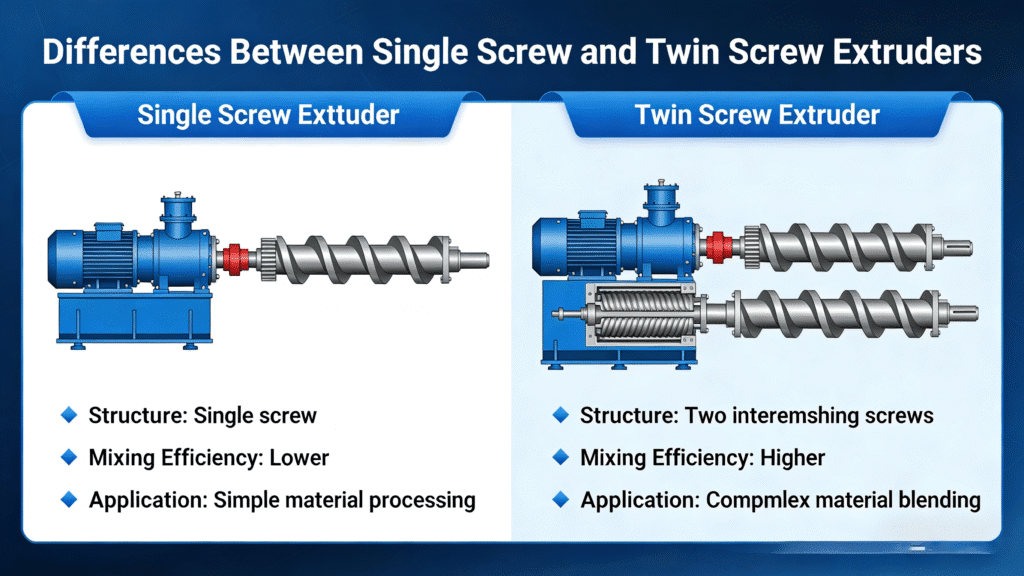
A twin-screw extruder is one of the most important pieces of equipment in modern food processing, pet food production, fish feed manufacturing, and industrial extrusion. Compared with a single-screw extruder, it uses two intermeshing screws to transport, mix, compress, cook, and extrude raw materials. This design provides better mixing performance, more stable material transportation, and greater flexibility in processing different formulations.
However, to understand how a twin-screw extruder works and how to operate and maintain it properly, it is essential to know its main components and their functions.
So, what are the main components of a twin-screw extruder? Let’s take a closer look.
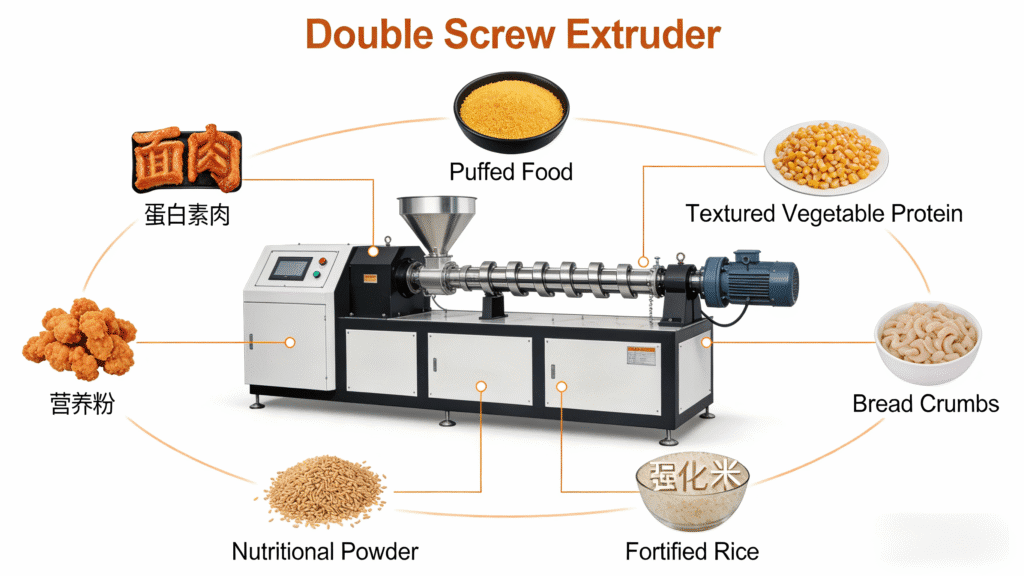
1. Feeding System
The feeding system is responsible for delivering raw materials into the extrusion chamber at a controlled and consistent rate. It is usually composed of a feeding hopper, feeder, and feeding mechanism.
The hopper stores the prepared raw materials, while the feeder controls the amount of material entering the machine. Depending on the production requirements, manufacturers may use screw feeders or other metering devices.
A stable feeding system is essential for maintaining consistent production. puff extruder machine If the feeding rate fluctuates, it may cause uneven cooking, unstable extrusion pressure, and inconsistent product quality.
For example, in dog food and fish feed production, accurate feeding helps maintain the nutritional composition and physical characteristics of the final products.
2. Twin Screws
The twin screws are the core components of a twin-screw extruder. They are installed inside the barrel and rotate together to transport and process raw materials.
Depending on the machine design, the screws can be co-rotating or counter-rotating. In many food extrusion applications, co-rotating intermeshing screws are commonly used because they provide effective mixing and material transportation.
The screws generally consist of several functional sections:
- Feeding section: Receives raw materials and transports them forward.
- Compression section: Gradually compresses the materials and increases pressure.
- Mixing section: Blends ingredients and distributes moisture, heat, and additives evenly.
- Cooking section: Uses mechanical energy and heat to cook and gelatinize the materials.
- Metering section: Helps stabilize the material flow and extrusion pressure before discharge.
Twin-screw extruders often use modular screw elements, allowing operators to adjust the screw configuration according to different raw materials and production requirements.

3. Extrusion Barrel
The barrel is the housing surrounding the twin screws.puff extruder machine It provides the enclosed processing space where raw materials are transported, mixed, compressed, and cooked.
The barrel is generally manufactured from high-strength, wear-resistant metal to withstand high temperatures, pressure, friction, and continuous operation.
Many industrial twin-screw extruders use segmented barrel designs. This allows different barrel sections to perform specific processing functions.
The barrel also works with the heating and cooling systems to maintain the required temperature in different processing zones.
Proper barrel maintenance is important because excessive wear can reduce processing efficiency, affect extrusion pressure, and increase energy consumption.
4. Heating and Cooling System
Temperature control is essential for successful extrusion. The heating and cooling system helps maintain the appropriate processing temperature throughout the extrusion process.
Common heating methods include electric heating and steam heating, depending on the machine design.
The heating system raises the barrel temperature to help cook raw materials, soften starches, and improve ingredient processing.
The cooling system prevents excessive temperatures from damaging the materials or affecting product quality. puff extruder machine Some machines use water circulation through cooling channels to regulate barrel temperature.
For products such as breakfast cereals, puffed snacks, dog food, and fish feed, accurate temperature control helps determine expansion, texture, density, and final moisture characteristics.
5. Main Drive System
The main drive system provides the mechanical power required to rotate the two screws. It usually consists of an electric motor, gearbox, coupling, and related transmission components.
The electric motor generates the power, while the gearbox reduces the motor speed and increases the torque required for extrusion.
The drive system must provide sufficient torque to process materials with different moisture levels, viscosities, and formulations.
A reliable drive system ensures stable screw rotation and helps prevent production interruptions caused by insufficient power or mechanical failure.
6. Die and Molding System
The die is installed at the discharge end of the extruder. It determines the shape and size of the material as it exits the machine.
When cooked materials pass through the die under pressure, they experience a sudden pressure drop. This can cause moisture to evaporate rapidly and the product to expand.
Different die designs can produce different product shapes, including:
- Round pellets
- Rings
- Tubes
- Strips
- Balls
- Specially shaped snacks
For dog food and fish feed production, the die can be customized to produce different pellet diameters and shapes.
The die is therefore an important component when manufacturers need to develop multiple product varieties using the same extrusion line.
7. Cutting System
The cutting system is usually installed directly after the die. Its main function is to cut continuously extruded materials into products of the required length.
It generally consists of a cutting motor, rotating blades, blade holder, and speed adjustment mechanism.
By adjusting the cutter speed, manufacturers can control product length. A higher cutting speed generally produces shorter pieces, while a lower speed produces longer pieces, assuming the extrusion output remains unchanged.
For example, in pet food production, the cutting system helps produce uniform kibble sizes. In puffed snack production, it creates consistent product lengths and improves product appearance.
Regular inspection and sharpening of the blades help ensure clean cutting and reduce product waste.
8. Control System
The control system is responsible for monitoring and adjusting the operating parameters of the twin-screw extruder.
Modern machines commonly use a PLC control system combined with a touchscreen interface.
Operators can monitor and adjust parameters such as:
- Screw rotation speed
- Feeding speed
- Barrel temperature
- Motor current
- Extrusion pressure
- Cutting speed
- Heating and cooling conditions
An advanced control system makes the production process easier to manage and improves operational consistency.
It also helps operators identify abnormal operating conditions and respond quickly to potential problems.
9. Lubrication System
The lubrication system supplies lubricant to important mechanical components, particularly the gearbox, bearings, and transmission parts.
Its primary purpose is to reduce friction, minimize mechanical wear, and prevent overheating.
Proper lubrication helps extend equipment service life and maintain stable machine operation.
Operators should follow the manufacturer’s recommendations regarding lubricant type, replacement intervals, and maintenance procedures.
Insufficient lubrication may cause excessive heat, abnormal noise, and premature mechanical damage.
10. Safety Protection System
Safety protection components are essential for ensuring safe equipment operation.
A twin-screw extruder may include:
- Emergency stop buttons
- Motor overload protection
- Temperature alarms
- Pressure monitoring devices
- Protective covers
- Electrical safety interlocks
These devices help prevent accidents and protect operators and equipment from abnormal operating conditions.
Before starting production, operators should inspect safety devices and ensure that all protective covers are correctly installed.
How Do These Components Work Together?
Although each component has a different function, all components must work together to complete the extrusion process.
The basic working sequence is as follows:
- Raw materials enter the feeding hopper.
- The feeding system delivers materials into the extrusion barrel.
- The twin screws transport, mix, compress, and cook the materials.
- The heating and cooling systems regulate processing temperatures.
- The main drive system provides the power needed for screw rotation.
- The cooked materials pass through the die and form the desired product shape.
- The cutting system cuts the extruded materials into uniform pieces.
- The control system monitors and adjusts the entire operation.
After extrusion, products usually enter subsequent processing stages, such as drying, cooling, seasoning, coating, or packaging, depending on the product type.
How to Maintain the Main Components of a Twin-Screw Extruder
Regular maintenance is essential for improving equipment performance and extending its service life.
Here are several important maintenance practices:
1. Clean the screws and barrel regularly.
Remove residual materials after production to prevent buildup, contamination, and blockages. Follow the manufacturer’s cleaning procedures.
2. Inspect screw elements for wear.
Check screw flights and mixing elements regularly. Replace severely worn components to maintain effective mixing and extrusion performance.
3. Check the gearbox and lubrication system.
Monitor lubricant levels, inspect for leakage, and replace lubricants according to the recommended maintenance schedule.
4. Inspect the heating and cooling systems.
Check temperature sensors, heating elements, cooling channels, and water circulation to ensure accurate temperature control.
5. Maintain the die and cutting blades.
Clean the die openings and inspect cutting blades regularly. Replace damaged or blunt blades when necessary.
6. Check electrical and control systems.
Inspect wiring, sensors, motors, and control panels to identify potential problems before they interrupt production.
Conclusion
A twin-screw extruder consists of several important components, including the feeding system, twin screws, extrusion barrel, heating and cooling system, main drive system, die, cutting system, control system, lubrication system, and safety protection system.
Each component plays an essential role in ensuring stable material transportation, effective mixing, uniform cooking, and consistent product formation.
Understanding these components helps manufacturers select suitable extrusion equipment, improve production efficiency, reduce maintenance costs, and manufacture high-quality products.
Whether you are planning to establish a puffed snack factory, dog food processing plant, or fish feed production facility, choosing a reliable twin-screw extruder with a well-designed structure is an important step toward successful production.


