
Introduction
Corn puffed snacks are among the most popular products in the modern snack food industry. They are known for their light weight, crispy texture, attractive shapes, and wide variety of flavors. Depending on the formulation and manufacturing method, corn puffed snacks can be produced as curls, balls, tubes, rings, sticks, or other customized shapes.
Behind these products is a series of carefully controlled manufacturing operations involving raw material preparation, mixing, extrusion cooking, shaping, drying or frying, seasoning, cooling, and automatic packaging.
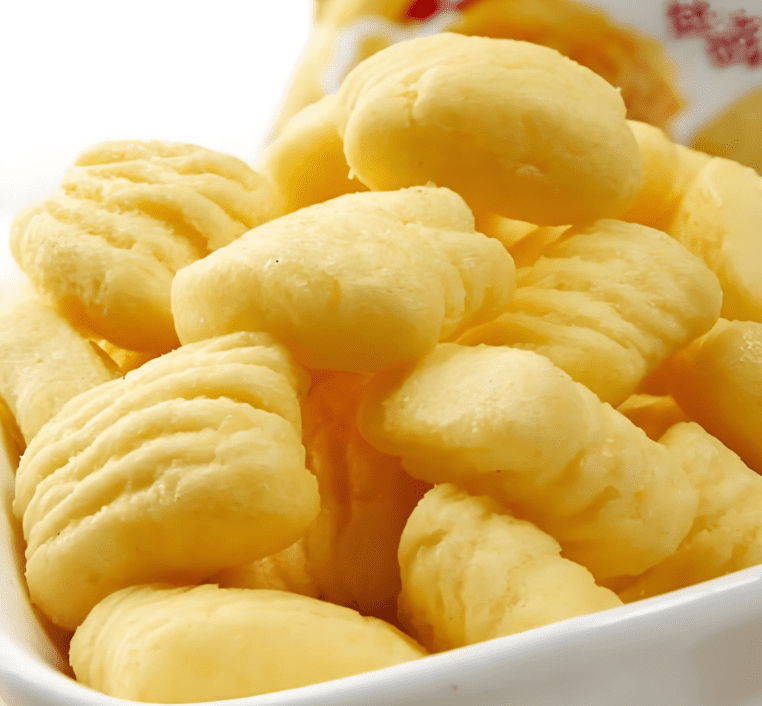
Modern corn puffing production lines use advanced extrusion technology to transform corn-based ingredients into expanded snack products. By controlling moisture, temperature, pressure, and mechanical energy, manufacturers can produce snacks with consistent texture, shape, and flavor.
This article explains the complete processing flow of corn puffed snacks, introduces the main machines used at each stage, and describes the key factors that affect product quality and production efficiency.
1. Raw Material Selection and Preparation
The first step in producing corn puffed snacks is selecting suitable raw materials.
Cornmeal or corn grits are the primary ingredients in many conventional corn puffed snacks. Depending on the desired product characteristics, manufacturers may also use rice flour, wheat flour, tapioca starch, potato starch, or other cereal and starch ingredients.
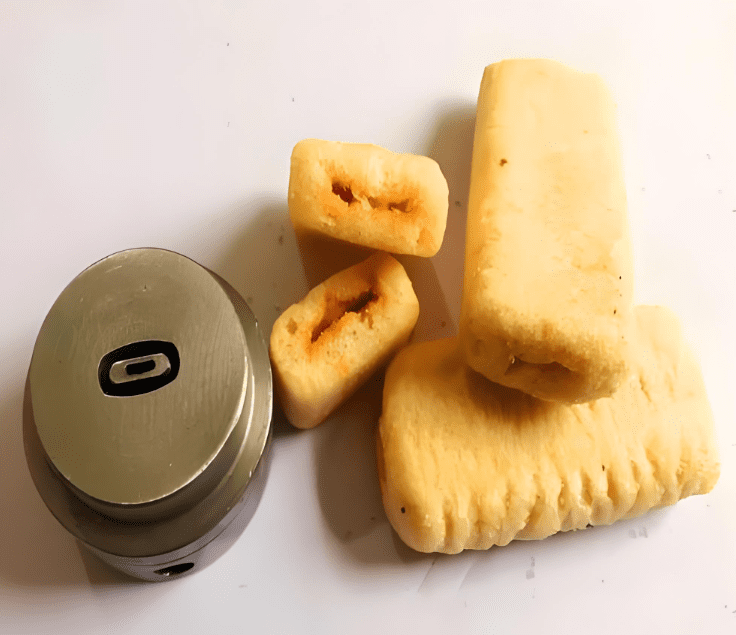
Common raw materials include:
- Cornmeal or corn grits
- Rice flour or other cereal flours, when required
- Food-grade starches
- Water
- Salt and other formulation ingredients
- Edible oil and seasoning ingredients, generally applied at later stages
The particle size and quality of cornmeal have a significant influence on the extrusion process. Excessively coarse particles may produce uneven hydration, corn puffs extruder while an unsuitable particle-size distribution can affect expansion and texture.
Raw materials should be inspected to ensure that they meet the factory’s quality specifications. Foreign materials should be removed through appropriate cleaning and screening equipment.
Proper raw material preparation provides a stable foundation for the entire production process.
2. Automatic Weighing and Ingredient Mixing
After raw material inspection, the ingredients are weighed according to the product formulation.
For industrial production, an automatic batching system can improve weighing accuracy and reduce manual handling. The measured ingredients are then transferred to a mixer.
The dry ingredients are blended until their composition is sufficiently uniform. This step helps ensure that each portion of the mixture has consistent starch content and processing characteristics.
The formulation depends on the target product. For example, a simple corn puff may contain a high proportion of corn-based ingredients, while a multigrain snack may contain several types of cereal flour and starch.
The ingredient ratio must be optimized according to the desired expansion rate, density, crispness, flavor, and processing stability.

3. Moisture Addition and Conditioning
Water is added to the dry mixture to achieve the appropriate moisture content for extrusion.
This is a critical step because moisture affects starch gelatinization, material flow, pressure development, and product expansion.
If the mixture is too dry, it may require excessive mechanical energy and can produce unstable extrusion. If it contains too much moisture, expansion may be reduced and the finished product may require additional drying.
A suitable mixing or conditioning system distributes moisture throughout the raw materials as uniformly as possible.
Depending on the production line, the conditioned mixture may be transferred directly to the extruder or held for a specified period to improve moisture uniformity.
Consistent moisture control helps reduce product defects and makes the extrusion process easier to stabilize.
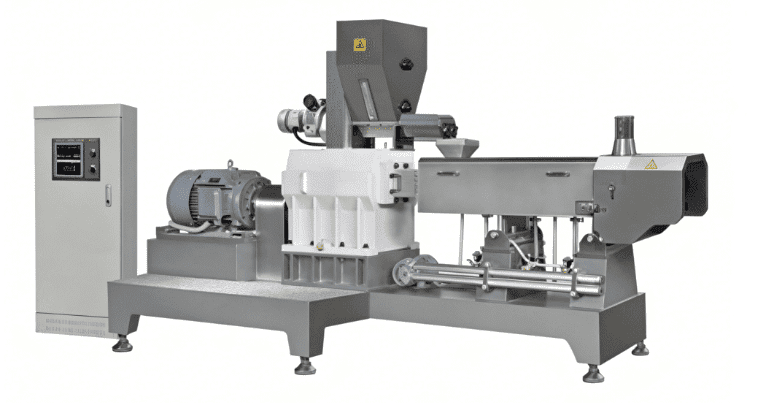
4. Extrusion Cooking: The Core of Corn Puff Production
Extrusion cooking is the central processing stage in many corn puffed snack production lines.
The conditioned mixture enters an industrial extruder, where rotating screws convey, mix, compress, and process the material inside a heated barrel.
During extrusion, the material is exposed to a combination of heat, pressure, shear, and mechanical energy. These conditions cause physical and structural changes in the starch-based ingredients.
The starch gelatinizes, and the material becomes a plasticized, cohesive mass that can flow through the extrusion die.
The main functions of the extruder include:
- Conveying and mixing the raw materials
- Applying mechanical energy and heat
- Developing the required material consistency
- Cooking and transforming the starch-based mixture
- Building the pressure needed for expansion at the die
The processing conditions depend on the formulation and the type of extruder. Screw speed, barrel temperature, feed rate, moisture content, and die design must be coordinated to obtain the desired product characteristics.
Why does corn puff when it leaves the extruder?
Inside the extruder, the material is processed under elevated pressure. corn puffs extruder When it exits through the die, the pressure drops rapidly.
Some of the water in the hot material vaporizes, creating bubbles within the softened matrix. These bubbles expand, forming a porous structure.
As the product cools and its structure sets, the expanded material becomes light and crispy.
This rapid pressure release is the fundamental physical mechanism behind many extruded puffed snacks.
5. Die Forming and Cutting
At the end of the extruder, the processed material passes through a specially designed die.
The die determines the initial cross-sectional shape of the product. corn puffs extruder Different die designs can produce tubes, rings, sticks, curls, and other shapes.
A cutting system positioned near the die separates the extruded material into individual pieces. Depending on the equipment configuration, the cutter may use rotating blades or another synchronized cutting mechanism.
The product’s final shape is influenced by several factors:
- Die opening geometry
- Raw material formulation
- Moisture content
- Extrusion pressure and temperature
- Cutting speed
- Material expansion behavior
For example, a ring-shaped product requires a suitable die opening, while a curl-shaped product depends on the interaction between the die design, material flow, expansion, and cutting conditions.
Accurate control of the extrusion rate and cutting speed helps maintain consistent product length and reduce waste.
6. Drying or Frying
After extrusion and cutting, the puffed snacks may require additional moisture removal or surface treatment.
The exact processing method depends on the product formulation and the intended texture.
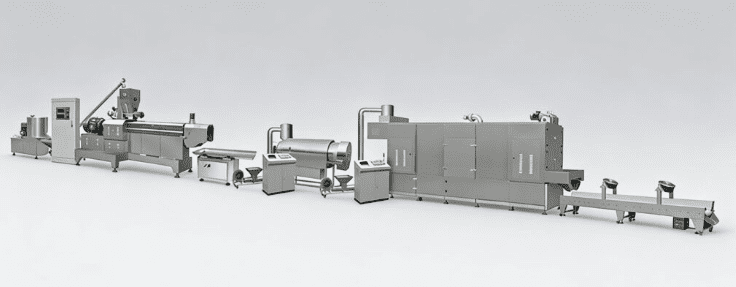
Option A: Hot-air drying
Some corn puffed snacks pass through a continuous hot-air dryer after extrusion.
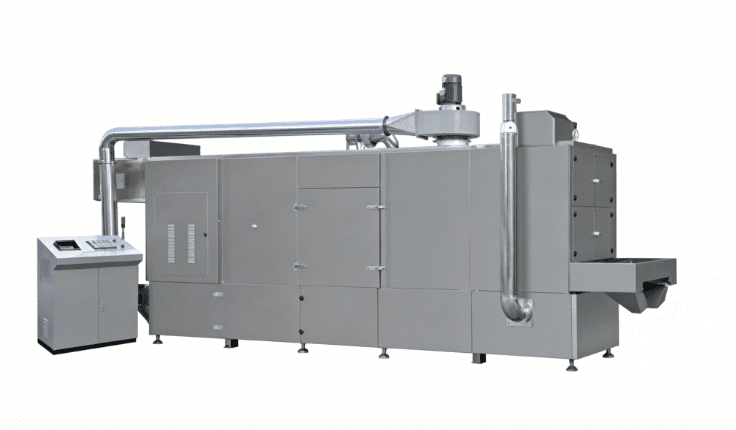
The dryer removes excess moisture and helps stabilize the expanded structure. Temperature, airflow, and residence time must be controlled to achieve the target moisture content without causing excessive browning or damaging the product.
Drying is particularly important when the extruded material contains more moisture than is suitable for the finished snack.
Option B: Frying
Other products are fried in hot edible oil to develop their final texture and flavor.
During frying, moisture evaporates and the product’s surface and internal structure change. Oil absorption, color, crispness, and flavor depend on the formulation and frying conditions.
The oil temperature, frying time, product size, and initial moisture content must be controlled carefully.
Which method is better?
Neither method is universally better. Hot-air drying and frying can produce different textures, flavors, and nutritional profiles.
The appropriate choice depends on the desired product, the equipment available, the target fat content, and the required production economics.
Some manufacturing systems also combine multiple heating or drying stages.
7. Seasoning and Flavor Coating
After the snacks reach the appropriate texture, they are transferred to a seasoning system.

A typical seasoning line consists of a feeding conveyor, an oil spraying system where required, a rotating seasoning drum, and a powder-dosing device.
A controlled amount of edible oil may be sprayed onto the product surface to help seasoning ingredients adhere.
The snacks then enter the seasoning drum, where they tumble while the seasoning mixture is distributed across their surfaces.
Popular flavor options include:
- Cheese
- Barbecue
- Tomato
- Spicy chili
- Sour cream and onion
- Salted corn
- Sweet or other specialty flavors
The seasoning formulation may contain salt, spices, flavorings, sugar, acidity regulators, and other permitted food ingredients.
Uniform seasoning is essential for consistent taste. Too little coating may result in weak flavor, while excessive seasoning can increase costs and create uneven product appearance.
The seasoning system must also be adjusted to avoid excessive breakage of the expanded snacks.
8. Cooling and Product Stabilization
After seasoning, the snacks are cooled before packaging.
Cooling conveyors allow air to circulate around the product and reduce its temperature to a suitable level for downstream handling.
This stage is important because packaging hot snacks can create condensation or other moisture-related problems under unsuitable conditions.
Moisture absorption can reduce crispness and shorten the product’s acceptable storage life.
Cooling also helps stabilize the product before it enters the weighing and packaging equipment.
The cooling area should be designed to minimize contamination, excessive handling, and product breakage.
9. Quality Control and Inspection
Quality control is necessary throughout the entire manufacturing process.
A corn puffed snack production line should monitor raw materials, processing conditions, intermediate products, and finished goods.
Important quality indicators include:
Appearance and shape: Products should have consistent dimensions, acceptable color, and no excessive deformation.
Expansion and density: The product should achieve the intended volume, structure, and weight characteristics.
Texture: The snacks should have the required crispness without being excessively hard or fragile.
Moisture content: Final moisture should meet the established product specification.
Seasoning distribution: Flavor coating should be sufficiently uniform across the batch.
Foreign material control: Suitable screening, metal detection, X-ray inspection, or other validated methods should be applied as appropriate.
Package integrity: Finished packages should meet the required sealing and weight specifications.
Factories should also maintain sanitation procedures, traceability records, allergen controls where applicable, and appropriate food-safety management systems.
Regular quality checks help manufacturers identify problems early, reduce waste, and maintain consistent product standards.
10. Automatic Weighing and Packaging
Packaging is the final stage of the production process.
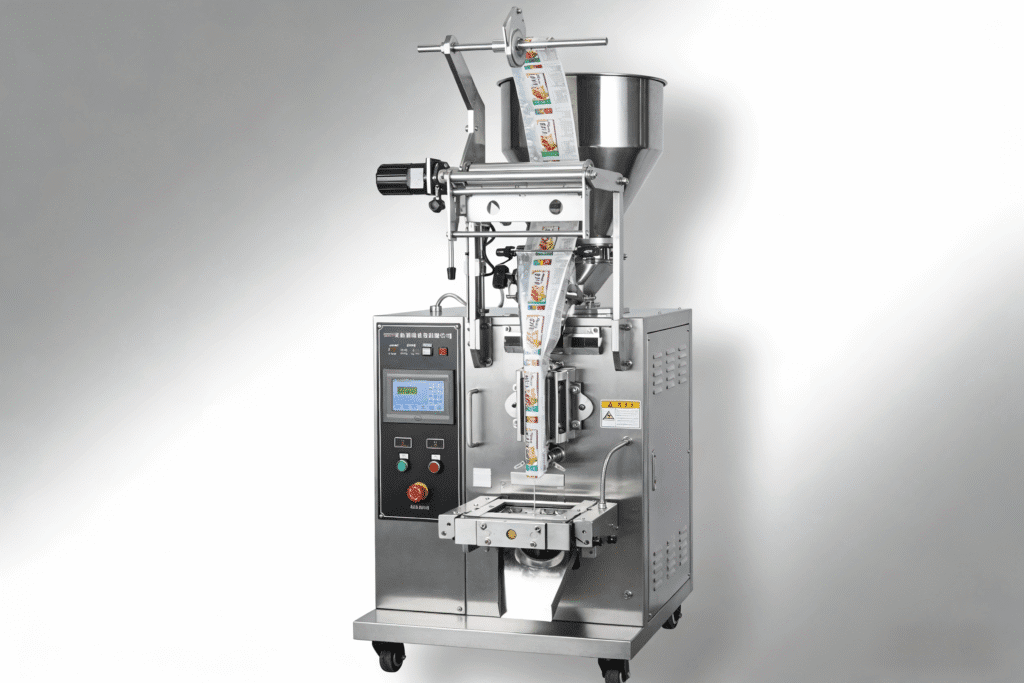
The finished snacks are conveyed to an automatic weighing system, which measures the required quantity for each package.
A typical packaging line includes:
- Product feeding conveyor
- Multihead weigher or another suitable dosing system
- Vertical form-fill-seal packaging machine
- Heat-sealing mechanism
- Date and batch coding system
- Finished-package inspection equipment
The packaging machine forms bags from a roll of packaging film, fills them with the measured product, and seals them.
Packaging material selection is important because corn puffed snacks are sensitive to moisture. Suitable barrier properties help preserve crispness during storage and distribution.
Depending on the product’s fat content, formulation, and shelf-life requirements, oxygen protection may also be important.
Finished packages are checked for weight accuracy, seal integrity, correct coding, and label compliance before being packed into cartons.
11. Storage and Transportation
After packaging, the finished products are transferred to the warehouse.
Corn puffed snacks should be stored in a clean, dry environment under the conditions specified by the manufacturer.
High humidity may cause the snacks to absorb moisture and lose their crispness. Excessive heat can also affect seasoning oils and product flavor.
During transportation, cartons should be protected from crushing, moisture, and rough handling.
Appropriate packaging, validated shelf-life testing, and suitable storage conditions help maintain the product’s quality until it reaches the consumer.
12. Main Equipment Required for a Corn Puffed Snack Production Line
The equipment configuration depends on the desired output, product shape, formulation, and processing method.
A typical production line may contain the following machines:
| Equipment | Main Function |
|---|---|
| Raw material sifter | Removes lumps and unwanted particles |
| Automatic weighing system | Measures ingredients according to the formula |
| Flour mixer | Blends dry ingredients uniformly |
| Moisture conditioning system | Adjusts and distributes moisture |
| Single-screw or twin-screw extruder | Cooks and expands the material |
| Forming die and cutter | Creates the desired shape and product length |
| Hot-air dryer | Reduces moisture when required |
| Continuous fryer | Fries products when required |
| Oil spraying system | Applies a controlled surface coating |
| Seasoning drum | Distributes flavoring ingredients |
| Cooling conveyor | Reduces product temperature |
| Multihead weigher | Measures the product quantity |
| Automatic packaging machine | Forms, fills, and seals packages |
| Inspection equipment | Checks selected product and package characteristics |
Not every production line requires all of these machines. For example, a line designed for baked or dried corn puffs may not require a fryer.
Equipment selection should be based on the final product specification and the required production capacity.
13. Common Production Problems and Solutions
Even with modern equipment, manufacturers may encounter several challenges during production.
Problem 1: Insufficient expansion
Possible causes include unsuitable moisture content, an inappropriate temperature profile, insufficient mechanical energy, or an unsuitable formulation.
Possible solutions: Optimize moisture conditioning, adjust the extrusion conditions, and review the raw material particle size and formulation.
Problem 2: Uneven product shape
Possible causes include unstable material feeding, inconsistent extrusion pressure, die blockage, or incorrect cutter synchronization.
Possible solutions: Stabilize the feeding system, inspect the die, and coordinate the extruder output with the cutting speed.
Problem 3: Products are too hard or too dense
Possible causes include insufficient expansion, unsuitable ingredient ratios, or excessive moisture remaining in the product.
Possible solutions: Review the formulation and extrusion conditions, then optimize the drying or frying process.
Problem 4: Excessive product breakage
Possible causes include an overly fragile expanded structure, rough conveying, excessive drum loading, or unsuitable packaging handling.
Possible solutions: Improve the product structure, reduce unnecessary transfer points, and optimize conveyor and seasoning-drum operation.
Problem 5: Uneven seasoning
Possible causes include inconsistent oil spraying, inaccurate powder dosing, or insufficient mixing inside the seasoning drum.
Possible solutions: Calibrate the spraying and dosing systems and optimize the drum speed, filling level, and processing time.
Problem 6: Loss of crispness during storage
Possible causes include excessive final moisture, inadequate packaging barriers, poor sealing, or exposure to humid conditions.
Possible solutions: Improve moisture control, verify package seal integrity, select suitable packaging materials, and maintain appropriate storage conditions.
A systematic approach to troubleshooting helps manufacturers identify the actual cause instead of making unnecessary changes to multiple production parameters.
14. How to Improve Production Efficiency
Manufacturers can improve production efficiency by optimizing the entire process rather than focusing on a single machine.
First, raw materials should be consistent in quality and particle size. Second, the mixing and conditioning systems should provide stable moisture distribution. Third, the extruder should operate within a validated process window.
The drying or frying system must be matched to the output of the extruder so that products do not accumulate between processing stages.
Seasoning and packaging equipment should also be synchronized with the production rate.
Other important measures include preventive maintenance, operator training, regular calibration, energy monitoring, and analysis of product waste.
Automated control systems can help monitor key parameters and reduce unnecessary production variation.
Conclusion
The manufacturing of corn puffed snacks is a continuous process that combines ingredient preparation, moisture conditioning, extrusion cooking, forming, thermal processing, seasoning, cooling, quality inspection, and automatic packaging.
The complete processing flow can be summarized as follows:
Raw Material Preparation → Automatic Weighing → Mixing → Moisture Conditioning → Extrusion Cooking → Die Forming and Cutting → Drying or Frying → Seasoning → Cooling → Quality Inspection → Automatic Packaging → Storage and Distribution.
Each stage plays an important role in determining the final product’s shape, expansion, crispness, flavor, and shelf life.
For manufacturers planning to establish a corn puffed snack production line, the most important initial decisions are the target product shape, raw material formulation, processing method, required capacity, and packaging format.
With suitable equipment, a well-designed process, and effective quality control, manufacturers can produce corn puffed snacks efficiently while maintaining consistent product quality and meeting food-safety requirements.


