
Introduction
Drying is one of the most important stages in commercial dog food production. After extrusion, freshly produced dog food pellets usually contain a relatively high moisture content. dog food machinery If they are packaged without sufficient drying, excess moisture can lead to microbial growth, product deterioration, reduced shelf life, and quality problems.
For dog food manufacturers, efficient drying is not simply about removing moisture as quickly as possible. It also involves maintaining product shape, texture, nutritional quality, and production consistency while minimizing energy consumption.
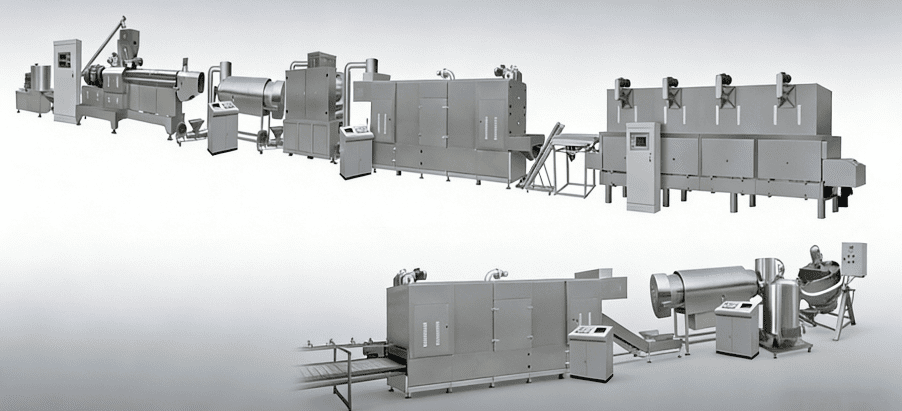
Whether you operate a small dog food processing factory or a large commercial pet food plant, optimizing the drying process can significantly improve production efficiency and reduce manufacturing costs.
So, how can you dry dog food efficiently? This article explores the key factors, equipment selection, and practical techniques for improving dog food drying performance.
1. Understand the Importance of Dog Food Drying
Drying plays several important roles in commercial dog food manufacturing.
Reducing moisture content
Freshly extruded dog food contains considerable moisture. Drying removes excess water and brings the product to the target moisture level required for storage and packaging.
Extending product shelf life
Excess moisture can encourage mold growth and other forms of microbial deterioration. Proper drying, combined with appropriate packaging and storage conditions, helps improve product stability.
Improving product texture
Drying affects the hardness, crispness, density, and internal structure of dog food pellets. Appropriate drying conditions help achieve the desired texture.
Improving packaging performance
Dog food should be cooled and stabilized before packaging. dog food machinery Excess moisture and residual heat can cause condensation inside packaging bags, potentially affecting product quality.
Supporting continuous production
An efficient drying system allows freshly extruded dog food to move smoothly through subsequent processing stages, reducing production bottlenecks.
2. Choose the Right Dog Food Drying Equipment
Selecting suitable drying equipment is the foundation of efficient dog food production.
Different dryers have different structures, heating methods, processing capacities, and energy requirements. Manufacturers should choose equipment according to their production scale, product characteristics, and factory conditions.
Multi-Layer Belt Dryer
A multi-layer belt dryer is widely used in commercial dog food production lines.
\<This equipment uses several conveyor belts arranged vertically. Dog food pellets move from one layer to another while hot air circulates through the product.
Its main advantages include:
- Large drying capacity.
- Continuous and automated operation.
- Adjustable conveying speed.
- Flexible temperature control.
- Relatively efficient use of factory space.
- Suitability for different dog food pellet sizes.
By adjusting belt speed, airflow, and temperature, manufacturers can control the drying time and final moisture content.

Multi-Pass Drying System
A multi-pass drying system allows dog food to pass through several drying sections with different operating conditions.
For example, the first section can use relatively higher temperatures to remove surface moisture, while subsequent sections gradually reduce moisture inside the pellets.
This staged drying method can help improve drying uniformity and reduce the risk of excessive surface hardening.
How to Choose Between Different Dryers
When comparing drying equipment, consider the following factors:
- Processing capacity and actual output.
- Number of drying layers or passes.
- Heating method and energy consumption.
- Hot air circulation efficiency.
- Temperature adjustment range.
- Automatic control capabilities.
- Cleaning and maintenance requirements.
The best dryer is not necessarily the one with the highest rated capacity. It should match the actual output of your extrusion line and provide stable drying performance.
3. Control the Drying Temperature Properly
Temperature is one of the most important factors affecting dog food drying efficiency.
If the temperature is too low, moisture removal will be slow, increasing drying time and energy consumption.
If the temperature is too high, the outer surface of the pellets may dry too quickly, while internal moisture remains trapped. dog food machinery Excessive heat exposure may also negatively affect heat-sensitive nutrients, fats, flavors, and product appearance.
Therefore, manufacturers should establish suitable temperature settings according to the dog food formulation, pellet size, initial moisture content, and dryer design.
A practical approach is to divide the drying process into several stages:
Initial drying: Use controlled hot air to remove a considerable proportion of surface moisture.
Intermediate drying: Continue removing moisture from the interior of the pellets while maintaining relatively uniform drying conditions.
Final drying: Adjust temperature and airflow to achieve the required final moisture content without excessive heat exposure.
The exact temperature settings should be determined through production trials rather than relying on a universal temperature standard.
4. Adjust the Drying Time According to Product Characteristics
Drying time directly affects production capacity and final product quality.
If dog food stays in the dryer for too short a period, the internal moisture content may remain too high. If the drying time is excessive, the pellets may become too hard or brittle, and unnecessary energy will be consumed.
Several factors influence the required drying time.
Pellet size: Larger dog food pellets generally require more time for internal moisture to migrate to the surface.
Pellet shape: Irregularly shaped products may dry less uniformly than standard round pellets.
Initial moisture content: Dog food with higher moisture content usually requires a longer drying period.
Product density: Dense pellets may require more time for moisture to move from the interior to the surface.
Hot air conditions: Temperature, airflow, and humidity all influence drying speed.
Manufacturers can adjust conveyor speed and dryer operating parameters to achieve a balance between production efficiency and product quality.
5. Improve Hot Air Circulation
Hot air circulation is essential for efficient drying.
Even if the dryer has a powerful heating system, poor airflow distribution can result in uneven drying. Some dog food pellets may become too dry while others retain excessive moisture.
To improve airflow performance, manufacturers should consider the following measures:
- Ensure that air ducts are properly designed.
- Maintain sufficient airflow throughout the drying chamber.
- Avoid excessive accumulation of dog food on conveyor belts.
- Regularly inspect fans and ventilation systems.
- Clean filters and air passages.
- Check whether hot air is distributed evenly across the entire conveyor width.
A well-designed circulation system helps maintain stable drying conditions and improves overall energy efficiency.

6. Control the Thickness of the Dog Food Layer
The thickness of the dog food layer on the conveyor belt has a significant influence on drying performance.
If too many pellets are placed on the belt, the lower layers may receive insufficient hot air. This can result in uneven moisture removal and longer drying times.
If the product layer is too thin, the dryer may not achieve its intended production capacity.
Therefore, manufacturers should distribute dog food evenly across the conveyor belt and maintain an appropriate material loading level.
Automatic feeding and spreading devices can help achieve consistent product distribution, especially in large commercial production lines.

7. Monitor Initial and Final Moisture Content
Efficient drying requires accurate moisture measurement.
Manufacturers should monitor moisture content before and after drying to determine whether the equipment is operating correctly.
The initial moisture content helps operators estimate the drying load, while the final moisture content indicates whether the product is ready for subsequent cooling and packaging.
For many conventional dry dog food products, final moisture content is commonly around 8%–10%. However, the appropriate target depends on the formulation, product type, water activity, packaging system, and applicable product standards.
It is important to distinguish moisture content from water activity. dog food machineryTwo products with similar moisture percentages may have different water activities and therefore different storage stability.
For better quality control, manufacturers should:
- Take representative samples from different areas of the production line.
- Use calibrated moisture measurement instruments.
- Check moisture content at regular intervals.
- Record drying temperatures and operating conditions.
- Adjust the dryer when moisture measurements become inconsistent.
Water activity testing is also recommended when establishing product shelf-life specifications.
8. Pay Attention to the Cooling Process After Drying
Many manufacturers focus heavily on drying but overlook the importance of cooling.
Freshly dried dog food is usually hot and should not be packaged immediately.
If hot pellets are sealed in packaging bags, temperature differences can cause condensation. This may increase moisture-related quality risks during storage.
A cooling machine allows dog food to gradually reach a suitable packaging temperature.
An effective cooling process should:
- Remove residual heat efficiently.
- Maintain uniform cooling.
- Avoid unnecessary exposure to humid air.
- Minimize product breakage.
- Prevent contamination during transportation.
It is also important to control the moisture of the surrounding air, particularly in humid environments.
9. Optimize the Dryer to Reduce Energy Consumption
Drying is often one of the major energy-consuming stages in commercial dog food manufacturing.
Improving energy efficiency can significantly reduce long-term production costs.
Here are several practical methods.
Use an efficient heating system
Choose a heating system that matches your factory’s energy availability and production requirements. Depending on the equipment design, options may include electricity, natural gas, steam, or other heating sources.
Improve insulation
Good thermal insulation reduces heat loss from the drying chamber and helps maintain stable operating temperatures.
Optimize hot air circulation
Proper airflow distribution helps reduce unnecessary heating and improves moisture removal efficiency.
Recover waste heat
Some industrial drying systems can recover part of the exhaust heat and reuse it to preheat incoming air.
Avoid unnecessary drying
Over-drying consumes additional energy and may negatively affect product quality. Monitor moisture content and stop drying once the required specifications have been achieved.
Maintain equipment regularly
Dirty filters, damaged insulation, worn fans, and blocked air ducts can increase energy consumption and reduce drying efficiency.
10. Maintain and Clean the Drying Equipment Regularly
Regular maintenance is essential for stable dryer operation.
During continuous production, dust, oil, and small food particles may accumulate inside the equipment. If these materials are not removed, they can affect airflow, heating efficiency, and hygiene.
A practical maintenance program should include:
- Cleaning conveyor belts and drying chambers.
- Inspecting fans, motors, and bearings.
- Checking heating elements and temperature sensors.
- Cleaning air filters and ventilation ducts.
- Inspecting conveyor tension and transmission components.
- Checking electrical connections and safety devices.
Manufacturers should also establish appropriate cleaning procedures to prevent cross-contamination between different formulations.
Regular inspection helps identify potential problems before they cause unexpected production interruptions.
11. Common Problems in Dog Food Drying and Their Solutions
Even with modern drying equipment, manufacturers may encounter various problems during production.
| Common problem | Possible cause | Recommended solution |
|---|---|---|
| Uneven moisture content | Poor airflow distribution | Adjust air circulation and product distribution |
| Excessive drying time | Low temperature or insufficient airflow | Optimize heating and ventilation |
| Hard or brittle pellets | Excessive drying or unsuitable processing conditions | Adjust temperature and drying time |
| High final moisture | Insufficient residence time | Reduce conveyor speed or optimize drying conditions |
| High energy consumption | Heat loss or over-drying | Improve insulation and monitor moisture |
| Product deformation | Excessive loading or unsuitable drying conditions | Adjust material layer thickness and temperature |
When problems occur, operators should examine the entire drying system rather than changing only one parameter.
For example, uneven drying may be caused by a combination of excessive product loading, blocked air ducts, and inconsistent feeding.
12. How to Build an Efficient Commercial Dog Food Drying System
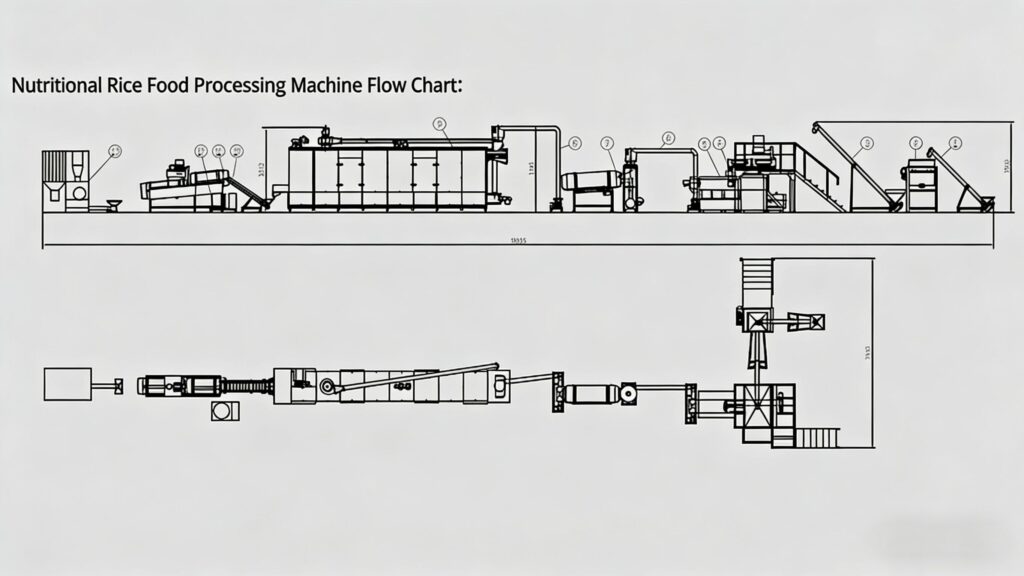
For manufacturers planning to establish a new dog food factory, it is important to consider the drying system as part of the entire production line.
A typical commercial dry dog food production process includes:
- Raw material grinding.
- Ingredient mixing.
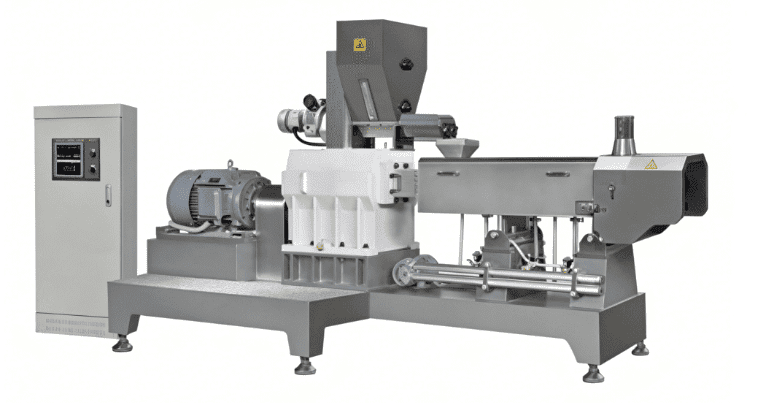
- Extrusion and shaping.
- Drying.
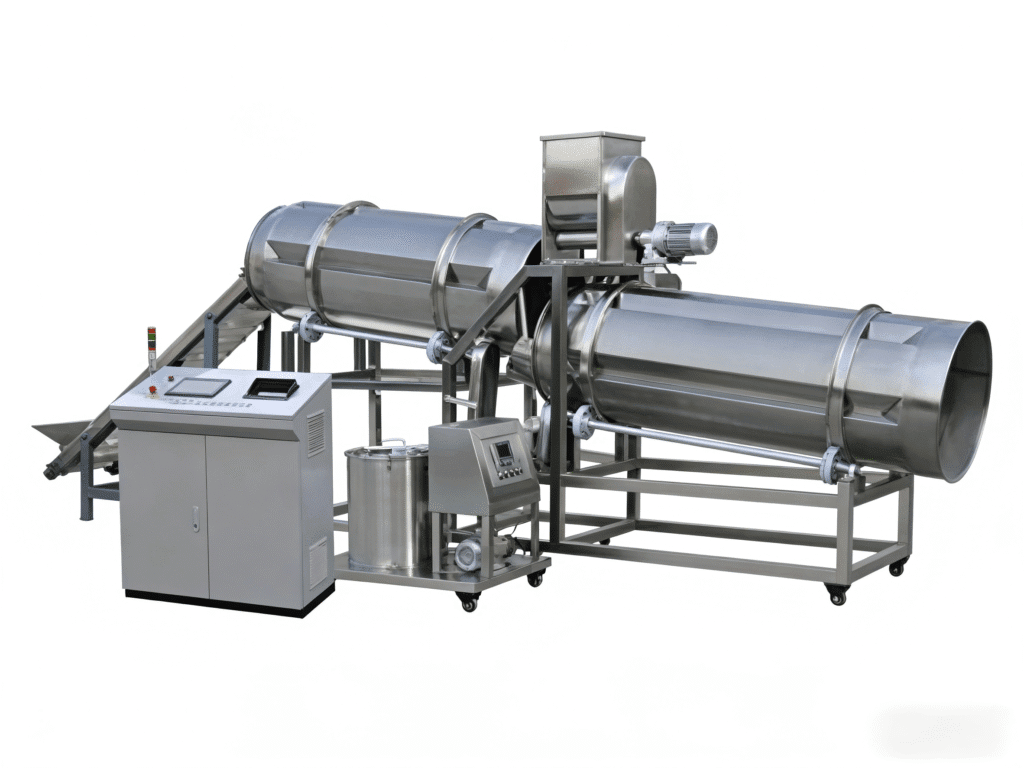
- Oil spraying and coating.
- Cooling.
- Screening and inspection.
- Automatic packaging.
The drying machine should be properly matched with the extruder’s output.
If the extrusion machine produces more dog food than the dryer can process, products may accumulate between production stages, reducing overall efficiency.
Similarly, an oversized dryer may increase investment and operating costs unnecessarily.
When purchasing equipment, ask the manufacturer to evaluate the complete production line, including material flow, dryer capacity, heating requirements, factory layout, and future expansion possibilities.
Conducting a production test with your actual raw materials is also an effective way to verify drying performance before purchasing the equipment.
Conclusion
Efficient dog food drying requires more than simply increasing the temperature or extending the drying time. It involves selecting suitable drying equipment, controlling temperature and airflow, adjusting conveyor speed, maintaining an appropriate product layer, and accurately monitoring moisture content.
For commercial dog food manufacturers, a well-designed multi-layer or multi-pass drying system can help improve production efficiency, achieve consistent product quality, and reduce energy consumption.
At the same time, cooling, equipment maintenance, and proper process monitoring should not be overlooked.
By optimizing every stage of the drying process, manufacturers can produce dog food with stable moisture levels, desirable texture, and better storage performance while improving the overall profitability of their production operations.
Fix the malformed equipment paragraphAdd a practical drying workflow


