
How Breakfast Corn Flakes are Manufactured: A Step-by-Step Guide
Breakfast corn flakes are a staple in many households, known for their crisp texture, light flavor, and nutritional value (often through fortification). what are corn flakes made of Their production is a precise industrial process that combines cooking, flaking, and toasting. Here is a step-by-step overview of how they are typically made.

1. Ingredient Selection and Mixing
The primary ingredient is whole grain corn (maize), usually degermed to remove the hull and germ, leaving mostly the endosperm. This is processed into corn grits ou corn meal. This base is mixed with minor ingredients in a large blender. The mix typically includes:
- Flavorings: Sugar, malt syrup (from barley), and salt.
- Fortificants: A vitamin and mineral pre-mix (e.g., iron, B vitamins like niacin, riboflavin, and thiamine).
- L'eau : To achieve the correct moisture for cooking.
2. Cooking: The Pressure Cooker Stage
The mixture is transferred to large, rotating batch cookers or continuous pressure cookers. Here, it is steamed under high pressure for 1-2 hours. what are corn flakes made of This crucial step:

- Gelatinizes the starch in the corn, making it digestible and malleable.
- Develops flavor and color through the Maillard reaction between the sugars and amino acids.
- Ensures complete hydration and mixing of all ingredients.
The result is a very soft, cooked corn “dough” or large, tender lumps.
3. Delumping and Drying (Tempering)
The cooked mass emerges as large, sticky aggregates. It is first passed through a delumping machine to break it into smaller, pea-sized pieces. These moist pieces are then conveyed to a large dryer.
The goal here is not to make the product crisp, but to reduce the surface moisture and achieve a uniform, firm internal texture—a process called tempering. The moisture content is carefully lowered to a specific level (typically around 20%).
4. Flaking: Creating the Signature Shape
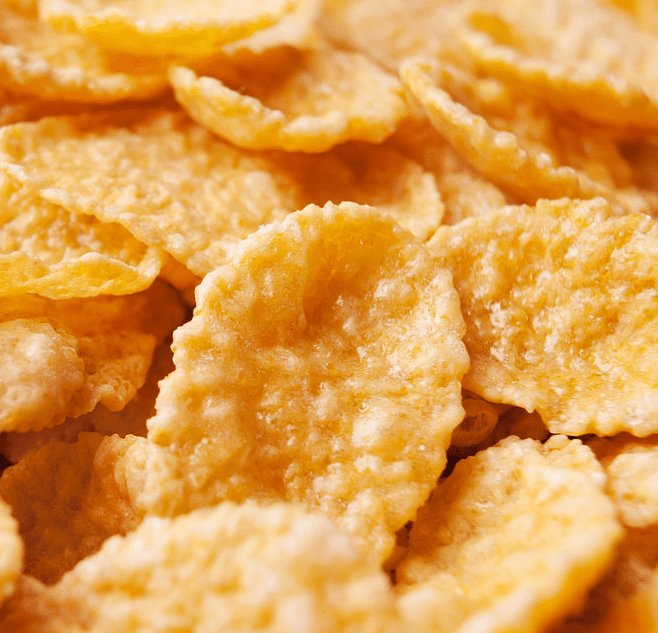
The tempered, rubbery pieces are now ready for their iconic shape. They are fed between two large, water-cooled steel rollers.
- One roller is typically smooth.
- The other is engraved with the desired flake pattern (which gives one side of the flake its textured imprint).
As the pieces pass through the nip (gap) between the rollers, they are flattened into thin flakes. The roller pressure, speed, and temperature are critical to producing a flake of the right thickness and integrity without breaking.
5. Toasting and Drying
The soft, flattened flakes now enter a large, multi-zone oven, what are corn flakes made of often a rotating drum or a conveyor belt toaster.
- Here, they are exposed to hot, dry air (around 300°C/570°F for a short time, e.g., 90 seconds).
- This process rapidly removes the remaining internal moisture, causing the flakes to puff slightly and become rigid and crisp.
- The toasting also develops the final golden-brown color and the characteristic toasted cereal flavor.
6. Coating and Cooling
As the hot flakes exit the toasting oven:
- Coating: They may pass through a flavor or vitamin spray chamber. A fine mist of vitamins (to replace those lost in heating) or sweeteners (like a thin sugar syrup) is applied.
- Cooling: The flakes are then conveyed on a long, open belt through a cooling tunnel. Ambient or forced cool air brings them to room temperature and ensures their crispness is set. This prevents sogginess in the package.
7. Packaging
Finally, the cooled flakes are fed into automated weighing and packaging lines. They are filled into inner bags (often wax-lined for moisture barrier) which are then placed into the familiar cardboard boxes. what are corn flakes made of Modern packaging machines use modified atmosphere packaging (MAP), flushing the bag with nitrogen to displace oxygen. This drastically slows oxidation (rancidity) and preserves freshness and crispness for months on the shelf.
Key Quality Control Points:
- Teneur en eau : Critical after tempering, toasting, and cooling.
- Flake Thickness & Integrity: Controlled by the flaking rolls.
- Color & Toast Level: Monitored by optical sensors in the oven.
- Flavor & Nutritional Content: Verified through lab testing.
In summary, transforming corn grits into the light, crisp flakes in your bowl is a harmonious blend of thermal processing (cooking and toasting) and mechanical forming (flaking), all tightly controlled to ensure consistency, safety, and the familiar taste and texture consumers expect.