Small-scale fried instant noodle production lines offer remarkable versatility, allowing manufacturers to produce a variety of noodle shapes—from classic waves to unique strips—using a streamlined, integrated process. Here is a breakdown of how different shapes are created, transformed, and fried on a compact line.
1. Dough Mixing & Kneading: The Uniform Foundation
Regardless of the final shape, the process begins with creating a uniform dough.
- Process: Wheat flour, water, salt, and alkaline agents (like kansui) are combined in a mixer, followed by a compound kneader. This develops the gluten network, ensuring dough strength and elasticity—essential for all subsequent shaping steps.
- Key Point: Dough consistency must be precise. A small variation in water absorption can affect how the dough sheets form and cut later.
2. Roller Sheeting & Compounding: Forming the Noodle Belt
The dough is transformed into a smooth, continuous sheet.
- Process: The dough passes through a series of calender rollers. Each subsequent pair of rollers has a narrower gap, progressively thinning the dough sheet. Multiple sheets are often layered and compressed (compounding) to create a dense, unified belt with a consistent texture.
- Shape Relevance: The thickness of the final sheet is the primary determinant of noodle thickness. For thin, straight noodles (like those for ramyeon), the gap is set very small. For thicker, wavy noodles, a slightly thicker sheet is used to provide enough material for the waving device to grip.
3. Slitting: Creating the Basic Noodle Strands
This is where the fundamental shape—the strand profile—is defined.
- Process: The continuous dough sheet passes through a fendeur, a roller fitted with precisely spaced cutting blades.
- Creating Different Strand Profiles:
- Square/Round Strands: The shape is determined by the cutting blades and subsequent forming rolls. Square-cut blades create straight-edged strands. Rounded edges on forming rolls can gently shape them towards a rounder profile.
- Flat/Ribbon Noodles: The slitter uses wide, rectangular cutting blades to create broad, flat strands.
- Width Variation: By simply changing the slitter roller, the line can produce wide (udon-style), standard, or thin (vermicelli-style) noodles from the same dough sheet.
4. Waving & Forming: The Iconic Instant Noodle Shape
This stage creates the signature wavy, block-ready form and is crucial for final texture.
- Process: The parallel strands from the slitter enter a waving device (often a pair of adjustable, rotating guide plates or a molding conveyor).
- Creating Different Wave Patterns & Forms:
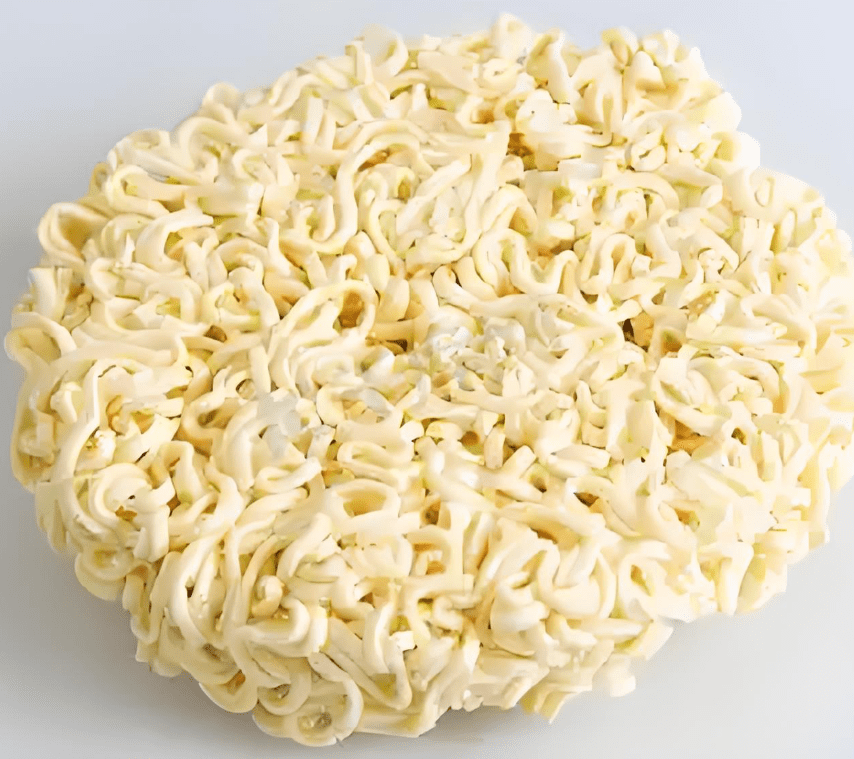
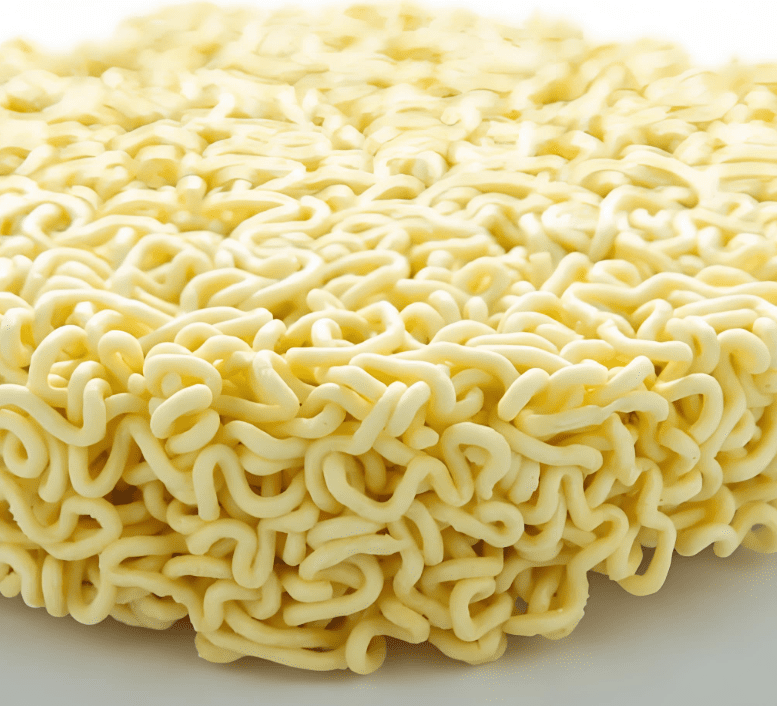
- Tight vs. Loose Waves: The speed differential between the incoming noodles and the slower-moving molding conveyor creates the waves. A greater speed difference creates tighter, denser waves suitable for cup noodles. A smaller difference yields looser waves, common in packet noodles.
- Block Shape: The noodles are laid into individual forming molds (noodle baskets). The pattern of laying—how densely the waves are packed—determines the final block’s size, shape (round or square), and structural integrity for frying.
- Straight Noodles: To produce non-waved, straight noodles, the waving device is bypassed or disengaged. The strands are cut and laid straight into the molds, requiring careful handling to ensure the block holds together.
5. Steaming: Gelatinizing the Starch
The shaped noodle blocks are steamed to set their structure.
- Process: Molds pass through a steam tunnel. Heat and moisture gelatinize the starch, partially cooking the noodles and fixing their waved or straight shape.
- Shape Relevance: Proper steaming ensures the noodle block maintains its form during cutting and frying. Inadequate steaming can cause the block to crumble.
6. Cutting & Frying: Finalizing the Form
This two-step process creates the individual, shelf-stable block.
- Cutting: After steaming, the continuous noodle mat is lifted from the molds and cut into discrete blocks using a vertical cutting machine. The cutting length is precisely set to match the target block weight.
- Frying (Deep-Frying): The cut blocks pass through a fryer with hot oil (~150-160°C). This rapidly removes moisture, creates tiny pores for quick rehydration, sets the final shape, and develops flavor and color.
- Shape & Frying Dynamics: The oil must penetrate evenly. Wavy shapes, with more surface area and air pockets, may fry slightly faster than dense, straight-noodle blocks. Frying time and temperature may need minor adjustments based on noodle thickness and wave density.
7. Cooling & Packaging
The fried blocks are cooled on a conveyor to set the structure and prevent condensation in the package before being wrapped.
Conclusion: Flexibility Through Modular Tooling
The ability of a small-scale line to produce different shapes hinges on quick-change modular components: the slitter rollers (for strand width/profile), the waving/form guides (for wave type or straight laying), and the forming molds (for block dimensions). By switching these tools and fine-tuning process parameters (roller gaps, speed differentials, frying time), a single compact line can efficiently produce a diverse portfolio of noodle shapes—from standard waves to flat ribbons, thin strands, or straight blocks—catering to varied market tastes with minimal downtime.