
Dog food is an essential part of the modern pet food industry. As pet owners increasingly focus on their dogs’ health, nutrition, and quality of life, the demand for high-quality dog food continues to grow. Producing nutritious, tasty, and easily digestible dog food requires carefully selected raw materials, advanced processing technology, and reliable production equipment.
But how is dog food manufactured? What machines are needed throughout the production process? This article introduces the complete dog food processing process, from raw material preparation to final packaging, helping manufacturers understand how to establish an efficient dog food production line.
1. Raw Material Selection and Preparation
14
Raw materials are the foundation of dog food quality. A balanced formula should provide dogs with sufficient protein, fat, carbohydrates, vitamins, and minerals.
Common ingredients used in dog food production include:
- Animal protein: Chicken meal, fish meal, beef meal, meat, and poultry by-products.
- Plant protein: Soybean meal, corn gluten meal, and other plant protein sources.
- Carbohydrates: Corn, wheat, rice, potatoes, and other grains or starch-rich ingredients.
- Fats and oils: Chicken fat, fish oil, and vegetable oils.
- Nutritional additives: Vitamins, minerals, amino acids, antioxidants, and other approved functional ingredients.
Before processing, raw materials need to be inspected to ensure freshness and safety. Grains and other dry ingredients may need cleaning, screening, and grinding to remove impurities and achieve the required particle size.
Proper raw material preparation helps improve mixing uniformity and ensures consistent product quality.
2. Raw Material Grinding
Grinding is an important step in dog food processing, especially when using grains, soybean meal, and other dry ingredients.
A hammer mill or similar grinding machine is commonly used to reduce raw materials into smaller particles.
The main purposes of grinding include:
- Improving the uniformity of raw materials.
- Making ingredients easier to mix.
- Improving starch gelatinization during extrusion.
- Helping produce dog food with a consistent texture and appearance.
The particle size should be selected according to the product formula and the requirements of the extrusion equipment. Excessively coarse particles may result in uneven processing, while excessively fine particles may affect material flow and increase energy consumption.
3. Ingredient Mixing
After grinding, different ingredients are transferred into a mixer according to the designed formula.
The mixing process ensures that proteins, carbohydrates, fats, vitamins, minerals, and other ingredients are evenly distributed throughout the mixture.
A horizontal mixer or ribbon mixer is commonly used in dog food production.
During mixing, manufacturers should pay attention to:
- Accurate ingredient weighing.
- Appropriate mixing time.
- Uniform distribution of small-dose additives.
- Consistent moisture content.
- Prevention of cross-contamination between different formulas.
Good mixing is essential because uneven ingredient distribution can lead to nutritional differences between individual dog food pieces.
4. Conditioning and Moisture Adjustment
Before extrusion, the mixed ingredients usually need to be conditioned by adding water or steam.
A conditioner helps distribute moisture and heat throughout the raw material. This process softens the mixture and prepares it for extrusion.
The main functions of conditioning include:
- Increasing material moisture content.
- Preheating the raw materials.
- Promoting starch gelatinization.
- Improving material plasticity.
- Reducing the workload of the extruder.
The appropriate moisture content and conditioning temperature depend on the recipe, equipment configuration, and desired product characteristics.
Proper conditioning helps improve extrusion stability and contributes to better dog food texture and digestibility.
5. Dog Food Extrusion
7
Extrusion is one of the most important stages in modern dry dog food production.
The conditioned mixture enters an extruder, where it is transported, compressed, mixed, heated, and cooked under controlled conditions.
There are two common types of equipment used in dog food manufacturing:
Single-screw extruder: Suitable for certain relatively straightforward formulations and production requirements. It generally has a simpler structure and lower equipment investment.
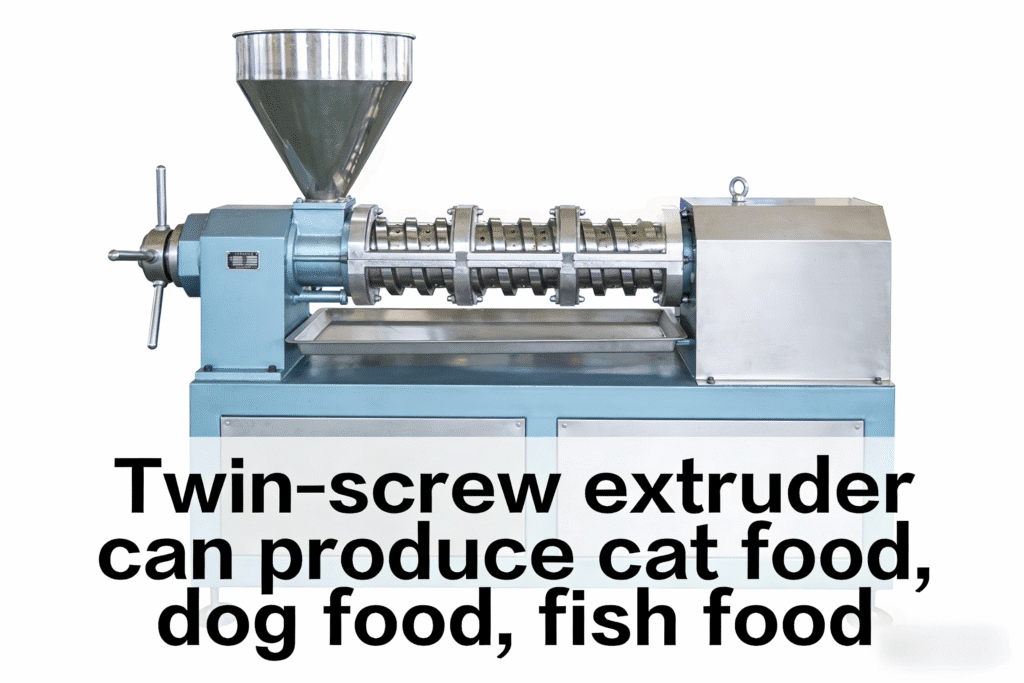
Twin-screw extruder: Offers stronger mixing and processing flexibility. It is suitable for more complex formulations and a wider range of product shapes and textures.
Inside the extruder, heat, pressure, moisture, and mechanical shear help cook the ingredients. When the material passes through the die and exits the extruder, the pressure drops rapidly, causing moisture to flash into steam and the product to expand.
A cutting device then cuts the expanded material into individual kibble pieces.
By changing the die design and cutting speed, manufacturers can produce dog food in different shapes, including:
- Round-shaped kibble.
- Bone-shaped dog food.
- Ring-shaped kibble.
- Small pillow-shaped pieces.
- Custom-shaped dog food.
The extrusion temperature, screw speed, moisture content, and pressure must be carefully controlled to achieve consistent product quality.
6. Dog Food Drying
Freshly extruded dog food usually contains relatively high moisture and needs to be dried before packaging.
A multi-layer belt dryer or continuous conveyor dryer is commonly used in large-scale dog food production.
During drying, hot air circulates through the product to remove excess moisture. This helps improve storage stability and prevents mold growth and product deterioration.
Important drying factors include:
Drying temperature: Excessively high temperatures may damage heat-sensitive nutrients or cause uneven drying.
Drying time: The residence time should be adjusted according to kibble size, moisture content, and dryer capacity.
Air circulation: Uniform airflow helps ensure that all dog food pieces are dried consistently.
Final moisture content: The target should be determined by the product specification, packaging requirements, and validated shelf-life conditions.
Proper drying is essential for producing dry dog food with a stable texture and longer shelf life.
7. Cooling
What Is Kibble in Dog Food and How Is It Produced?
After drying, the dog food should be cooled before further processing.
A cooling conveyor or counterflow cooler can gradually reduce the product temperature.
Cooling serves several important purposes:
- Preventing condensation inside packaging.
- Reducing the risk of moisture accumulation.
- Improving product handling.
- Preparing dog food for coating and packaging.
Dog food should be cooled sufficiently and evenly before entering the next production stage.
8. Oil and Flavor Coating
Flavor and nutritional coating is an important step in improving dog food palatability.
After cooling, dog food pieces enter a coating machine, where oils, fats, flavor enhancers, and certain nutritional ingredients can be applied to the kibble surface.
Common coating ingredients include:
- Chicken fat.
- Fish oil.
- Animal protein hydrolysates.
- Natural flavor ingredients.
- Approved vitamin and nutritional supplements.
A rotating drum coating machine is often used to distribute the coating materials evenly.
Manufacturers should control the spraying rate and coating quantity to prevent excessive oil accumulation or uneven distribution.
Proper coating can improve the aroma, taste, and nutritional characteristics of dog food, making it more attractive to dogs.
9. Screening and Quality Inspection
Unveiling the Pet Food Manufacturing Process
Before packaging, dog food needs to undergo screening and quality inspection.
A vibrating screen can separate oversized pieces, broken kibble, and excessive powder from qualified products.
Manufacturers should also conduct quality checks, including:
- Moisture content testing.
- Nutritional composition analysis.
- Product size and shape inspection.
- Bulk density testing.
- Microbiological testing.
- Foreign material detection.
- Packaging and sealing inspection.
Depending on the product and applicable food safety regulations, metal detectors and other inspection equipment may also be installed.
Strict quality control helps ensure that finished dog food meets nutritional, safety, and appearance requirements.
10. Automatic Weighing and Packaging
Full automatic high yield pet food pouch vertical form fill seal packaging line
Packaging is the final stage of the dog food manufacturing process.
Qualified dog food is transported to an automatic weighing and packaging machine, which measures the required quantity and fills individual bags.
Common packaging sizes include:
- 500 g small packages.
- 1 kg retail packages.
- 2 kg and 5 kg family packages.
- 10 kg and 20 kg bulk packages.
Manufacturers can select different packaging materials according to their target markets and product requirements. Moisture-resistant and oxygen-barrier packaging materials can help protect product quality during storage and transportation.
After filling, the bags are sealed, labeled, and prepared for storage or shipment.
11. Complete Dog Food Production Line Equipment
A modern dog food production line consists of several machines working together. Different production capacities and product requirements may require different equipment configurations.
What Is a Pet Food Processing Machine and How Does It Work?
How Kormotech is growing its pet food business during war | PetfoodIndustry
โรงงานผลิต เพอร์เฟค คอมพาเนียน กรุ๊ป
12
The main equipment generally includes:
| Processing stage | Main equipment |
|---|---|
| Raw material preparation | Cleaning and screening equipment |
| Grinding | Hammer mill |
| Mixing | Horizontal mixer |
| Conditioning | Preconditioner |
| Extrusion | Single-screw or twin-screw extruder |
| Cutting | Rotary cutting device |
| Drying | Multi-layer belt dryer |
| Cooling | Cooling conveyor |
| Coating | Oil and flavor coating machine |
| Screening | Vibrating screen |
| Packaging | Automatic weighing and packaging machine |
In addition, manufacturers may need elevators, conveyors, storage silos, dust collection systems, boilers or steam generators, and laboratory testing equipment.
The equipment configuration should be determined according to production capacity, raw material characteristics, product formula, factory space, and investment budget.
12. Important Factors Affecting Dog Food Quality
Producing high-quality dog food requires more than simply purchasing advanced machinery. Several factors need to be considered throughout the manufacturing process.
1. Scientific formulation
The formula should meet the nutritional requirements of dogs at different life stages. Protein, fat, carbohydrates, vitamins, minerals, and other nutrients should be properly balanced.
2. Raw material quality
Fresh, safe, and traceable ingredients provide the foundation for consistent product quality.
3. Extrusion parameters
Temperature, moisture, pressure, screw speed, and die design influence kibble expansion, density, texture, and cooking quality.
4. Drying control
Uniform drying helps achieve stable moisture levels and reduces the risk of microbial growth during storage.
5. Flavor and palatability
Appropriate coating ingredients can improve aroma and acceptance, helping make the finished product more appealing to dogs.
6. Food safety management
Manufacturers should establish strict hygiene procedures, control potential contamination risks, and implement appropriate quality management systems throughout production.
Conclusion
The dog food processing process involves several interconnected stages, including raw material preparation, grinding, mixing, conditioning, extrusion, drying, cooling, coating, screening, and packaging.
Each stage plays an important role in determining the nutritional value, texture, appearance, palatability, and storage stability of the finished product.
For businesses planning to enter the pet food industry, choosing suitable dog food processing equipment and establishing an efficient production process are essential steps. With a properly designed production line, manufacturers can produce different shapes, sizes, and formulations of dog food to meet the needs of various markets.
Whether you are planning to build a small dog food processing factory or establish a large-scale commercial production facility, understanding the complete manufacturing process will help you make better decisions about equipment selection, production management, and product quality.