
Comprehensive Guide to Dog Food Processing Equipment: From Raw Materials to Finished Product
Introduction to the Dog Food Industry
The global pet food industry has experienced remarkable growth over the past few decades, evolving from simple table scraps to scientifically formulated nutrition. Dog food making machine manufacturing represents a sophisticated segment of this industry, combining animal nutrition science with advanced food processing technology. Modern dog food processing equipment transforms raw ingredients into safe, nutritious, and palatable products that meet the diverse needs of canines across life stages, breeds, and health conditions.
This comprehensive guide explores the complex machinery and systems that enable large-scale production of dog food, covering everything from initial ingredient handling to final packaging. The equipment discussed represents the intersection of food science, Dog food making machinemechanical engineering, and automation technology, all working in concert to produce consistent, high-quality pet food products.
Section 1: Raw Material Handling and Preparation Equipment
1.1 Ingredient Receiving and Storage Systems
The dog food manufacturing process begins with the receipt and storage of raw materials. These include various protein sources (meat, poultry, fish), carbohydrates (grains, potatoes), fats, vitamins, minerals, and functional additives.
Receiving Equipment:
- Dump Hoppers and Pits: Reinforced concrete or stainless steel structures where bulk ingredients are initially deposited. These often include grating systems to remove large contaminants.
- Pneumatic Receiving Systems: Used for dry ingredients like grains and cereals, these systems use vacuum pressure to transport materials from delivery vehicles to storage silos.
- Liquid Receiving Tanks: Temperature-controlled tanks for receiving animal fats, oils, and other liquid ingredients.
- Meat Receiving Bays: Refrigerated areas with specialized flooring and drainage for receiving fresh or frozen meat products.
Storage Equipment:
- Silos: Cylindrical storage structures for dry ingredients, ranging from 50 to 5000 tons capacity. Modern silos include:
- Level indicators and sensors
- Temperature monitoring systems
- Aeration systems to prevent caking
- First-in-first-out (FIFO) discharge systems
- Liquid Storage Tanks: Insulated, heated tanks maintain fats and oils in liquid state. These typically include:
- Heating coils or jackets
- Temperature controllers
- Agitators to prevent separation
- Nitrogen blanketing to prevent oxidation
- Refrigerated/Frozen Storage: Walk-in freezers and cold rooms for meat and fish products, usually maintained at -18°C to 4°C depending on product type.
Material Handling Equipment:
- Bucket Elevators: Vertical conveying systems for lifting dry ingredients to various processing stages.
- Screw Conveyors: Helical blades within tubes that move materials horizontally or at slight inclines.
- Drag Chain Conveyors: Enclosed systems that gently move fragile materials like expanded kibble.
- Pneumatic Conveying Systems: Use air pressure to transport powders and small particulates through piping networks.
1.2 Cleaning and Sorting Equipment
Raw materials must be cleaned to remove contaminants before processing. The specific equipment varies by ingredient type:
Grain Cleaning Systems:
- Scalpers: Remove large impurities like stones, strings, and sticks
- Aspirators: Use air currents to remove dust, husks, and lightweight materials
- Sieves and Screens: Vibrating or rotating screens separate materials by size
- Destoners: Remove stones and other high-density contaminants through gravity separation
- Magnetic Separators: Remove ferrous metals using permanent magnets or electromagnets
Meat Preparation Equipment:
- Bone Separators: Mechanical systems that separate soft tissue from bones in meat trimmings
- Grinders and Mincers: Reduce meat particle size for consistent processing
- Thawing Systems: Controlled temperature systems for safely defrosting frozen meats
Section 2: Size Reduction and Mixing Equipment
2.1 Grinding and Milling Equipment
Size reduction is crucial for creating uniform particles that process consistently and yield uniform final products.
Hammermills:
- Design: Feature rotating hammers that impact materials against breaker plates
- Screen Systems: Perforated screens control final particle size
- Applications: Primary grinding of grains, secondary grinding of meat mixtures
- Variations: Full-circle and half-circle designs with different hammer arrangements
Roller Mills:
- Design: Two or more parallel rollers rotating at different speeds
- Function: Shearing and crushing action for more controlled particle size reduction
- Advantages: Lower heat generation, better control of particle size distribution
- Applications: Particularly valuable for cereal grains
Wet Grinding Systems:
- Colloid Mills: Use high-speed rotor-stator systems to create fine emulsions
- Applications: Creating uniform meat slurries, fat dispersions
Specialized Size Reduction:
- Cryogenic Grinding: For temperature-sensitive ingredients
- Pin Mills: Ultra-fine grinding for specialized applications
2.2 Weighing and Batching Systems
Precise ingredient proportioning is critical for nutritional consistency and regulatory compliance.
Ingredient Scaling Systems:
- Loss-in-Weight Feeders: Continuously weigh materials as they leave hoppers
- Gain-in-Weight Systems: Weigh materials as they enter mixing vessels
- Multi-Ingredient Scales: Handle multiple ingredients in single systems
Liquid Metering Systems:
- Positive Displacement Pumps: Provide precise volumetric delivery
- Mass Flow Meters: Measure liquids by mass for greater accuracy
- Micro-ingredient Systems: Handle vitamins, minerals, and additives in minute quantities
Automation and Control:
- Programmable Logic Controllers (PLCs): Coordinate weighing sequences
- Recipe Management Systems: Store and execute formulation instructions
- Gravimetric Blending: Continuous proportioning based on mass flow rates
2.3 Mixing and Blending Equipment
Thorough, uniform mixing ensures consistent nutrient distribution throughout each batch.
Ribbon Mixers:
- Design: Horizontal trough with internal spiral agitators
- Capacity: Range from 500 kg to 10,000 kg per batch
- Applications: Dry and semi-moist mixing
- Features: Often include liquid addition ports, discharge gates, and jacket heating/cooling
Paddle Mixers:
- Design: Rotating paddles on horizontal or vertical shafts
- Advantages: Gentle mixing action, suitable for fragile ingredients
- Variations: Single-shaft, double-shaft, and counter-rotating designs
Plow Mixers:
- Design: High-speed plow-shaped elements create intense mixing action
- Applications: Excellent for cohesive materials and adding liquids to dry mixes
Continuous Mixers:
- Twin-Screw Mixers: Intermeshing screws provide conveying and mixing
- Paddle Continuous Mixers: Series of paddles on rotating shaft
- Applications: High-volume production with consistent output
High-Shear Mixers:
- Design: Rotor-stator systems creating intense mechanical shear
- Applications: Creating stable emulsions, dispersing powders in liquids
Vacuum Mixers:
- Function: Remove air during mixing to prevent oxidation
- Benefits: Improved shelf life, better liquid incorporation
Section 3: Cooking and Extrusion Systems
3.1 Preconditioning Equipment
Preconditioning hydrates and partially cooks the mixture before extrusion, improving process efficiency and product quality.
Single-Shaft Preconditioners:
- Design: Inclined cylinder with single rotating shaft and paddles
- Function: Mix steam and water with dry ingredients
- Residence Time: Typically 1-3 minutes
- Capacity: Match throughput of extrusion systems
Twin-Shaft Preconditioners:
- Design: Two intermeshing shafts with paddles
- Advantages: Better mixing, longer residence times (up to 4 minutes)
- Applications: High-moisture formulations, difficult-to-process ingredients
Differential Diameter Preconditioners:
- Design: Shafts of different diameters create varied mixing intensities
- Benefits: Enhanced heat and moisture transfer
Preconditioner Features:
- Steam Injection Systems: Direct and indirect steam injection points
- Liquid Addition Ports: For fats, molasses, and other liquids
- Temperature Probes: Monitor and control cooking temperature
- Variable Speed Drives: Adjust residence time based on formulation
3.2 Extruders
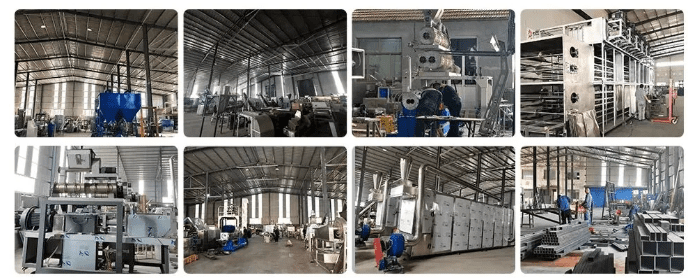
Extrusion is the heart of dry and semi-moist dog food production, where preconditioned material is cooked under pressure and forced through a die to create specific shapes.
Extrudeuses à vis unique :
- Basic Design: Rotating screw inside stationary barrel
- Sections: Feeding, compression, metering
- Applications: Simple shapes, lower complexity products
- Limitations: Less flexible, lower pressure capability
Extrudeuses à double vis :
- Design: Two intermeshing screws in figure-8 barrel
- Configurations: Co-rotating (same direction) and counter-rotating (opposite directions)
- Advantages:
- Better mixing and heat transfer
- Higher flexibility for different formulations
- Ability to handle high-moisture and high-fat ingredients
- Self-wiping action reduces cleaning requirements
- Modular Design: Barrel sections and screw elements can be reconfigured for different products
Extruder Components:
- Feed Section: Receives material from preconditioner
- Sections du canon: Modular segments with different functions:
- Conveying sections: Move material forward
- Kneading blocks: Provide mixing and shear
- Reverse elements: Create back pressure and additional mixing
- Heating/Cooling Jackets: Control barrel temperature
- Die Assembly: Shapes the extruded product
- Knife Assembly: Cuts extrudate to desired length
Extrusion Process Parameters:
- Screw Speed: Typically 200-500 RPM
- Barrel Temperature: 100-150°C
- Pressure at Die: 20-40 bar (300-600 psi)
- Specific Mechanical Energy (SME): 20-40 kWh/ton
- Moisture Content: 20-30% during extrusion
3.3 Die and Knife Technology
The die and cutting system determine product shape and size, critical for market appeal and functional characteristics.
Die Design Considerations:
- Shape Complexity: Simple circles to intricate bone shapes
- Ratio d'expansion: Die land length to diameter ratio affects expansion
- Material: Hardened steel or specialized alloys for wear resistance
- Coatings: Non-stick coatings reduce product buildup
Die Types:
- Single-Layer Dies: Produce uniform composition throughout
- Multi-Layer Dies: Create products with different interior and exterior compositions
- Co-extrusion Dies: Allow filling or coating during extrusion
Cutting Systems:
- Face Cutters: Rotating blades cut at die face
- Razor Blades vs. Knives: Different cutting mechanisms
- Variable Speed Control: Adjust cut length based on expansion characteristics
- Air Knife Systems: Use air jets to direct cut pieces away from die
Section 4: Drying and Cooling Systems
4.1 Dryers
After extrusion, products contain 20-30% moisture and must be dried to 8-12% for shelf stability.
Single-Pass Dryers:
- Design: Product makes one pass through drying chamber
- Configuration: Multiple conveyor belts in vertical arrangement
- Air Flow: Cross-flow, counter-flow, or combination
- Applications: High-capacity operations with limited floor space
Multi-Pass Dryers:
- Design: Product makes several passes through drying zones
- Advantages: Better moisture uniformity, gradual drying
- Typical Configuration: 3-6 passes with increasing temperature zones
Fluidized Bed Dryers:
- Design: Air passed upward through product bed at velocity sufficient to suspend particles
- Advantages: Excellent heat transfer, uniform drying
- Applications: Small, uniform products
Dryer Components and Features:
- Heat Sources: Natural gas, steam, or electric heating
- Air Handling System: Fans, ducts, and filters
- Humidity Control: Exhaust and fresh air dampers
- Product Conveyance: Perforated belts, vibrating decks, or moving beds
- Zoned Control: Different temperature and humidity in each section
Drying Parameters:
- Inlet Air Temperature: 100-150°C
- Exhaust Air Temperature: 40-60°C
- Drying Time: 15-30 minutes depending on product size
- Moisture Reduction: Typically from 25% to 10%
4.2 Coolers
After drying, products must be cooled to near ambient temperature before coating and packaging.
Vertical Coolers:
- Design: Similar to vertical dryers but without heating
- Air Flow: Ambient or slightly cooled air
- Advantages: Space-efficient, natural product flow by gravity
Horizontal Coolers:
- Design: Single long conveyor with cooling sections
- Advantages: Easier access for maintenance, better product inspection
- Applications: Larger or more fragile products
Fluidized Bed Coolers:
- Design: Similar to fluidized bed dryers but using ambient or cooled air
- Benefits: Rapid, uniform cooling
Cooling Parameters:
- Final Product Temperature: Typically 5-10°C above ambient
- Cooling Time: 10-20 minutes
- Moisture Stabilization: Allows final moisture equilibrium
4.3 Energy Efficiency and Heat Recovery
Modern drying systems incorporate numerous energy-saving features:
Heat Recovery Systems:
- Air-to-Air Heat Exchangers: Transfer heat from exhaust to incoming air
- Thermal Wheels: Rotating matrix that transfers heat and moisture
- Heat Pumps: Extract heat from exhaust for use elsewhere
Advanced Control Systems:
- Model Predictive Control: Anticipates process changes for optimal operation
- Humidity-Based Control: Adjusts drying parameters based on exhaust humidity
- Multi-Zone Optimization: Independently controls each dryer zone
Section 5: Coating and Enrobing Systems
5.1 Coating Application Methods
Coatings enhance palatability, add nutrients, and improve appearance.
Rotary Coaters:
- Design: Rotating drum with internal flights that lift and tumble product
- Spray System: Nozzles apply coating evenly
- Applications: Fat and powder coatings
- Advantages: Uniform coating, gentle product handling
Fluidized Bed Coaters:
- Design: Product suspended in air stream while coating is applied
- Applications: Fine powders and delicate coatings
- Benefits: Excellent coating uniformity
Enrobbing Belts:
- Design: Product passes through curtain of coating material
- Applications: Thick coatings, gravy applications
- Variations: Bottom-only or full coverage systems
Spray Systems:
- Hydraulic Nozzles: Use pressure to atomize liquid
- Pneumatic Nozzles: Use compressed air for finer atomization
- Ultrasonic Nozzles: Use high-frequency vibration for very fine mist
- Rotary Atomizers: Centrifugal force creates fine droplets
5.2 Coating Ingredients and Handling
Fat Coatings:
- Application Temperature: 5-10°C above melting point
- Solid Content: Typically 100% fat or blends
- Antioxidant Addition: Often incorporated to prevent rancidity
Digest and Palatability Coatings:
- Composition: Protein hydrolysates, animal digests, flavor enhancers
- Viscosity Control: Critical for uniform application
- Microbial Considerations: Often require pasteurization
Powder Coatings:
- Types: Flours, protein powders, vitamin/mineral premises
- Application Methods: Dusting, adhesive coating (applying powder to tacky surface)
5.3 Coating Penetration and Retention
Ensuring coatings adhere properly and penetrate sufficiently is critical for product quality.
Penetration Enhancement:
- Surface Roughness: Created during extrusion or through post-extrusion treatment
- Temperature Differential: Warm product, cool coating (or vice versa)
- Vacuum Coating: Remove air from pores before coating application
Coating Quality Control:
- Weight Gain Measurement: Track coating application rate
- Color Uniformity: Spectrophotometer analysis
- Palatability Testing: In-house or third-party testing
Section 6: Specialized Processing Equipment
6.1 Retort Processing for Wet Food
Wet or canned dog food requires different processing to ensure sterility.
Batch Retorts:
- Design: Pressure vessels that process containers in batches
- Types: Still steam, steam-air, or water immersion
- Control Systems: Programmable temperature/pressure cycles
Continuous Retorts:
- Hydrostatic Retorts: Use water columns to maintain pressure
- Rotary Retorts: Containers rotate during processing for faster heat transfer
- Applications: High-volume production
Aseptic Processing:
- UHT Treatment: Ultra-high temperature sterilization of product before packaging
- Aseptic Filling: Sterile product filled into sterile containers in sterile environment
- Advantages: Better nutrient retention, longer shelf life without refrigeration
6.2 Baking Equipment
Some premium and treats are baked rather than extruded.
Direct-Fired Ovens:
- Band Ovens: Continuous conveyor through heated chamber
- Rotary Ovens: Product rotates on multiple shelves for even baking
- Temperature Profiles: Multiple zones with different temperatures
Baking Parameters:
- Temperature: 150-250°C depending on product
- Time: 5-30 minutes
- Humidity Control: Steam injection for specific crust characteristics
6.3 Freeze-Drying Equipment
Freeze-dried products represent a growing premium segment.
Freeze Dryer Components:
- Freezing Chamber: Rapidly freezes product to -30°C to -50°C
- Vacuum System: Reduces pressure to 0.1-1.0 mbar
- Heating System: Gradual heating to sublime ice without melting
- Condenser: Captures water vapor
Process Characteristics:
- Cycle Time: 12-48 hours depending on product thickness
- Moisture Content: Typically 1-3% final moisture
- Quality Advantages: Excellent nutrient retention, texture, and rehydration properties
6.4 High-Pressure Processing (HPP)
Non-thermal pasteurization method gaining popularity for premium products.
HPP Equipment:
- Pressure Vessels: Rated for 400-600 MPa (58,000-87,000 psi)Dog food making machine
- Pressure Medium: Water
- Cycle Time: 3-10 minutes including loading and unloading
- Benefits: Microbial reduction without heat, minimal effect on nutrients and flavor
Section 7: Packaging Systems
7.1 Bagging Equipment
Dry dog food is primarily packaged in multi-wall bags with various barrier properties.
Form-Fill-Seal (FFS) Machines:
- Vertical FFS: Film formed into bag, filled, then sealed
- Horizontal FFS: Pre-made bags opened, filled, then sealed
- Speed: Up to 100 bags per minute
Bag Types and Materials:
- Multi-wall Paper Bags: 2-5 layers with plastic liner
- Woven Polypropylene: High strength, good moisture barrier
- Stand-up Pouches: Flexible with good retail presentation
- Barrier Properties: Often include foil or metallized layers for oxygen and moisture barrier
Bagging Features:
- Check Weighers: Ensure correct net weight
- Metal Detectors: Final contamination check
- Gas Flushing: Nitrogen or CO2 to extend shelf life
- Resealable Features: Zippers or other closure systems
7.2 Canning and Tray Sealing
Wet food requires hermetic sealing for sterility.
Can Seamers:
- Operation: Form double seam between can and lid
- Speed: Up to 1000 cans per minute on high-speed lines
- Monitoring: Regular seam tear-downs for quality control
Tray and Pouch Sealers:
- Heat Sealers: For plastic trays and pouches
- Modified Atmosphere Packaging: Gas flush before sealing
- Leak Testing: Often included in-line
7.3 Case Packing and Palletizing
Secondary packaging for distribution.
*Case Erectors: Form corrugated cases from flat blanks *Case Packers: Load bags, cans, or trays into cases
*Case Sealers: Apply adhesive or tape to close cases *Palletizers: Arrange cases on pallets in stable patterns
*Stretch Wrappers: Secure loads with plastic film *Automatic Guided Vehicles (AGVs): Move pallets to storage
Section 8: Quality Control and Testing Equipment
8.1 Laboratory Analysis Equipment
Comprehensive quality control is essential for nutritional consistency and safety.
Proximate Analysis:
- Moisture Analyzers: Loss-on-drying, Karl Fischer titration
- Protein Analyzers: Kjeldahl or Dumas combustion methods
- Fat Analyzers: Solvent extraction, NMR, or near-infrared
- Fiber Analyzers: Chemical digestion methods
- Ash Analyzers: Muffle furnace incineration
Analyse nutritionnelle :
- Vitamin Assays: HPLC for water-soluble, HPLC or GC for fat-soluble
- Mineral Analysis: Atomic absorption or ICP spectroscopy
- Amino Acid Profilers: Ion-exchange chromatography or HPLC
Physical Testing:
- Texture Analyzers: Measure hardness, fracturability
- Colorimeters: Quantify color consistency
- Bulk Density Testers: Important for packaging and feeding guidelines
- Water Activity Meters: Predict microbial stability
8.2 Process Analytical Technology (PAT)
Real-time monitoring and control of critical quality attributes.
Near-Infrared (NIR) Analyzers:
- At-line Systems: Sample removed from process for analysis
- In-line Systems: Probe inserted directly into process stream
- On-line Systems: Divert side-stream for continuous analysis
- Applications: Moisture, protein, fat, and fiber monitoring
Vision Inspection Systems:
- Color Cameras: Detect color variations
- Shape Recognition: Identify misshapen product
- Foreign Material Detection: Identify non-product items
X-ray Inspection:
- Detection Capability: Metals, stones, glass, bone fragments
- Integration: Often just before final packaging
8.3 Microbial Testing
Ensuring product safety through pathogen testing.
Rapid Methods:
- PCR Systems: Detect specific DNA sequences
- ELISA Tests: Enzyme-linked immunosorbent assays
- ATP Bioluminescence: General sanitation verification
Traditional Methods:
- Incubators: For plate counts
- Selective Media: For specific pathogen detection
Section 9: Cleaning and Sanitation Systems
9.1 Clean-in-Place (CIP) Systems
Automated cleaning of processing equipment without disassembly.
CIP Components:
- Tanks: For cleaning solutions and rinse water
- Pumps: High-pressure circulation
- Spray Devices: Rotating spray balls, fixed sprays
- Heat Exchangers: Control solution temperature
Cleaning Programs:
- Prerinse: Remove gross soil
- Alkaline Wash: Degrease and remove protein
- Intermediate Rinse: Remove alkaline solution
- Acid Wash: Remove mineral deposits
- Final Rinse: Potable water rinse
- Sanitizer: Chemical or hot water sanitization
9.2 Dry Cleaning Systems
For areas where water cannot be used or is less effective.
Methods:
- Vacuum Systems: Remove dry powders
- Brush Systems: Mechanical removal of adhered material
- CO2 Blasting: Frozen CO2 pellets impact and lift contamination
9.3 Environmental Monitoring
Ensuring overall facility cleanliness.
Air Handling Systems:
- HEPA Filtration: For critical areas
- Positive Pressure: Prevent contamination ingress
- Air Changes: Specific rates for different areas
Surface Testing:
- Swab Tests: Microbial load on surfaces
- Allergen Tests: Ensure complete removal of allergenic materials
Section 10: Automation and Control Systems
10.1 Process Control Architecture
Modern dog food plants employ sophisticated control systems.
Levels of Control:
- Field Level: Sensors and actuators
- Control Level: PLCs and DCS
- Supervisory Level: SCADA systems
- Enterprise Level: MES and ERP integration
Network Architectures:
- Industrial Ethernet: High-speed communication
- Fieldbus Networks: Device-level communication
- Wireless Networks: For mobile devices and difficult-to-wire areas
10.2 Manufacturing Execution Systems (MES)
Bridge between control systems and business systems.
MES Functions:
- Recipe Management: Version control, approval workflows
- Batch Tracking: Traceability from ingredients to finished product
- Performance Monitoring: OEE calculation, downtime analysis
- Quality Management: Integration with lab systems
10.3 Data Analytics and Optimization
Using process data to improve efficiency and quality.
Statistical Process Control (SPC):
- Control Charts: Monitor process stability
- Capability Analysis: Determine process capability
- Trend Analysis: Identify long-term shifts
Advanced Analytics:
- Machine Learning: Predict quality issues before they occur
- Digital Twins: Virtual models of processes for optimization
- Prescriptive Analytics: Recommend actions based on data
Section 11: Sustainability and Energy Efficiency
11.1 Energy Recovery Systems
Reducing the environmental impact of processing.
Waste Heat Recovery:
- From Dryer Exhaust: Preheat incoming air or water
- From Extruder Barrel Cooling: Heat water for other processes
- Thermal Storage: Store heat for use during production peaks
Water Conservation:
- Closed-Loop Cooling: Recycle cooling water
- Condensate Recovery: Reuse steam condensate
- Water Treatment and Reuse: Treat process water for non-product applications
11.2 Byproduct Utilization
Minimizing waste through utilization of byproducts.
Edible Byproducts:
- Screenings: Small particles used in other product lines
- Off-spec Product: Reprocessed or used in lower-grade products
Non-edible Byproducts:
- Animal Feed: Ingredients not suitable for pet food used in livestock feed
- Rendering: Conversion of inedible materials to fats and proteins
- Anaerobic Digestion: Generate biogas from organic waste
11.3 Renewable Energy Integration
Solar Power:
- Photovoltaic Panels: Generate electricity
- Solar Thermal: Heat water or air
Biomass Energy:
- Boiler Fuel: Use process waste as fuel
- Biogas: From anaerobic digestion
Section 12: Future Trends and Innovations
12.1 Industry 4.0 and Smart Manufacturing
IoT Integration:
- Smart Sensors: Provide additional data beyond traditional measurements
- Predictive Maintenance: Anticipate equipment failures before they occur
- Augmented Reality: Maintenance and training applications
Blockchain Technology:
- Supply Chain Transparency: Track ingredients from source to finished product
- Quality Assurance: Immutable record of quality data
12.2 Advanced Processing Technologies
Microwave Processing:
- Drying Applications: More energy-efficient than conventional drying
- Sterilization: For wet foods without retort processing
Cold Plasma:
- Surface Sterilization: For ingredients and packaging
- Modification of Functional Properties: Alter ingredient characteristics
3D Printing:
- Customized Nutrition: Tailored products for individual pets
- Novel Textures: Create structures not possible with traditional processing
12.3 Personalized Nutrition
On-Demand Manufacturing:
- Small-Batch Systems: Flexible production of customized formulations
- Direct-to-Consumer: E-commerce integration with manufacturing
Nutrigenomics Integration:
- DNA-Based Formulations: Tailored to genetic predispositions
- Health Monitoring Integration: Adjust formulations based on health data
Dog food processing equipment represents a remarkable integration of food science, mechanical engineering, and automation technology. From the initial receipt of raw materials to the final packaged product, each piece of equipment plays a crucial role in transforming diverse ingredients into safe, nutritious, and palatable dog food.
The industry continues to evolve, driven by advances in nutrition science, changing consumer preferences, and technological innovation. Modern processing equipment must be flexible enough to handle a wide range of formulations while maintaining strict quality and safety standards. Energy efficiency, sustainability, and digital integration are becoming increasingly important considerations in equipment selection and plant design.
As the pet food industry continues to grow and evolve, so too will the equipment that supports it. Future developments will likely focus on greater flexibility, enhanced sustainability, deeper integration of digital technologies, and the ability to produce increasingly specialized products tailored to individual pets’ needs.
For manufacturers, investing in the right equipment—and maintaining it properly—is essential for producing high-quality products efficiently and consistently. For equipment suppliers, understanding the complex needs of dog food processors and developing innovative solutions to meet those needs will be key to success in this dynamic industry.The sophisticated equipment described in this guide represents the culmination of decades of innovation and refinement. As we look to the future, this equipment will continue to evolve, incorporating new technologies and adapting to changing market demands while maintaining the fundamental goal of producing high-quality nutrition for our canine companions.