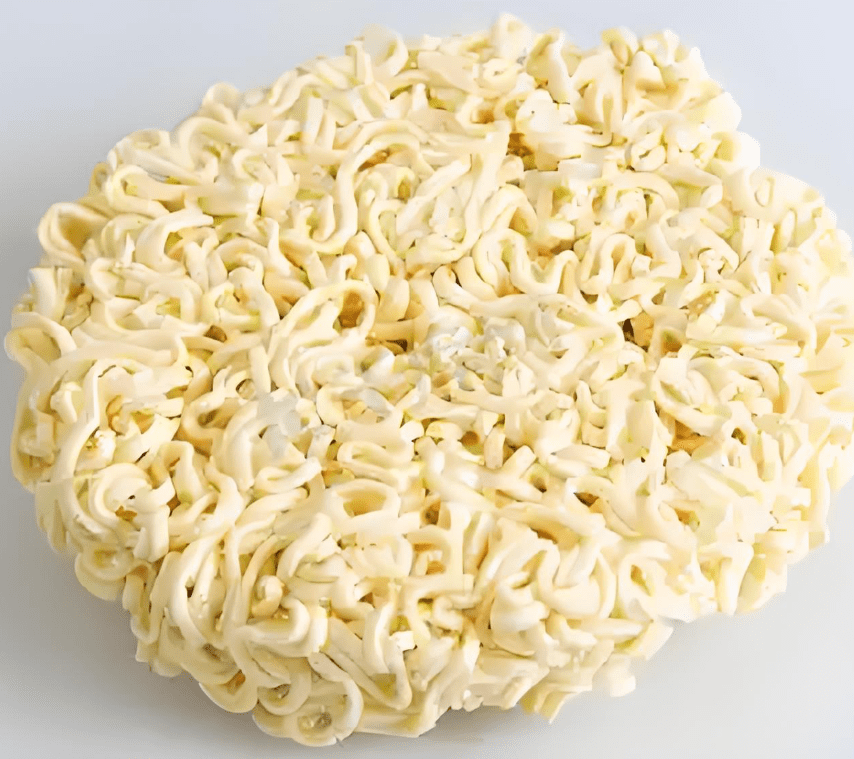
A small-scale fried instant noodle production line is a compact, integrated system designed to transform basic raw materials (flour, water, salt, and oil) into finished, packaged noodle blocks. Unlike massive industrial lines that produce tens of thousands of packs per hour, small-scale equipment is designed for startups, small factories, or R&D facilities, typically producing between 50 kg to 500 kg of noodles per hour.
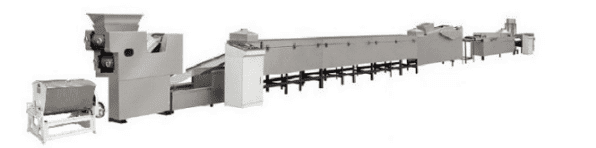
This production line consists of six core systems, each performing a critical function. Below is a detailed breakdown of each component.
System 1: Raw Material Preparation & Dough Mixing
This is the starting point where dry and wet ingredients are combined into a homogenous dough.
1.1 Powder Feeder (Flour Sifter)
- Fonction : Removes impurities and lumps from flour while aerating it for better mixing.
- Small-scale type: A screw conveyor with a vibrating sieve.
1.2 Water Metering & Mixing Unit
- Fonction : Precisely measures water, salt, and alkaline agents (kansui) before adding to flour.
- Small-scale type: A dosing tank with flow meter and solenoid valve.
1.3 Dough Mixer (Horizontal or Vertical)
- Fonction : Mixes flour, water, and additives into a crumbly, semi-dry dough (30–35% moisture).
- Small-scale type: Horizontal ribbon blender or vertical spiral mixer (50–100 kg per batch).
- Key feature: Mixing time control (typically 10–20 minutes) to ensure even gluten development.
System 2: Noodle Formation (Sheeting & Sizing)
This system converts the loose dough crumbs into thin, continuous noodle strands.
2.1 Dough Sheeter (Calendar Roller)
- Fonction : Compresses the dough crumbs into a uniform, flat dough sheet.
- Mechanism: Two or three large steel rollers that progressively reduce the dough thickness.
- Small-scale type: Double-sheeter with adjustable roller gap (1–5 mm).
2.2 Slitting and Wave-Forming Unit
- Fonction : Cuts the dough sheet into individual noodle strands and creates the signature “wave” or curl.
- Mechanism: A slitting roller (multiple circular knives) followed by a wave-forming comb or a differential speed conveyor.
- Small-scale type: Integrated slitter-cutter with adjustable wave amplitude.
2.3 Steaming Box (Pre-Gelatinization)
- Fonction : Partially cooks and gelatinizes the starch in the noodles using saturated steam.
- Temperature: 90–100°C (atmospheric pressure).
- Residence time: 60–120 seconds.
- Small-scale type: A 2–4 meter long enclosed tunnel with steam injection nozzles.
- Purpose: This pre-cooking step reduces frying time and improves noodle texture.
System 3: Block Forming & Frying (The Core Process)
This is where the noodle strands become the final fried noodle block.
3.1 Noodle Block Former (Cutting & Shaping)
- Fonction : Cuts the steamed noodle curtain into individual portions and shapes them into rectangular or round blocks.
- Mechanism: A rotary cutter and a forming box that folds the noodles into a mold.
- Small-scale type: Mechanical or pneumatic cutting press synchronized with conveyor speed.
- Weight range: Typically 70–150 grams per block (adjustable).
3.2 Continuous Fryer (Submerged Oil Bath)

- Fonction : Rapidly removes water from the noodle block, gelatinizes remaining starch, and creates the porous, crispy structure.
- Temperature: 140–160°C.
- Residence time: 60–150 seconds.
- Small-scale type: A single-layer or double-layer frying tank with:
- Electric or gas heating elements submerged in the oil.
- A chain conveyor that pushes noodle blocks through the hot oil.
- Oil circulation pump for even temperature distribution.
- Oil filtration system (optional but recommended) to remove crumbs.
- Key physics: The rapid water evaporation creates the sponge-like texture and reduces final moisture to 3–8%.
3.3 De-Oiling Mechanism (Cooling & Oil Drainage)
- Fonction : Removes excess surface oil and cools the noodles.
- Mechanism: A vibrating conveyor or air blower positioned immediately after the fryer exit.
- Small-scale type: Perforated belt conveyor with oscillating motion + fans.
- Result: Reduces oil content from ~25% (straight out of fryer) to ~18–22%.
System 4: Cooling & Conveying
4.1 Cooling Conveyor (Air Cooling Tunnel)
- Fonction : Lowers the noodle block temperature from ~100°C to near room temperature (25–30°C) before packaging.
- Why important: Hot noodles will cause condensation inside the packaging, leading to mold growth.
- Small-scale type: A 3–5 meter long mesh belt conveyor with ambient or forced-air fans.
System 5: Seasoning Application (Optional but Common)
Not all fried noodle lines include this, but many small-scale lines integrate a simple seasoning system for “instant cup noodle” or “snack noodle” applications.
5.1 Powder Coating Drum (Batch or Continuous)
- Fonction : Sprays or sprinkles seasoning powder onto the noodle block after cooling.
- Small-scale type: A rotating drum (like a concrete mixer) with a powder dispenser.
- Alternative: Seasoning is often packaged separately in a sachet instead of applied to the noodle directly.
System 6: Packaging & Sealing
This final system protects the noodles from moisture, oxygen, and contamination.
6.1 Vertical Form-Fill-Seal (VFFS) Machine
- Fonction : Forms a plastic bag from a roll of film, fills it with one noodle block (and optional seasoning sachet), and seals it.
- Materials: Polypropylene (PP) or oriented polypropylene (OPP) films, often printed.
- Small-scale type: A semi-automatic or fully automatic VFFS machine with:
- Film unwinder.
- Forming tube.
- Vertical and horizontal heat sealers.
- Rotary cutter for individual packs.
6.2 Gas Flushing Attachment (Optional)
- Fonction : Replaces air inside the bag with nitrogen (N₂) before sealing to prevent oxidation and rancidity.
- Small-scale type: A simple gas nozzle integrated into the VFFS machine.
6.3 Batch Coding Machine
- Fonction : Prints production date, batch number, and expiry date on each pack.
- Small-scale type: Inkjet printer or hot-stamp coder mounted on the VFFS.
System Integration Layout (Simplified Flow)
Below is a typical floor plan arrangement for a small-scale line:
Raw Material → [Mixer] → [Sheeter] → [Slitter] → [Steamer] → [Former]
                    ↓
            [Fryer] → [De-oiler] → [Cooling Conveyor] → [Optional Seasoning]
                    ↓
            [VFFS Packaging] → [Batch Coding] → [Finished Product Box]
Summary Table: Small-Scale vs. Large-Scale Equipment
| Composant | Small-Scale | Large-Scale (Industrial) |
|---|---|---|
| Production capacity | 50–500 kg/hour | 2,000–10,000 kg/hour |
| Dough mixer | Batch type (50–100 kg) | Continuous mixer |
| Fryer length | 3–8 meters | 20–40 meters |
| Heating method | Electric or gas (indirect) | Steam or direct gas |
| Automation level | Semi-automatic to PLC-controlled | Fully automatic with remote monitoring |
| Floor space | 50–150 m² | 500–2,000 m² |
| Investment cost | $15,000 – $80,000 USD | $500,000 – $3,000,000 USD |
Optional Add-On Components
For a slightly higher investment, small-scale lines can include:
- Oil filtration system: Continuously removes burnt crumbs, extending oil life by 2–3x.
- Noodle cooling tunnel with dehumidifier: Prevents condensation in humid climates.
- Multi-lane packaging: Wraps 2–4 noodle blocks simultaneously.
- Seasoning sachet filler: Automatically drops a powder or liquid seasoning packet into each bag.
Conclusion
A small-scale fried instant noodle production line is a carefully orchestrated sequence of specialized machines: mixer → sheeter → slitter → steamer → former → fryer → de-oiler → cooler → packager. While each component can be purchased separately, most small-scale producers opt for an integrated line from a single manufacturer to ensure compatibility, easier maintenance, and lower startup costs. The compact design allows a production capacity suitable for local markets, restaurants, or export testing, with the flexibility to expand as demand grows.
Can we visit your factory ?
Yes , wlecome to our factory at any time , you can contact me .
1.Will you help us with the installation ?
Yes , We will send engineers to install and debug the equipment, and assist in training your staff.
2.Are you a factory or trading company?
We are a factory.
3.What certificate do you have?
We have ISO and CE certificate.
4.How long is the warranty period?
All of our machines have one year warranty.
5.What’s the main market of your company?
Our customers all over the world.
6.How much production capacity of your company one year?
This depends on your needs.