
Guide complet pour l'établissement d'une ligne de production de nouilles instantanées à petite échelle
Abstract
This guide provides a thorough, step-by-step framework for entrepreneurs, food technologists, and small-scale industrialists aiming to establish a compact, efficient, and profitable instant noodle production facility. The instant noodle, a staple of modern convenience food, requires a precise interplay of food science, mechanical engineering, and business acumen to produce successfully. This document delves into every critical aspect, Instant noodle making machine supplier from market research and regulatory compliance to the intricate details of the manufacturing process, quality control, and packaging. Designed for a production capacity of approximately 5,000 to 50,000 packets per day, this guide emphasizes scalability, food safety, and cost-effectiveness, providing the foundational knowledge necessary to navigate this complex but rewarding industry.
Table des matières
- Introduction & Feasibility Study
- 1.1. Understanding the Instant Noodle Market
- 1.2. Defining Your Product and Niche
- 1.3. Initial Capital Investment and Financial Projections
- 1.4. Location, Site Selection, and Regulatory Landscape
- Core Production Process: A Stage-by-Stage Breakdown
- 2.1. Stage 1: Raw Material Selection and Handling
- 2.2. Stage 2: Dough Mixing and Kneading
- 2.3. Stage 3: Sheet Forming and Compound Pressing
- 2.4. Stage 4: Slitting and Waving
- 2.5. Stage 5: Steaming
- 2.6. Stage 6: Cutting and Folding
- 2.7. Stage 7: Frying or Air-Drying (The Dehydration Process)
- 2.8. Stage 8: Cooling
- 2.9. Stage 9: Weighing and Packaging
- The Small-Scale Production Line: Machinery and Layout
- 3.1. Detailed Machinery List and Specifications
- 3.2. Production Line Layout for Optimal Flow
- 3.3. Utility Requirements (Power, Water, Steam, Gas)
- 3.4. Sourcing Equipment: New vs. Used
- The Science of the Noodle: Formulation and Quality Control
- 4.1. Wheat Flour Specifications and Gluten Development
- 4.2. The Role of Water, Salt, and Alkaline Agents (Kansui)
- 4.3. Additives: Starches, Gums, and Phosphates
- 4.4. Oil Chemistry: Selection and Management of Frying Oil
- 4.5. Soup Base and Seasoning Sachet Production
- 4.6. In-Process and Final Product Quality Control Protocols
- Ancillary Processes and Support Systems
- 5.1. Soup Base and Powdered Seasoning Manufacturing
- 5.2. Packaging Material Sourcing and Specifications
- 5.3. Warehousing and Raw Material Storage
- 5.4. Finished Goods Storage and Logistics
- Sanitation, Maintenance, and Workforce
- 6.1. Implementing a Food Safety Plan (HACCP)
- 6.2. Sanitation Standard Operating Procedures (SSOPs)
- 6.3. Preventative Maintenance Schedules
- 6.4. Staffing Structure and Skill Requirements
- Troubleshooting Common Production Issues
- Conclusion: Path to Market and Future Scalability
1. Introduction & Feasibility Study
Before a single machine is purchased or a bag of flour is ordered, a rigorous feasibility study is paramount. This phase determines whether your venture is viable, sustainable, and positioned for success.
1.1. Understanding the Instant Noodle Market
The global instant noodle market is vast and competitive, dominated by multinational giants. However, significant opportunities exist for small-scale producers who can capitalize on:
- Local Tastes: Developing flavors that cater specifically to regional or ethnic palates that large corporations may overlook.
- Premiumization: Creating high-quality products using organic ingredients, authentic broths, unique proteins, or healthier dehydration methods (air-drying).
- Special Diets: Targeting niches such as gluten-free, low-sodium, high-protein, or vegan instant noodles.
- Hyper-Local Distribution: Supplying local supermarkets, convenience stores, institutions (colleges, prisons), and food service providers with lower logistics costs and faster turnaround.
Conduct thorough market research to identify your target demographic, understand their purchasing habits, and analyze your competitors’ products, pricing, and distribution channels.
1.2. Defining Your Product and Niche
Your product definition will dictate your equipment and ingredient choices.Instant noodle making machine supplier Key decisions include:
- Noodle Style: Straight, wavy, thick, thin, ribbon-style?
- Dehydration Method:
- Friture : Traditional method. Yields a faster cooking time (typically 3 minutes) and a characteristic rich, oily mouthfeel. Requires a fryer and involves higher oil costs and greater health perceptions.
- Air-Drying (Non-Fried): Healthier perception. Noodles are dried with hot air, resulting in lower fat content. The process is longer, requires more energy for drying, and the cooking time is slightly longer (4-5 minutes). Requires a larger, more energy-intensive drying tunnel.
- Packaging Format: Bag-type, cup-type, or bowl-type? Each requires different filling and sealing machinery.
- Seasoning System: Powder soup, liquid soup, oil sachet, vegetable sachet, chili paste? Will you produce these in-house or outsource?
1.3. Initial Capital Investment and Financial Projections
A small-scale line requires a significant upfront investment. A detailed breakdown is crucial.
- Capital Expenditure (CAPEX):
- Machinery & Equipment: (See Section 3.1 for details) This is the largest cost.
- Factory Renovation: Flooring (epoxy resin), walls, drainage, lighting, ventilation.
- Utility Installations: Electrical upgrades, water lines, steam boiler, compressed air, gas lines.
- Licensing and Permits.
- Operational Expenditure (OPEX):
- Raw Materials (Flour, oil, seasonings, packaging).
- Labor (Production, QC, management).
- Utilities (Electricity, water, gas).
- Maintenance and Repairs.
- Marketing and Distribution.
- Overheads (Rent, insurance).
Create a 3-year financial model projecting your revenue, cost of goods sold (COGS), operating expenses, and net profit. Calculate your break-even point—the production volume at which total revenue equals total costs.
1.4. Location, Site Selection, and Regulatory Landscape
The factory location is critical. Key considerations:
- Space: A minimum of 3,000 to 5,000 square feet (approx. 300-500 sq. meters) is recommended for a small line, including production, storage, and office space.
- Infrastructure: Reliable and ample electricity (likely 3-phase industrial power), clean water supply, and efficient drainage. Good road access for material delivery and product dispatch.
- Zoning: Must be in an area zoned for industrial or light industrial food manufacturing.
- Regulations: You must comply with your national and local food safety regulations (e.g., FDA in the USA, FSSAI in India, EFSA in Europe). This involves:
- Registering your facility.
- Implementing a Food Safety Management System (FSMS) like HACCP.
- Adhering to Good Manufacturing Practices (GMP).
- Accurate nutritional labeling.
Engage with the local food regulatory authority early in the process to understand all requirements.
2. Core Production Process: A Stage-by-Stage Breakdown
The manufacturing process for instant noodles is a continuous, integrated flow. Understanding the science and purpose behind each stage is key to producing a quality product.
2.1. Stage 1: Raw Material Selection and Handling
Quality in, quality out. The primary raw material is wheat flour.
- Flour: For instant noodles, a medium to strong protein content (10-12%) is ideal. The protein, primarily gluten, forms the network that gives the noodle its strength and chewy texture (al dente). The ash content should be low (0.4-0.5%) for a brighter, Instant noodle making machine supplier more appealing noodle color. Flour must be stored in a cool, dry, pest-controlled silo or warehouse.
- L'eau : Potable water is non-negotiable. Its quality and temperature are critical. Water temperature is used to control dough temperature, typically kept between 25-30°C to optimize gluten development without activating enzymes prematurely.
- Salt (Sodium Chloride): Provides flavor and strengthens the gluten network.
- Kansui: This is an alkaline salt solution, typically a blend of Sodium Carbonate and Potassium Carbonate. It is the signature ingredient that gives Asian-style instant noodles their characteristic yellow color, firm, elastic texture, and distinctive flavor. It raises the pH of the dough, which affects the flour components and inhibits spoilage.
- Additifs : Food-grade additives may be used to improve quality:
- Guar Gum or Xanthan Gum: Improve water binding, reduce breakage, and provide a smoother mouthfeel.
- Starches (Tapioca, Potato): Can be added to modify texture and transparency.
- Acidity Regulators (e.g., Sodium Phosphate): Help control pH and stabilize the product.
2.2. Stage 2: Dough Mixing and Kneading
The goal is to create a homogeneous, fully developed dough with a consistent crumb structure.
- Process: Pre-weighed flour is fed into a horizontal or vertical mixer. Water, pre-dissolved with salt and kansui, is added gradually. The mixing action hydrates the flour particles and begins to align the gluten proteins.
- Key Parameters: Mixing time and speed are critical. Under-mixing results in an undeveloped, weak dough. Over-mixing can cause the dough to become too warm and sticky. The ideal final dough temperature is 28-32°C. The dough should have a moisture content of around 32-35%.
- Output: The mixed dough is a crumbly, loose mass, not a smooth ball. It is then conveyed to a resting hopper to allow for water hydration to fully complete and the gluten to relax, which makes it easier to sheet.
2.3. Stage 3: Sheet Forming and Compound Pressing
This stage transforms the crumbly dough into a continuous, smooth, and cohesive sheet.

- Process: The dough crumbs are fed between two large, counter-rotating rollers. This initial pass creates a thick, ragged sheet. This sheet is then fed through a series of progressively narrowing rollers in a “compound press.”
- Key Parameters: The gap between each set of rollers is precisely reduced. This gradual reduction shears and aligns the gluten network, creating a strong, laminated sheet structure. The final sheet thickness is typically between 0.8mm and 1.2mm, depending on the desired noodle thickness. The sheet must be uniform; any variations will lead to inconsistent cooking and dehydration later.
2.4. Stage 4: Slitting and Waving
The continuous sheet is now cut into strands and given its iconic wavy shape.
- Slitting: The sheet passes through a “slitter” – a roller equipped with precisely spaced blades on its surface. This cuts the sheet into parallel strands of the desired width.
- Waving: Immediately after slitting, the straight strands pass through a pair of metal or plastic “wave guides.” These guides create a back-and-forth folding motion, forming the waves. The wavelength and amplitude can be adjusted. The waving process is crucial as it:
- Prevents the noodles from sticking together.
- Creates a looser “nest” that allows steam and hot oil/air to penetrate more evenly during subsequent stages.
- Gives the noodle block its characteristic form.
2.5. Stage 5: Steaming
This is a partial gelatinization process, essential for setting the noodle’s structure.
- Process: The waved noodle strands are conveyed through a steam tunnel. The steam, at around 100°C, condenses on the cooler noodles, transferring heat and moisture.
- Key Parameters: Steam time and temperature are vital. The goal is to gelatinize the starch on the surface and partially in the core of the noodle. Sufficient steaming (typically 1-3 minutes) makes the noodle strands cohere into a block after cutting and allows for rapid rehydration later. Inadequate steaming results in a weak, crumbly block and a white, floury core that doesn’t cook well.
2.6. Stage 6: Cutting and Folding
The continuous ribbon of steamed noodles is now formed into individual blocks.
- Process: The noodles are cut to a specific length by a reciprocating or rotary cutter. Simultaneously, a folding mechanism (often a set of tines or a folding plate) tucks the cut noodles into a rectangular or round mold, forming the familiar block shape. The precision of this cut and fold determines the weight and consistency of the final product.
2.7. Stage 7: Frying or Air-Drying (The Dehydration Process)
This stage removes moisture to preserve the noodle and create its porous, quick-cooking structure.
A. Frying (for Fried Instant Noodles)
- Process: The noodle blocks are conveyed through a long, temperature-controlled oil bath. The oil temperature is typically between 150-160°C. The frying time is short, usually 60-100 seconds.
- Science: The intense heat rapidly vaporizes the water inside the noodle, creating a multitude of tiny pores and channels. The oil replaces the evaporated water, resulting in a fat content of 15-20%. This porous structure is why fried noodles rehydrate in minutes. The frying process also develops flavor and color (Maillard reaction).
- Oil Management: The choice of oil (palm olein is common due to its stability and neutral flavor) is critical. The oil must be continuously filtered to remove food particles and monitored for Free Fatty Acid (FFA) content and peroxide value to prevent rancidity and off-flavors.
B. Air-Drying (for Non-Fried Instant Noodles)
- Process: The noodle blocks pass through a multi-stage drying tunnel. Hot, dehumidified air is blown over the noodles at varying temperatures and humidity levels.
- Science: Drying is much slower than frying, taking 30-60 minutes. The process must be carefully controlled. If the outside dries too quickly, a hard shell forms that traps moisture inside (“case hardening”), leading to spoilage. A gradual reduction in moisture (e.g., from 40% down to 8-10%) is achieved by programming different temperature and humidity zones within the tunnel. The resulting noodle has a much lower fat content (2-5%) but a denser structure, requiring a slightly longer rehydration time.
2.8. Stage 8: Cooling
After the intense heat of frying or drying, Instant noodle making machine supplier the noodles must be cooled to near ambient temperature before packaging.
- Process: A cooling conveyor, often with fans, carries the noodle blocks for several minutes.
- Purpose: Prevents condensation from forming inside the packaging, which would lead to sogginess and microbial growth. It also makes the blocks safe to handle for packaging operators.
2.9. Stage 9: Weighing and Packaging
This final stage ensures product integrity and shelf appeal.
- Weighing: Each noodle block is automatically weighed. Underweight blocks are rejected. This is a critical quality control check.
- Packaging:
- Inner Bag: The noodle block is dropped into a plastic-film bag (often a laminate of BOPP/CPP for moisture and aroma barrier).
- Seasoning Sachet Insertion: One or more seasoning sachets are automatically placed into the bag alongside the noodle block.
- Scellage : The bag is evacuated of air and filled with nitrogen gas (inert gas flushing) before being heat-sealed. Nitrogen flushing removes oxygen, which prevents oxidative rancidity of the frying oil and preserves flavor and color, significantly extending shelf life.
- Outer Packaging: Sealed bags are then collated, counted, and packed into cardboard cartons for shipping.
3. The Small-Scale Production Line: Machinery and Layout
A typical small-scale line is semi-automatic, requiring operator intervention at key points like material loading and packaging.
3.1. Detailed Machinery List and Specifications
- Flour Sifter/Siever: To aerate flour and remove foreign materials.
- Automatic Weighing and Mixing System:
- Flour Hopper with automatic weigher.
- Solution Tank with mixer and pump for salt/kansui water.
- Dough Mixer: A double-arm or horizontal mixer with a capacity of 50-100kg per batch.
- Dough Resting Hopper: A covered, temperature-controlled hopper that holds the crumbly dough for 15-30 minutes.
- Compound Sheeter: A series of 4 to 6 pairs of rollers that gradually reduce the dough sheet to the desired thickness.
- Slitter and Waver: A unit that cuts the sheet into strands and imparts the wave.
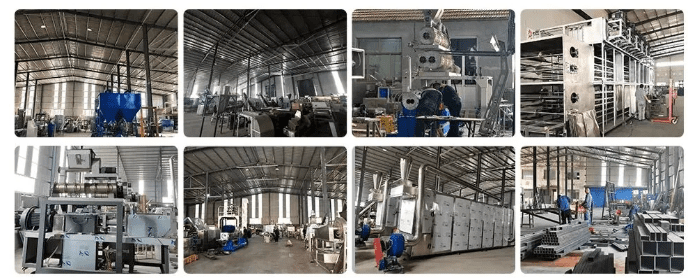
- Steaming Tunnel: A stainless-steel tunnel, 3-6 meters long, with a steam generator (boiler).
- Noodle Cutter and Folding Machine: Forms the individual blocks.
- Dehydration Unit:
- For Frying: A continuous fryer (6-10 meters long) with a temperature controller, oil circulation system, and oil filtration unit.
- For Air-Drying: A multi-zone drying tunnel (15-25 meters long) with independent temperature and humidity controls for each zone.
- Cooling Conveyor: A mesh conveyor 5-10 meters long with cooling fans.
- Automatic Weigher and Checkweigher: Weighs each block and rejects under/overweight ones.
- Packaging Machine: An automatic bag-forming, filling, and sealing machine capable of nitrogen flushing. This is often the most complex and expensive single machine on a small line.
- Seasoning Sachet Packaging Machine (if producing in-house): A separate machine to form, fill, and seal the powder or liquid seasoning sachets.
3.2. Production Line Layout for Optimal Flow
The layout should follow a linear, U-shaped, or L-shaped flow to minimize cross-traffic and contamination risk.
- Raw Material Infeed: One end of the facility receives flour and other dry ingredients.
- Wet Process Area: Dough mixing, sheeting, slitting, waving, and steaming. This area requires good drainage and humidity control.
- Dehydration Area: The fryer or dryer is a major heat source and should be well-ventilated.
- Cooling and Dry Area: After dehydration, the area should be kept clean, dry, and cool.
- Packaging Area: This should be the most environmentally controlled area, with positive air pressure to keep dust out. The packaging machines are placed here.
- Finished Goods Outfeed: The other end of the facility where cartoned products are palletized for storage.
3.3. Utility Requirements
- Electricity: A 3-phase industrial power supply is essential. Total connected load for a small line can range from 80 to 150 kW.
- L'eau : Requires a consistent supply of clean, potable water. A water treatment system (softening, filtration) may be necessary depending on local water quality.
- Steam: A gas or electric-fired boiler is needed for the steaming tunnel. Capacity: 0.5 to 1.5 tons/hour.
- Gas: If using a gas-fired fryer or boiler.
- Compressed Air: Required for pneumatic controls on machinery.
3.4. Sourcing Equipment: New vs. Used
- New Equipment: High cost, but comes with warranties, technical support, and modern efficiency and safety features. Recommended for core machines like the mixer and packaging machine.
- Used/Refurbished Equipment: Lower initial cost, but carries risks of hidden faults, lack of spare parts, and higher maintenance costs. A thorough inspection by a qualified engineer is mandatory. Can be a good option for robust, simple machines like sheeters or conveyors.
4. The Science of the Noodle: Formulation and Quality Control
Consistency is king. Small variations in formulation or process can lead to significant defects.
4.1. Wheat Flour Specifications and Gluten Development
Work closely with your flour supplier. Specify your requirements: protein content, ash content, moisture, and falling number (a measure of enzymatic activity). Regularly test incoming flour batches to ensure consistency.
4.2. The Role of Water, Salt, and Alkaline Agents (Kansui)
- Water Absorption: The amount of water added determines dough consistency. It must be precise and consistent.
- Kansui Ratio: The ratio of sodium to potassium carbonate affects color and flavor intensity. Experiment to find the perfect blend for your product.
4.3. Oil Chemistry: Selection and Management of Frying Oil
For fried noodles, oil is a primary ingredient. Use high-stability oils (e.g., palm olein, high-oleic sunflower oil). Implement a robust oil management protocol:
- Filtration: Continuous or batch filtration to remove particulates.
- Turnover: Regularly add fresh oil to maintain quality (the “oil turnover rate”).
- Testing: Daily tests for FFA (<0.25%) and Peroxide Value (<2 meq/kg).
4.4. Soup Base and Seasoning Sachet Production
This is where you differentiate your product.
- Powder Bases: Typically a blend of salt, MSG, sugar, yeast extract, spices, and dehydrated vegetables/meat powders. You will need a powder mixer (ribbon blender) and a sachet packaging machine.
- Liquid/Paste Bases: Require cooking kettles, homogenizers, and more complex liquid filling machines. They offer richer flavor but have a shorter shelf life and are more prone to leakage.
4.5. In-Process and Final Product Quality Control Protocols
QC must be integrated at every stage.
- Incoming Raw Materials: Inspect and test flour, oil, and packaging.
- In-Process Checks:
- Dough: Temperature and moisture.
- Sheet: Thickness and uniformity.
- Steamed Noodle: Degree of gelatinization (using a colorimetric test with iodine).
- Fried Noodle: Oil temperature, frying time, final oil content.
- Dried Noodle: Moisture content at different stages of the tunnel.
- Final Product Checks:
- Weight: Ensure it meets labeled weight.
- Teneur en eau : <10% for fried, <12% for air-dried.
- Oil Content: For fried noodles (typically 16-20%).
- Rehydration Test: Cook noodles in boiling water for the specified time and evaluate texture, taste, and broth clarity.
- Évaluation sensorielle : Trained panel assesses color, aroma, flavor, and texture.
- Tests microbiologiques : Total plate count, yeast, and mold to ensure shelf-life stability.
- Packaging Integrity: Check seal strength and gas flush efficiency (oxygen analyzer).
5. Ancillary Processes and Support Systems
A successful operation depends on robust support systems.
5.1. Soup Base Manufacturing
If done in-house, this requires a separate, dedicated area to prevent cross-contamination of flavors. You’ll need:
- Dry and wet ingredient storage.
- Weighing scales.
- Powder mixer (for powders).
- Cooking kettle, homogenizer, and filler (for liquids).
- Sachet packaging machine.
5.2. Packaging Material Sourcing
The packaging must protect the product.
- Inner Bag: Must have excellent moisture and oxygen barrier properties. Laminates of Polypropylene (PP), Polyethylene (PE), and metalized films are common.
- Seasoning Sachet: Must be compatible with the seasoning (e.g., aluminum foil laminate for oily pastes).
- Cartons: Corrugated cardboard for shipping.
5.3. Warehousing
- Raw Material Warehouse: Store flour on pallets away from walls, in a cool, dry environment. Oil should be stored in tanks or drums.
- Finished Goods Warehouse: Similarly cool and dry. Practice First-In-First-Out (FIFO) inventory management.
6. Sanitation, Maintenance, and Workforce
6.1. Implementing a Food Safety Plan (HACCP)
Hazard Analysis Critical Control Point (HACCP) is a systematic, Instant noodle making machine supplier preventive approach. It involves:
- Conducting a hazard analysis.
- Determining the Critical Control Points (CCPs) – points where a hazard can be prevented, eliminated, or reduced to an acceptable level. In noodle production, CCPs are typically the frying/drying stage (kills pathogens) and the metal detection stage.
- Establishing critical limits for each CCP (e.g., fryer temperature must be >150°C).
- Establishing monitoring procedures.
- Establishing corrective actions.
- Establishing verification procedures.
- Establishing record-keeping procedures.
6.2. Sanitation Standard Operating Procedures (SSOPs)
Detailed, written procedures for cleaning every piece of equipment and area of the factory. This includes daily cleaning of machines, weekly deep-cleaning, and pest control measures.
6.3. Preventative Maintenance Schedules
Breakdowns are costly. Create a schedule for inspecting, lubricating, and replacing wear parts on all machinery (e.g., roller bearings, conveyor belts, fryer baskets, sealing jaws).
6.4. Staffing Structure
A small operation may require:
- Production Manager
- Food Technologist / QC Manager
- Machine Operators (2-3 per shift)
- Packaging Operators (2-3 per shift)
- Maintenance Technician (can be part-time)
- Sanitation Crew
7. Troubleshooting Common Production Issues
- Noodle Block Too Hard/Dense: Dough too dry, over-mixing, insufficient steaming, or dehydration too rapid (case hardening in air-drying).
- Noodle Block Too Soft/Crumbly: Dough too wet, under-mixing, insufficient steaming.
- Noodles Stick Together: Inadequate waving, insufficient dusting flour, or over-steaming.
- Uneven Color: Inconsistent kansui dispersion, uneven steaming, or uneven frying/drying.
- Short Shelf Life / Rancidity: Poor oil quality, inadequate nitrogen flushing, poor packaging seal, or storage in warm conditions.
- High Breakage Rate: Weak gluten in flour, improper dough development, or excessive drying.
Launching a small-scale instant noodle production line is a challenging yet attainable goal. Success hinges on meticulous planning, a deep understanding of the food science involved, Instant noodle making machine supplier and an unwavering commitment to quality and safety. Start by solidifying your business plan, securing funding, and navigating the regulatory environment. Then, focus on engineering a reliable production process and creating a product that genuinely resonates with your target market.
Begin with a focused product portfolio—perhaps one or two core flavors—and master their production before expanding. As your brand gains recognition and your operational efficiency improves, you can consider scaling up. This could involve adding a second production line, expanding into cup-noodle production, or automating further to increase capacity and reduce labor costs.
The journey from raw flour to a convenient, satisfying meal in a packet is a complex ballet of chemistry and engineering. By following this comprehensive guide, you are equipped with the knowledge to choreograph this process, turning a simple idea into a thriving and nourishing business.