
Introduction
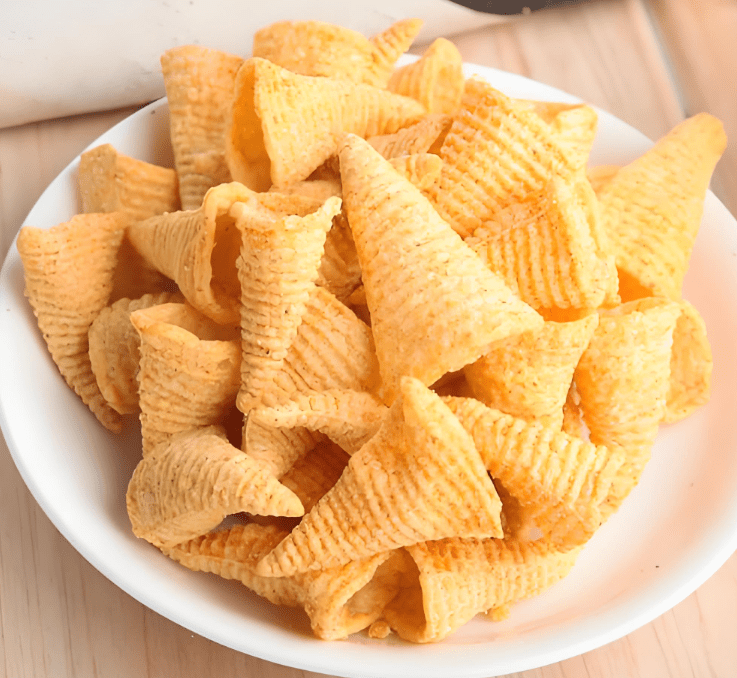
Bugles are a distinctive horn-shaped corn snack produced by General Mills. First launched in 1964 in the United States, Bugles have since become a global brand with a particularly strong presence in the Chinese market, where they were introduced in 1999 and now feature over a dozen localized flavors . What sets Bugles apart from ordinary flat potato chips or corn curls is their three-dimensional, hollow horn shape—a geometry that requires a highly engineered manufacturing process. This article examines the industrial methods used to transform simple corn meal into these iconic crispy cones.
Raw Materials
The ingredient list for Original Bugles is deceptively short. According to General Mills’ official product specifications, the components are: degermed yellow corn meal, vegetable oil (coconut and/or palm), sugar, salt, distilled monoglycerides, baking soda, and BHT as a freshness preservative . The use of coconut oil is notable—it contributes a significantly higher proportion of medium-chain triglyceride saturated fat compared to snacks fried in soybean or other vegetable oils, and Bugles contain no hydrogenated oils .
In the Chinese market, however, the formulation emphasizes a blend of starches rather than solely corn meal. Baidu Baike’s entry on bugles describes the primary raw materials as corn starch, rice starch, and potato starch . This multi-starch approach is designed to achieve the specific textural and expansion characteristics required for the 3D shape.
The Manufacturing Process
Mixing and Preconditioning
The process begins with dry ingredients being mixed uniformly with water to achieve a pre-moistened state. This step allows the starches to begin hydrating, a crucial preparation for later expansion. The moisture content of the mixed material is typically controlled between 28% and 35% . This hydration phase influences the final product’s forming quality more than almost any other variable in the early stages.
Extrusion and Cooking
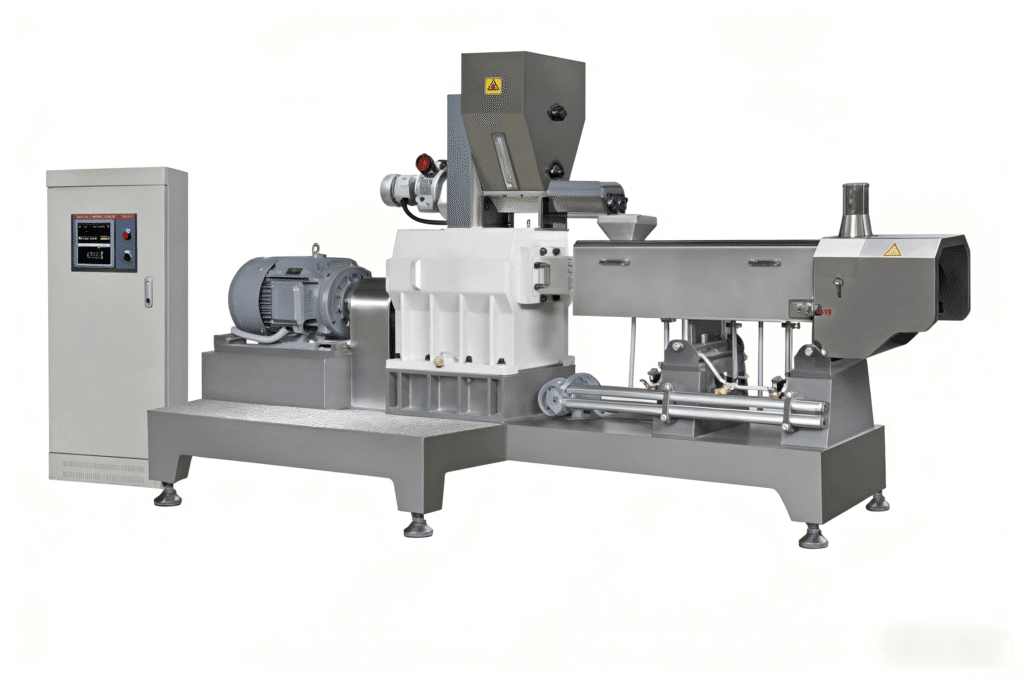
The hydrated mixture then enters a screw extruder, where it undergoes significant thermal and mechanical processing. The material is cooked to approximately 90%–100% gelatinization, transforming into a plastic, molten state free of residual stress. This is achieved through a specialized screw design and a temperature-controlled barrel, typically maintained at 100–120°C with internal pressures of 2–3 atmospheres .
A key patent describing similar extrusion technology notes that cooked cereal dough can reach temperatures of 120–194°C during processing . The starch granules are disrupted, and the material becomes a continuous, moldable matrix.
Sheeting and Cooling
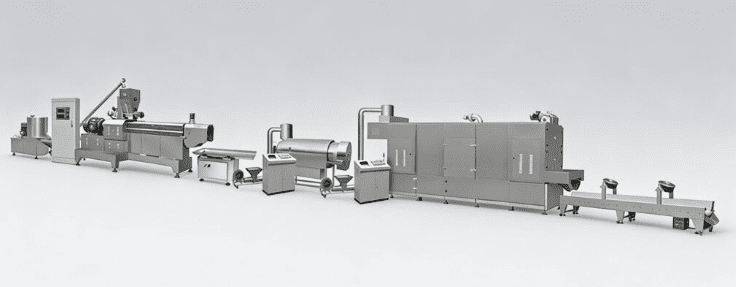
From the extruder, the cooked dough is forced through a specialized die to form a wide, thin sheet—approximately 200 mm wide and 0.8–1 mm thick. The sheet emerges semi-transparent and possessing good flexibility . This thickness is critical: it directly determines how the subsequent composite forming and drying steps will proceed. The die is equipped with pressure-balancing mechanisms to ensure uniform output.
The extruded sheet must then be cooled over a length of 8–12 meters. This cooling step is essential for ensuring that the sheet can be cleanly released from the forming equipment without sticking or tearing. To conserve factory floor space, the cooling conveyor is often arranged in a vertically circulating configuration that still provides the minimum required 10 meters of cooling path .
Embossing and Composite Forming
This is the step that gives Bugles their signature shape. The process involves three coordinated programs. First, embossing rollers press a mesh-like pattern onto the sheet’s surface while simultaneously pulling it forward. For animal-shaped or other products that do not require surface patterning, smooth rollers can be substituted that perform only the traction function .
Second, two sheets are guided into alignment and fed together through a composite roller. The embossed layers bond at the cutting surfaces, creating the hollow, three-dimensional horn form. Third, any excess material is recovered by a return conveyor system that feeds it back into the extruder, ensuring continuous production with minimal waste .
Drying
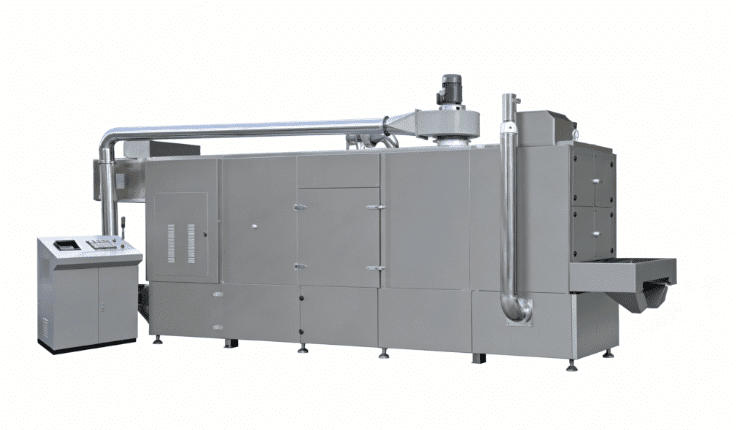
The freshly formed Bugles “half-products” (pellets) emerge with a moisture content of 20%–30%. Before they can be fried, this must be reduced to approximately 12% . Because the pellets have now developed a dense, structural form, rapid drying at high temperatures would cause cracking or deformation. Instead, they are dried slowly at lower temperatures—typically around 60°C—over an extended period to maintain shape stability .
A subtle but important detail: to prevent the composite pellets from sticking to each other during drying, the equipment often incorporates a micro-vibration mechanism that gently separates the pieces as they dry .
Frying and Expansion
The dried pellets now enter the deep fryer, where the final transformation occurs. The frying oil serves two purposes: it cooks the product to completion, and it drives off the remaining moisture, bringing the final water content down to 2%–3%. As the water inside the dense pellet rapidly vaporizes, the internal structure expands dramatically—the pellets puff to 2–3 times their original size, creating the porous, crispy texture and solidifying the 3D shape .
General Mills uses coconut oil and/or palm kernel oil for frying, which contributes to the product’s characteristic crispness and distinctive saturated fat profile . After frying, the Bugles are centrifuged to remove excess surface oil, addressing the greasiness that can accompany fried snacks .
Seasoning and Packaging
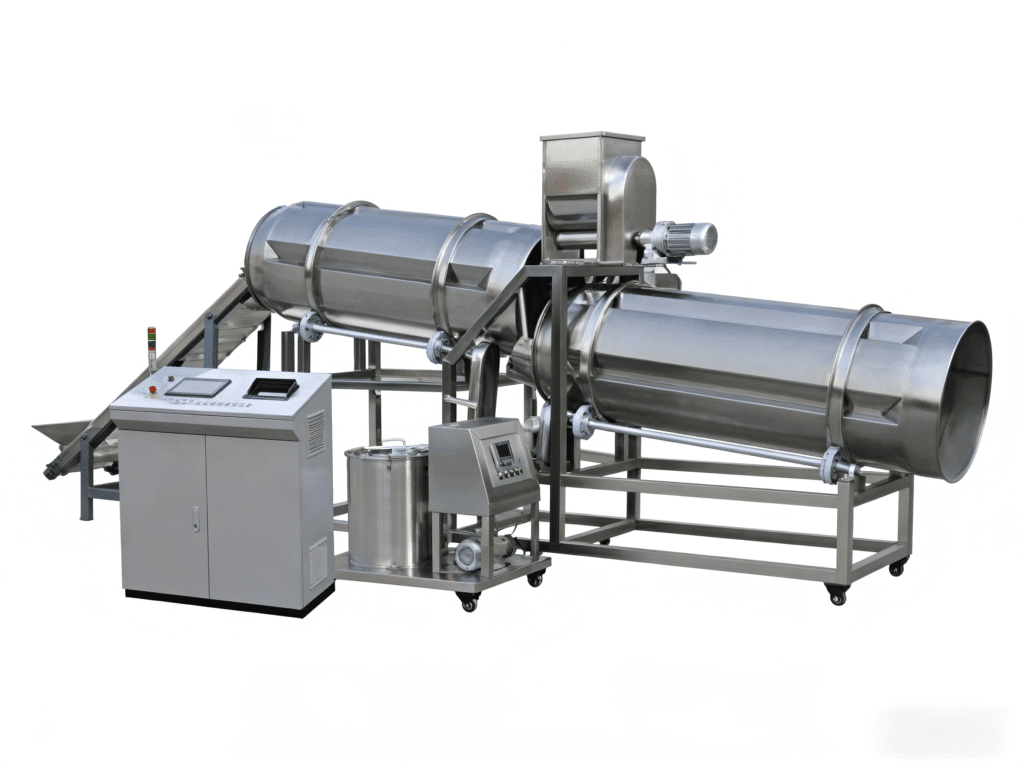
The final step is topical seasoning. Powdered flavorings are applied to the fried Bugles using automatic drum seasoning machines or powder sprayers, depending on the specific flavor profile being produced . The seasoned product is then packaged under conditions that protect against moisture absorption and oxidation, with BHT included in the formulation to preserve freshness .
Conclusion
The manufacture of Bugles is a multi-stage industrial process that transforms ordinary corn and starch powders into a structurally complex, three-dimensional snack. From precise moisture control during mixing to the delicate balance of extrusion temperature and pressure, from the cold-forming of composite sheets to the explosive expansion during frying, each step is engineered to produce a consistent, recognizable product. The next time you place one of these horn-shaped snacks on your fingertips, consider the remarkable series of physical and chemical transformations—gelatinization, extrusion, lamination, dehydration, and rapid vapor expansion—that brought it there.