
Essential Considerations for Operating an Extruder in Puffed Cereal Production
1. Pre-Startup Procedures: The Foundation for Success
Before energizing the machine, thorough preparation is essential.
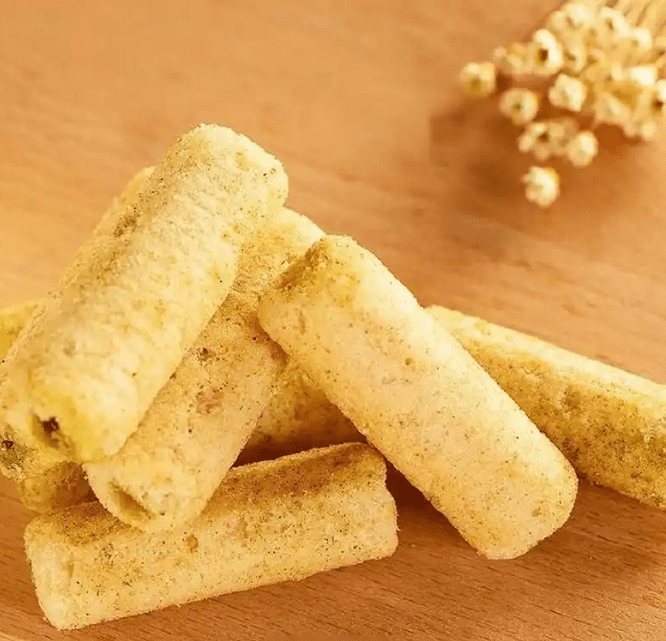
- Equipment Inspection & Cleaning:
- Barrel and Screws: Visually inspect for signs of wear, corrosion, or residual material from the previous run. Ensure the barrel and screw configuration (type, arrangement) is correct for the specific product (e.g., corn puffs vs. high-protein cereal). A mismatch can cause poor performance or damage.
- Die Assembly: Check the die plate for cleanliness, ensuring flow channels are not clogged. Verify that the die is securely fastened and aligned. The die shape directly determines the product’s final form (rings, balls, stars).
- Cutting Mechanism: Inspect the rotary cutter blades for sharpness and proper clearance from the die face. Dull blades will tear the product instead of cutting it cleanly, creating fines and irregular shapes.
- Lubrication: Check all grease points and oil levels per the manufacturer’s manual. Bearings in the drive assembly and screw shaft are under tremendous stress and require proper lubrication to prevent catastrophic failure.
- Utility Verification:
- Steam & Water: Confirm that steam pressure and cooling water supply to the barrel jackets are stable and at the required parameters. Leaks must be addressed immediately.
- Electrical & Control Systems: Ensure all safety interlocks (guards, emergency stops) are functional. Boot up the control system (PLC/SCADA) and verify that temperature, pressure, and motor load sensors are reading correctly.
- Material Readiness:
- The pre-blended raw material (e.g., cornmeal, flavorings) should be tested for consistent particle size and moisture content. Variations here are the most common cause of process instability.
- Ensure the feed hopper is ready and the feeding system (often a loss-in-weight feeder) is calibrated to deliver the target mass flow rate.
2. Startup & Process Stabilization: A Controlled Ramp-Up
A gradual, controlled startup prevents equipment shock and material waste.

- Initial Purging: Start the extruder drive motor at a low speed (e.g., 10-20% of rated RPM) with the feed turned off. Gradually introduce a low-moisture, high-fiber purge material (like oat bran) to clean the barrel and warm the system gently.
- Sequential Parameter Adjustment: Do not immediately set parameters to the final “run” values. Follow a stepwise approach:
- Begin heating the barrel zones to the target cooking temperature.
- As the purge material exits and the barrel warms, slowly introduce the production formula.
- Gradually increase the screw speed and feed rate in tandem until the desired throughput is reached.
- Fine-tune the moisture injection (steam/water) to achieve the proper melt consistency. The operator should learn to recognize the sound and appearance of a well-balanced extrudate—smooth, consistent, and emerging steadily from the die.
- Achieving Equilibrium: The goal is to reach a steady-state condition where key parameters—motor load (amperage), die pressure, and product temperature—are stable. This may take 15-30 minutes. Product from this transition phase is often off-spec and should be diverted.
3. Critical In-Process Monitoring & Adjustment
Once stable, continuous vigilance is required to maintain quality.
- Monitor Key Parameters:
- Motor Load (Amperage): The primary indicator of mechanical energy input. A sudden spike can indicate a blockage or overly dry feed. A drop can signal a loss of feed or too much moisture.
- Die Pressure: Monitored via transducers. High pressure ensures proper cooking and expansion. A falling pressure can warn of wear, a feed shortage, or incorrect viscosity.
- Barrel Zone Temperatures: Critical for controlling starch gelatinization and protein denaturation. The final cooking zone temperature most directly affects expansion.
- Conduct Sensory Checks:
- Regularly examine the extrudate as it leaves the die. Look for:
- Uniformity of Shape and Size
- Surface Texture (should be smooth, not rough or “shark-skinned”)
- Color
- Expansion Ratio (cut a sample and measure its density; lower density = higher expansion)
- Regularly examine the extrudate as it leaves the die. Look for:
- Manage Moisture Balance: The single most critical variable. Incoming material moisture, injected steam/water, and mechanical shear all contribute. Small adjustments can have large effects on product density and texture.
4. Safety: The Non-Negotiable Priority
Extruders are powerful machines with inherent hazards.
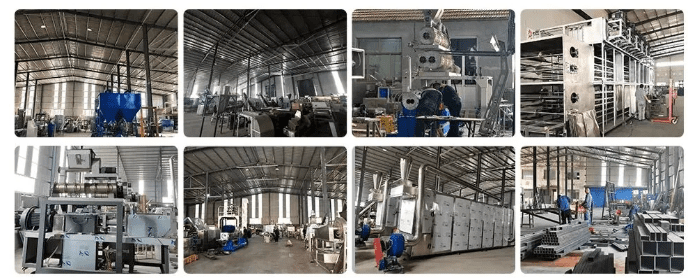
- Physical Hazards:
- Rotating Parts: Never reach into the feed throat or near the screws while the machine is running. All guards must be in place.
- High Pressure/Temperature: The molten dough inside can be at pressures exceeding 50 bar and temperatures over 150°C (300°F). Never stand directly in front of the die during startup or adjustment. Use proper tools for die changes after the system is fully depressurized and cooled.
- Hot Surfaces: Barrel jackets, dies, and product are extremely hot. Wear appropriate heat-resistant gloves and PPE.
- Lockout/Tagout (LOTO): This procedure is mandatory for any maintenance, cleaning, or die change. Isolate all energy sources (electrical, steam, hydraulic) and verify isolation before beginning work.
5. Shutdown & Cleaning Procedures
A proper shutdown ensures a smooth next startup and maintains hygiene.
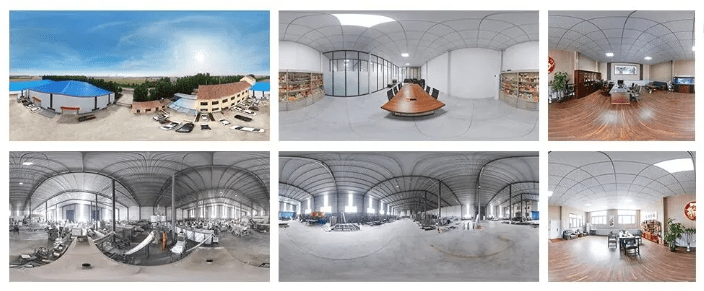
- Orderly Ramp-Down: Do not simply turn off the feed and motor.
- Switch the feed to a purge material (e.g., dry oatmeal, soy grits) to push out the production formula.
- Gradually reduce moisture injection and screw speed.
- Once purge material is exiting cleanly, stop the feed and allow the screws to run until the barrel is nearly empty.
- Turn off barrel heaters and reduce screw speed to minimum before stopping the motor. This prevents material from baking onto the screws.
- Disassembly and Cleaning: After LOTO, disassemble the die head and screws. Use appropriate tools (brass scrapers, approved foaming cleaners) to remove all residual product. Avoid abrasive tools that scratch surfaces. Dry all components thoroughly before reassembly to prevent rust.
Mastering extruder operation requires a deep understanding of the interplay between mechanical inputs (screw speed, configuration), thermal energy (barrel temperature), and material properties (moisture, composition). By rigorously following pre-operational checks, implementing a controlled startup, maintaining diligent in-process monitoring, prioritizing safety above all else, and executing thorough clean-downs, operators can ensure the consistent production of high-quality puffed cereal while maximizing equipment life and ensuring a safe working environment. Continuous training and documentation of optimal parameters for each product are the hallmarks of an expert extrusion team.