
Breakfast corn flakes are among the most popular breakfast cereal products worldwide. They are widely consumed because of their crispy texture, convenient preparation, nutritional value, and versatility. They can be eaten directly or served with milk, yogurt, fresh fruit, and other ingredients.
With the increasing demand for convenient and nutritious breakfast foods, more food manufacturers are investing in corn flakes production lines. However, producing high-quality breakfast corn flakes is not simply a matter of mixing corn flour and processing it through machines. Every production stage, from raw material selection to final packaging, requires careful attention.
So, what problems should manufacturers pay attention to during breakfast corn flakes production? How can they improve product quality, maintain consistent texture, and reduce production losses? This article discusses the most important considerations.

1. Pay Attention to Raw Material Selection
Raw material quality is the foundation of breakfast corn flakes production. The main ingredient is corn, and its quality directly influences the color, flavor, texture, and nutritional characteristics of the finished product.
Common ingredients include:
- Corn grits: The primary raw material, providing the characteristic corn flavor and structure.
- Sugar: Adds sweetness and improves the overall taste.
- Salt: Balances the flavor and enhances the natural sweetness of corn.
- Malt extract: Can contribute to flavor development and browning.
- Agua: Adjusts the moisture content of the mixture.
- Vitamins and minerals: Used in fortified breakfast cereal formulations.
- Other permitted ingredients: Depending on the formulation, manufacturers may add flavoring ingredients or other functional components.
Several issues should be considered when selecting raw materials:
First, corn grits should have consistent particle size. Excessively large particles may cause uneven cooking, while excessively fine particles can affect the texture and processing performance.
Second, raw materials should be clean and free from foreign materials, mold, and abnormal odors.
Third, manufacturers should establish strict supplier evaluation and incoming material inspection procedures to ensure consistent quality.
2. Control the Proportion of Ingredients
The ingredient formulation directly affects the taste, texture, color, and nutritional value of breakfast corn flakes.
Different manufacturers may use different formulations depending on their target markets and product positioning.
For example, products intended for children may emphasize sweetness and flavor, while healthier breakfast cereals may focus on whole grains, lower sugar content, and added vitamins and minerals.
During formulation, manufacturers should pay attention to the following:
- The proportion of corn grits and other cereal ingredients.
- Sugar and salt content.
- Water addition.
- The amount and stability of added vitamins and minerals.
- The effects of ingredients on extrusion and cooking performance.
An unsuitable formulation may result in poor expansion, uneven color, insufficient crispness, or an undesirable taste.
Therefore, manufacturers should conduct repeated formulation tests before starting large-scale production.

3. Ensure Uniform Mixing
After preparing the ingredients, they are transferred into a mixing machine.
Mixing is an important step because it ensures that corn grits, water, sugar, salt, and other ingredients are distributed evenly.
Uneven mixing can lead to differences in moisture content and ingredient concentration, which may affect cooking and flaking performance.
For better mixing results, manufacturers should:
- Weigh each ingredient accurately.
- Add water gradually according to the formulation.
- Control the mixing time.
- Ensure uniform moisture distribution.
- Avoid excessive water addition.
The mixture should have consistent moisture before entering the cooking or extrusion stage.
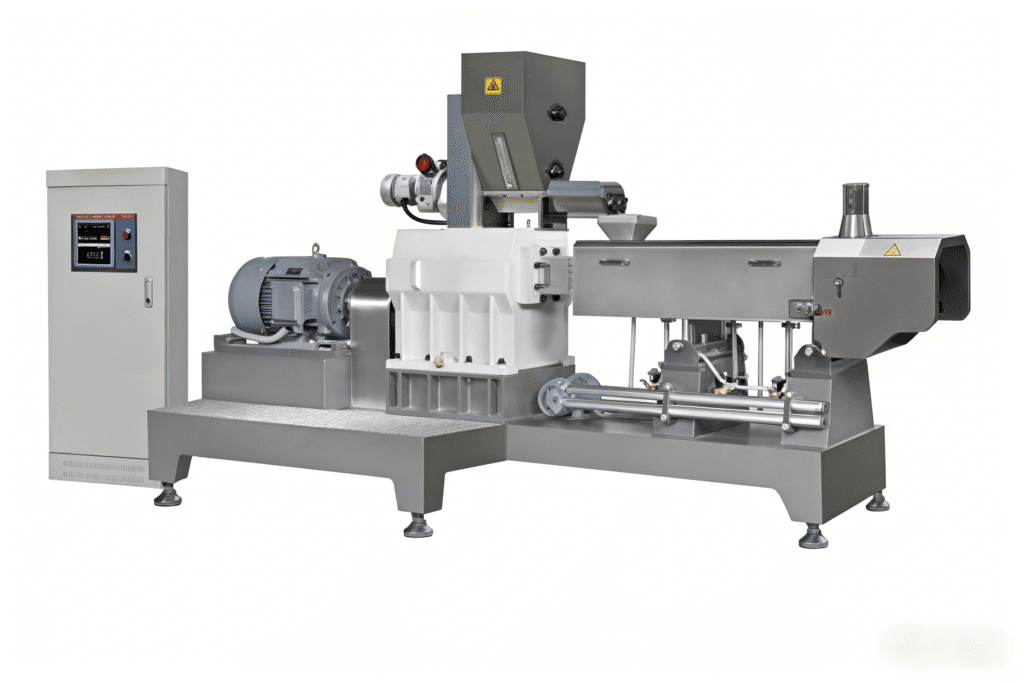
4. Pay Attention to Cooking and Extrusion Conditions
Cooking is an essential stage in breakfast corn flakes production.
Depending on the production technology, manufacturers may use a batch cooker or a continuous cooking extruder.
During cooking, heat and moisture cause starch gelatinization and help develop the structure required for subsequent flaking.
For extrusion-based production, the material is transported through the extruder, where it experiences mechanical shear, pressure, and heat.
Several parameters require careful control:
Temperature: An appropriate temperature ensures sufficient cooking. Excessive temperatures may cause overprocessing, while insufficient temperatures can result in incomplete starch gelatinization.
Moisture content: Proper moisture helps maintain stable material flow and uniform cooking.
Screw speed: The screw speed affects material residence time, shear, and cooking intensity.
Feeding rate: The feeding rate should remain consistent to prevent fluctuations in product quality.
Manufacturers should adjust these parameters according to the raw material characteristics and equipment specifications.
5. Control the Flaking Thickness
Flaking is one of the most important stages in breakfast corn flakes production.
After cooking, the cereal material is processed into suitable pieces or pellets and then passed through flaking rollers to form thin flakes.
The thickness of the flakes directly affects their crispness, appearance, cooking characteristics, and eating experience.
If the flakes are too thick, they may become hard and difficult to chew. If they are too thin, they may break easily during subsequent drying, roasting, and packaging.
Manufacturers should pay attention to:
- Roller gap adjustment.
- Roller pressure.
- Material feeding uniformity.
- Roller surface condition.
- Flake thickness consistency.
The flaking rollers should be inspected and maintained regularly to prevent uneven pressure and inconsistent product dimensions.
6. Pay Attention to Drying Conditions
After flaking, breakfast corn flakes usually contain excessive moisture and must be dried before roasting.
Drying helps reduce moisture content and prepares the flakes for subsequent heat treatment.
During drying, manufacturers should carefully control temperature, airflow, and drying time.
The following issues deserve particular attention:
Avoid excessive drying: Overdrying may make the flakes fragile and increase breakage during transportation.
Prevent insufficient drying: Excessive residual moisture can affect roasting performance and finished-product crispness.
Maintain uniform airflow: Uneven hot-air circulation may cause differences in moisture content between different areas of the dryer.
Control product loading: Excessive material accumulation can prevent hot air from contacting the flakes evenly.
A well-designed drying system helps improve product consistency and reduce unnecessary energy consumption.
7. Control the Roasting Temperature
Roasting is another critical stage in breakfast corn flakes production.
After drying, the flakes enter a roasting oven, where controlled heat treatment develops their characteristic golden color, crispy texture, and roasted corn aroma.
Roasting temperature and time must be carefully adjusted according to flake thickness, moisture content, and formulation.
If the temperature is too high, the flakes may become excessively dark, develop a burnt flavor, or lose their desirable appearance.
If the temperature is too low, the finished flakes may not develop the expected crispness and aroma.
Manufacturers should regularly monitor oven temperature and ensure that heat is distributed evenly throughout the roasting chamber.
8. Pay Attention to Sugar Coating and Seasoning
To meet different consumer preferences, breakfast corn flakes are often coated with sugar or other flavoring ingredients.
Common varieties include:
- Original corn flakes.
- Honey corn flakes.
- Chocolate corn flakes.
- Cinnamon corn flakes.
- Fruit-flavored corn flakes.
- Low-sugar corn flakes.
Sugar coating should be applied evenly to avoid excessive sweetness in some areas and insufficient flavor in others.
If a liquid coating is used, the spraying system should provide stable and uniform distribution.
After coating, additional drying or setting may be necessary to stabilize the coating and prevent the flakes from sticking together.
For fortified breakfast cereals, heat-sensitive vitamins and minerals require special consideration. Their addition point and processing conditions should be selected to minimize nutrient losses.
9. Ensure Uniform Cooling
After roasting and coating, the corn flakes should be cooled before packaging.
Cooling is necessary to reduce product temperature and prevent condensation inside the package.
If the flakes are packaged while still hot, moisture may accumulate inside the package, reducing crispness and potentially affecting storage stability.
During cooling, manufacturers should pay attention to:
- Cooling air cleanliness.
- Airflow uniformity.
- Product temperature.
- Conveyor speed.
- Environmental humidity.
The cooling system should be designed to minimize product breakage while ensuring that the flakes reach a suitable packaging temperature.
10. Strengthen Quality Inspection
Quality inspection should be conducted throughout the production process rather than only at the end.
Manufacturers should establish clear quality standards and regularly inspect important production indicators.
Key inspection items include:
| Inspection item | Main purpose |
|---|---|
| Raw material quality | Prevent unsuitable ingredients from entering production |
| Moisture content | Maintain stable processing and crispness |
| Flake thickness | Ensure consistent product structure |
| Color | Prevent under-roasting or excessive browning |
| Texture | Ensure the desired crispness |
| Flavor and aroma | Maintain consistent product taste |
| Nutritional content | Verify formulation and fortification claims |
| Microbiological safety | Ensure food safety |
In addition, manufacturers should establish procedures for detecting foreign materials and controlling potential contamination.
11. Choose Suitable Packaging Materials
Breakfast corn flakes are sensitive to moisture. Once they absorb moisture from the environment, they can quickly lose their characteristic crispy texture.
Therefore, packaging plays a major role in maintaining product quality and shelf life.
Common packaging options include:
- Laminated plastic bags.
- Moisture-resistant cereal bags.
- Inner bags placed inside cardboard boxes.
- Other food-grade packaging materials with suitable barrier properties.
Manufacturers should pay attention to the following packaging details:
Moisture barrier: Packaging materials should prevent moisture from entering the package.
Oxygen barrier: Appropriate oxygen protection helps reduce oxidation and preserve flavor.
Sealing performance: Poor sealing may lead to moisture absorption and product contamination.
Packaging strength: The material should protect fragile flakes from excessive crushing during transportation.
Nitrogen flushing may also be considered when appropriate for the product formulation and packaging system.
12. Maintain and Clean Production Equipment Regularly
Equipment maintenance and sanitation are essential for stable breakfast corn flakes production.
Food residues can accumulate in mixers, extruders, rollers, dryers, coating drums, and conveyors. If these areas are not cleaned properly, they may become sources of contamination or affect machine performance.
Manufacturers should develop a regular cleaning and maintenance schedule.
Important tasks include:
- Cleaning mixers after production.
- Removing accumulated material from extrusion equipment.
- Inspecting and cleaning flaking rollers.
- Removing food residues from dryers and ovens.
- Checking conveyor belts and transmission components.
- Inspecting electrical and temperature-control systems.
- Lubricating equipment according to manufacturer instructions.
Cleaning procedures should be suitable for food-processing environments, with appropriate controls to prevent cleaning chemicals or water from contaminating the product.
13. Improve Production Efficiency and Reduce Waste
For small and medium-sized breakfast cereal manufacturers, production efficiency directly affects operating costs and profitability.
To improve production efficiency, manufacturers should focus on the coordination of different processing stages.
For example, the feeding speed of the mixer, cooking equipment, flaking machine, dryer, and packaging machine should be properly matched.
If one machine operates significantly slower than the others, it may become a production bottleneck.
Other useful measures include:
- Selecting equipment with suitable production capacity.
- Standardizing operating procedures.
- Training operators regularly.
- Monitoring energy and water consumption.
- Reducing product breakage.
- Maintaining equipment to avoid unexpected downtime.
- Collecting and analyzing production data.
A well-organized production line can reduce waste, improve product consistency, and lower manufacturing costs.
Conclusion
Producing high-quality breakfast corn flakes requires careful attention to every stage of the manufacturing process, including raw material selection, ingredient formulation, mixing, cooking, flaking, drying, roasting, coating, cooling, and packaging.
Among these stages, moisture control, cooking conditions, flake thickness, drying temperature, roasting conditions, and packaging performance are particularly important.
For manufacturers planning to establish or improve a breakfast corn flakes production line, selecting suitable processing equipment and implementing strict quality management procedures are essential.
By controlling key production parameters, maintaining clean equipment, and continuously improving production efficiency, manufacturers can produce crispy, flavorful, and high-quality breakfast corn flakes that meet different consumer preferences and market requirements.


