
The Science and Technology of Puffed Snacks: A Comprehensive Guide to Expansion
Resumen
Puffed snacks represent a ubiquitous and immensely popular category within the global food industry, characterized by their light, crispy texture, low density, and high consumer appeal. The seemingly simple act of “puffing” is, in reality, a complex interplay of food science, engineering, and thermodynamics. This article provides a exhaustive examination of the technologies behind puffed snack production. It delves into the fundamental scientific principles of puffing, explores the diverse raw materials and their functional roles, and offers a detailed, step-by-step analysis of the primary manufacturing methods: extrusion puffing, frying, hot-air puffing, and microwave puffing. Furthermore, it covers critical post-processing operations such as seasoning, coating, and packaging, alongside discussions on quality control, nutritional aspects, and emerging future trends. The objective is to present a holistic and technical overview of the entire puffed snack manufacturing value chain.
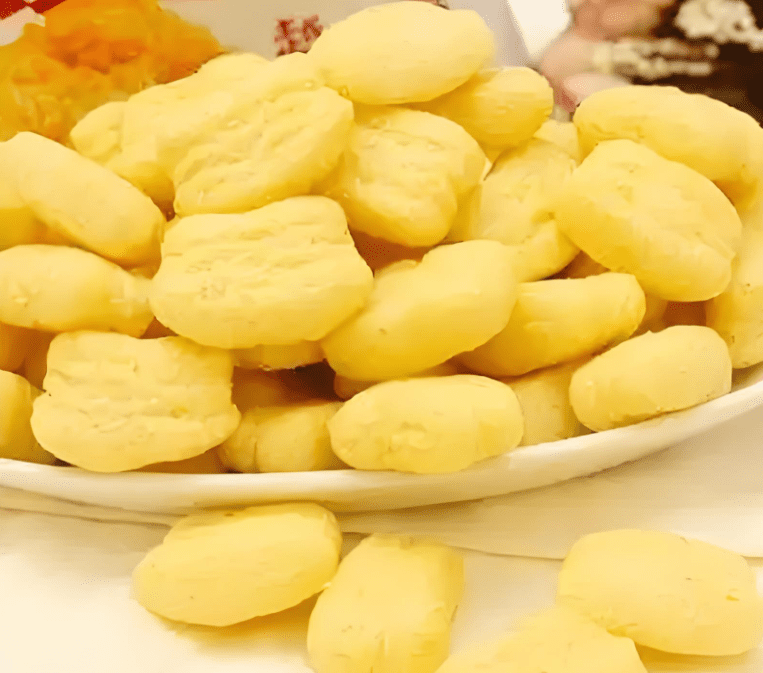
1. Introduction: The Allure of Air
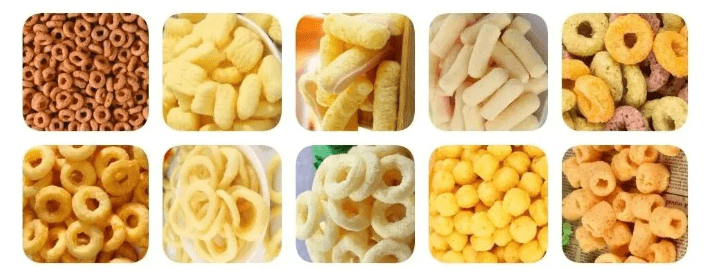
The global market for puffed snacks is a multi-billion-dollar industry, continuously evolving with consumer tastes. From classic cheese puffs and potato chips to sophisticated lentil-based crisps and whole-grain extrudates, the common denominator is a porous, aerated structure. This structure is not merely a textural attribute; it is the very essence of the product, influencing flavor release, mouthfeel, and overall sensory experience.
The creation of this structure hinges on a single, pivotal event: the rapid expansion of a gas within a plasticized or gelatinized food matrix. This process, known as puffing, transforms a dense, often unappealing raw material into a light, crispy, and palatable snack. The technological challenge lies in precisely controlling this expansion to achieve consistent product size, shape, density, and texture, batch after batch, on an industrial scale.
This article will systematically deconstruct the entire process, beginning with the foundational science that makes puffing possible.
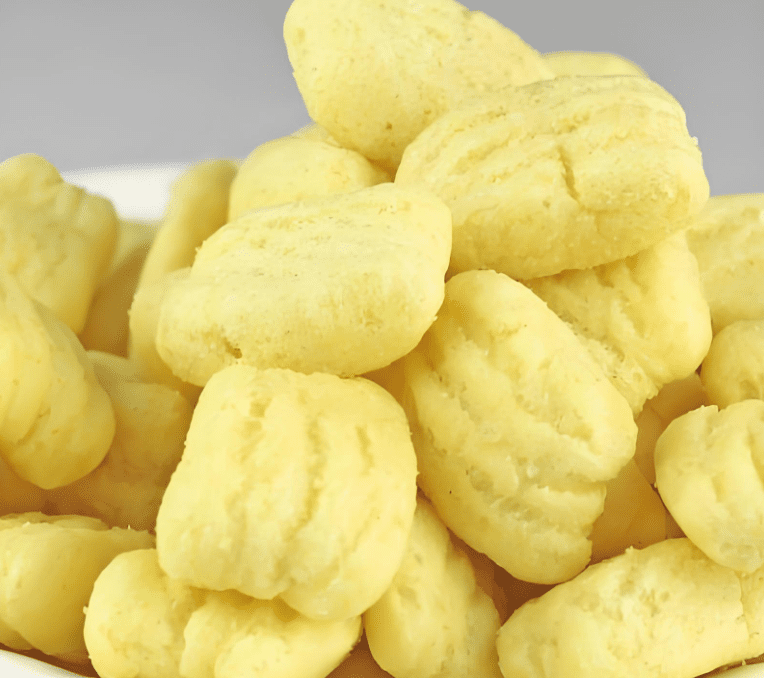
2. The Scientific Foundations of Puffing
To understand how puffing works, one must first grasp the key physical and chemical transformations that occur in starchy and proteinaceous materials under heat and pressure.
2.1. The Role of Starch
Starch is the most common polymer used in puffed snacks. Native starch exists as semi-crystalline granules composed of two glucose polymers: amylose (a linear chain) and amylopectin (a highly branched chain). The puffing process fundamentally alters these granules:
- Gelatinización: When starch is heated in the presence of water, the granules absorb water and swell, losing their crystalline structure. This is gelatinization. The temperature at which this occurs (the gelatinization temperature) varies by starch source (e.g., corn, wheat, potato). Gelatinization is a hydration process that plasticizes the starch, making it malleable.
- Plasticization: The gelatinized starch, under the influence of heat and shear, becomes a viscous, plastic melt. This “dough” can be shaped and manipulated. Its rheological properties (viscosity, elasticity) are critical for the subsequent expansion.
- Superheating and Flash Evaporation: The plasticized starch melt is subjected to high temperature and pressure. The water within the melt remains in a liquid state despite being above its normal boiling point—it is “superheated.” When this pressurized melt is suddenly exposed to atmospheric pressure, the superheated water undergoes an instantaneous phase change into steam. This rapid vaporization, known as flash evaporation, provides the expansive force for puffing.
- Glass Transition and Setting: As the steam expands the matrix, it simultaneously cools it. The starch-water mixture rapidly loses moisture and cools below its glass transition temperature (Tg). At this point, the amorphous starch solidifies into a glassy state, “freezing” the expanded cellular structure in place. This setting process is what gives puffed snacks their characteristic crispness and mechanical strength. If the product absorbs moisture from the environment, it can surpass its Tg, becoming rubbery and stale—a common mode of quality failure.
2.2. The Role of Water
Water is the blowing agent in nearly all puffed snacks. Its triple role is indispensable:
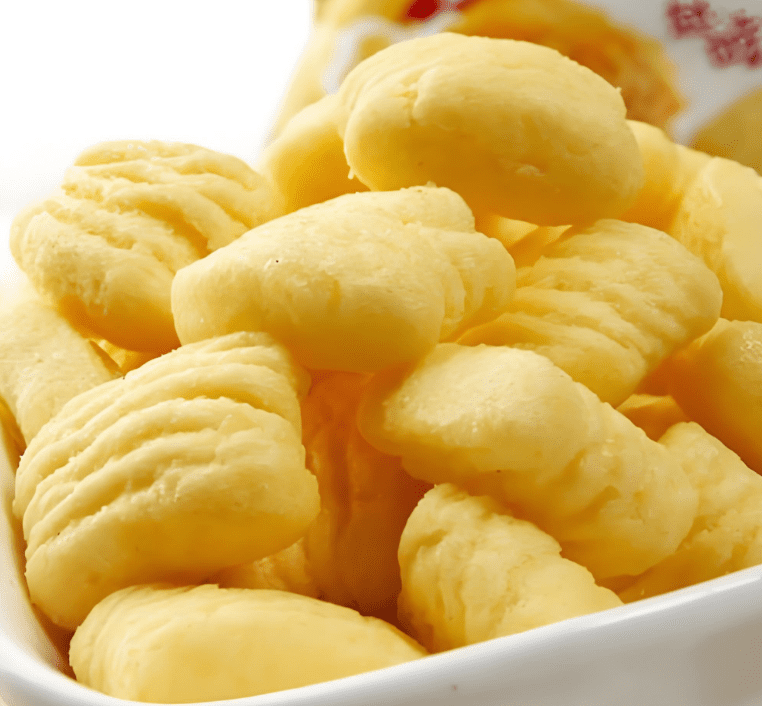
- Plasticizer: It enables starch gelatinization and reduces the glass transition temperature of the biopolymer matrix, allowing it to be deformed.
- Blowing Agent: In its superheated state, it provides the internal pressure for expansion.
- Thermal Medium: It transfers heat efficiently throughout the product.
The initial moisture content of the raw material and the dough is a critical process parameter. Too little water, and gelatinization is incomplete, leading to poor expansion and a hard, vitreous texture. Too much water, and the viscosity of the melt is too low, causing over-expansion, structural collapse, and a fragile, poor-textured product.
2.3. The Nucleation and Growth of Bubbles
The expansion is not a simple, uniform inflation. It is a process of bubble nucleation and growth. Nucleation sites are tiny gas pockets trapped within the dough during mixing, or formed at imperfections. Upon the pressure drop, the superheated water vaporizes into these nuclei, causing them to grow. The rheology of the molten matrix determines how these bubbles grow and coalesce. A viscous, elastic melt will resist expansion, resulting in smaller, more uniform cells, while a less viscous melt will allow for larger, but potentially more fragile, bubbles.
3. Raw Materials: Building the Matrix
The choice of raw materials defines the product’s nutritional profile, flavor, expansion potential, and cost.
3.1. Base Ingredients
- Cereals: Corn (grits, meal) is the king of puffed snacks, especially for extrusion. Its high starch content and favorable amylose-to-amylopectin ratio yield excellent expansion. Rice, wheat, oats, and barley are also widely used, often in blends, to modify texture and flavor.
- Potatoes: Potato flakes, granules, or starches are the base for many direct-expanded snacks and pellet-based products. Potato starch has superior swelling power, contributing to a light, crisp texture.
- Pseudocereals and Pulses: Growing demand for gluten-free and high-protein snacks has driven the use of quinoa, amaranth, chickpeas, lentils, and black beans. These often require processing aids or blending with traditional starches to achieve acceptable expansion, as their higher protein and fiber content can disrupt the starch matrix.
3.2. Functional Additives
- Proteins: Whey, soy, or pea protein can be added to boost nutritional value. However, they can interfere with starch expansion, acting as filler particles that puncture cell walls, leading to denser products. Specialized high-protein extrusion techniques have been developed to mitigate this.
- Fats and Oils: Small amounts (1-2%) of emulsifiers like mono- and diglycerides are crucial. They act as lubricants within the extruder barrel, reducing mechanical energy input, and more importantly, they stabilize the expanding cell walls, preventing collapse and creating a more uniform microstructure.
- Sodium Bicarbonate (Baking Soda): Used in some pellet-based and direct-expanded products, it decomposes upon heating to release carbon dioxide gas, providing an additional leavening force alongside steam.
- Salt, Sugar, and Flavors: These can be incorporated into the dough (pre-conditioning) or applied post-puffing. Internal flavors must be heat-stable to survive the high temperatures of extrusion or frying.
4. Primary Puffing Technologies: A Detailed Analysis
There are several distinct industrial methods for achieving puffing, each with its own advantages, limitations, and typical product outcomes.
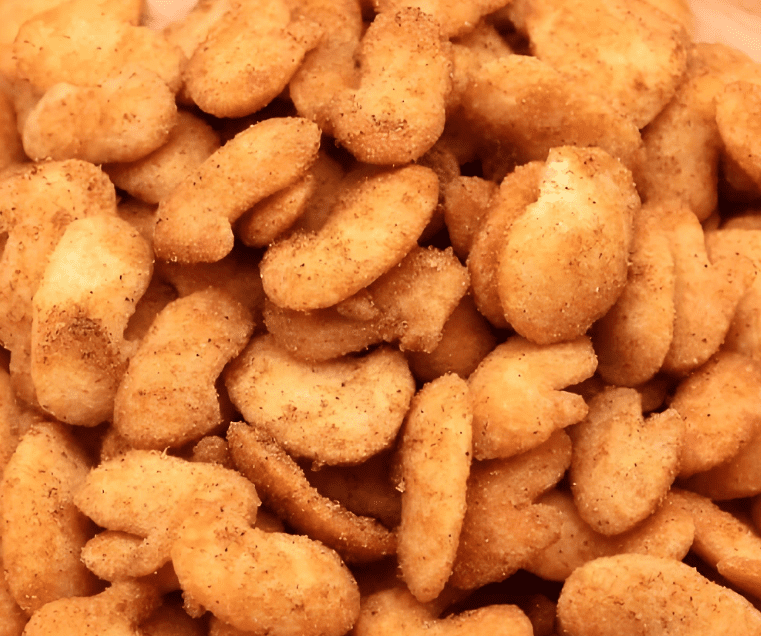
4.1. Extrusion Puffing
Extrusion cooking is the most versatile and widely used method for producing direct-expanded puffed snacks. A thermoplastic extruder is essentially a high-temperature, short-time (HTST) bioreactor that continuously cooks, shears, and shapes raw materials.
- Process Overview: The process begins with the feeding of raw materials (e.g., corn grits) into the extruder’s feed hopper. A metered feeding system ensures a consistent mass flow rate.
- The Extruder Barrel: The heart of the system is a long, screw-shaped rotor inside a stationary barrel. The screw is designed with specific sections:
- Feed Section: Conveys the raw material from the hopper.
- Compression Section: Applies mechanical shear and pressure, beginning the cooking process. The combination of internal friction (viscous dissipation) and external barrel heating raises the temperature, initiating starch gelatinization.
- Metering Section: Homogenizes the melt into a uniform, plasticized dough. The temperature and pressure here are at their peak, often reaching 120-175°C and 20-50 bar.
- The Die and Knife Assembly: The plasticized melt is forced through a die—a shaped orifice at the end of the barrel. This is the critical point of puffing. As the superheated dough exits the die, it experiences an instantaneous pressure drop to atmospheric pressure. The superheated water flashes into steam, rapidly expanding the product. A rotating knife cuts the expanding rope of product into pieces of desired length. The shape of the die determines the two-dimensional shape of the product (e.g., circles, stars, tubes), while the expansion dynamics determine the three-dimensional structure.
- Types of Extruders:
- Extrusoras monohusillo: Simpler, rely more on slip at the barrel wall. Good for high-fat or high-moisture formulations.
- Extrusoras de doble husillo: More complex and expensive, but offer superior control. The intermeshing, co-rotating screws provide positive conveying, excellent mixing, and self-wiping capabilities. They are highly flexible and can handle a wider range of raw materials, including those that are sticky, oily, or have high fiber content.
- Key Process Parameters: Critical variables that must be meticulously controlled include:
- Screw Speed: Influences shear rate and residence time.
- Barrel Temperature Profile: Zones are independently controlled to manage the cooking progression.
- Die Pressure and Temperature: Directly correlated with the degree of superheating and thus, expansion.
- Contenido de humedad: The single most important variable affecting viscosity, gelatinization, and expansion.
4.2. Frying (Oil Puffing)
Frying is a simultaneous cooking and drying process where hot oil serves as the heat transfer medium. It is the traditional method for products like potato chips and tortilla chips, and is also used for half-products (pellets).
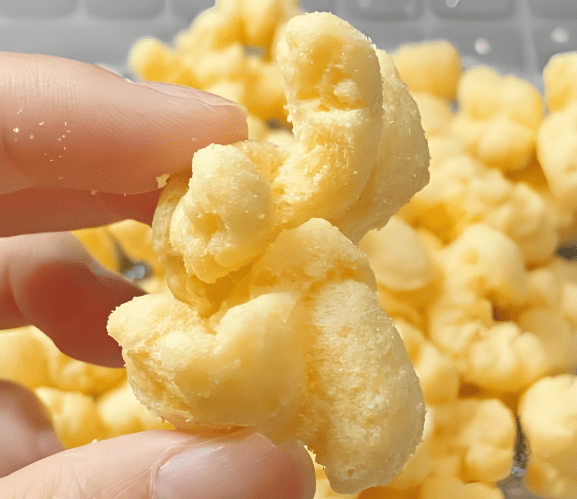
- Mechanism: When a high-moisture food (e.g., a potato slice) is immersed in oil at 160-190°C, the surface water rapidly vaporizes, creating a hard, porous crust. The internal water is heated and turns to steam, cooking the interior and creating internal pressure. This pressure pushes moisture towards the surface and helps create a porous, expanded structure. The rapid dehydration at the surface sets the structure.
- Types of Fryers:
- Continuous Fryers: The industry standard for high-volume production. A conveyor belt carries the product through a long tank of hot oil. The oil is continuously filtered and heated. Residence time is controlled by belt speed.
- Batch Fryers: Used for smaller-scale or artisanal production.
- The Case of Pellets (Third-Generation Snacks): This is a two-step process that decouples shaping from puffing.
- Pellet Production: A dough (often containing pre-gelatinized starch) is formed via a low-shear cold extruder into a specific shape. This “half-product” or pellet is then dried to a very low, stable moisture content (8-12%). It is glassy, hard, and shelf-stable.
- Puffing: The pellets are later exposed to a high-heat source, most commonly hot oil in a fryer. The rapid heat transfer causes the remaining water to vaporize, puffing the pellet into its final form. The key advantage is logistical: stable pellets can be shipped globally and puffed locally, reducing transportation costs (as they are dense) and maximizing freshness.
4.3. Hot-Air (Oven) Puffing
This method uses superheated air or combustion gases instead of oil as the heat transfer medium. It is often used to produce “baked” or “low-fat” alternatives to fried snacks.
- Mechanism: Similar to frying, but the heat transfer is less efficient. Hot air (~250-300°C) convects heat to the product surface, causing water to evaporate and the product to puff. To achieve sufficient puffing, the raw material often needs a specific structure, such as that of a pellet, or a high initial moisture content.
- Applications: Primarily used for puffing pellets to create low-fat snacks. It is also used for certain direct-expanded products like popcorn (where the hard pericarp acts as a pressure vessel) and puffed breakfast cereals.
- Advantages and Disadvantages: The main advantage is the production of snacks with very low fat content (<1%). The disadvantages include less efficient heat transfer, which can lead to longer cooking times, a drier texture, and different flavor development compared to frying (lacking the Maillard reaction and lipid-derived flavors from oil).
4.4. Microwave Puffing
Microwave puffing is a novel and rapidly developing technology, primarily used for finishing half-products.
- Mechanism: Microwaves (typically at 2450 MHz) penetrate the food and cause polar water molecules to oscillate rapidly, generating heat volumetrically. This means heat is generated throughout the entire product simultaneously, not just from the surface inward. This rapid and uniform heating creates internal steam pressure very quickly, leading to explosive puffing.
- Applications: Its primary industrial application is in the production of shelf-stable, ready-to-eat popcorn in sealed bags. The bag acts as a pressure vessel, and the kernels are puffed by microwave energy. It is also being explored for puffing pellets and other starch-based products for at-home preparation, offering ultimate freshness.
- Challenges: Achieving uniform puffing can be difficult due to uneven electromagnetic field distribution in microwave ovens. It also requires specialized packaging and product design.
5. Post-Puffing Processes: Flavor and Finish
A puffed product straight from the extruder, fryer, or oven is bland and requires the application of flavorings and seasonings to become a palatable snack.
5.1. Coating and Seasoning Systems
The large surface area and porous nature of puffed snacks make them ideal substrates for coating.
- Application Methods:
- Tumbling Drum: The most common method. The warm, puffed product is tumbled in a rotating drum while a seasoning blend is sprayed or dusted onto it. The tumbling action ensures even distribution. To aid adhesion, a light coating of oil (e.g., vegetable, sunflower) is often applied first. The oil can be sprayed as a fine mist into the drum.
- Enrobing: Used for thicker coatings, such as chocolate or yogurt-based layers. The product is conveyed under a curtain of the coating liquid.
- Dusting/Fallings: Dry powder seasonings are applied directly. Adhesion relies on the product’s surface oil or inherent stickiness.
- Types of Seasonings:
- Powdered: Cheese powder, barbecue seasoning, sour cream & onion, salt, spices.
- Liquid/Slurry: Soy sauce, Worcestershire sauce. These require subsequent drying.
- Flavor Encapsulates: Advanced technology where volatile flavor compounds are trapped within a starch or gum matrix, protecting them from heat and oxidation during processing and storage, releasing them only upon consumption.
5.2. Drying and Cooling
After seasoning, some products may require a final drying stage, especially if a liquid seasoning was applied, to reduce water activity and ensure crispness and microbial stability. Cooling is essential before packaging to prevent condensation inside the package, which would lead to sogginess and microbial growth.
6. Quality Control and Packaging: Preserving Perfection
The shelf life of a puffed snack is a race against two primary enemies: moisture migration and lipid oxidation.
6.1. Critical Quality Parameters
- Expansion Ratio: The ratio of the puffed product’s volume to its un-puffed volume. It is a direct measure of process efficiency and product lightness.
- Bulk Density: Mass per unit volume. It is inversely related to expansion.
- Texture (Instrumental): Measured using a texture analyzer (e.g., a puncture test or a three-point bend test) to quantify crispness (peak force) and brittleness (number of peaks).
- Water Activity (aw): A critical measure of microbial safety and textural stability. For puffed snacks, aw is typically kept below 0.3-0.4 to maintain crispness.
- Color: Measured using colorimeters (Lab* scale) to ensure consistent visual appeal.
- Contenido de aceite: Particularly important for fried snacks, measured by solvent extraction.
6.2. Packaging Technologies
Packaging is the final, crucial line of defense.
- Barrier Materials: Multilayer flexible films are standard. They typically consist of:
- Outer Layer: A tough polymer like Polyester (PET) or Nylon for durability and printability.
- Barrier Layer: Aluminum foil or Metallized film (a thin layer of aluminum vapor-deposited onto a polymer like PET or PP). This layer is imperative for blocking oxygen (preventing rancidity) and light (which catalyzes oxidation).
- Sealant Layer: A polymer like Polyethylene (PE) or Cast Polypropylene (CPP) that provides a hermetic heat seal.
- Modified Atmosphere Packaging (MAP): The air inside the package is flushed out and replaced with an inert gas, typically pure Nitrogen (N2). Nitrogen does not support oxidation and also acts as a cushioning agent, protecting the fragile product from physical breakage during transit.
- Integrity Testing: Packages are routinely tested for seal strength and leak detection to ensure the barrier remains intact throughout the shelf life.
7. Nutritional Considerations and Future Trends
The traditional puffed snack has faced criticism for being high in carbohydrates, sodium, and (if fried) fat, while being low in protein, fiber, and micronutrients. The industry is actively responding to these concerns.
7.1. Nutritional Challenges and Opportunities
- Reducing Fat: Achieved by shifting from frying to hot-air puffing or using vacuum frying (which lowers the boiling point of water, allowing for lower oil temperatures and reduced oil uptake).
- Reducing Sodium: A significant challenge due to its fundamental role in flavor. Strategies include using potassium chloride (though it can impart a bitter taste), flavor enhancers like yeast extracts, and optimizing particle size and distribution of salt to maximize perceived saltiness with less total sodium.
- Fortification and “Better-for-You” Formulations: Incorporating whole grains, pulses, and seeds to increase fiber and protein. Using nutrient-dense flours from ancient grains or vegetables. Fortification with vitamins and minerals is also common.
- Clean Label: A powerful trend driving the removal of artificial flavors, colors, and preservatives. This pushes R&D towards using natural seasonings like spice extracts (e.g., paprika for color, rosemary extract for antioxidant activity).
7.2. Emerging and Future Trends
- 3D Food Printing: Using edible “inks” (often starchy pastes) to create highly intricate and customized snack shapes via additive manufacturing, which can then be puffed.
- Precision Fermentation: Creating novel proteins, flavors, or functional ingredients through microbial fermentation, which could be incorporated into puffed snack matrices.
- Sustainable Sourcing and Upcycling: Using ingredients derived from agricultural by-products (e.g., fruit pomace, spent grains) to reduce waste and improve the environmental footprint.
- Advanced Protein Texturization: Developing new extrusion technologies to create high-protein, meat-alternative textured pieces that can be used in snacks.
- Personalized Nutrition: The potential for on-demand, small-batch production of snacks tailored to individual dietary needs and preferences.
The production of puffed snacks is a remarkable fusion of fundamental food science and sophisticated engineering. From the microscopic transformation of starch granules under heat and shear to the macroscopic expansion of a product as it exits a die, every step is a carefully controlled variable. The industry has matured from producing simple, monolithic products to a diverse landscape of textures, flavors, and nutritional profiles, driven by technologies like twin-screw extrusion and third-generation pellet systems. As consumer demands evolve towards healthier, cleaner, and more sustainable options, the science of puffing will continue to advance, pushing the boundaries of what is possible with air, water, and the humble starch molecule. The future of puffed snacks lies not just in making them lighter and crispier, but in making them smarter, healthier, and more aligned with the values of a modern, conscious consumer.