
Fried instant noodles are one of the most popular convenience foods worldwide. They are widely appreciated for their quick cooking time, convenient storage, affordable price, and delicious taste. With increasing demand for convenient food products, establishing a small-scale fried instant noodle processing factory has become an attractive business opportunity for food entrepreneurs.
Compared with large industrial production facilities, a small instant noodle production line requires a relatively modest investment and can offer flexible production capacity. However, producing high-quality fried instant noodles requires careful control of raw materials, dough preparation, noodle forming, steaming, frying, cooling, and packaging.
So, how are fried instant noodles manufactured in a small factory? What equipment is needed, and what processing details should manufacturers pay attention to? This article introduces the complete processing technology of small-scale fried instant noodles.
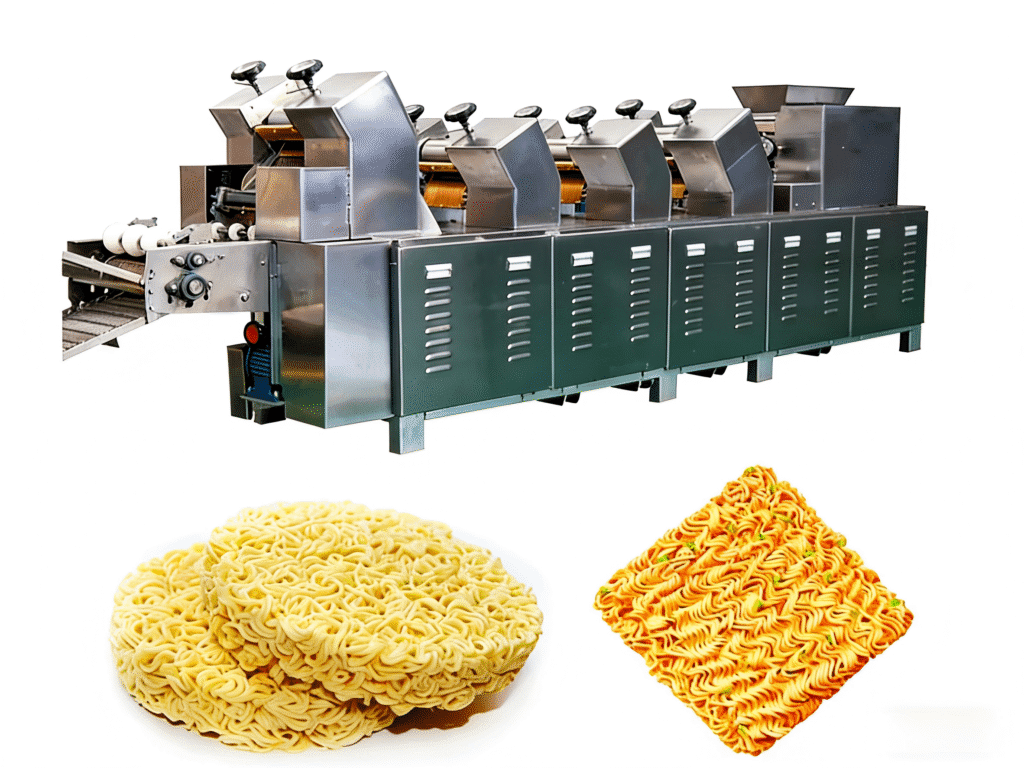
1. Raw Material Preparation
Raw material preparation is the first step in fried instant noodle production. The quality of the ingredients directly affects the elasticity, color, taste, and cooking performance of the finished noodles.
The main raw materials include:
- Wheat flour: The primary ingredient, providing the basic structure of the noodles.
- Agua: Combines with flour to form dough and determines dough moisture content.
- Salt: Improves noodle flavor and helps strengthen the gluten network.
- Alkaline salts: Usually sodium carbonate or potassium carbonate, which contribute to the characteristic color, elasticity, and texture of instant noodles.
- Starch: Can be added to adjust noodle texture and processing properties.
- Other permitted additives: Depending on the formulation, ingredients such as stabilizers and processing aids may be used.
Before production, all raw materials should be inspected and weighed according to the product formulation. Wheat flour should be screened to remove impurities and prevent foreign materials from entering the production line.
Choosing suitable wheat flour is particularly important. Flour with appropriate protein content and gluten strength helps produce noodles with good elasticity and structural stability.
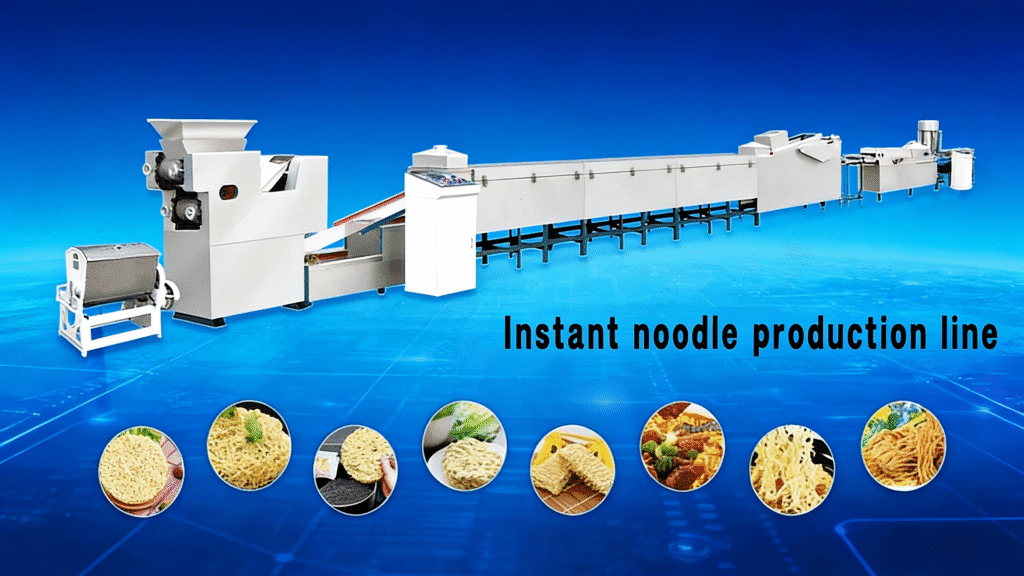
2. Dough Mixing
After preparing the raw materials, the next step is dough mixing.
First, wheat flour is transferred into a horizontal or vertical dough mixer. Salt, alkaline salts, and other dry ingredients are dissolved in water before being gradually added to the flour.
The mixer combines the ingredients until the water is distributed evenly throughout the flour particles.
Unlike ordinary bread dough, instant noodle dough is relatively firm and does not require extensive kneading into a smooth, elastic mass. Instead, it usually forms small, evenly hydrated particles that can be processed through successive rolling stages.
Important factors to control during mixing include:
- Water addition rate
- Dough moisture content
- Mixing time
- Ingredient proportions
- Mixing uniformity
Insufficient mixing may result in uneven moisture distribution, while excessive water can make the dough sticky and difficult to roll.
A well-prepared dough provides a stable foundation for subsequent noodle sheet formation.

3. Dough Resting
After mixing, the dough is usually allowed to rest for a certain period.
During this stage, moisture gradually penetrates the flour particles, allowing the gluten network to develop more uniformly.
Proper resting helps improve dough processing properties and reduces unevenness during rolling.
The resting time depends on flour characteristics, dough moisture, temperature, and production requirements.
Manufacturers should keep the dough covered or use an appropriate enclosed resting system to prevent excessive moisture loss.
4. Dough Sheet Rolling
Dough rolling is a key stage in instant noodle processing.
The prepared dough is fed into a series of rolling machines, where it is gradually compressed into continuous dough sheets.
Usually, multiple pairs of rollers are arranged in sequence. Each pair reduces the dough thickness progressively until the required sheet thickness is achieved.
The rolling process helps produce a uniform dough sheet with a consistent structure.
Several factors should be monitored:
Roller gap: Determines the thickness of the dough sheet. The gap should be adjusted gradually rather than reduced too aggressively.
Roller pressure: Excessive pressure may damage the dough structure, while insufficient pressure may result in uneven sheets.
Feeding speed: The feeding speed should match the rolling speed to avoid wrinkles and breakage.
Uniform dough sheets are essential for producing noodles with consistent thickness and cooking characteristics.

5. Noodle Cutting and Waving
After rolling, the continuous dough sheet enters the noodle cutting machine.
A special cutting roller equipped with grooves or blades cuts the dough sheet into thin noodle strands.
For traditional fried instant noodles, the strands are then passed through a waving or shaping device.
This process creates the familiar wavy appearance of instant noodles.
The shape and thickness of the noodle strands influence the final product’s appearance, frying performance, and rehydration speed.
Manufacturers can adjust the cutting rollers according to the desired noodle width and product specifications.
For small-scale production, a compact noodle cutting and waving system can provide sufficient flexibility for different product sizes.
6. Steaming Process
After cutting and shaping, the fresh noodle strands are transported into a continuous steaming machine.
Steaming is an essential step because it gelatinizes the starch and partially cooks the noodles.
During steaming, hot saturated steam transfers heat into the noodle strands, causing changes in the starch and protein structures.
Proper steaming helps noodles maintain their shape and improves their ability to rehydrate during preparation.
The main parameters requiring control include:
- Steam temperature
- Steaming time
- Steam pressure
- Steam distribution
- Noodle layer thickness
Insufficient steaming may result in incomplete starch gelatinization, leading to poor texture and uneven cooking. Excessive steaming may make the noodles too soft and difficult to handle.
A uniform steaming process is therefore important for maintaining product consistency.
7. Cutting and Portioning
After steaming, the continuous noodle strands are divided into individual portions.
An automatic cutting and portioning machine cuts the noodles according to the required weight and length.
The portions are then arranged into noodle blocks using a forming mold or shaping device.
Common shapes include rectangular blocks, square blocks, and round blocks.
The noodle block dimensions should be consistent to ensure uniform frying and convenient packaging.
At this stage, manufacturers should avoid excessive compression or mechanical damage that could cause the noodle strands to break.
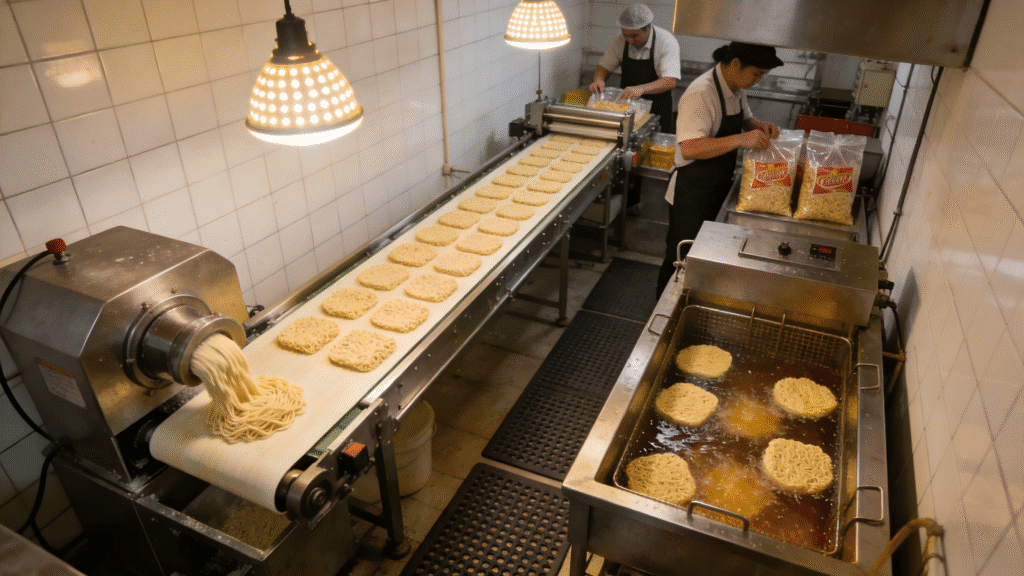
8. Frying Process
Frying is the most distinctive stage in fried instant noodle production.
The formed noodle blocks are transported into a frying machine, where they are immersed in hot edible oil.
During frying, moisture inside the noodles evaporates rapidly, creating numerous small pores and producing the characteristic porous structure of fried instant noodles.
This structure allows hot water to penetrate the noodles quickly during preparation.
Frying also contributes to the characteristic aroma, flavor, and crispy texture of the noodle blocks.
Important frying parameters include:
Frying temperature: The oil temperature must be controlled within a suitable range according to the noodle formulation and equipment design. Excessively high temperatures may cause surface browning and uneven frying, while low temperatures may increase oil absorption and processing time.
Frying time: The frying duration determines the final moisture content, color, and texture. It must be adjusted according to noodle thickness and portion size.
Oil quality: Fresh, food-grade frying oil should be used. Oil quality must be monitored regularly to prevent oxidation and excessive degradation.
Oil circulation: Proper oil circulation helps maintain uniform temperature throughout the frying chamber.
For small-scale factories, compact continuous fryers or batch frying machines can be selected according to production capacity.
9. Oil Removal and Cooling
After frying, the noodle blocks are removed from the hot oil and transferred to an oil-draining system.
Excess oil on the surface is allowed to drain away, helping improve product appearance and reduce unnecessary oil residue.
The fried noodle blocks are then transported through a cooling conveyor.
Cooling allows the products to reach a suitable temperature before packaging.
Adequate cooling is important because packaging hot noodles may lead to condensation, which can negatively affect product quality and storage stability.
During this stage, manufacturers should also inspect the noodle blocks for broken strands, abnormal colors, and uneven shapes.
10. Seasoning and Flavor Preparation
Seasoning is an important part of fried instant noodle production.
Although some products are sold as plain fried noodle blocks, many manufacturers include seasoning sachets to provide different flavors.
Common seasoning ingredients include:
- Salt
- Sugar
- Dehydrated vegetables
- Chili powder
- Onion powder
- Garlic powder
- Chicken or beef flavoring
- Spice blends
- Other permitted flavor ingredients
The seasoning powder and liquid seasoning can be processed separately according to the product formulation.
For small factories, seasoning sachets can be prepared using a powder mixing machine and an automatic sachet packaging machine.
Different seasoning formulations allow manufacturers to develop various products, including spicy noodles, chicken noodles, beef noodles, seafood noodles, and vegetable noodles.
11. Packaging Process
Packaging is the final stage of fried instant noodle manufacturing.
After cooling and inspection, the noodle blocks are transferred to an automatic packaging machine.
The packaging machine places each noodle block into a suitable package, while seasoning sachets are inserted according to the product design.
Common packaging options include:
- Pillow bags
- Plastic film bags
- Paper-plastic composite packaging
- Multi-layer laminated packaging
Packaging materials should provide suitable moisture and oxygen barrier properties to help preserve product quality.
The sealing process must be reliable to prevent moisture absorption, oil oxidation, and contamination during transportation and storage.
Manufacturers should also ensure that product labels contain the required ingredient information, net weight, production date, shelf-life information, and other legally required details.
12. What Equipment Is Needed for a Small Fried Instant Noodle Production Line?
A small-scale fried instant noodle production line generally consists of the following machines:
- Flour screening machine: Removes impurities from wheat flour.
- Dough mixer: Mixes flour, water, salt, and alkaline ingredients.
- Dough resting system: Allows moisture to distribute evenly.
- Compound rolling machine: Gradually forms the dough into sheets.
- Noodle cutting machine: Cuts dough sheets into noodle strands.
- Waving machine: Creates the characteristic wavy noodle shape.
- Steaming machine: Gelatinizes starch and partially cooks the noodles.
- Cutting and portioning machine: Divides noodles into individual blocks.
- Frying machine: Dehydrates the noodle blocks through deep frying.
- Oil-draining conveyor: Removes excess surface oil.
- Cooling conveyor: Cools the fried noodle blocks.
- Packaging machine: Packs the noodle blocks and seasoning sachets.
The specific equipment configuration depends on the desired production capacity, factory space, degree of automation, and product specifications.
For a small factory, choosing machines with compatible production speeds is especially important. This helps prevent bottlenecks between processing stages and improves overall production efficiency.
13. Key Factors Affecting the Quality of Fried Instant Noodles
To produce high-quality fried instant noodles, manufacturers should pay attention to the following factors:
1. Flour quality
The protein content and gluten strength of wheat flour affect noodle elasticity, toughness, and cooking performance.
2. Dough moisture
Proper moisture distribution ensures that the dough can be rolled smoothly and formed into uniform noodle strands.
3. Rolling thickness
Consistent dough sheet thickness helps ensure uniform steaming and frying.
4. Steaming conditions
Adequate starch gelatinization is necessary for good noodle texture and rapid rehydration.
5. Frying temperature and time
These factors determine final moisture content, oil absorption, color, and texture.
6. Frying oil management
Regular oil filtration, temperature monitoring, and oil-quality testing help maintain product safety and flavor.
7. Packaging quality
Good packaging protects the finished noodles from moisture, oxygen, and external contamination.
Conclusion
The processing of small-scale fried instant noodles involves several important stages, including raw material preparation, dough mixing, resting, rolling, noodle cutting, steaming, portioning, frying, cooling, and packaging.
Each stage influences the final product’s taste, texture, appearance, and shelf life. For manufacturers planning to establish a small fried instant noodle factory, understanding the complete processing technology is essential.
By selecting suitable production equipment, developing a stable formulation, controlling frying conditions, and implementing effective quality management, small food manufacturers can produce fried instant noodles with consistent quality and competitive market value.


