
Frying is one of the most important stages in the production of fried instant noodles. It directly affects noodle texture, color, moisture content, rehydration performance, flavor, and shelf life. Proper frying temperature allows moisture to evaporate quickly and creates a porous internal structure, enabling instant noodles to soften rapidly when prepared with hot water.
However, if the frying temperature is too high or too low, various quality problems may occur. Excessive temperatures can cause uneven coloring, burnt flavors, and increased oil deterioration, while insufficient temperatures may result in excessive oil absorption, poor dehydration, and undesirable noodle textures.
So, how should manufacturers control frying temperature when producing instant noodles? This article explains the key factors and practical methods for achieving stable frying results.

1. Understand the Importance of Frying Temperature
Frying temperature plays a critical role in determining the quality of fried instant noodles.
During frying, the moisture inside the steamed noodle cake rapidly evaporates. As water escapes, numerous small pores form inside the noodle structure. These pores allow hot water to penetrate quickly during rehydration.
Temperature influences several important product characteristics:
- Moisture content: Appropriate frying temperatures help remove moisture efficiently and achieve the target final moisture level.
- Noodle color: Temperature affects the appearance of noodle cakes. Excessive heat may cause dark or uneven coloring.
- Texture: Proper frying creates a porous structure and helps noodles maintain a desirable texture after rehydration.
- Oil absorption: Frying conditions influence the amount of oil absorbed by noodles.
- Flavor: Excessive temperatures may produce burnt or undesirable flavors.
- Shelf life: Appropriate frying and moisture control help reduce the risk of microbial growth and quality deterioration during storage.
Therefore, controlling frying temperature is essential for producing consistent instant noodles.
2. Determine the Appropriate Frying Temperature
In industrial fried instant noodle production, frying temperatures commonly fall within approximately 140–160°C, although the optimal range depends on noodle thickness, formulation, moisture content, frying equipment, and production speed.
Manufacturers should determine the appropriate temperature through equipment trials and product quality testing rather than relying on one fixed value.
The frying process can be divided into several stages:
Initial Frying Stage
When steamed noodle cakes enter the frying machine, they contain relatively high moisture.
During the initial stage, moisture begins evaporating rapidly. Temperature should be sufficient to support efficient dehydration without causing excessive surface browning.
If the temperature is too high, the noodle surface may become excessively dry or dark before the internal moisture has been adequately removed.
Main Frying Stage
This is the key stage of moisture removal.
As frying continues, water inside the noodle structure escapes, gradually forming a porous structure.
Stable oil temperature is particularly important at this stage. Large temperature fluctuations may lead to inconsistent moisture levels and uneven product quality.
Final Frying Stage
During the final stage, the noodle cakes approach their target moisture content.
The objective is to complete dehydration while avoiding excessive browning, burnt flavors, and unnecessary oil deterioration.
The finished noodle cakes should have consistent color, appropriate crispness, and good rehydration performance.
3. Use an Automatic Temperature Control System
For small and medium-sized instant noodle factories, installing an automatic temperature control system is an effective way to improve frying consistency.
Modern industrial frying machines may use temperature sensors, automatic controllers, and heating adjustment systems to maintain the required oil temperature.
The main components include:
Temperature sensors: These continuously measure the frying oil temperature and transmit readings to the control system.
Automatic controllers: These compare the actual temperature with the preset value and determine whether heating adjustments are necessary.
Heating systems: Depending on the equipment design, electric heating, gas heating, or other suitable heating methods can be used to maintain the required temperature.
Alarm systems: Temperature alarms can alert operators when the oil temperature exceeds or falls below the established operating limits.
An automatic control system reduces the need for constant manual adjustments and helps maintain stable production conditions.
However, sensors and controllers should be regularly calibrated to ensure accurate readings.
4. Ensure Uniform Oil Temperature
Maintaining the correct average oil temperature is not enough. Oil temperature should also be relatively uniform throughout the frying zone.
If some areas of the frying machine are significantly hotter than others, noodle cakes may experience uneven frying.
This can lead to:
- Different colors between noodle cakes.
- Uneven moisture content.
- Inconsistent oil absorption.
- Differences in noodle texture.
- Reduced product consistency.
To improve temperature uniformity, manufacturers should consider the following measures:
- Use frying equipment with a suitable oil circulation system.
- Ensure that heating elements are properly distributed.
- Avoid excessive loading that restricts oil circulation.
- Inspect oil circulation pumps and pipelines regularly.
- Monitor temperature at appropriate locations within the frying system.
A well-designed frying machine helps distribute heat more evenly and improves production stability.
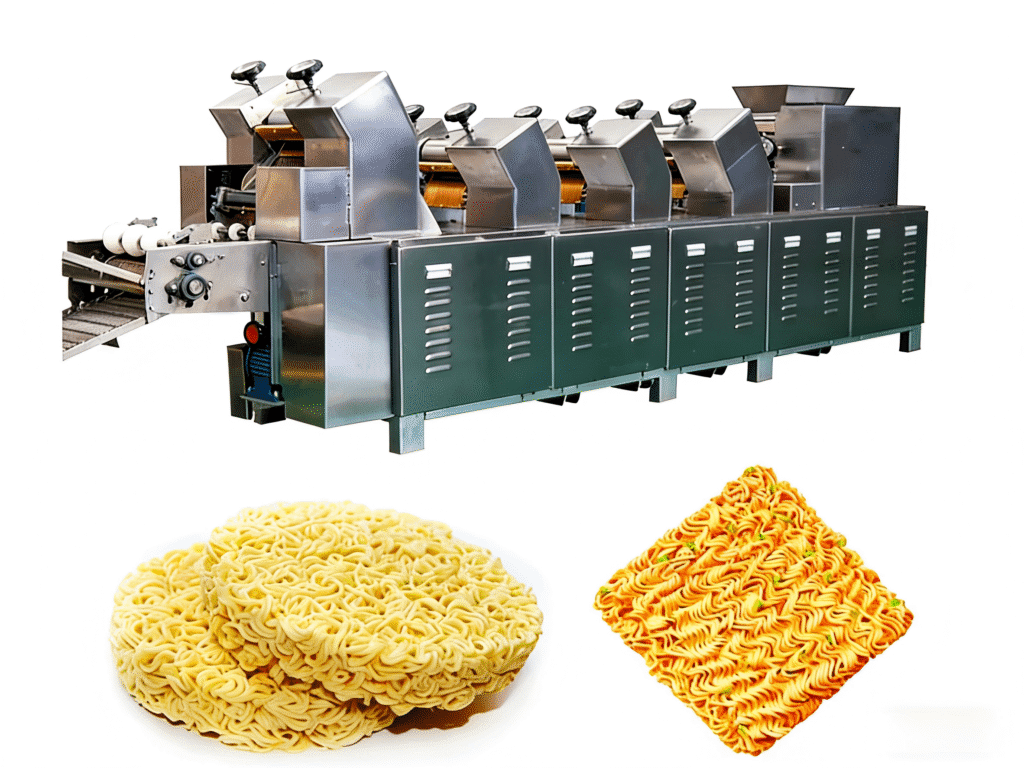
5. Control the Feeding Speed and Production Capacity
The speed at which noodle cakes enter the frying machine also influences oil temperature.
When a large quantity of cold, steamed noodle cakes enters the fryer continuously, the oil temperature may drop significantly.
If the heating system cannot recover quickly enough, the frying process may become unstable.
Manufacturers should therefore coordinate feeding speed with the heating capacity and oil volume of the frying machine.
Important considerations include:
- Maintain a stable feeding rate.
- Avoid sudden increases in production volume.
- Match conveyor speed with frying time.
- Ensure that the heating system can handle the required production capacity.
- Adjust the operating parameters according to noodle cake weight and thickness.
For small instant noodle factories, maintaining a consistent production speed is particularly important because smaller frying systems may have less thermal capacity than large industrial systems.
6. Monitor Frying Oil Quality
Temperature control and frying oil management are closely related.
Even when the temperature is maintained within the appropriate range, deteriorated frying oil can negatively affect noodle quality.
Repeated heating and prolonged use can cause oil oxidation, hydrolysis, and polymerization. These changes may affect oil color, viscosity, flavor, and performance.
To maintain frying oil quality, manufacturers should:
Select suitable edible oil: Choose frying oil with appropriate heat stability and quality characteristics.
Monitor oil condition: Regularly evaluate oil color, odor, foaming, and other indicators.
Control excessive heating: Avoid unnecessary high temperatures and prolonged heating when production is stopped.
Filter the oil: Remove food particles and other residues that may accelerate oil deterioration.
Replace oil when necessary: Establish replacement criteria based on oil quality testing and applicable food safety regulations.
It is also important to monitor total polar compounds and other relevant indicators according to local regulatory requirements.
Good oil management helps maintain consistent product flavor and reduces quality risks.
7. Pay Attention to the Moisture Content of Steamed Noodles
The moisture content of noodle cakes before frying has a direct influence on frying performance.
If the noodles contain too much moisture, more energy and time will be required to achieve the target final moisture content.
If the moisture content is too low, the noodles may become difficult to process properly and may develop undesirable texture characteristics.
Therefore, manufacturers should control the moisture content and steaming conditions before frying.
Important factors include:
- Water addition during dough mixing.
- Dough resting conditions.
- Noodle sheet thickness.
- Steaming temperature and duration.
- Noodle cake weight and dimensions.
Keeping these parameters consistent makes it easier to maintain stable frying conditions.
8. Control Frying Time Together with Temperature
Frying temperature should never be considered separately from frying time.
Both parameters determine the degree of dehydration and the final characteristics of instant noodles.
For example:
- High temperature combined with excessive frying time may cause dark coloring and burnt flavors.
- Low temperature combined with insufficient frying time may leave excessive moisture in the finished noodles.
- Appropriate temperature combined with properly controlled frying time helps produce a uniform porous structure.
The actual frying time depends on the noodle cake’s thickness, weight, initial moisture content, equipment design, and target final moisture.
Manufacturers should conduct repeated trials to establish suitable temperature and time combinations.
It is also important to measure the final moisture content instead of judging frying results only by appearance.
9. Common Problems Caused by Improper Temperature Control
Understanding common frying problems helps operators identify production issues quickly.
| Problem | Possible causes | Recommended solutions |
|---|---|---|
| Noodles become too dark | Excessive oil temperature or frying time | Adjust temperature and frying duration |
| Noodles have excessive moisture | Insufficient temperature or frying time | Optimize dehydration conditions |
| Uneven noodle color | Uneven oil temperature or inconsistent feeding | Improve oil circulation and feeding stability |
| Excessive oil absorption | Unsuitable frying conditions or noodle structure | Optimize steaming, frying, and formulation |
| Burnt flavor | Excessive temperature or deteriorated oil | Reduce overheating and monitor oil quality |
| Poor rehydration | Inadequate porous structure or inconsistent frying | Adjust steaming and frying parameters |
Operators should investigate the actual causes before changing production settings, since multiple factors may contribute to the same quality problem.
10. Establish a Complete Frying Temperature Monitoring System
For factories seeking long-term production stability, it is advisable to establish a standardized temperature monitoring procedure.
A practical monitoring system should include:
- Checking the temperature control system before production.
- Confirming that the oil has reached the required operating temperature.
- Recording oil temperature at regular intervals.
- Monitoring temperature changes during continuous production.
- Checking the condition of frying oil.
- Measuring finished noodle moisture content.
- Recording product color, texture, and rehydration performance.
- Investigating and documenting any temperature deviations.
These records help manufacturers identify production trends, improve process control, and maintain consistent product quality.
11. Follow Essential Safety Precautions
Frying instant noodles involves hot edible oil, high temperatures, and potentially significant fire risks.
Therefore, temperature control must also be part of a comprehensive workplace safety program.
Important precautions include:
- Install suitable over-temperature protection.
- Maintain reliable temperature sensors and controllers.
- Prevent water from entering hot frying oil.
- Keep the frying area clean and free of unnecessary combustible materials.
- Inspect heating systems, electrical connections, and oil pipelines regularly.
- Provide appropriate fire protection equipment.
- Train employees in emergency shutdown procedures.
- Follow applicable fire safety and occupational safety regulations.
Never leave a heating fryer operating without appropriate supervision and safety controls.

Conclusion
Controlling frying temperature is one of the most important factors in producing high-quality fried instant noodles. It affects moisture removal, noodle color, texture, oil absorption, flavor, and final product consistency.
To achieve good frying results, manufacturers should select an appropriate temperature range, install reliable automatic control systems, maintain uniform oil circulation, coordinate feeding speed with production capacity, and monitor frying oil quality.
More importantly, frying temperature must be controlled together with frying time, steaming conditions, and noodle moisture content.
For small instant noodle factories, establishing standardized operating procedures and conducting regular product quality inspections can significantly improve production stability.
By combining suitable frying equipment with scientific temperature management, manufacturers can produce fried instant noodles with attractive color, desirable texture, good rehydration performance, and consistent quality.


