
1. Introduction
Puffed snacks are popular snack foods enjoyed by consumers around the world. They come in a wide variety of shapes, flavors, textures, and colors, including cheese puffs, corn curls, crunchy sticks, rings, and other puffed snack products.
These snacks are manufactured using an extrusion process that combines raw material mixing, heat, pressure, and mechanical force to create products with unique shapes and textures. corn puffs machine Modern extrusion technology enables manufacturers to produce snacks efficiently, consistently, and in large quantities.
So, how are extruded snacks made? Let’s take a closer look at the entire manufacturing process, from raw material preparation to final packaging.
2. Raw Material Selection and Preparation
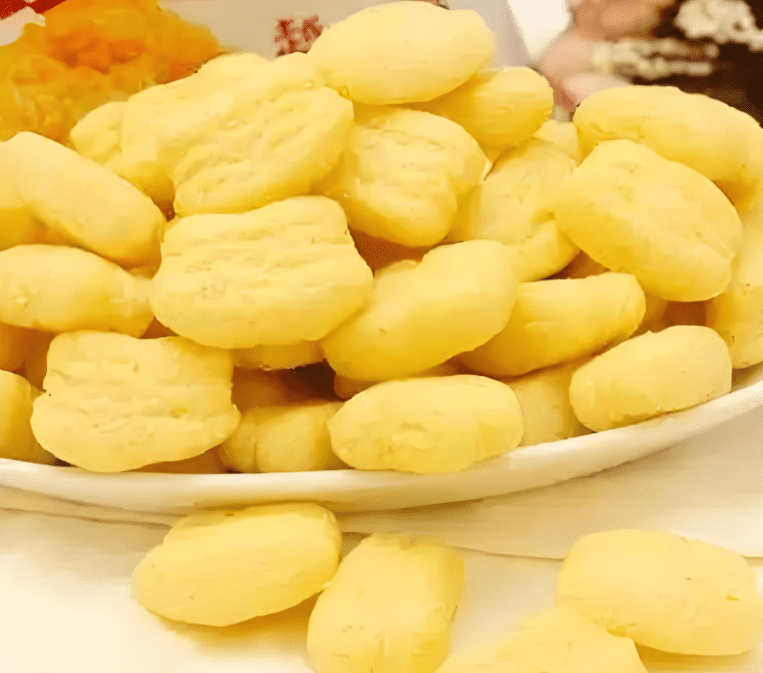
The first step in extruded snack production is selecting suitable raw materials. Common ingredients include corn grits, corn flour, rice flour, wheat flour, starch, and other cereal-based materials.
Depending on the desired product, manufacturers may also use vegetable oil, salt, sugar, seasonings, and other permitted ingredients.
The quality of raw materials has a significant impact on the final product’s taste, texture, appearance, and expansion characteristics. corn puffs machine Therefore, incoming materials should be inspected to ensure that they meet established quality and food safety requirements.
Before processing, the raw materials may need to be cleaned, screened, ground, or blended to achieve a consistent particle size and composition.
3. Mixing and Moisture Adjustment
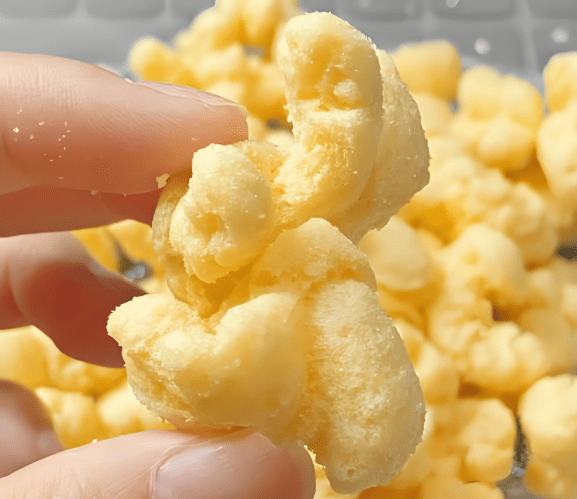
After preparation, the raw materials are transferred to a mixing machine, where they are blended according to a specific formula.
Water is usually added to adjust the moisture content of the mixture. Proper moisture control is essential because it affects the material’s flow through the extruder, cooking behavior, expansion rate, and final texture.
Different snack products require different formulations and moisture levels. Manufacturers must optimize these parameters according to the raw materials, extruder design, and desired product characteristics.
Once mixing is complete, the prepared material is fed into the extrusion system.
4. Extrusion and Puffing
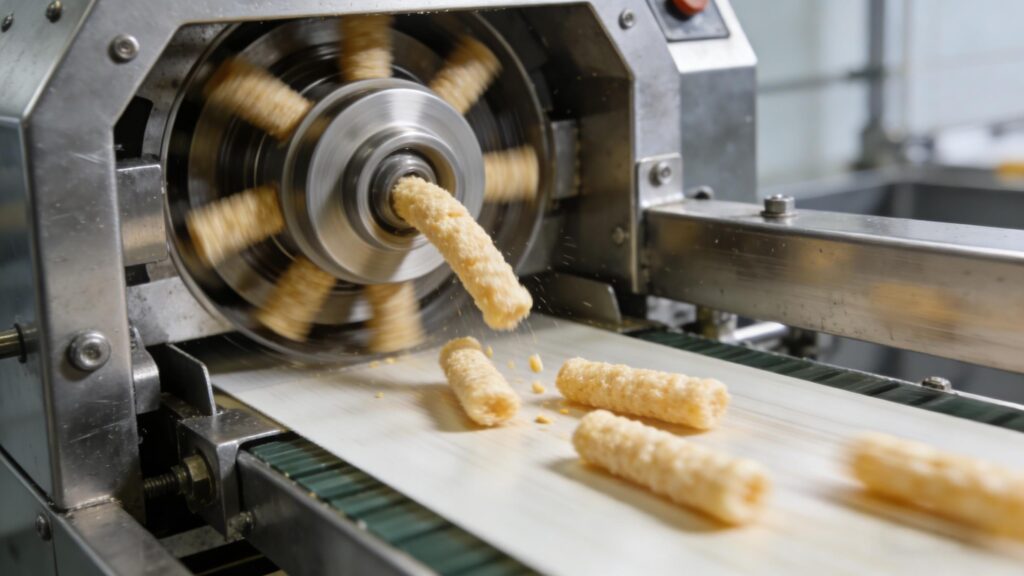
Extrusion is the key stage in the production of extruded snacks. corn puffs machine The process typically uses a single-screw or twin-screw extruder to transport, mix, cook, and pressurize the raw material.
Inside the extruder, rotating screws move the material through a heated barrel. Mechanical energy and heat raise the temperature of the mixture, causing the starch and other components to undergo physical and structural changes.
As the material moves toward the die, it is subjected to pressure and shear forces. When the cooked material exits through the die, the sudden pressure drop causes some of the water to flash into steam. This rapid expansion creates the porous structure that gives many extruded snacks their characteristic light and crispy texture.
The shape of the die determines the initial shape of the product. By changing the die design, manufacturers can produce curls, tubes, rings, sticks, stars, and many other shapes.
The extrusion process must be carefully controlled. Important parameters include temperature, screw speed, feed rate, moisture content, pressure, and die design.
5. Cutting and Shape Control
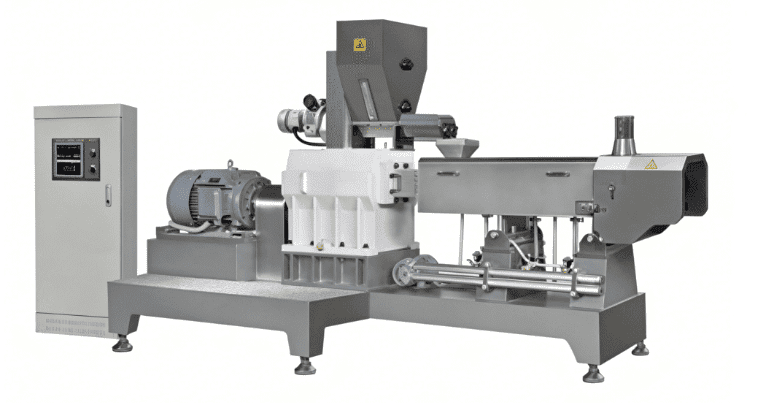
After leaving the extrusion die, the expanded material is cut into pieces by a rotating cutter or another suitable cutting device.
The cutting speed and blade configuration determine the product length and shape. Proper synchronization between the extruder output and cutter helps ensure uniform product dimensions.
At this stage, operators should monitor product appearance, expansion, density, and consistency. Any deviations may indicate that the extrusion conditions or raw material properties need adjustment.
6. Drying and Moisture Reduction
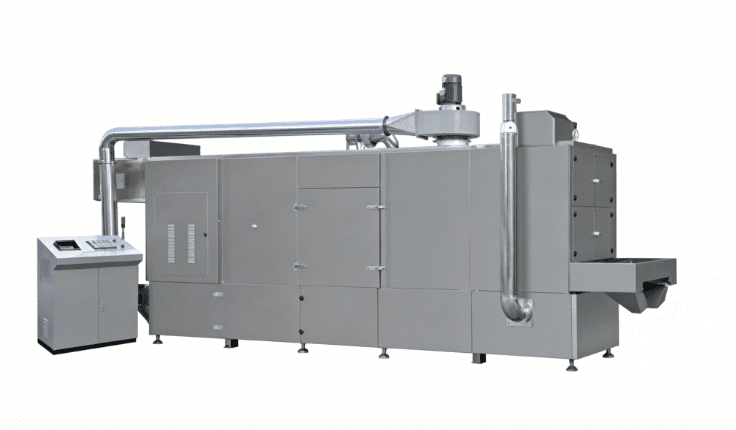
Freshly extruded snacks often contain more moisture than is desirable for long-term storage and a crispy finished texture. Therefore, the products are usually transferred to a dryer or baking system.
Hot air is commonly used to remove excess moisture. corn puffs machine Drying temperature, residence time, airflow, and product loading must be controlled according to the product type.
Proper drying helps improve crispness, reduce the risk of spoilage, and achieve a more stable final product. However, excessive drying can cause undesirable color changes, excessive brittleness, or unnecessary energy consumption.
After drying, the snacks should reach the target moisture content and water activity established through product development and food safety validation.
7. Flavoring and Seasoning
\
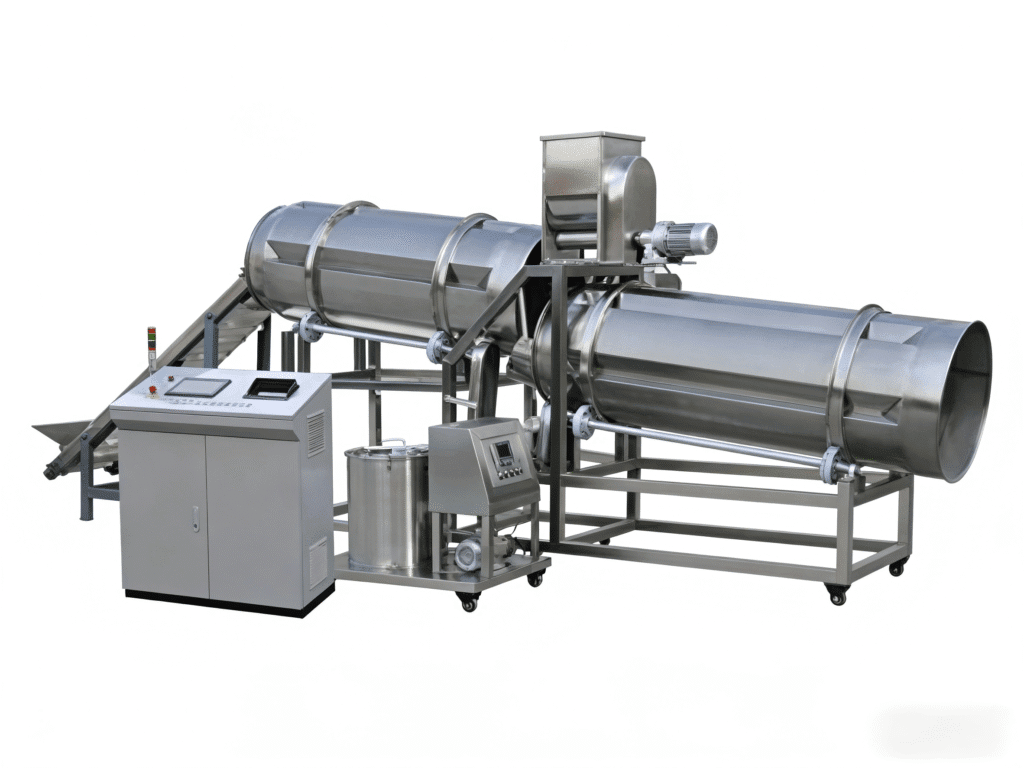
Once the snacks have been dried, they may be transferred to a seasoning machine to develop their final flavor.
Common seasoning options include cheese, barbecue, barbecue-style spices, tomato, barbecue chicken, chili, seaweed, and sour cream and onion.
Depending on the recipe, a controlled amount of edible oil may be applied to the product surface to help seasoning powders adhere evenly. The snacks are then tumbled in a rotating drum or processed through another suitable coating system.
The seasoning ratio, oil application, mixing time, and product temperature all influence flavor consistency and coating uniformity.
For products that require a more neutral taste, seasoning may be omitted. Other products may receive different coatings or flavor treatments according to their formulations.
8. Cooling and Quality Inspection
After seasoning, the snacks are cooled to a suitable temperature before packaging. This helps prevent condensation inside the package and supports packaging performance.
The quality control team inspects the products to confirm that they meet the required specifications. Typical inspection items include:
- Appearance, color, shape, and size
- Texture, crispness, and expansion
- Flavor and seasoning uniformity
- Moisture content and water activity
- Product weight and consistency
- Foreign-material control
- Microbiological or chemical testing, where appropriate
Metal detectors or other suitable foreign-material detection systems may be installed at appropriate points in the production line.
A documented quality management system helps ensure that products remain consistent from batch to batch.
9. Weighing and Packaging
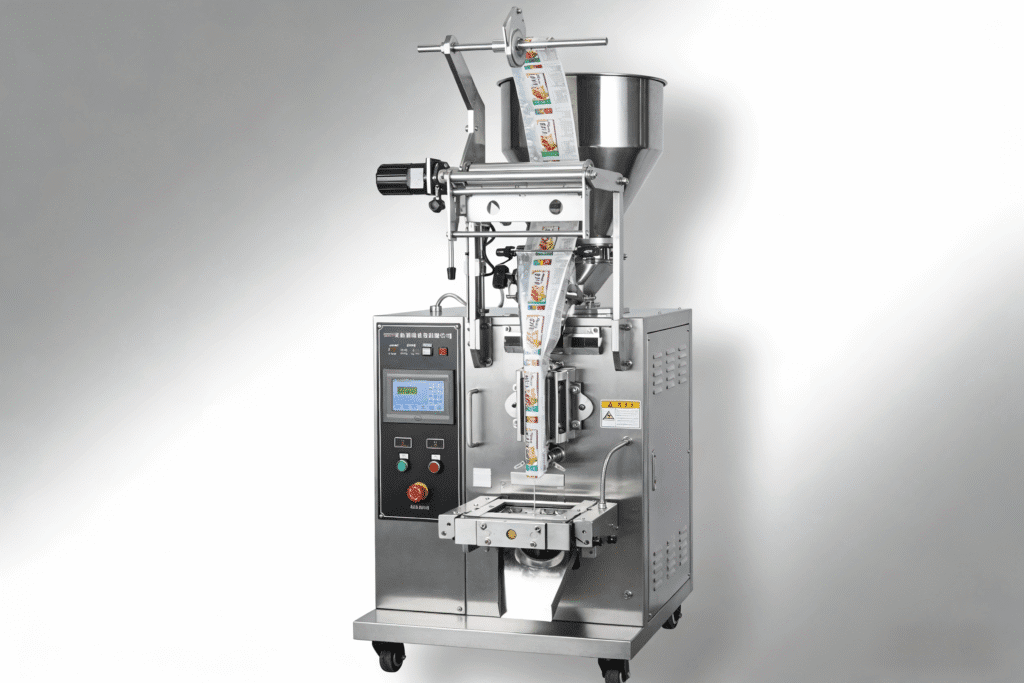
Packaging is the final major stage of the manufacturing process.
Automatic weighing machines measure the required quantity of snacks, and packaging machines fill and seal the bags. Depending on production requirements, the factory may use vertical form-fill-seal machines, premade pouch packaging machines, or other suitable systems.
Packaging materials should provide appropriate protection against moisture, oxygen, and physical damage. This is particularly important for crispy snacks because moisture absorption can quickly reduce their crunchiness.
The company must also ensure that product labels comply with the regulations of the intended market. Label information may include the product name, ingredients, allergen declarations, net weight, manufacturer details, lot identification, date marking, storage instructions, and nutrition information, as applicable.
After sealing, the packages should be checked for seal integrity, correct weight, coding accuracy, and overall appearance.
10. Finished Product Storage and Distribution
After packaging, finished products are transferred to the warehouse for storage and distribution.
The storage area should be clean, dry, well organized, and protected from pests. Temperature and humidity should be maintained according to the product’s validated storage requirements.
Products should be managed using an appropriate inventory rotation system, such as first-in, first-out or first-expired, first-out.
Before shipment, the warehouse team should verify product identification, batch numbers, quantities, packaging condition, and delivery documentation.
Proper transportation and storage help maintain product quality until the snacks reach distributors, supermarkets, convenience stores, and consumers.
11. Main Equipment Required for an Extruded Snack Production Line
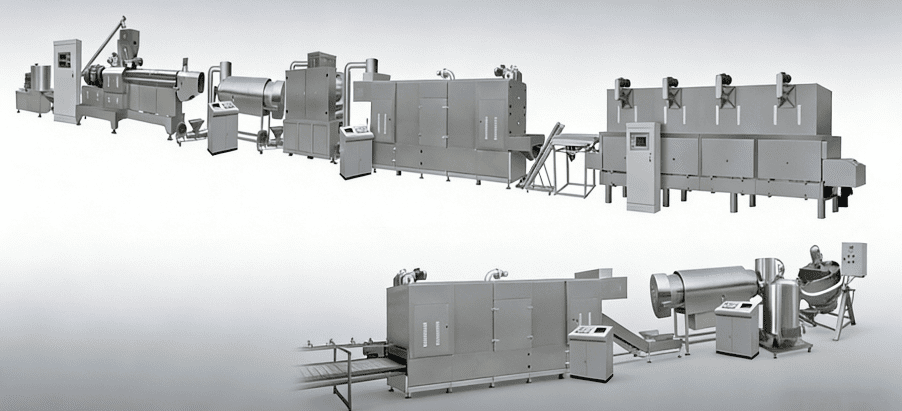
A typical extruded snack manufacturing line may include the following equipment:
| Equipment | Main Function |
|---|---|
| Raw material mixer | Blends ingredients uniformly |
| Feeder | Delivers material at a controlled rate |
| Food extruder | Cooks, shapes, and expands the material |
| Cutting device | Cuts extruded snacks to the required size |
| Dryer or baking system | Reduces moisture to the target level |
| Sazonador | Applies oil and flavoring powders |
| Cooling conveyor | Cools products before packaging |
| Automatic weighing machine | Measures the required product quantity |
| Packaging machine | Fills and seals product bags |
| Inspection equipment | Supports quality and foreign-material control |
The specific equipment configuration depends on the product type, required production capacity, available factory space, budget, and desired level of automation.

12. Factors Affecting Product Quality and Production Efficiency
Successful extruded snack manufacturing depends on controlling several important factors.
Raw material quality: Consistent raw materials help maintain stable processing conditions and product characteristics.
Moisture content: Moisture affects extrusion behavior, expansion, texture, and drying requirements.
Extrusion parameters: Temperature, screw speed, pressure, feed rate, and die design influence product shape, density, and texture.
Drying conditions: Appropriate drying is essential for achieving the desired crispness and storage stability.
Seasoning uniformity: Controlled oil application and seasoning distribution help ensure consistent flavor.
Packaging performance: Proper packaging protects the product from moisture and helps maintain freshness and crispness.
Equipment maintenance: Regular cleaning, inspection, and preventive maintenance reduce downtime and improve production reliability.
By monitoring these factors and keeping accurate production records, manufacturers can improve product consistency, reduce waste, and optimize operating costs.
13. Conclusion
The production of extruded snacks involves a series of interconnected processes, including raw material preparation, mixing, extrusion, cutting, drying, seasoning, cooling, quality inspection, and packaging.
Among these stages, extrusion is particularly important because it determines much of the product’s shape, expansion, and texture. However, every stage contributes to the quality and stability of the finished product.
With appropriate equipment, carefully controlled processing parameters, qualified employees, effective quality management, and reliable packaging technology, manufacturers can produce a wide variety of extruded snacks efficiently and consistently.
As consumer demand for convenient, flavorful, and innovative snack products continues to develop, modern extrusion technology provides manufacturers with opportunities to improve production efficiency, expand their product ranges, and compete in domestic and international markets.
Remove the embedded image placeholdersCondense the article for easier reading


