
Engineering Diversity: A Comprehensive Guide to the Production of Multifaceted Puffed Snacks
The modern puffed snack market is a testament to human ingenuity, a landscape far removed from the simple cheese puff or rice cake. Today, consumers demand variety—not just in flavor, but in shape, size, texture, nutritional content, and ingredient provenance. snacks machinery This diversity is not achieved by chance; it is the result of precise engineering and a deep understanding of food science and processing technology. This article provides an exhaustive exploration of the strategies and methodologies employed to produce a vast array of puffed snacks. We will dissect the core principles of puffing and then systematically examine the levers of diversification: raw material selection, advanced extrusion technology, alternative puffing methods, co-extrusion, multi-component assembly, innovative flavor delivery systems, and the application of novel ingredients. The goal is to provide a foundational blueprint for creating an endless portfolio of exciting, high-quality puffed products that cater to every segment of the market.
1. Introduction: The Imperative of Diversity in a Saturated Market
In the highly competitive and saturated snack food industry, differentiation is not merely a strategy for growth; it is a necessity for survival. Consumer loyalty is fleeting, driven by a desire for novelty, health-conscious choices, and experiential eating. snacks machinery The ability to rapidly innovate and produce a diverse range of puffed snacks is, therefore, a critical competitive advantage.
Diversity in puffed snacks can be categorized into several key dimensions:
- Morphological Diversity: Variations in shape, size, and structural complexity (e.g., spheres, tubes, stars, 3D shapes, multi-layered structures).
- Textural Diversity: Variations in mouthfeel, from light and airy to dense and crunchy, and including complex combinations like crispness with a soft filling.
- Compositional Diversity: Variations in the core ingredients, such as ancient grains, legumes, vegetables, and high-protein sources, catering to gluten-free, organic, or high-protein diets.
- Sensorial Diversity: Variations in flavor, aroma, and color, encompassing everything from classic savory profiles to sweet, dessert-like, and international culinary inspirations.
- Functional Diversity: Variations that provide added health benefits, such as prebiotic fibers, probiotics, vitamins, and minerals.
Achieving this diversity requires moving beyond a one-size-fits-all approach to a modular, principles-based manufacturing paradigm. The following sections will deconstruct this paradigm, starting with the very building blocks of the snack itself.
2. The Raw Material Palette: Formulating for Function and Variety
The journey to a diverse product portfolio begins with the selection and combination of raw materials. Each ingredient is not just a nutrient source; it is a functional component that dictates processing behavior and final product characteristics.
2.1. The Starch Matrix: Choosing the Right Canvas
The primary base for most puffed snacks is starch. snacks machinery The type of starch source is the first and most significant determinant of texture, flavor, and expansion.
- Corn (Maize): The workhorse of the industry.
- Yellow Corn Grits: Delivers the classic “cheese puff” texture—highly expanded, light, and crispy with a robust corn flavor. Different granulation sizes (e.g., fine, medium, coarse) allow for texture tuning; finer grits produce a more uniform, melt-in-the-mouth cell structure.
- White Corn: Provides a neutral color and slightly milder flavor, ideal for applying delicate or sweet flavors where a strong corn note is undesirable.
- Blue Corn: Offers a natural, visually distinctive color and a slightly nuttier flavor, used for premium and artisanal positioning.
- Rice: The Master of Crispness and Neutrality
- Rice Flour: Expands into a very white, light, and crisp product with a clean, neutral flavor. It is the preferred base for many coated snacks and crisps where the seasoning is the star. Its low lipid content and high amylose ratio contribute to its excellent expansion and hard crunch.
- Brown Rice Flour: Imparts a whole-grain, slightly nutty flavor and a denser texture due to the presence of bran and germ, which can disrupt the starch continuum. Often used in health-positioned products.
- Potato: The Gold Standard for Melt-in-Mouth Crispness
- Potato Flakes/Granules: Reconstitute to create a dough that can be sheeted, cut, and fried or baked to make potato-based puffs and stacks. They deliver a uniquely delicate, fast-melting crispness.
- Potato Starch: Often used in blends with other starches to improve crispness and lighten the texture.
- Wheat: The Structural Contributor
- Wheat Flour: The gluten content provides structure and chew, which is generally undesirable for direct-expansion puffs but can be beneficial in pellet-based (third-generation) snacks that require durability. Semolina, a coarser wheat product, is essential for producing pasta-like pellets that expand into snacks like fried lentil curls.
- The “Ancient Grains” and Pseudocereals: A Healthful Diversification
- Oats: Provide beta-glucan, a soluble fiber, and a characteristic soft, creamy flavor. Oats expand poorly on their own and are almost always used in blends.
- Quinoa, Amaranth, Millet: These are marketed for their high protein and mineral content. They present processing challenges due to low starch content and often require specialized pre-conditioning or blending strategies (typically at 15-30% inclusion rates) to achieve acceptable puffing.
- Sorghum: A hardy, gluten-free grain that puffs well and has a mild, sweet flavor, making it an excellent base for a wide range of products.
- Legumes and Pulses: The Protein Revolution
- Pea Protein Isolate/Flour, Lentil Flour, Chickpea Flour: The drive for high-protein snacks has brought legumes to the forefront. They are rich in protein and fiber but lack the expansive properties of pure starch. Successful puffs often use a base of rice or corn (50-70%) to provide the expandable matrix, into which legume flour (30-50%) is incorporated. Specialized high-shear, high-temperature extrusion can create textured vegetable protein (TVP) puffs with over 70% protein, though the texture can be harder and more rigid.
2.2. Modifying the Matrix: Functional Ingredients for Controlled Diversity
Beyond the base, a host of minor ingredients are used to fine-tune the processing and final product attributes, enabling a wider range of outcomes from the same equipment.
- Proteins: As mentioned, they can densify the product. However, this can be used strategically. Whey protein or soy protein concentrate can be added to create a nutritionally fortified, “meaty” textured snack bar rather than a light puff.
- Dietary Fibers: Ingredients like oat fiber, apple pomace, inulin, or psyllium are added for nutritional labeling. They are highly hygroscopic and can severely limit expansion and create a harder bite if not properly managed through recipe balancing and increased moisture/energy input.
- Fats and Oils: Internal lubricants (0.5-2%) reduce mechanical shear and product expansion, allowing for the creation of a denser, harder crunch—desirable for some snack types. Higher fat contents (>5%) will prevent puffing entirely, a critical consideration when adding flavorings pre-extrusion.
- Sugars and Salts: These soluble solids compete with starch for water, raising the gelatinization temperature. They can be used to reduce expansion and create a darker color through caramelization/Maillard reactions, which is desirable for certain “baked” or “toasted” flavor profiles.
- Leavening Agents: Sodium bicarbonate and acidulants (e.g., monocalcium phosphate, sodium acid pyrophosphate) generate carbon dioxide in-situ. This creates a finer, more numerous, and more uniform cell structure within the expanding starch matrix, resulting in a lighter, more delicate crispness rather than a glassy hardness.
- Emulsifiers: Lecithin and mono-glycerides improve dough homogeneity and reduce stickiness. They also complex with amylose to reduce retrogradation (staling), extending the shelf-life of the crisp texture.
3. The Engine of Creation: Processing Technologies for Morphological Diversity
While ingredients set the stage, the processing technology is the director that dictates the final form. The choice of process is the single greatest determinant of the shape and texture of the snack.
3.1. The Versatile Workhorse: Twin-Screw Extrusion
Twin-screw extruders are the most flexible tools for creating shape diversity. snacks machinery The screw configuration, die design, and cutter work in concert to produce an almost limitless array of forms.
- Die Design: The Gateway to Shape
- Simple Shapes: The most basic dies are plates with multiple round or slot-shaped holes. Round holes produce classic cylindrical puffs (like cheese balls). Slot-shaped dies produce flat, ribbon-like puffs that can be cut into chips or curls.
- Complex 2D Shapes: By machining the die hole into a specific shape—a star, a triangle, a club, a fish—the extrudate takes that form. The complexity is limited by the need for the dough to flow evenly through the die without creating dead spots that can cause burning. The land length (the thickness of the die) is critical: a short land promotes greater expansion, which can blur the intricate shape, while a longer land provides more definition but can increase density.
- 3D and Hollow Shapes: This is a more advanced application. One method involves using a die with a pin in the center, which creates a hollow tube as the product expands around it. This is the principle behind products like 3D cheese curls. By combining this with a rotating cutter, the tubes can be cut into individual pieces that are pinched closed on both ends, creating a pillow-like shape.
- The Cutter: Defining Size and Adding Texture
- The cutter, spinning just outside the die face, slices the expanding extrudate into pieces. The speed of the cutter is precisely synchronized with the flow rate of the extrudate.
- Velocidad de corte lenta: Produces long, pillow-like shapes.
- Velocidad de corte rápida: Produces short, crisp, almost spherical shapes.
- Textured Cutters: The cutting blades can be serrated or patterned to impart a textured edge on the product, adding visual interest and a different mouthfeel.
3.2. The Pellet Pathway: Second and Third-Generation Snacks
This two-step process decouples the formation of the shape from the puffing event, unlocking a different realm of diversity, particularly for dense, hard-textured snacks.
- Step 1: Pellet Production (Half-Products): A low-moisture (<25%), unexpanded dough is made via extrusion. The die for this step can be very complex, producing small, intricate shapes like shells, wheels, or spirals. Because the product is not meant to expand at this stage, the shapes remain perfectly defined. The pellets are then dried to a shelf-stable, glassy state (10-12% moisture).
- Step 2: Puffing/Frying: The consumer or the manufacturer later puffs the pellets by applying intense, sudden heat. This can be done in:
- Hot Oil (Frying): This is the most common method, producing snacks like fried lentil curls, shrimp chips, and a vast array of textured chips. The oil provides excellent heat transfer, resulting in a fast, uniform puff and a characteristic fried flavor and texture.
- Hot Air (Popping/Air Puffing): Used for lower-fat snacks. The pellets are heated in a stream of hot air or tumbled in a heated rotary drum. The expansion is less dramatic than frying, resulting in a harder, crunchier bite.
- Microwave Puffing: Some pellets are designed to be microwaved by the consumer, using the internal water as the puffing agent. This requires very precise formulation to control the dielectric properties of the pellet.
3.3. Sheeting and Cutting: The Art of the Chip
For products that emulate traditional potato chips or tortilla chips, a sheeting process is used.
- Dough Formation: The base ingredients (e.g., potato flakes, corn masa, whole grain flours) are mixed with water into a cohesive dough.
- Sheeting: The dough is passed through a series of counter-rolling sheeting rolls, which gradually reduce its thickness to a precise, uniform sheet (e.g., 0.5mm to 1.5mm).
- Cortando: The sheet is then cut by rotary cutters. These cutters can create a stunning variety of shapes: standard rounds, large triangles, tortilla chip shapes, or even intricate lattice patterns. The scrap dough is recycled back into the mixer.
- Puffing/Cooking: The cut pieces are then cooked, typically by frying (for a traditional chip) or baking (for a low-fat alternative). Baking produces a different texture—firmer and less crisp—but allows for “baked” claims on the label.
4. Advanced Architectural Techniques: Multi-Component and Filled Snacks
To achieve the next level of diversity and sophistication, manufacturers combine multiple components to create complex sensory experiences.
4.1. Co-Extrusion: The Ultimate in Textural Contrast
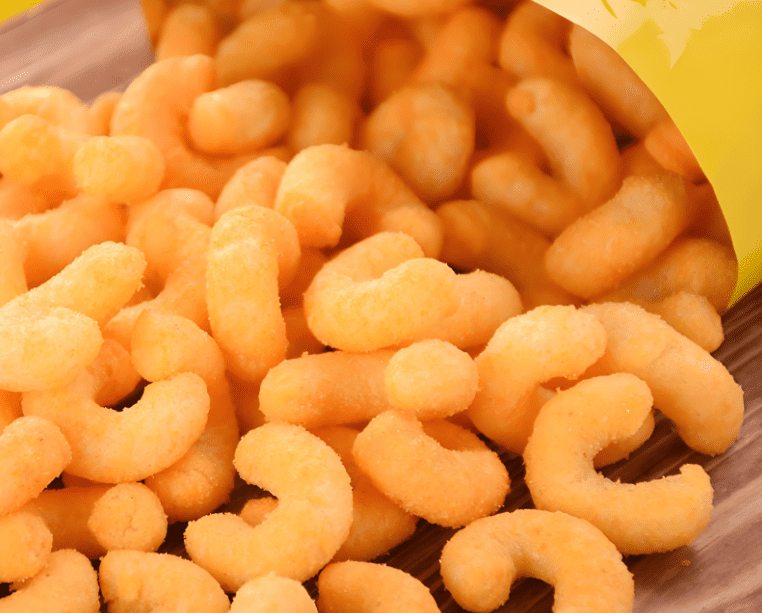
Co-extrusion is a pinnacle of snack engineering, allowing for the simultaneous extrusion of two or more different doughs to create a single, composite snack.
- Technology: Two separate extruders (or one extruder with a divided barrel) deliver different dough streams to a single, specialized die. The die is designed to merge the streams concentrically or in a predefined pattern just before expansion.
- Applications:
- Filled Snacks: A crisp, outer shell dough is co-extruded with a soft, dense, often flavored filling. The filling does not expand, creating a delightful textural contrast. Examples include cheese-filled puffs or fruit-filled cereal bites. The filling can be dairy-based, fruit-based, or even a savory meat analogue.
- Multi-Colored/Layered Snacks: Two differently colored or flavored doughs can be extruded side-by-side or in a marbled pattern to create visually striking products. This requires precise control of the viscosity of both doughs to ensure they expand at the same rate and adhere properly.
4.2. Secondary Assembly: Adding Toppings and Layers
Another method for creating complexity is to assemble snacks after the primary puffing step.
- Sandwiching: Two identical puffed pieces can be bound together with a creamy filling, such as peanut butter, cheese spread, or chocolate.
- Clustering: Small puffed pieces, nuts, and seeds can be mixed with a sweet binder (e.g., sugar syrup, honey) or a savory binder (e.g., cheese sauce, starch slurry) and then formed into a cluster or bar and dried or cooled.
- Enrobing: Unlike coating with a powder, enrobing involves covering a puffed base (e.g., a peanut) with a thick layer of another material, most commonly chocolate or yogurt, to create a composite confectionery snack.
5. The Flavor and Color Spectrum: Sensorial Diversification
A diverse shape is nothing without an appealing flavor and appearance.snacks machinery The application of seasonings and colors is a science in itself.
5.1. Coating Systems: Ensuring Uniformity and Adhesion
The goal is to deliver a consistent flavor experience with every single piece.
- Oil-Based Slurry Coating: The most common method. The warm, dry puffs are tumbled in a rotating drum. A slurry of oil and fine seasoning powder is sprayed in. The oil acts as a adhesive, and the tumbling action ensures even distribution. The type of oil (palm, sunflower, high-oleic sunflower, coconut) affects flavor stability and mouthfeel.
- Dusting: Dry seasonings are applied directly. This requires the puff to have a slightly oily or sticky surface, which can be achieved by a light pre-oiling spray or by leveraging the puff’s inherent residual surface fat.
- Spray-On Systems: For liquid-based flavors, such as hot sauce or butter, pressurized spray systems are used. This is often followed by a drying tunnel to set the coating.
- Seasoning Adhesion: Key factors include the particle size of the seasoning, the viscosity and temperature of the oil, the surface topography of the puff (a rough surface holds more seasoning), and the tumbling speed of the drum.
5.2. Flavor Delivery and Innovation
- Encapsulated Flavors: To protect volatile flavor compounds (like citrus or herbs) during the high-heat extrusion process, they can be encapsulated in a starch or gum matrix. These capsules remain intact during processing and then rupture in the consumer’s mouth, delivering a potent “burst” of flavor.
- Savory Flavors: Beyond cheese, the world of umami (e.g., mushroom, soy, tomato, aged cheese), spice (e.g., sriracha, jalapeño, habanero), and global cuisine (e.g., Tikka Masala, Kimchi, Thai Curry) provides endless inspiration.
- Sweet Flavors: The line between snack and cereal/confectionery is blurring. Sweet puffs coated with cinnamon-sugar, chocolate, or fruit powders cater to the dessert snack occasion.
- Color: Colors can be added to the dough pre-extrusion (for a uniform base color) or applied via the coating. The trend is strongly towards natural colors derived from turmeric (yellow), paprika (orange-red), spirulina (blue-green), and vegetable juices (purple, red).
6. Quality and Consistency: The Foundation of Sustainable Diversity
Producing a diverse range of products is futile if they are not consistently high-quality. A robust Quality Management System (QMS) is essential.
- Raw Material Variance: Sourcing from multiple suppliers for the same ingredient (e.g., corn grits) can introduce variation. Strict specifications for particle size distribution, moisture, and composition are critical.
- In-Line Process Control: Modern factories use Near-Infrared (NIR) sensors to monitor moisture in real-time, laser triangulation to measure product size and shape, and machine vision systems to inspect for color consistency and detect malformed products, automatically rejecting them.
- Texture Analysis: Instrumental texture analyzers provide objective data on hardness, fracturability, and crispiness, ensuring that a “light and airy” product remains so across all production batches.
- Pruebas de vida útil: Accelerated stability testing (e.g., storing products at 38°C and 80% relative humidity) is used to predict the shelf-life of new, often more delicate, formulations, ensuring they remain stable and safe.
7. Future Frontiers: The Next Wave of Snack Diversity
The innovation pipeline is constantly active, driven by consumer trends and technological advancements.
- 3D Food Printing: This emerging technology could revolutionize snack morphology, allowing for the creation of personalized, highly complex, and intricate shapes that are impossible to achieve with traditional dies.
- Precision Fermentation: This technology can create novel proteins and flavor ingredients that are identical to those from animal sources but are produced sustainably by microorganisms, enabling a new generation of plant-based, yet animal-free, savory snacks.
- Upcycled Ingredients: Using by-products from other food industries (e.g., fruit pulps, spent grains from brewing, vegetable trimmings) adds a sustainability story and unique nutritional profiles to snacks.
- Personalized Nutrition: The ultimate frontier could involve on-demand, small-batch production of snacks tailored to an individual’s dietary needs and flavor preferences, using digital platforms and flexible manufacturing systems.
The production of diverse puffed snacks is a sophisticated discipline that blends the art of culinary creativity with the rigid science of food engineering. snacks machinery It is a multi-faceted endeavor that requires a deep understanding of material science, rheology, thermodynamics, and process control. By strategically manipulating the raw material palette, leveraging the full capabilities of extrusion and alternative processing technologies, and mastering advanced techniques like co-extrusion and precision coating, manufacturers can navigate the vast landscape of consumer demand. From the simple, comforting cheese ball to the complex, multi-textured, globally-inspired filled snack, the potential for innovation is bounded only by the imagination of the product developer and the precision of the production engineer. In the end, the ability to consistently deliver this diversity with high quality is what separates the market leaders from the followers in the dynamic and ever-evolving world of snack foods.