
Corn extruded snacks are among the most popular snack foods in the global food market. With their crispy texture, attractive appearance, diverse shapes, and rich flavors, they have become popular among consumers of different ages. From puffed corn curls and cheese balls to crispy corn sticks and ring-shaped snacks, corn-based extruded products offer manufacturers considerable opportunities for product innovation.
But how are these delicious snacks manufactured? What raw materials are required? Which machines are used in the production process? And how can manufacturers produce corn extruded snacks with a crispy texture and consistent quality?
In this article, we will reveal the complete corn extruded snack processing technology, covering raw material preparation, mixing, extrusion, shaping, drying, frying, seasoning, and packaging.
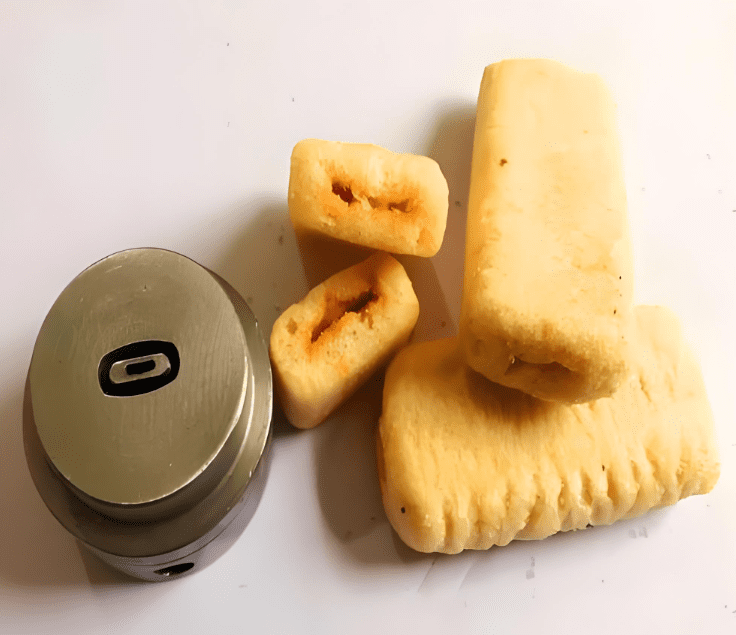
1. Raw Material Selection for Corn Extruded Snacks
Raw material selection is the first step in producing high-quality corn extruded snacks. Different raw materials influence the expansion rate, texture, flavor, color, and nutritional characteristics of the finished products.
The main ingredients include:
Corn flour: Corn flour is the primary raw material in most corn extruded snacks. Its starch content plays an important role in expansion and texture formation during extrusion.
Wheat flour: Some formulations include wheat flour to adjust dough properties and influence the final product structure.
Rice flour: Rice flour can be added to improve crispness and modify the texture of extruded snacks.
Vegetable oils: Oils may be used during formulation or applied after extrusion to improve flavor and provide a suitable surface for seasoning.
Salt and sugar: These ingredients help develop the basic flavor of the snacks.
Food additives: Depending on the product formulation and applicable regulations, emulsifiers, antioxidants, and other permitted ingredients may be used to improve processing performance and product stability.
Seasoning ingredients: Cheese powder, barbecue seasoning, chili powder, tomato powder, and other flavoring materials can be used to create different products.
Manufacturers should select food-grade raw materials and establish suitable inspection procedures to ensure consistent ingredient quality.
2. Raw Material Grinding and Sieving
Before mixing, corn and other grain ingredients may need to be ground into a suitable particle size.
A hammer mill or other food-grade grinding machine can be used to produce uniform corn flour.
After grinding, the flour passes through a screening system to remove oversized particles and foreign materials.
Particle size is an important factor in extrusion processing. If the flour is too coarse, it may result in uneven hydration, unstable extrusion, and rough product surfaces. Excessively fine flour may also influence water absorption and dough behavior.
Therefore, manufacturers should select an appropriate grinding fineness according to the extruder design and product requirements.
3. Ingredient Mixing and Water Addition
After raw material preparation, the different ingredients are transferred into a mixing machine.
The mixer combines corn flour, rice flour, wheat flour, and other dry ingredients according to the production formula.
Water is then added gradually to adjust the moisture content of the mixture.
Uniform mixing is essential because the ingredients must be evenly distributed before entering the extruder.
Several factors should be considered during this stage:
- Ingredient proportions: Maintain accurate ingredient ratios to ensure consistent product quality.
- Water addition: Adjust moisture content according to raw material characteristics and extrusion requirements.
- Mixing time: Ensure sufficient mixing without unnecessary processing delays.
- Ingredient uniformity: Avoid dry pockets, excessive lumps, and uneven moisture distribution.
Proper mixing helps improve extrusion stability and ensures that the finished snacks have consistent expansion and texture.
4. Extrusion Cooking: The Core of Corn Snack Production
\
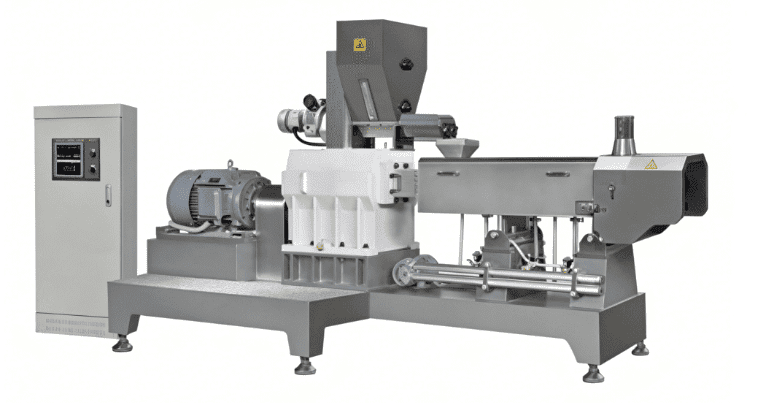
Extrusion cooking is the most important stage in the corn extruded snack manufacturing process.
A food extruder uses mechanical energy, heat, pressure, and moisture to transform the mixed ingredients into a cooked and expandable material.
Depending on the product type, manufacturers can choose a single-screw or twin-screw extruder.
The extrusion process generally includes the following operations.
4.1 Feeding
The prepared corn mixture is transferred into the extruder through a feeding system.
A stable feeding rate is important because fluctuations in material supply can affect extrusion pressure, product expansion, and finished product dimensions.
4.2 Conveying and Mixing
Inside the extruder barrel, rotating screws convey and mix the ingredients.
The material gradually moves forward while being subjected to mechanical shear and compression.
During this process, starch undergoes gelatinization, while proteins and other ingredients undergo structural changes.

4.3 Extrusion Cooking
Heat and mechanical energy increase the temperature of the material.
The combination of moisture, temperature, pressure, and mechanical shear helps cook the ingredients and develop the structure required for expansion.
The operating conditions must be adjusted according to the formulation and desired product characteristics.
4.4 Die Extrusion and Expansion
The cooked material is forced through a specially designed die.
When it exits the die, the sudden pressure reduction causes moisture to evaporate rapidly. This creates an expanded structure and gives the snack its characteristic porous texture.
By changing the die design, manufacturers can produce different corn snack shapes, including:
- Corn curls.
- Cheese balls.
- Corn sticks.
- Ring-shaped snacks.
- Tubular snacks.
- Triangle-shaped snacks.
- Customized puffed products.
The screw configuration, die design, moisture content, and extrusion temperature all influence the final expansion ratio and product texture.
5. Cutting and Shaping
After extrusion, the expanded material is cut into the required lengths by a rotating cutting system.
For products such as corn curls and corn sticks, cutting speed can be adjusted to control product length.
Different product shapes require different dies and forming configurations.
For example, ring-shaped snacks require specially designed forming openings, while tubular snacks need dies that create a hollow structure.
Accurate cutting and stable extrusion help ensure consistent product dimensions and improve the appearance of the finished snacks.
6. Drying the Extruded Corn Snacks
Freshly extruded corn snacks generally contain excess moisture and need to be dried before further processing.
A continuous belt dryer is commonly used in industrial production.
The products are transported through the drying chamber while hot air circulates around them, gradually removing excess moisture.
The main objectives of drying include:
- Reducing moisture content to the required level.
- Improving product crispness.
- Supporting product stability during storage.
- Preparing the snacks for frying or seasoning.
- Reducing the risk of quality deterioration caused by excessive moisture.
Drying temperature, residence time, airflow, and product loading density should be carefully controlled.
If the drying temperature is too high, the outside of the product may dry too quickly while the interior remains moist. If drying is insufficient, the snacks may become soft during storage.
For products that require additional frying, the drying conditions should be designed according to the subsequent frying process.
7. Frying: Creating a Crispier Texture
Not all corn extruded snacks need to be fried. Some products are dried and seasoned directly, while others undergo an additional frying process to develop a richer flavor and crispier texture.
For fried corn snacks, a continuous frying machine is commonly used.
The dried or partially dried products enter the fryer and are exposed to hot edible oil for a controlled period.
Several factors influence frying quality:
Oil temperature: The frying temperature must be controlled according to product size, moisture content, and formulation.
Frying time: Appropriate frying time ensures that the products develop the desired texture without excessive browning.
Oil quality: Regularly monitor oil quality and replace or filter oil according to a suitable management plan.
Feeding rate: Maintain stable product feeding to avoid significant temperature fluctuations.
After frying, excess oil should be removed using a vibrating oil-draining conveyor or centrifugal oil-removal equipment.
Proper frying helps develop a crispy structure, attractive color, and distinctive fried flavor.
8. Seasoning and Flavoring
Seasoning is an important stage in corn extruded snack processing because it determines much of the product’s final flavor and consumer appeal.
After drying or frying, the snacks enter a seasoning machine.
A rotating seasoning drum is commonly used to distribute flavoring ingredients evenly across the product surface.
The seasoning process generally includes:
- Feeding the snacks into the seasoning drum.
- Spraying a controlled amount of edible oil or liquid coating when required.
- Adding powdered seasonings.
- Rotating the drum to distribute the ingredients evenly.
- Adjusting the seasoning quantity according to the product formula.
Popular seasoning options include:
- Cheese flavor.
- Barbecue flavor.
- Spicy chili flavor.
- Tomato flavor.
- Sour cream and onion flavor.
- Salted flavor.
- Sweet corn flavor.
The amount of seasoning and oil should be carefully controlled. Too little seasoning may result in weak flavor, while excessive coating may cause the snacks to become greasy or lose their desired texture.
Manufacturers can develop multiple product varieties using the same basic production line simply by changing seasoning formulas.
9. Cooling and Screening
After seasoning, the corn snacks should be cooled before packaging.
Cooling allows the products to reach an appropriate temperature and helps stabilize their texture.
If hot snacks are packaged immediately, moisture condensation may occur inside the packaging, potentially reducing crispness and affecting shelf life.
A cooling conveyor can be used to lower product temperature under controlled conditions.
The snacks then pass through a screening machine to remove broken pieces, excessive seasoning powder, and irregular products.
This step improves product appearance and ensures greater consistency in the final packages.
10. Automatic Packaging
Packaging is the final stage of the corn extruded snack manufacturing process.
Automatic packaging machines can weigh, fill, and seal products into different types of bags.
Common packaging formats include:
- Small snack bags for individual consumption.
- Medium-sized packages for supermarkets.
- Large family-sized packages.
- Bulk packages for food service and distribution businesses.
Since corn extruded snacks are generally lightweight, crispy, and sensitive to moisture, packaging materials should provide effective moisture and oxygen barriers.
Nitrogen flushing may also be used to reduce oxygen inside the package and help protect product quality.
Each package should include the ingredient list, nutritional information, net weight, allergen information, production date, expiration date, and other legally required labeling details.
11. Quality Control in Corn Extruded Snack Production
Producing high-quality corn snacks requires strict quality control throughout the entire manufacturing process.
The following factors deserve special attention.
Raw material quality: Check corn flour particle size, moisture content, ingredient freshness, and potential contamination.
Mixing uniformity: Ensure that dry ingredients and water are evenly distributed.
Extrusion parameters: Monitor temperature, pressure, screw speed, feed rate, and moisture content.
Product expansion: Check expansion ratio, density, shape, and internal structure.
Drying performance: Monitor final moisture content and water activity to support product stability.
Frying quality: Control oil temperature, frying time, color, and residual oil.
Seasoning uniformity: Ensure consistent flavor distribution and coating coverage.
Finished product inspection: Evaluate crispness, flavor, appearance, breakage rate, packaging integrity, and shelf stability.
Food manufacturers should also establish sanitation procedures, pest control measures, traceability systems, and appropriate food safety management programs.
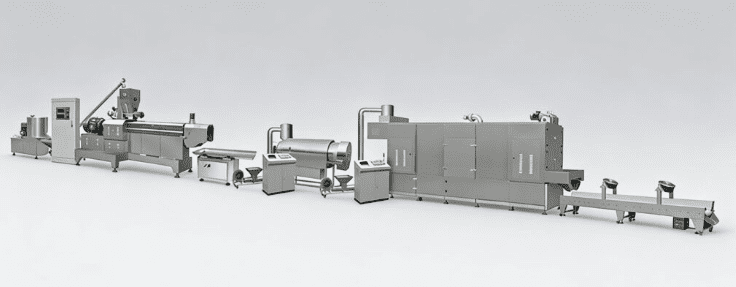
12. What Machines Are Needed for a Corn Extruded Snack Production Line?
A complete corn extruded snack production line consists of several machines working together.
| Equipment | Main Function |
|---|---|
| Corn grinder | Grinds corn into suitable flour |
| Screening machine | Removes oversized particles and impurities |
| Mixing machine | Mixes raw materials and water |
| Screw feeder | Transfers ingredients into the extruder |
| Food extruder | Cooks and expands corn-based materials |
| Cutting machine | Cuts snacks into required lengths |
| Continuous dryer | Reduces product moisture |
| Frying machine | Fries snacks when required |
| Oil-draining machine | Removes excess surface oil |
| Sazonador | Applies flavoring ingredients |
| Cooling conveyor | Cools finished snacks |
| Packaging machine | Weighs and packages products |
The specific equipment configuration depends on the product type, production capacity, processing method, and investment budget.
For example, a production line designed for non-fried puffed corn snacks may only require extrusion, drying, seasoning, and packaging equipment. A fried corn snack production line needs an additional frying and oil-removal section.
13. How to Improve the Quality of Corn Extruded Snacks
Although extrusion technology is relatively mature, producing consistently high-quality corn snacks still requires careful process optimization.
Here are several practical suggestions:
1. Select suitable corn flour. Raw material quality directly influences starch gelatinization, expansion, and final texture.
2. Control moisture content. Water content affects extrusion pressure, cooking performance, expansion ratio, and product structure.
3. Optimize extrusion conditions. Adjust screw speed, barrel temperature, feeding rate, and die design according to the desired product.
4. Maintain stable cutting performance. Proper cutting speed helps ensure consistent snack dimensions.
5. Establish a suitable drying program. Uniform drying prevents excessive moisture and helps maintain crispness.
6. Control frying conditions. For fried products, stable oil temperature and appropriate frying time help prevent uneven color and excessive oil absorption.
7. Improve seasoning uniformity. Use appropriate coating equipment and control the amount of seasoning added.
8. Choose suitable packaging materials. Effective moisture protection is essential for maintaining the crisp texture of corn snacks during storage.
14. Conclusion
Corn extruded snack processing is a systematic manufacturing process involving raw material preparation, mixing, extrusion cooking, shaping, drying, optional frying, seasoning, cooling, and packaging.
Among these stages, extrusion plays a central role in determining the expansion ratio, internal structure, and basic texture of the products. Drying and seasoning also have a significant influence on final product quality and consumer acceptance.
For manufacturers planning to enter the corn snack industry, selecting the right production equipment and establishing a reliable processing formula are essential.
With a properly designed corn extruded snack production line, manufacturers can produce a wide range of crispy corn-based snacks, improve production efficiency, reduce product waste, and respond to changing consumer preferences.
As the global snack food market continues to evolve, investing in advanced extrusion technology and developing innovative flavors and shapes can help food manufacturers strengthen their competitiveness and explore new business opportunities.


