
The global pet food industry is experiencing unprecedented growth, driven by the humanization of pets and increasing demand for high-quality nutrition. However, for entrepreneurs and manufacturers, establishing a pet food factory is not merely an exercise in production capacity; Pet food making machine it is a complex legal and administrative undertaking. Because pet food sits at the intersection of agriculture, human food safety, and animal health, it is one of the most heavily regulated consumer goods in the world .
The specific administrative licenses and permits required vary drastically by jurisdiction. A facility approved in China cannot ship a single bag to the United States without undergoing a separate compliance process. This article provides a detailed overview of the administrative licenses and regulatory requirements for opening a pet food factory in the United States, the European Union, China, the United Kingdom, Australia, and New Zealand.
1. The United States: A Dual System of Federal and State Control
In the United States, the regulatory framework for pet food is shared between the federal Food and Drug Administration (FDA) and individual state authorities. Manufacturers must navigate both layers to operate legally.
Federal Registration and Compliance
The cornerstone of U.S. federal regulation is the Federal Food, Drug, and Cosmetic Act (FD&C Act) . All facilities that manufacture, process, pack, or hold pet food intended for consumption in the U.S. must register with the FDA via a Food Facility Registration . This registration must be renewed biennially.
Beyond registration, manufacturers must comply with the Current Good Manufacturing Practices (cGMPs) and Preventive Controls for Animal Food (PCAF) rules, mandated by the Food Safety Modernization Act (FSMA) . This requires facilities to implement a written food safety plan, conduct a hazard analysis, and establish risk-based preventive controls. There is no federal “pre-approval” for most pet food products, but manufacturers must ensure that all ingredients are generally recognized as safe (GRAS) or have a valid food additive clearance, often referencing standards set by the Association of American Feed Control Officials (AAFCO) .
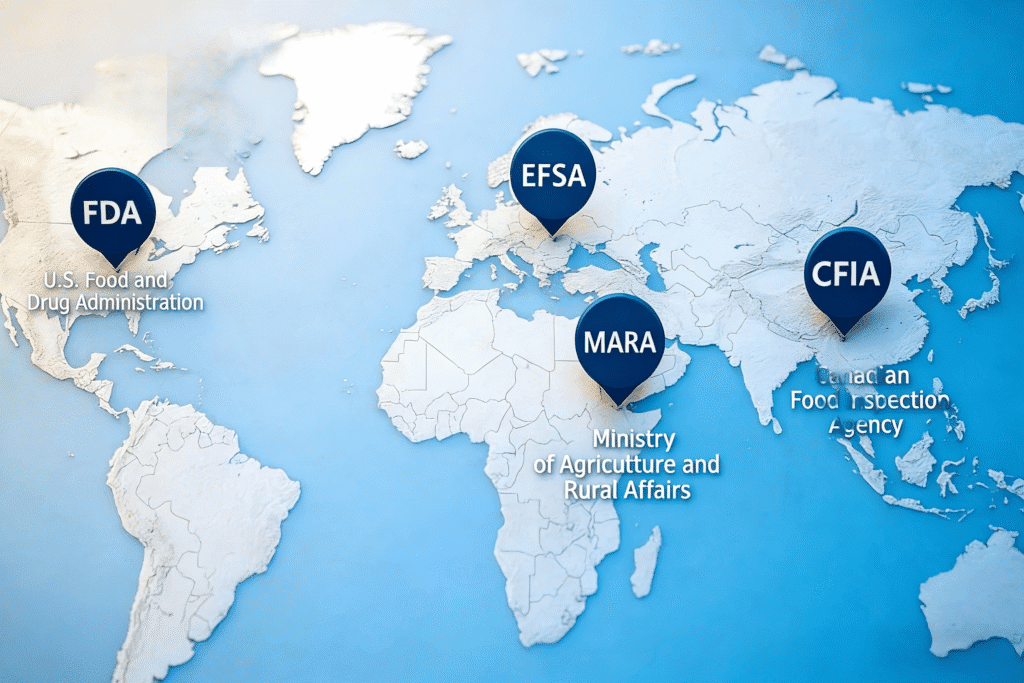
| Region | Main Authority | Key Permit/Requirement | Notes |
| United States | FDA (CVM) + State Feed Offices | Facility Registration, Feed License, Label Pre-Approval | Must follow FSMA Preventive Controls; AAFCO standards widely referenced |
| European Union | European Commission (DG SANTE) + FEDIAF Guidance | Feed Business Operator Registration, HACCP, Traceability | Uniform standards across member states; strict on additives and GMOs |
| China | Ministry of Agriculture and Rural Affairs | Pet Food Production Permit, Label Filing, Import/Export Registration | Labels must include Chinese; ingredient approval tightly controlled |
| Canada | CFIA (Canadian Food Inspection Agency) | Feed Registration, Facility Compliance, BSE Rules | Focus on ingredient approvals and import certification |
State-Level Licenses
While the FDA oversees safety, individual states regulate the sale and distribution of pet food within their borders. Most states require pet food manufacturers to obtain a state feed license and register their product labels before the food can be sold. These state laws often adopt AAFCO model regulations regarding labeling, guaranteeing minimum nutritional adequacy, and ingredient definitions . A proposed federal bill (the PURR Act) seeks to streamline this, but currently, a national distribution strategy requires compliance with 50 different state programs .
2. The European Union: Harmonized Standards with Local Enforcement
The European Union operates under a harmonized legal framework, meaning that laws are consistent across member states, but administrative enforcement is handled by national authorities.
Establishment Approval and Registration
Any business manufacturing pet food in the EU must comply with Regulation (EC) No 183/2005 (Feed Hygiene Regulation). Facilities must be either approved o registered by the competent authority of the member state in which they are located (e.g., the Food Standards Agency in the UK prior to Brexit, or similar bodies in France, Germany, etc.) .
To gain approval, a factory must demonstrate that it operates according to Hazard Analysis and Critical Control Points (HACCP) principles. This includes strict traceability protocols from “stable to table,” as outlined in the General Food Law Regulation (EC) No 178/2002 .
Material and Additive Compliance
Pet food in the EU must comply with strict regulations concerning ingredients, particularly Animal By-Products (ABP) . Regulation (EC) No 1069/2009 categorizes animal by-products by risk level, and pet food manufacturers must only use materials from Category 3 (low-risk) sources . Additionally, Regulation (EC) No 767/2009 governs labeling and marketing, prohibiting misleading claims and ensuring that ingredients are listed according to the EU Catalogue of Feed Materials .
3. China: Strict State Control and Import Protocols
China has emerged as a massive market for pet food, but its regulatory environment is highly centralized and stringent, governed primarily by the Ministry of Agriculture and Rural Affairs (MARA) .
Domestic Production Licenses
For factories located within China, the primary administrative hurdle is obtaining the Pet Food Production License. This is governed by a series of normative documents including the Administrative Measures for Pet Feed and the Pet Feed Production License Conditions . Applicants must pass an on-site audit by MARA officials, who inspect facilities for proper equipment, sanitation, quality control laboratories, and qualified technical personnel. The factory must also file its product formulas and labels with the local agricultural department.
Import Registration for Foreign Factories
For international manufacturers wishing to export to China, the process is even more complex. China requires foreign pet food manufacturers to be registered with MARA—a process that is not merely administrative but often involves a substantive review of the exporting country‘s regulatory system and individual facility audits . Additionally, every product formula intended for sale in China must be registered and approved, a process that can take months or even years and requires full disclosure of ingredient compositions .
4. The United Kingdom: Retained EU Law with Domestic Enforcement
Since leaving the EU, the UK has established its own regulatory regime, though it remains largely aligned with EU standards.
Approval from the Food Standards Agency (FSA)
In Great Britain (England, Scotland, and Wales), pet food manufacturers must be approved or registered by the FSA or local authority Trading Standards departments under the Animal By-Products (Enforcement) (England) Regulations 2013 and retained EU legislation . Like the EU, the UK mandates full traceability, HACCP plans, and strict controls on animal by-products. For factories handling high-risk materials or exporting, full approval (rather than simple registration) is often required. In Northern Ireland, the EU regulatory framework continues to apply under the Windsor Framework .
5. Australia and New Zealand: Environmental and Biosecurity Controls
Australia and New Zealand have unique requirements that blend food safety with strict biosecurity and environmental protection laws.
Australia: State-Based Licensing and Federal Oversight
In Australia, pet food manufacturing is regulated by a combination of state authorities and federal standards. Facilities must comply with the Australian Standard for the Hygienic Production of Pet Meat (AS 5812:2017) or similar guidelines . At the state level, factories require specific licenses; for example, in New South Wales, the NSW Food Authority requires an animal food processing license . In Victoria, under the Environment Protection Act, a facility with a production capacity exceeding 200 tonnes per year must hold a development and operating licence from the EPA, focusing on waste management and noise control . The federal Department of Agriculture also enforces biosecurity import conditions for any imported ingredients.
New Zealand: The ACVM Act
In New Zealand, pet food is classified as an “oral nutritional compound” (ONC) under the Agricultural Compounds and Veterinary Medicines (ACVM) Act 1997 . While most standard pet foods are exempt from formal product registration, they must meet the conditions of that exemption. Manufacturers must ensure their products do not contain unregistered veterinary medicines and must comply with labeling and safety requirements overseen by the Ministry for Primary Industries (MPI) . Any product making a therapeutic claim (e.g., “treats arthritis”) would immediately lose its exempt status and require full registration as a veterinary medicine .
Common Global Requirements: The Universal Baseline
Despite the national variations, certain administrative requirements are universal when opening a pet food factory anywhere in the world:
- Facility Standards (GMP): All jurisdictions require facilities to be constructed in a way that prevents contamination, with proper zoning of raw and finished product areas, impervious surfaces, and pest control systems .
- Food Safety System (HACCP): A documented Hazard Analysis and Critical Control Points plan is the international standard for safety management .
- Traceability: “One step forward, one step back” traceability is mandatory. Regulators globally expect a manufacturer to be able to trace finished goods back to the batch of raw ingredients and forward to the distributor within a matter of hours .
- Labeling Compliance: Labels must include a proper product name, net quantity statement, ingredient list (in descending order), nutritional adequacy statement, and manufacturer contact information .
Opening a pet food factory requires a strategic approach to regulatory compliance. The “license” is rarely a single document; it is a portfolio of permits, registrations, and approved safety plans. For domestic producers, the focus is on obtaining local production licenses and passing facility inspections. For international exporters, the challenge multiplies, requiring compliance with both the manufacturing standards of the home country and the import registration protocols of the target market. Engaging with local regulatory consultants and legal experts is not merely advisable—it is an essential step in ensuring that a pet food business is built on a solid, compliant foundation . Permits are not just bureaucracy—they build trust and open global markets. Whether local or export, design compliance into your factory early. Our Pet food production line solutions can help reduce risks, simplify audits, and let you focus on growth.
Comprehensive FAQ: Expert Answers
How do I know if my country requires federal registration?
A: You can check national food safety authorities (e.g., FDA, EFSA, MARA).
What’s the quickest way to prepare for export?
A: Ensure bilingual labeling, lot coding, and lab validation. Request mock inspections.
A: Yes, product liability insurance is often required by importers.
Can I use consultants instead of a full-time nutritionist?
A: Yes. Many firms hire freelance consultants to meet standards like AAFCO/FEDIAF.
A: Rules still apply. Safety, labeling, and sanitation remain mandatory.