
1. Introduction
Doritos are among the most popular corn-based tortilla chips in the global snack food market. Known for their distinctive triangular shape, crispy texture, rich corn flavor, and bold seasonings, Doritos have become a favorite snack among consumers of different ages.
Behind their appealing taste and appearance is a carefully controlled food processing procedure. From raw corn preparation to dough mixing, extrusion or sheeting, cutting, frying or baking, seasoning, and packaging, every production stage plays an important role in determining the final product quality.
For food manufacturers interested in producing Doritos-style tortilla chips, understanding the processing technology and selecting suitable production equipment are essential.
This article introduces the main steps involved in manufacturing Doritos-style corn chips and explains the key factors that affect production efficiency and product quality.

2. Raw Materials for Doritos Production
The quality of raw materials directly affects the flavor, texture, color, and nutritional characteristics of the finished chips.
The main ingredients generally include:
Corn or corn flour: Corn is the primary raw material and provides the characteristic flavor and structure of tortilla chips. Depending on the production process, manufacturers may use whole corn or prepared corn flour.
Water: Water is added to adjust the moisture content of the dough, helping the ingredients mix evenly and form a workable dough.
Vegetable oil: Vegetable oil is commonly used for frying and may also be applied during seasoning to help spices adhere to the chip surface.
Salt: Salt enhances the natural corn flavor and provides a basic seasoning profile.
Seasoning powders: Different combinations of cheese powder, chili powder, barbecue seasoning, tomato powder, and other flavor ingredients can create a variety of products.
Other ingredients: Depending on the desired product characteristics, manufacturers may use small quantities of approved additives, such as emulsifiers or processing aids, in accordance with local food regulations.
Choosing clean, stable, and high-quality raw materials is the first step toward consistent production.

3. The Complete Doritos Processing Process
Commercial Doritos-style corn chips are generally produced through several major stages. One common production approach involves preparing corn dough, forming thin triangular pieces, and then frying or baking them.
Step 1: Corn Preparation
Corn preparation is the foundation of the entire production process.
When whole corn is used, it must first be cleaned to remove stones, dust, broken kernels, and other impurities. Depending on the selected manufacturing technology, the corn may undergo cooking and alkaline treatment, similar to the traditional nixtamalization process used for tortilla production.
After cooking, the corn is washed and drained before being ground into a suitable dough.
Alternatively, manufacturers can use prepared corn flour, which is mixed directly with water and other ingredients.
The purpose of this stage is to obtain a clean and uniform corn-based material with suitable moisture and processing characteristics.
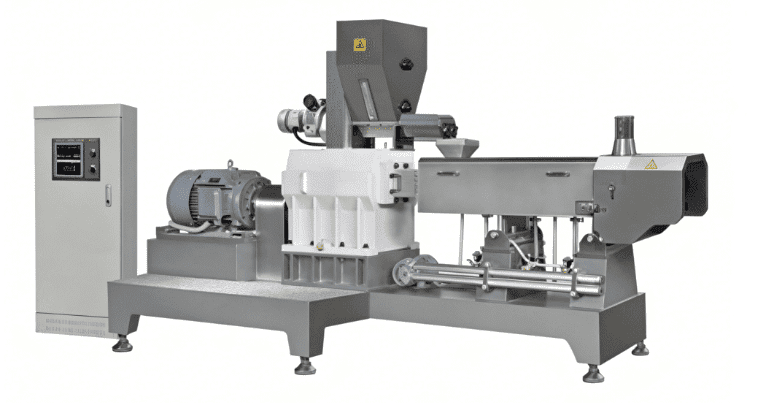
Step 2: Dough Mixing
The prepared corn material is transferred into a mixing machine.
Water, salt, and other selected ingredients are added according to the product formulation. The mixer combines the materials until a uniform dough is obtained.
Proper mixing is important because uneven moisture distribution can cause problems during forming and frying.
If the dough is too dry, it may crack during sheeting or cutting. If it contains too much moisture, the chips may become difficult to handle and require longer frying or drying times.
Manufacturers should control the ingredient ratios, mixing time, and dough temperature to ensure stable processing.
Step 3: Dough Sheeting
After mixing, the dough is transferred to a sheeting machine.
The machine presses the dough into a thin, continuous sheet with a relatively uniform thickness.
Sheet thickness is one of the most important factors affecting the final texture of Doritos-style chips.
If the sheet is too thick, the finished chips may be hard and dense. If it is too thin, they may become fragile and break easily during transportation and packaging.
Therefore, manufacturers should adjust the roller gap and feeding speed according to the desired product specifications.
Step 4: Triangle Cutting
The corn dough sheet is transported to a cutting machine, where rotary cutters or specially designed molds cut it into triangular pieces.
The triangular shape is one of the most recognizable characteristics of Doritos-style snacks.
The cutting equipment should ensure consistent dimensions and clean edges. Irregular shapes can affect frying uniformity, product appearance, and packaging efficiency.
Excess dough remaining after cutting can often be collected and returned to the production process when food safety and product-quality requirements allow.
Step 5: Frying or Baking
After cutting, the triangular corn pieces enter the cooking stage.
There are two common approaches: deep frying and baking.
Deep Frying
Deep frying is widely used to produce crispy tortilla chips with a characteristic fried flavor.
The cut pieces are transferred into a continuous fryer, where they are cooked in hot vegetable oil.
Frying temperature, residence time, oil quality, and product moisture all influence the final texture and color.
If the oil temperature is too high, the chip surface may brown too quickly while the interior remains insufficiently cooked. If the temperature is too low, the products may absorb excessive oil and develop an undesirable texture.
Manufacturers should monitor oil temperature continuously and maintain good oil filtration and replacement practices.
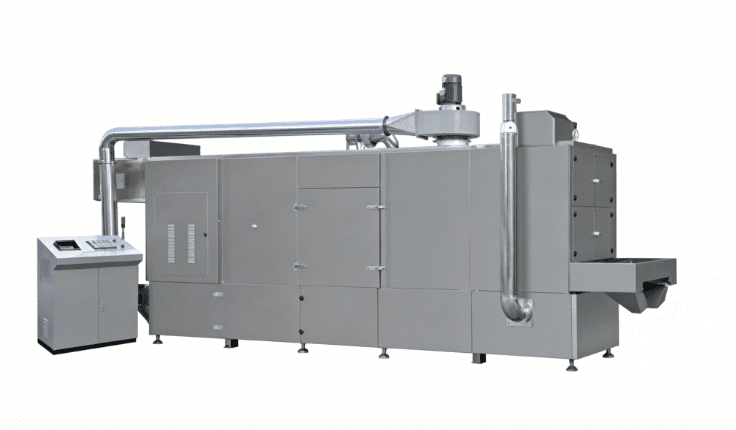
Baking
Some manufacturers choose baking instead of deep frying to produce a different texture and reduce the amount of added oil.
The triangular pieces are transported through an industrial baking oven, where controlled heat removes moisture and develops a crisp structure.
Baking temperature, airflow, and residence time must be adjusted according to the product formulation and thickness.
The choice between frying and baking depends on the desired taste, nutritional profile, production capacity, and target market.
Step 6: Cooling
After frying or baking, the chips need to be cooled before seasoning.
A cooling conveyor allows hot products to release heat and reach a suitable temperature for the next processing stage.
Proper cooling helps prevent moisture condensation inside packaging and reduces the risk of seasoning clumping.
It also makes the chips easier to handle during subsequent processing.
Step 7: Seasoning
Seasoning is one of the most important stages in Doritos-style snack production.
After cooling, the triangular chips enter a seasoning drum or flavoring machine.
Seasoning powder is distributed over the surface while the drum rotates. A controlled amount of oil or seasoning adhesion solution may be applied to improve powder adhesion.
Different seasoning formulations create different flavors, including:
- Nacho cheese flavor
- Spicy chili flavor
- Barbecue flavor
- Cool ranch-style flavor
- Tomato flavor
- Sour cream and onion flavor
The amount of seasoning, particle size, application uniformity, and adhesion all influence the final product.
Too little seasoning results in a weak flavor, while excessive seasoning may cause powder loss and uneven coating.
Manufacturers should develop suitable seasoning formulas according to consumer preferences and local food regulations.
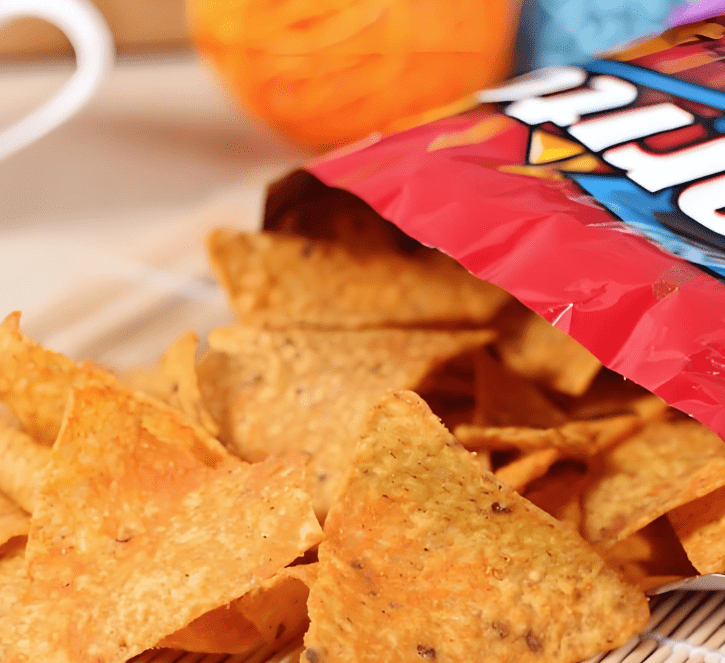
Step 8: Weighing and Packaging
The seasoned chips are transported to an automatic weighing and packaging system.
A multihead weigher measures the required quantity of chips and feeds them into a packaging machine.
The packaging machine forms bags, fills them with products, and seals them automatically.
For crispy corn chips, moisture and oxygen protection are especially important. Therefore, manufacturers commonly use laminated packaging materials with suitable barrier properties.
Nitrogen flushing may also be used to help protect product freshness and reduce oxidation.
Packaging should provide sufficient protection against moisture absorption, breakage, and contamination during storage and transportation.
4. Main Equipment Required for Doritos Production
A commercial Doritos-style corn chip production line generally consists of the following equipment:
| Equipment | Main Function |
|---|---|
| Corn cleaning machine | Removes impurities from raw corn |
| Corn cooking system | Cooks and prepares corn when whole-kernel processing is used |
| Grinding machine | Processes prepared corn into dough |
| Dough mixer | Mixes corn material with water and other ingredients |
| Sheeting machine | Produces uniform dough sheets |
| Triangle cutting machine | Cuts the dough into triangular pieces |
| Continuous fryer | Fries the corn pieces |
| Baking oven | Bakes products when a baked process is selected |
| Cooling conveyor | Cools finished chips |
| Seasoning machine | Applies flavoring powders and oil |
| Multihead weigher | Measures product quantities |
| Automatic packaging machine | Fills and seals snack bags |
The exact equipment configuration depends on the raw materials, processing technology, production capacity, and desired finished-product characteristics.
5. Key Factors Affecting Doritos Quality
Producing attractive and crispy corn chips requires careful control of several processing parameters.
5.1 Dough Moisture Content
Moisture content affects dough flexibility, sheet formation, and cooking performance.
Insufficient moisture can cause cracks and uneven cutting. Excessive moisture may increase cooking time and lead to inconsistent product texture.
Manufacturers should establish an appropriate moisture range through production trials.
5.2 Sheet Thickness
Uniform dough thickness helps ensure that all chips cook evenly.
Thickness variations may cause some products to become overcooked while others remain insufficiently cooked.
Regular inspection and adjustment of the sheeting machine are essential.
5.3 Frying Temperature
Frying temperature directly influences color, crispness, oil absorption, and production efficiency.
Manufacturers should select suitable operating parameters based on the raw material formulation, product thickness, and fryer design.
5.4 Oil Quality
Frying oil gradually deteriorates during repeated heating.
Poor oil management may negatively affect product flavor, color, and shelf life.
Regular oil filtration, quality monitoring, and timely replacement are necessary for maintaining consistent production.
5.5 Seasoning Uniformity
Consumers expect each chip to have a consistent flavor.
An appropriately designed seasoning drum and accurate powder-feeding system help improve coating uniformity and reduce seasoning waste.
5.6 Packaging Quality
Even perfectly processed corn chips can lose their crispness if the packaging does not provide adequate moisture protection.
Manufacturers should select appropriate packaging films and ensure that sealing performance is reliable.
6. Common Problems in Doritos Production and Their Solutions
Problem 1: Chips Break Easily
Possible causes include insufficient dough moisture, excessive sheet thinness, and improper handling.
Solutions:
- Adjust the dough moisture content.
- Optimize sheet thickness.
- Reduce excessive vibration and mechanical impact during conveying.
Problem 2: Uneven Product Color
Possible causes include inconsistent sheet thickness, unstable frying temperature, or uneven product feeding.
Solutions:
- Improve dough sheeting uniformity.
- Maintain stable fryer temperature.
- Ensure consistent product distribution across the fryer.
Problem 3: Excessive Oil Absorption
Possible causes include unsuitable frying conditions, excessive product moisture, and inappropriate fryer operation.
Solutions:
- Optimize frying temperature and residence time.
- Control dough moisture.
- Improve oil drainage after frying.
Problem 4: Seasoning Falls Off Easily
Possible causes include insufficient adhesion, unsuitable seasoning particle size, or uneven seasoning distribution.
Solutions:
- Adjust the amount of oil or adhesion solution.
- Select suitable seasoning powder.
- Optimize seasoning drum speed and feeding rate.
Problem 5: Chips Become Soft During Storage
Possible causes include insufficient cooking, inadequate cooling, poor packaging materials, or moisture entering the bags.
Solutions:
- Optimize frying or baking conditions.
- Ensure proper cooling.
- Use high-barrier packaging materials.
- Check packaging seals carefully.
7. How to Improve Production Efficiency
For manufacturers planning to establish a commercial corn chip factory, improving production efficiency is just as important as maintaining product quality.
First, selecting an appropriately sized production line helps match equipment capacity with actual market demand.
Second, automatic conveying, continuous frying, seasoning, weighing, and packaging systems can reduce manual operations and improve production consistency.
Third, manufacturers should establish standardized operating procedures for each processing stage. Operators need to understand how to control dough moisture, sheet thickness, cooking temperature, and seasoning quantities.
Finally, regular equipment maintenance is essential. Cleaning the production line, inspecting moving parts, checking heating systems, and maintaining food-contact surfaces can help reduce unexpected downtime.
8. Food Safety and Quality Control
Food safety must be considered throughout the entire production process.
Manufacturers should use food-grade raw materials, maintain clean production environments, and prevent cross-contamination.
Important quality-control measures include:
- Inspecting incoming corn and other ingredients.
- Monitoring water quality and ingredient storage conditions.
- Maintaining hygienic equipment and production areas.
- Monitoring frying oil quality.
- Controlling cooking and moisture-removal conditions.
- Checking finished-product moisture and crispness.
- Testing seasoning ingredients for relevant safety requirements.
- Verifying packaging integrity and product traceability.
A well-designed HACCP-based food safety management system can help identify and control potential hazards throughout production.
9. Investment Considerations for a Doritos-Style Corn Chip Factory
Before investing in a corn chip production line, entrepreneurs should evaluate several important factors.
Production Capacity: Determine the expected daily and annual output based on target market demand.
Equipment Selection: Choose suitable machinery according to the intended processing method, product specifications, and available investment budget.
Factory Layout: Arrange raw material storage, processing, frying or baking, seasoning, packaging, and finished-product storage in a logical workflow.
Energy Consumption: Evaluate electricity, gas, water, and heating requirements to estimate operating costs.
Raw Material Supply: Establish reliable suppliers for corn, vegetable oil, seasoning ingredients, and packaging materials.
Market Positioning: Decide whether to produce traditional salted corn chips, cheese-flavored snacks, spicy products, or other innovative varieties.
Regulatory Compliance: Check local requirements for food manufacturing licenses, labeling, hygiene, product testing, and food safety.
Starting with a suitable production capacity and expanding gradually can help reduce investment risks.
10. Conclusion
Doritos-style corn chip production involves several interconnected processing stages, including raw material preparation, dough mixing, sheeting, triangular cutting, frying or baking, cooling, seasoning, and packaging.
Each stage has a direct impact on the appearance, flavor, texture, and shelf life of the finished product.
For manufacturers, choosing appropriate production equipment and establishing stable processing parameters are essential to producing high-quality corn chips.
With growing consumer demand for convenient and flavorful snacks, investing in an efficient corn chip production line can provide opportunities for food manufacturers. By combining reliable machinery, high-quality ingredients, standardized production procedures, and innovative seasoning formulas, businesses can develop competitive corn snack products for different markets.


