
Critical Considerations in Small-Scale Instant Noodle Processing: A Comprehensive Guide to Quality, Safety, and Efficiency
The production of instant noodles, a globally ubiquitous and affordable food staple, appears deceptively simple. However, transforming basic ingredients like flour, water, and salt into a consistent, safe, and palatable product requires a meticulous understanding of food science, engineering, and quality control. For small-scale producers, the challenges are magnified. Without the vast resources of multinational corporations, they must rely on precision, rigorous process control, and a deep knowledge of each processing stage to compete in a demanding market. Instant noodle making machine This article provides an exhaustive examination of the entire small-scale instant noodle production process, from raw material selection to final packaging. It delves into the critical problems that can arise at each juncture and offers detailed, practical solutions to ensure the production of a high-quality, safe, and profitable product. We will explore the intricacies of ingredient functionality, dough rheology, steaming kinetics, frying thermodynamics, and packaging integrity, all through the lens of a small-scale operation where margin for error is minimal.
1. Introduction: The Art and Science of a Simple Product
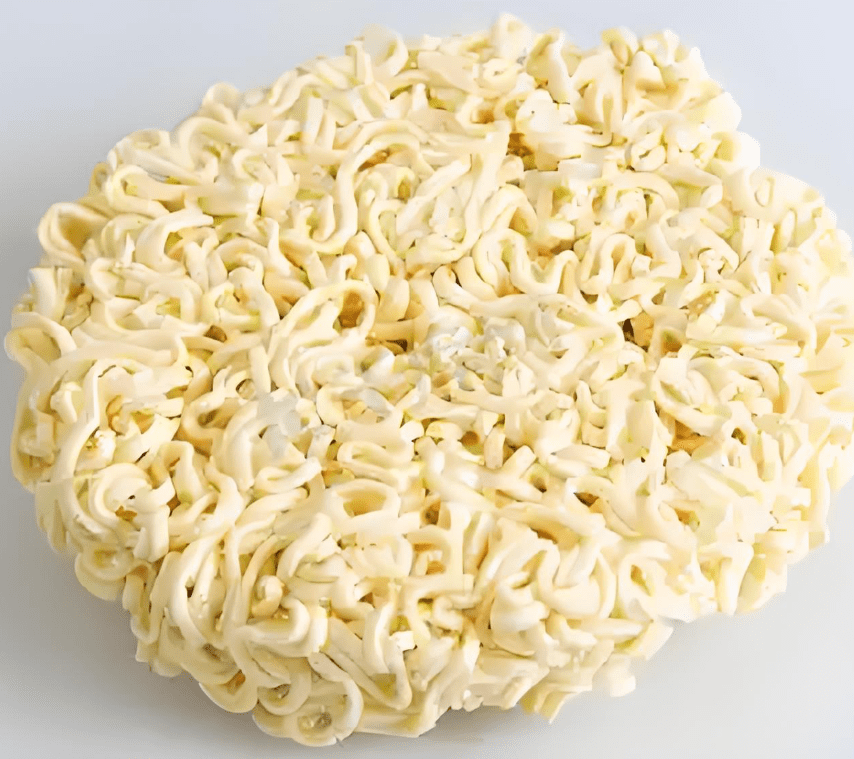
Instant noodles represent a remarkable feat of food engineering. Their long shelf-life, convenience, and satisfying texture are the result of carefully controlled processes that dehydrate and preserve a cooked noodle. The global market is dominated by two primary types: fried noodles, Instant noodle making machine which are dehydrated through immersion in hot oil, and non-fried (air-dried or hot-air dried) noodles, which use circulating hot air. Each method presents a unique set of challenges and considerations.
For a small-scale producer, success hinges not on high-volume throughput but on exceptional quality control, niche marketing, and operational efficiency. A single batch failure due to a overlooked detail can represent a significant financial loss. Therefore, a proactive, problem-prevention mindset is paramount. This guide is structured to follow the sequential steps of production, highlighting potential pitfalls and their remedies at every stage.
2. Stage 1: Raw Material Selection and Handling – The Foundation of Quality
The quality of the final product is irrevocably determined by the quality of the raw materials. Compromising here is a fundamental error.
2.1 Wheat Flour: The Primary Structural Component
Wheat flour is not a uniform commodity. For instant noodles, specific functional properties are non-negotiable.
- Problem: Incorrect Protein Content and Quality.
- Detail: Instant noodles require a medium-to-strong gluten network. Flour with too low a protein content (e.g., cake flour) will result in a weak, fragile dough that tears easily during sheeting and cutting, leading to excessive breakage. Flour with excessively strong, elastic gluten (like some bread flours) will cause shrinkage after sheeting, Instant noodle making machine making dimensional control difficult and resulting in a tough, chewy final texture.
- Solution: Source flour with a protein content typically between 9.5% and 12.5%. The quality of the protein is as important as the quantity. Perform or request from your supplier a detailed analysis including:
- Protein Content: Standard Kjeldahl or NIR analysis.
- Ash Content: Indicates extraction rate; lower ash (<0.50%) is preferable for brighter, cleaner-colored noodles.
- Farinograph or Mixolab Tests: These measure water absorption, dough development time, stability, and weakening. A stable curve with moderate water absorption is ideal.
- Problem: Moisture and Infestation.
- Detail: Flour delivered with high moisture content (>14%) is prone to spoilage, mold growth, and infestation by pests like weevils and moths. It can also throw off the precise water-to-flour ratio in the mixing stage.
- Solution:
- Supplier Qualification: Work only with reputable mills that provide certificates of analysis (CoA).
- Incoming Inspection: Use a portable moisture meter to check every batch upon delivery.
- Storage: Store flour in a cool, dry, and well-ventilated warehouse. Use pallets to keep sacks off the floor and away from walls. Implement a strict First-In-First-Out (FIFO) inventory system. Regularly inspect for signs of pests.
2.2 Water: The Universal Solvent and Plasticizer
Water is an active ingredient, not just a passive liquid.
- Problem: Variable Water Quality.
- Detail: Tap water can contain chlorine, high mineral content (hardness), and varying pH levels. Chlorine can bleach the flour and weaken the gluten network. High calcium and magnesium ions can also strengthen gluten excessively, leading to a hard texture. Microbial contamination is a critical safety risk.
- Solution: Install a water treatment system tailored to your local water supply. This should at a minimum include:
- Filtration: Multi-stage sediment and carbon filters to remove chlorine, particulates, and organic matter.
- Softening: If water is hard, an ion-exchange softener is crucial.
- Reverse Osmosis (RO): For the highest control, RO provides a consistent, pure water base to which specific minerals can be added back for optimal dough performance.
- Regular Testing: Test water frequently for pH (target 6.5-7.0), hardness, and microbial count (Total Plate Count, Coliforms).
2.3 Edible Oils (For Frying): The Dehydration Medium
The choice of oil is critical for shelf-life, flavor, and nutritional profile.
- Problem: Oil Rancidity and Oxidation.
- Detail: Oils high in polyunsaturated fats (like soybean or sunflower oil) are prone to oxidative rancidity, leading to off-flavors and unpleasant odors. The high temperatures of frying accelerate this process. Hydrolytic rancidity can also occur from moisture in the noodles breaking down the oil.
- Solution:
- Oil Selection: Choose oils with high smoke points and good oxidative stability. Palm olein is industry-standard due to its cost-effectiveness and stability. High-oleic sunflower or canola oil are more expensive but offer a “healthier” profile and good stability.
- Oil Management: This is a continuous process, not a one-time choice.
- Filtration: Implement continuous or batch filtration using paper filters or diatomaceous earth to remove food particles (cracker crumbs) that catalyze oil degradation.
- Turnover: Regularly add fresh oil to the fryer to maintain oil quality. The rate of turnover is key; a slow turnover allows degradation products to accumulate.
- Monitoring: Track oil quality using:
- Free Fatty Acids (FFA): A rising FFA level indicates hydrolysis. Set a maximum limit (e.g., 0.5-1.0%).
- Peroxide Value (PV): Measures primary oxidation products. Set a limit (e.g., 2.0 meq/kg).
- Anisidine Value (AV) or Total Polar Compounds (TPC): TPC is the most accurate indicator of overall oil degradation. The legal limit in many countries is 24-27%. For quality, aim to discard oil well before this point.
2.4 Minor Ingredients: Potentiators and Preservators
Salt, alkaline salts (kansui), starches, and gums each have a precise role.
- Problem: Inconsistent Alkaline Salt (Kansui) Mixture.
- Detail: Kansui (typically a blend of sodium and potassium carbonates and phosphates) is responsible for the characteristic yellow color, firm texture, and distinctive flavor of many instant noodles. An imprecise or inconsistent blend will lead to batch-to-batch variation in color and texture.
- Solution: Purchase pre-mixed, food-grade kansui from a reliable supplier. If mixing on-site, use calibrated digital scales and maintain meticulous records of every batch. Instant noodle making machine Dissolve kansui in the mixing water to ensure even distribution.
- Problem: Functional Starches and Gums.
- Detail: Native or modified starches (e.g., tapioca, potato) are sometimes added to improve texture or reduce oil uptake. Gums like guar or xanthan are used as stabilizers. Over-use can lead to a gummy, sticky, or overly dense noodle.
- Solution: Use these additives judiciously and understand their functionality. Conduct small-scale trials to determine the optimal percentage (usually 1-5% for starches, 0.1-0.5% for gums) for your specific process and formulation.
3. Stage 2: Dough Mixing and Kneading – Developing the Gluten Network
This is where the transformation from a powder to a cohesive viscoelastic mass begins.

- Problem: Inconsistent Dough Hydration.
- Detail: The amount of water added, expressed as a percentage of flour weight, is critical. Low hydration produces a crumbly, dry dough that won’t sheet properly. High hydration creates a sticky, soft dough that clogs machinery and results in noodles that fuse together during steaming and frying.
- Solution: Use high-precision load cells on the mixer hopper or weigh all ingredients, including water, on calibrated scales. Account for the inherent moisture content of the flour in your calculations. The optimal hydration typically falls between 32% and 38%, depending on flour absorption.
- Problem: Inadequate or Excessive Mixing.
- Detail: Under-mixing fails to fully hydrate the flour particles and develop the gluten network, leading to a weak dough. Over-mixing can “break” the gluten network, causing the dough to become sticky and slack.
- Solution: Standardize the mixing time and speed. Use a horizontal or vertical mixer with a dough hook. The endpoint is not always time-based; it is a sensory and visual assessment. The ideal dough should be crumbly yet cohesive, with a slightly glossy sheen, and should form a ball when squeezed in the hand without being sticky. Document the optimal mixing parameters for your equipment and formulation.
- Problem: Dough Temperature Control.
- Detail: Friction during mixing generates heat. High dough temperature (>35°C) can prematurely gelatinize starch, weaken gluten, and accelerate yeast/mold growth if present.
- Solution: Use chilled water in the mix, especially in warm environments. Consider a mixer with a jacketed bowl for cooling. Limit mixing time to minimize heat generation. Allow the dough to rest in a temperature-controlled environment.
4. Stage 3: Dough Sheet Forming and Compound Sheeting – Creating the Noodle Strand
This stage involves rolling the crumbly dough into a continuous, uniform sheet and then gradually thinning it to the desired gauge.
- Problem: Improper Dough Resting (Aging).
- Detail: After mixing, the dough is tense and the gluten network is under stress. Immediately sheeting it can cause tearing, shrinkage, and an uneven texture.
- Solution: Implement a resting period of 15-45 minutes. This allows for moisture equilibration and gluten relaxation, resulting in a more pliable, easier-to-sheet dough. Use a covered conveyor or resting bin to prevent surface drying.
- Problem: Inconsistent Sheet Thickness and Blistering.
- Detail: The series of sheeting rolls must be precisely calibrated. Misaligned or worn rolls will produce a sheet that is thicker on one side than the other. If the reduction ratio between successive rolls is too high, it can cause “blistering” – the formation of air pockets and an uneven, blistered surface on the sheet.
- Solution:
- Roll Calibration: Regularly check and calibrate the gap between sheeting rolls using feeler gauges. Check for roll wear and re-grind or replace as necessary.
- Reduction Ratios: Follow a gradual reduction. A typical sequence might be: 10mm -> 6mm -> 4mm -> 2.5mm -> 1.5mm. Avoid reductions greater than 50% per pass.
- Compound Sheeting: For a more uniform texture, the broad sheet is often folded and laminated (compounded) before the final thinning passes. This helps to align the gluten structure and eliminate inconsistencies.
5. Stage 4: Noodle Slitting and Waving – Forming the Final Shape
The continuous sheet is now cut into strands and given its characteristic wavy form.
- Problem: Irregular Slit Width and Ragged Edges.
- Detail: The cutting rolls have interlocking grooves. If these become dull, clogged with dough, or misaligned, they will produce noodles of varying widths or with frayed, ragged edges. This affects the cooking time, texture, and visual appeal.
- Solution: Establish a strict cleaning schedule for the cutting rolls. Inspect them daily for damage or wear. Ensure the rolls are properly tensioned and aligned.
- Problem: Poor Waving (Crimping) Formation.
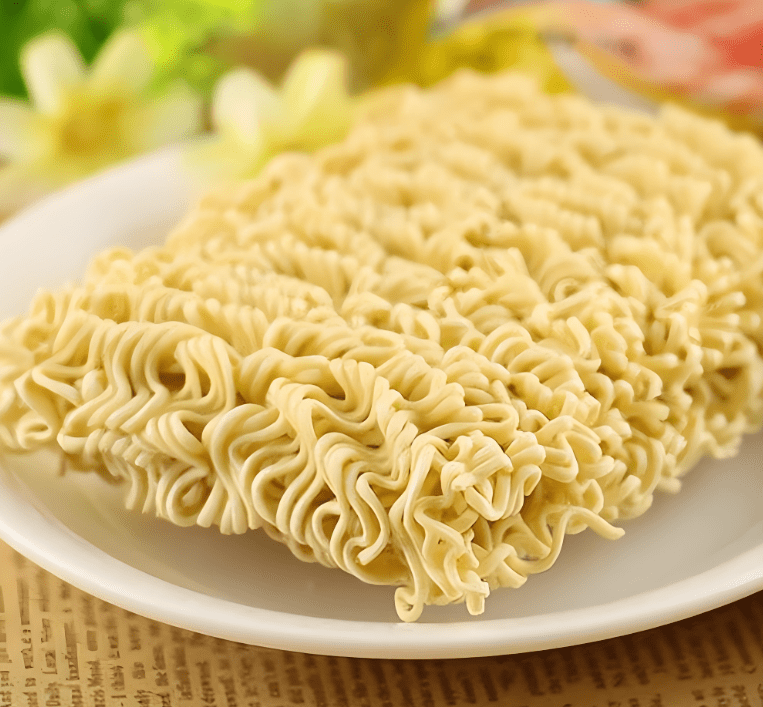
- Detail: The wavy form is not merely aesthetic; it creates a more open structure for efficient steaming and frying, and prevents the noodles from fusing into a solid block. Inconsistent waving can be caused by incorrect conveyor speed, misadjusted guide plates, or incorrect dough consistency (too dry or too sticky).
- Solution: The waving is created by a speed differential between the conveyor and the cutting rolls, and by guide plates that gently compress the noodles into folds. Adjust these parameters carefully. The ideal waved noodle block should be loose and open, not dense and compacted.
6. Stage 5: Steaming – Partial Gelatinization
Steaming is a crucial step that partially cooks the noodle, setting its structure and preparing it for the dehydration stage.
- Problem: Incomplete or Non-Uniform Gelatinization.
- Detail: The goal of steaming is to gelatinize the starch in the flour—swelling the starch granules and breaking down its crystalline structure. Incomplete gelatinization (typically below 80%) results in a white, raw core in the noodle strand. This leads to a hard, brittle texture after frying/drying and a long, unsatisfactory recooking time. Non-uniform steaming means some noodles are perfectly cooked while others are raw.
- Solution:
- Steam Saturation: Use saturated steam, not superheated steam. Superheated steam is dry and will cause surface drying before the heat penetrates the core.
- Temperature and Time: A typical steaming condition is 100-105°C for 1-5 minutes. This must be optimized based on noodle thickness and density. Use a temperature data logger to profile the steamer.
- Steamer Maintenance: Ensure the steamer is well-sealed to prevent steam escape. Use baffles and proper airflow design to ensure steam penetrates all parts of the noodle belt evenly. Condensate drains must be clear to prevent water from dripping onto the noodles.
- Problem: Noodle Block Distortion.
- Detail: If the steamed noodles are too soft, the weight of the noodles can cause the block to sag or distort as it moves from the steamer to the next stage.
- Solution: Ensure the dough is not over-hydrated or over-steamed. A short period of cool air blowing after steaming can help set the surface and provide more rigidity.
7. Stage 6: Dehydration – The Preservation Core
This is the most critical step for determining shelf-life and texture. Instant noodle making machine We will examine both frying and non-frying methods.
7.1 Frying Dehydration
- Problem: High Oil Uptake.
- Detail: Oil is a major cost and nutritional concern. High oil content leads to greasy noodles, higher costs, and reduced shelf-life due to rancidity. Oil uptake is influenced by surface area, moisture content, and oil temperature.
- Solution:
- Optimal Final Frying Moisture: The moisture content of the noodle entering the fryer is critical. If it’s too low, the noodle will absorb more oil. The steaming step should leave the noodle with sufficient internal moisture that flashes off as steam, creating a barrier to oil absorption. Aim for a consistent pre-fry moisture content.
- Frying Temperature: Maintain a consistent oil temperature, typically between 150°C and 165°C. Too low a temperature results in slow moisture removal and high oil pickup. Too high can burn the outside before the inside is dehydrated.
- Frying Time: This is directly linked to temperature. The goal is to reduce the moisture content from ~35% to ~3-5%. Use a moisture analyzer to check the final product frequently.
- Noodle Structure: A well-waved, open-structured noodle block will dehydrate more evenly and efficiently than a dense one.
- Problem: Blistering and Scorching.
- Detail: Localized hot spots in the fryer or contact with heating elements can cause blisters or burnt spots on the noodles.
- Solution: Ensure even heat distribution in the fryer through proper agitator design and flow. Regularly clean heating elements. Use a mesh conveyor to minimize direct contact with hot surfaces.
- Problem: Inconsistent Final Moisture.
- Detail: Some noodle blocks may be under-dried (high moisture, leading to microbial spoilage) or over-dried (brittle and fragile).
- Solution: The fryer must have a precise and consistent dwell time. The conveyor speed must be synchronized and stable. The noodle blocks must be placed on the conveyor with consistent spacing to allow for even oil circulation.
7.2 Non-Frying (Hot-Air Drying) Dehydration
- Problem: Case Hardening.
- Detail: This is the primary challenge in air-drying. If the temperature is too high and the humidity too low at the initial stage, the surface of the noodle dries and hardens rapidly, forming a crust. This crust traps moisture inside, preventing it from escaping. The result is a noodle that appears dry but has a high internal moisture content, leading to potential spoilage and a very long, hard-to-cook core.
- Solution: Implement a multi-stage drying profile:
- Conditioning Stage: Lower temperature (60-70°C), higher humidity to allow for gentle, uniform moisture removal without case hardening.
- Main Drying Stage: Higher temperature (75-85°C) to drive out the bulk of the moisture.
- Cooling/Final Stage: Lower temperature to equilibrate the noodle to ambient conditions.
- Humidity Control: This is non-negotiable. The dryer must have controlled humidity zones to manage the drying rate effectively.
- Problem: Long Drying Times and High Energy Cost.
- Detail: Air-drying is a much slower process than frying, limiting production capacity and increasing energy consumption per unit.
- Solution: Optimize the drying profile through experimentation. Ensure the dryer is well-insulated. Consider technologies like heat recovery systems to improve energy efficiency.
8. Stage 7: Cooling – Stabilizing the Product
The noodles exit the fryer or dryer at a high temperature and must be cooled before packaging.

- Problem: Packaging while Hot.
- Detail: Packaging hot noodles creates condensation inside the package, which is a primary cause of mold growth and sogginess. The heat can also stress the packaging material.
- Solution: Implement a sufficient cooling tunnel. Use ambient or cooled air to bring the noodle blocks down to within 5°C of the ambient temperature (typically <35°C). Monitor the noodle temperature at the packaging head.
9. Stage 8: Packaging – The Final Barrier
Packaging protects the product from its three greatest enemies: oxygen, moisture, and light.
- Problem: Poor Seal Integrity.
- Detail: The most common packaging failure is a leaky seal. This allows oxygen and moisture to enter, leading to rancidity and softening. Causes include contamination of the sealing surface with dust or oil, incorrect temperature/pressure/dwell time of the sealer, or poor-quality packaging film.
- Solution:
- Sealer Calibration: Daily checks and calibration of the heat sealer parameters are essential.
- Cleanliness: Keep the sealing jaws impeccably clean.
- Packaging Material: Use a multi-layer laminate. A typical structure is BOPP (outer print layer) / Aluminum Foil (barrier layer) / CPP (inner sealant layer). The foil provides an excellent barrier to oxygen, moisture, and light.
- Quality Control: Perform destructive seal tests every 30-60 minutes. This involves tearing open a pack and inspecting the seal for uniformity and strength. Use a seal strength tester periodically.
- Problem: Incorrect Headspace Gas (for Nitrogen Flushing).
- Detail: To prevent oxidative rancidity, the air inside the package is replaced with inert nitrogen gas. An inadequate oxygen level (<3% is a common target) inside the package defeats the purpose.
- Solution: Use a headspace oxygen analyzer. Regularly puncture randomly selected packages and measure the residual oxygen level. Adjust the nitrogen flushing parameters (flow, timing, nozzle position) to ensure consistent low-oxygen packaging.
- Problem: Incorrect Labeling and Weights.
- Detail: Regulatory non-compliance due to inaccurate ingredient lists, allergen statements, or net weight can lead to fines and recalls. Under-weight packages cheat the consumer, while over-weight packages erode profit.
- Solution: Implement a checkweigher after the packaging machine to reject under or over-weight packs. Have a documented process for managing any weight drift. Have all labels and packaging artwork reviewed for regulatory compliance.
10. Stage 9: Seasoning and Soup Base Production
While often a separate process, the quality of the seasoning packet is integral to the product experience.
- Problem: Hygroscopicity and Caking.
- Detail: Ingredients like salt, sugar, and hydrolyzed vegetable protein (HVP) absorb moisture from the air, causing the powder to cake into a solid block inside the packet.
- Solution:
- Processing: Use agglomerated or encapsulated ingredients where possible.
- Packaging: Use a high-barrier laminate for the seasoning sachet, similar to the noodle bag.
- Environmental Control: Maintain low humidity in the seasoning mixing and packaging room.
- Problem: Microbial and Foreign Material Contamination.
- Detail: Herbs, spices, and dehydrated vegetables can be sources of microbial contamination (e.g., Salmonella, Bacillus cereus) and foreign material like stones or metal fragments.
- Solution: Source ingredients from approved suppliers with good agricultural and manufacturing practices. Implement metal detectors and sieves in the seasoning processing line. Consider microbial reduction steps like steam treatment or irradiation for high-risk ingredients like garlic and onions.
11. Overarching Considerations: The Framework for Success
Beyond the specific stages, several horizontal systems are vital for a small-scale operation.
11.1 Sanitation and Food Safety (HACCP)
A dirty plant cannot produce a safe product. Instant noodle making machine Implement a rigorous sanitation program.
- Master Cleaning Schedule: Detail what to clean, how to clean it, with what chemicals, and how often.
- HACCP (Hazard Analysis Critical Control Point): This is a systematic, preventive approach. Develop a HACCP plan by:
- Conducting a hazard analysis (Biological, Chemical, Physical).
- Determining the Critical Control Points (CCPs) – points where control is essential to prevent or eliminate a hazard. Likely CCPs in instant noodle production are: Steaming (biological), Frying (biological), and Cooling/Packaging (biological).
- Establishing critical limits for each CCP (e.g., minimum steam temperature, final moisture content, maximum cooling temperature).
- Implementing monitoring procedures (e.g., continuous temperature chart recorders, moisture checks).
- Establishing corrective actions for when a deviation occurs.
- Verification procedures (e.g., calibration of instruments, microbial testing).
- Record-keeping.
11.2 Quality Control and Laboratory Support
You cannot control what you do not measure.
- In-Process Checks: Moisture, dough consistency, noodle weight, oil temperature, seal integrity.
- Finished Product Specifications: Moisture, oil content, acid value of oil, texture (using a texture analyzer), cooking time, sensory evaluation (color, aroma, flavor, texture).
- Shelf-Life Testing: Conduct accelerated shelf-life studies by storing products at elevated temperatures (e.g., 37°C) and monitoring quality parameters over time.
11.3 Maintenance and Engineering
A well-maintained line is a reliable line.
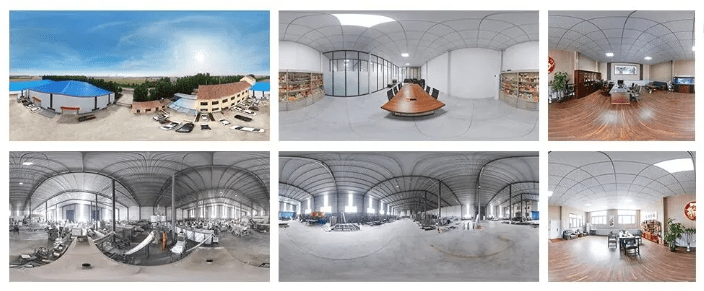
- Preventive Maintenance (PM): Don’t wait for equipment to break down. Create a PM schedule for all major equipment: mixers, sheeters, steamers, fryers, dryers, and packaging machines. This includes lubrication, belt tension checks, and part replacements based on running hours.
The journey from raw flour to a shelf-stable instant noodle is a complex ballet of physics, chemistry, and engineering. For the small-scale producer, success is not found in a single secret ingredient but in the relentless, disciplined application of knowledge and control at every single step of the process. From the protein quality of the incoming flour to the integrity of the final seal, Instant noodle making machine each variable must be understood, monitored, and optimized. By treating production as a integrated system—where raw material handling is as critical as frying thermodynamics, and sanitation is as vital as sheeter calibration—a small-scale operation can overcome its scale disadvantages. It can produce a product of exceptional quality, safety, and consistency, building a reputation that allows it to thrive in the shadow of industry giants. The margin for error is small, but the reward for precision is a sustainable and respected business built on a deceptively simple bowl of noodles.