
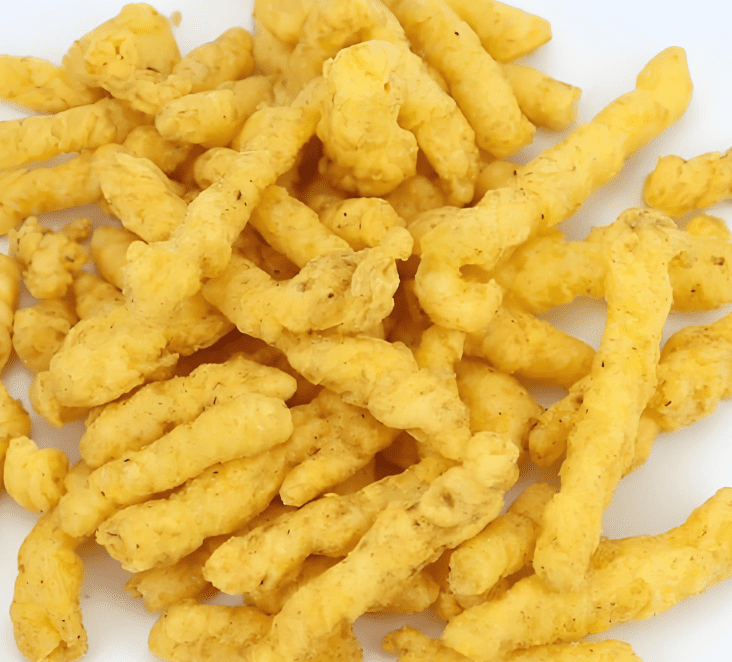
Cheetos is one of the most recognizable cheese-flavored snack brands in the global snack food market. Known for its distinctive crunchy texture, bright orange color, unique shapes, and rich cheese flavor, this popular snack has attracted consumers around the world.
Have you ever wondered how Cheetos are manufactured? kurkure manufacturing What ingredients are used to create their unique texture? Which machines are required to produce cheese-flavored corn snacks on an industrial scale?
Although commercial formulations and manufacturing parameters are proprietary, the general processing technology behind Cheetos-style extruded cheese snacks can be explained through modern corn extrusion technology.
This article reveals the complete manufacturing process, from raw material preparation and extrusion to drying, frying, seasoning, and packaging.
1. Raw Material Selection
The first step in producing Cheetos-style snacks is selecting suitable raw materials. Corn is the primary ingredient and plays a decisive role in the expansion, texture, and flavor of the finished products.
The main ingredients generally include:
Corn grits or cornmeal: Corn provides the starch required for extrusion cooking and expansion. Its particle size and quality influence the final product structure.
Water: Water is added to adjust the moisture content of the corn mixture and support starch gelatinization during extrusion.
Vegetable oil: Edible oil may be used during frying or seasoning to improve texture and flavor.
Cheese powder: Cheese powder is an important ingredient in cheese-flavored coatings. It contributes the characteristic cheesy taste and aroma.
Seasoning ingredients: Salt, milk powder, whey powder, spices, and other suitable flavoring ingredients may be incorporated into the seasoning formula.
Food additives: Depending on the product formulation and applicable regulations, permitted emulsifiers, antioxidants, and other processing ingredients may be used.
The quality of raw materials directly affects product consistency. Therefore, manufacturers should establish strict inspection procedures before production.
2. Corn Grinding and Sieving
After raw material selection, corn is processed into suitable particles.
A hammer mill or corn grinder can be used to grind the corn into the required particle size.
The ground material then passes through a screening machine to remove oversized particles and unwanted impurities.
Uniform particle size is important because it helps improve water absorption, mixing performance, and extrusion stability.
If the corn particles are too coarse, the finished snacks may have an uneven surface or inconsistent internal structure. Therefore, manufacturers should select suitable grinding specifications according to the extruder and product requirements.
3. Mixing and Moisture Adjustment
The prepared cornmeal is transferred into a mixing machine.
During this stage, water is added gradually while the mixer operates. kurkure manufacturing The objective is to achieve uniform moisture distribution throughout the corn mixture.
Proper moisture adjustment is particularly important for extrusion processing.
If the mixture contains too little water, starch gelatinization may be insufficient, resulting in poor expansion and a hard texture. Excessive moisture may reduce expansion and affect product shape.
The main factors to control include:
- Raw material proportions.
- Water addition rate.
- Mixing time.
- Initial moisture content.
- Uniformity of the mixed material.
After mixing, the prepared corn mixture is transferred to the extrusion system through a screw feeder or other suitable feeding equipment.
4. Extrusion Cooking: The Core of Cheetos-Style Snack Production
\
Extrusion is the most important stage in manufacturing Cheetos-style snacks.
The process uses a specialized food extruder to cook, compress, and shape corn-based materials under controlled temperature, pressure, moisture, and mechanical shear.
Depending on the product design, manufacturers may use different extrusion systems and screw configurations.
The extrusion process generally involves four main steps.
4.1 Material Feeding
The mixed cornmeal enters the extruder through a feeding system.
Stable feeding is important because fluctuations in material supply can lead to unstable extrusion pressure and inconsistent product dimensions.
4.2 Conveying and Compression
Inside the extruder barrel, rotating screws convey and compress the corn mixture.
The material is subjected to mechanical shear and friction, while heat is generated through mechanical energy and controlled heating.
4.3 Starch Gelatinization
As the corn mixture moves through the extruder, the combination of moisture, temperature, pressure, and mechanical energy causes starch gelatinization.
This process helps transform the raw corn material into a cooked, deformable mass suitable for expansion.
4.4 Extrusion and Expansion
The cooked material passes through specially designed dies.
When it exits the die, the sudden pressure reduction causes moisture to evaporate rapidly, creating an expanded and porous structure.
This process gives the snacks their characteristic lightweight and crunchy texture.
The extrusion system and die design determine the basic shape and structural characteristics of the finished products.
5. Shaping and Cutting
After extrusion, the expanded corn material needs to be shaped and cut into the desired dimensions.
Different forming dies can produce different snack shapes.
Common Cheetos-style snack shapes include:
- Curved corn curls.
- Straight corn sticks.
- Hollow tubular snacks.
- Cheese-flavored puffed snacks.
- Customized extruded shapes.
For curl-shaped snacks, specialized forming and cutting arrangements are used to create their distinctive curved appearance.
The cutting speed, die opening, extrusion pressure, and material moisture content all influence product dimensions.
Manufacturers should regularly inspect the forming dies and cutting equipment to ensure stable production.
6. Drying the Extruded Snacks
Freshly extruded corn curls usually contain relatively high moisture content. Therefore, drying is necessary before further processing.
A continuous belt dryer is commonly used in commercial snack production.
The freshly extruded products enter the dryer and move through different drying zones. Hot air circulates around the products, gradually removing excess moisture.
The main objectives of drying include:
- Reducing moisture content.
- Stabilizing the internal structure.
- Preparing products for subsequent frying or seasoning.
- Improving storage stability.
- Maintaining consistent product quality.
Several factors should be carefully controlled:
Drying temperature: Excessively high temperatures may cause uneven drying or undesirable color changes.
Drying time: Residence time depends on product size, initial moisture, and dryer performance.
Air circulation: Uniform airflow helps prevent inconsistent moisture levels.
Product loading: Excessive product accumulation can reduce drying efficiency.
A suitable drying program helps prevent excessive moisture and supports the desired crunchy texture.
7. Frying: Developing the Characteristic Crunchy Texture
Some Cheetos-style corn curls undergo an additional frying process to develop a richer flavor and crispy texture.
A continuous frying machine is commonly used for this operation.
The dried or partially dried snacks enter the fryer and are exposed to hot edible oil under controlled conditions.
The main factors affecting frying quality include:
- Oil temperature: The temperature should be appropriate for product size, moisture content, and formulation.
- Frying time: Sufficient time is needed to achieve the desired texture and color.
- Oil quality: Regular filtration and quality monitoring help maintain consistent frying performance.
- Feeding speed: Stable feeding helps prevent significant fluctuations in oil temperature.
After frying, the products pass through an oil-removal system to eliminate excess surface oil.
It is worth noting that not all Cheetos-style products use the same cooking method. Some extruded cheese snacks are produced using different combinations of extrusion, drying, and frying.
8. Cheese Seasoning and Flavor Coating
\
Cheese seasoning is one of the most important stages in Cheetos-style snack production.
The distinctive cheese flavor and orange appearance mainly come from the seasoning ingredients applied to the surface of the snacks.
After drying or frying, the products enter a rotating seasoning drum.
The seasoning process generally includes the following steps:
Step 1: Product Feeding
The cooked and prepared corn snacks are transferred into the seasoning machine.
Step 2: Oil Application
A controlled amount of edible oil may be sprayed onto the product surface to help seasoning powder adhere.
Step 3: Cheese Powder Addition
Cheese powder and other flavoring ingredients are added through a controlled feeding system.
Step 4: Uniform Mixing
The rotating drum continuously tumbles the snacks, helping distribute seasoning evenly across their surfaces.
Step 5: Final Inspection
The seasoned products are checked for coating uniformity, flavor consistency, and appearance.
Common seasoning ingredients may include cheese powder, whey powder, milk ingredients, salt, and permitted flavoring materials.
The seasoning formula determines the final flavor profile. Manufacturers can also develop different varieties, such as spicy cheese, barbecue, chili, and other customized flavors.
9. Cooling and Screening
After seasoning, the snacks need to be cooled before packaging.
Cooling helps stabilize the products and prevents residual heat from affecting the packaging environment.
A cooling conveyor can be used to bring the snacks to an appropriate temperature.
The products then pass through a screening system to remove broken pieces, excessive seasoning powder, and irregular products.
For large-scale production, additional inspection equipment can be installed to improve product consistency and food safety.
10. Automatic Packaging
Packaging is the final stage of Cheetos-style snack manufacturing.
Automatic packaging machines are used to weigh, fill, and seal the finished snacks.
Since extruded corn snacks are lightweight and fragile, packaging equipment should be designed to minimize product breakage during transportation and filling.
Common packaging options include:
- Small individual snack bags.
- Medium-sized retail packages.
- Large family-sized bags.
- Bulk packaging for commercial distribution.
Packaging materials should provide effective moisture and oxygen barriers to maintain product crispness and flavor.
Nitrogen flushing can also be used to reduce oxygen inside the package and help protect product quality.
Each package should contain the legally required product information, including ingredients, nutritional information, allergen declarations, net weight, production date, and expiration date.
11. What Machines Are Needed to Produce Cheetos-Style Snacks?
A complete Cheetos-style corn snack production line generally consists of the following equipment:
| Equipment | Main Function |
|---|---|
| Corn grinder | Grinds corn into suitable particles |
| Screening machine | Removes oversized particles and impurities |
| Mixing machine | Mixes cornmeal and water |
| Screw feeder | Transfers materials into the extruder |
| Food extruder | Cooks and expands corn materials |
| Forming die | Determines snack shape |
| Cutting machine | Controls product length |
| Continuous dryer | Reduces product moisture |
| Frying machine | Fries snacks when required |
| Oil-removal machine | Removes excess surface oil |
| Seasoning machine | Applies cheese powder and flavorings |
| Cooling conveyor | Cools finished products |
| Automatic packaging machine | Weighs and packages snacks |
The specific equipment configuration depends on the product type, production capacity, investment budget, and required level of automation.
For manufacturers planning to produce different types of corn curls, interchangeable dies and adjustable processing parameters can provide greater production flexibility.
12. Quality Control in Cheetos-Style Snack Production
Maintaining consistent product quality requires strict control throughout the entire production process.
The following aspects deserve particular attention.
Raw material quality: Ensure that cornmeal has suitable particle size, moisture content, and quality characteristics.
Mixing uniformity: Maintain consistent ingredient proportions and moisture distribution.
Extrusion parameters: Monitor temperature, pressure, screw speed, feeding rate, and material moisture.
Expansion quality: Check product density, expansion ratio, shape, and internal structure.
Drying performance: Control temperature, residence time, airflow, and final moisture content.
Frying quality: Monitor oil temperature, frying time, oil condition, and product color.
Seasoning uniformity: Ensure that cheese powder and other flavoring ingredients are evenly distributed.
Packaging quality: Check package sealing, weight accuracy, and product protection.
Manufacturers should also implement appropriate sanitation procedures, allergen management, traceability systems, and food safety controls.
13. How to Produce High-Quality Cheetos-Style Snacks
Producing attractive and delicious cheese-flavored corn snacks requires more than purchasing an extrusion machine. Manufacturers must optimize the entire processing system.
Here are several important suggestions:
1. Select suitable corn raw materials. Corn quality influences starch gelatinization, expansion, and final product texture.
2. Control moisture accurately. Stable moisture content helps maintain consistent extrusion performance.
3. Optimize extrusion conditions. Adjust temperature, screw speed, feeding rate, and die design according to product requirements.
4. Maintain consistent product shapes. Appropriate forming dies and cutting systems help produce uniform corn curls.
5. Establish a reliable drying process. Proper drying helps maintain product structure and reduces the risk of moisture-related quality problems.
6. Control frying conditions. For fried products, stable oil temperature and appropriate processing time are essential.
7. Improve seasoning technology. Uniform oil application and seasoning distribution help achieve consistent cheese flavor.
8. Use high-quality packaging materials. Proper packaging protects the finished snacks from moisture and physical damage.
14. Conclusion
The manufacturing process of Cheetos-style snacks involves several interconnected operations, including corn grinding, mixing, extrusion cooking, shaping, drying, optional frying, cheese seasoning, cooling, and packaging.
Among these stages, extrusion is the core technology because it determines the product’s expansion, shape, and internal structure. Drying, frying, and seasoning further influence the final texture, flavor, and appearance.
For food manufacturers interested in entering the extruded snack industry, investing in a suitable corn snack production line is an important step.
With appropriate extrusion equipment, reliable processing technology, and carefully developed seasoning formulas, manufacturers can produce a wide range of cheese-flavored corn snacks to meet different market demands.
As consumer preferences continue to evolve, developing new shapes, flavors, and textures will create additional opportunities for businesses in the global extruded snack market.


