
1. Introduction
Cheetos are one of the world’s most recognizable extruded cheese-flavored snacks. Known for their light, crunchy texture, distinctive shapes, and rich cheese flavor, these popular snacks have attracted consumers in many countries.
Behind their appealing appearance and taste is a specialized food extrusion process. Unlike traditional potato chips or tortilla chips, Cheetos-style snacks are generally produced using corn-based ingredients and high-temperature extrusion technology.
From raw material preparation and mixing to extrusion, drying or frying, seasoning, and packaging, every processing stage plays an important role in determining the final product quality.
For food manufacturers planning to produce Cheetos-style snacks, understanding the processing technology and selecting suitable production equipment are essential.
This article explains the complete Cheetos-style snack manufacturing process, the main machines required, and the key factors affecting product quality.

2. Raw Materials Used in Cheetos Production
Raw material selection is the foundation of high-quality Cheetos-style snack production. Different ingredients influence the product’s expansion, texture, flavor, and nutritional characteristics.
The main ingredients include:
2.1 Corn Grits or Corn Flour
Corn grits or corn flour are the primary raw materials used in Cheetos-style snack production. They provide the starch necessary for extrusion and expansion.
The particle size, moisture content, and starch properties of corn materials directly influence extrusion performance.
Manufacturers should select clean, uniform corn materials with stable quality to ensure consistent production.
2.2 Water
Water is added during the mixing process to adjust the moisture content of the raw materials.
Appropriate moisture helps the corn mixture pass smoothly through the extruder and achieve the desired expansion characteristics.

2.3 Vegetable Oil
Vegetable oil is commonly used during frying or as a carrier for seasoning.
It can also help seasoning powders adhere to the product surface.
2.4 Cheese Powder
Cheese powder is one of the most important ingredients responsible for the characteristic flavor of Cheetos-style snacks.
Depending on the product formula, manufacturers may combine cheese powder with milk powder, whey powder, salt, and other flavor ingredients.
2.5 Other Seasonings
Different seasoning formulas can produce a variety of flavors, including:
- Original cheese flavor
- Spicy cheese flavor
- Barbecue flavor
- Chili flavor
- Tomato flavor
- Sour cream and onion flavor
The seasoning formula should be adjusted according to target consumers and local food regulations.
3. The Complete Cheetos Processing Process
Cheetos-style snacks are typically manufactured using corn-based extrusion technology. Different product shapes and textures may require different extruder configurations and downstream processing methods.
The general processing flow is:
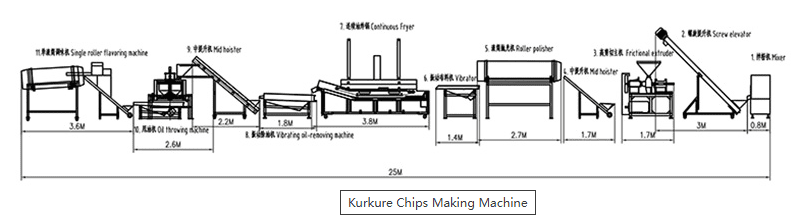
Raw Material Preparation → Mixing → Extrusion and Shaping → Cutting → Drying or Frying → Cooling → Seasoning → Packaging
Let’s examine each step in detail.
Step 1: Raw Material Cleaning and Preparation
Before production begins, corn materials must be inspected and prepared.
If whole corn is used, it should first pass through a cleaning machine to remove stones, dust, metal particles, and other impurities.
After cleaning, the corn is processed into suitable grits or flour through milling and screening.
If commercially prepared corn grits or corn flour are used, manufacturers should inspect their particle size, moisture content, and quality before adding them to the production line.
Proper raw material preparation helps protect equipment and ensures stable extrusion.
Step 2: Raw Material Mixing
The prepared corn grits or flour are transported into a mixing machine.
Water and other ingredients are added according to the product formulation.
The mixer combines the materials until moisture is distributed evenly throughout the mixture.
This stage is particularly important because uneven moisture can cause unstable feeding, inconsistent expansion, and irregular product shapes.
The moisture content should be controlled according to the extruder type, screw configuration, and desired product characteristics.
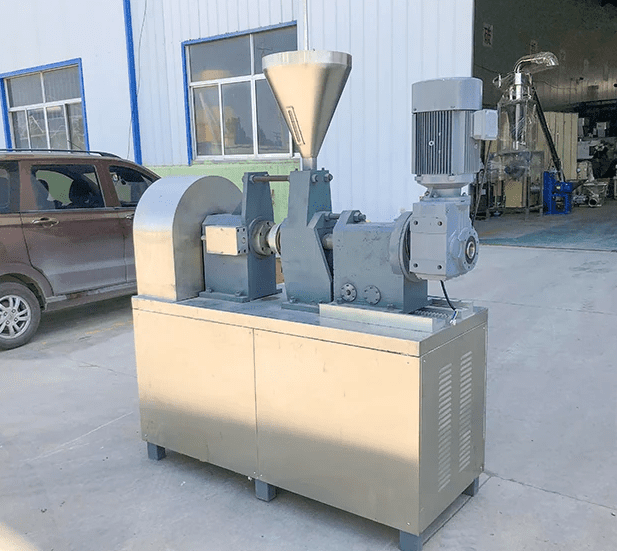
Step 3: Extrusion and Shaping
Extrusion is the most important stage in Cheetos-style snack production.
The conditioned corn mixture is fed into an extruder, where rotating screws transport, compress, mix, and process the material under controlled heat and pressure.
As the material moves through the extrusion barrel, starch undergoes gelatinization and structural changes.
When the processed material exits through the die, the sudden pressure reduction causes moisture to expand rapidly into vapor, creating a porous and expanded structure.
This process gives the snack its characteristic light texture.
Different die designs can produce different shapes, such as:
- Curl-shaped snacks
- Ring-shaped snacks
- Tube-shaped snacks
- Ball-shaped snacks
- Other customized shapes
The screw speed, barrel temperature, moisture content, feeding rate, and die design all influence the final product.
Step 4: Cutting
After extrusion, the expanded corn material passes through a cutting device.
A rotary cutter or other cutting mechanism divides the continuous extruded material into pieces of the required length.
For curl-shaped products, the extrusion and cutting system can be configured to create the characteristic curved appearance.
The cutting speed should match the extrusion output to ensure consistent product dimensions.
Improper cutting may produce irregular lengths, excessive broken pieces, or uneven shapes.
Step 5: Drying or Frying
After extrusion, the products usually need further processing to achieve the desired moisture content and texture.
There are two common processing approaches.
Option A: Drying
For many extruded corn snacks, drying is used to reduce moisture and stabilize the expanded structure.
The freshly extruded products are transported into a continuous drying oven.
Hot air circulates through the dryer, removing excess moisture from the products.
Drying temperature, airflow, residence time, and product loading density must be properly controlled.
If drying is insufficient, the snacks may become soft during storage. Excessive drying may result in a hard texture or unnecessary energy consumption.
Option B: Frying
Some Cheetos-style products use frying to develop a richer flavor and crispier texture.
The extruded pieces enter a continuous fryer containing heated vegetable oil.
Frying temperature and residence time should be adjusted according to product size, initial moisture, and desired texture.
After frying, excess oil should be removed through a suitable drainage or vibrating conveyor system.
The choice between drying and frying depends on the specific product design and production technology.
Step 6: Cooling
After drying or frying, the snacks need to be cooled before seasoning.
A cooling conveyor transports the products while allowing heat to dissipate.
This helps stabilize the product structure and prevents excessive heat from affecting the seasoning ingredients.
Cooling also reduces the possibility of moisture condensation inside the packaging.
For consistent product quality, the cooling process should provide sufficient airflow and appropriate residence time.
Step 7: Seasoning
Seasoning is essential for creating the characteristic cheese flavor of Cheetos-style snacks.
The cooled products enter a seasoning machine, usually a rotating seasoning drum.
During operation, the drum rotates continuously, allowing the snacks to tumble and mix.
Cheese powder, salt, spices, and other seasoning ingredients are distributed over the product surface.
A controlled amount of vegetable oil or seasoning oil may be sprayed onto the products to improve seasoning adhesion.
The seasoning formula and application quantity should be carefully controlled.
Too little seasoning results in weak flavor, while excessive seasoning can cause powder accumulation, uneven coating, and increased production costs.
Manufacturers can also develop different flavor combinations to expand their product range.
Step 8: Weighing and Packaging
After seasoning, the finished snacks are transported to an automatic weighing and packaging system.
A multihead weigher measures the required product quantity and feeds it into the packaging machine.
The packaging machine forms bags, fills them with snacks, and seals them automatically.
Because extruded snacks are lightweight and fragile, the packaging system should minimize mechanical impact during feeding and filling.
High-barrier packaging materials are recommended to protect products from moisture and oxygen.
Nitrogen flushing can also be used to help maintain freshness and reduce oxidation.
Proper packaging helps preserve the crispy texture, flavor, and shelf life of Cheetos-style snacks.
4. Main Equipment Required for Cheetos Production
A complete Cheetos-style snack production line generally includes the following machines.
| Equipment | Main Function |
|---|---|
| Corn cleaning machine | Removes impurities from raw materials |
| Grinding machine | Processes corn into suitable grits or flour |
| Vibrating sieve | Screens raw materials and removes oversized particles |
| Powder mixer | Mixes corn materials and water |
| Screw conveyor | Transports raw materials |
| Food extruder | Processes and expands corn materials |
| Cutting machine | Cuts extruded snacks into suitable lengths |
| Continuous dryer | Reduces product moisture |
| Continuous fryer | Fries snacks when required |
| Cooling conveyor | Cools finished products |
| Seasoning machine | Applies cheese powder and other flavors |
| Multihead weigher | Measures product quantities |
| Automatic packaging machine | Fills and seals snack bags |
The specific equipment configuration depends on the desired product shape, processing method, production capacity, and investment budget.
5. Key Factors Affecting Cheetos Product Quality
Producing high-quality Cheetos-style snacks requires precise control of several important processing parameters.
5.1 Raw Material Particle Size
The particle size of corn grits or flour affects material feeding, moisture absorption, and extrusion performance.
If the particle size is too large or uneven, the finished snacks may have inconsistent expansion.
Manufacturers should select suitable raw materials and use screening equipment to maintain particle-size consistency.
5.2 Moisture Content
Moisture content directly affects the extrusion process.
If the mixture is too dry, extrusion may become unstable and expansion may be insufficient.
If the moisture content is too high, the products may become dense or require longer drying times.
Therefore, moisture should be controlled according to the specific extruder and product formula.
5.3 Extrusion Temperature
Temperature is one of the most important parameters in extrusion processing.
It affects starch gelatinization, material flow, expansion, and final texture.
Excessive temperature may cause overprocessing or product discoloration, while insufficient temperature may result in poor expansion.
Manufacturers should optimize the temperature profile through production trials.
5.4 Screw Speed
Screw speed influences material conveying, mixing, shear, and residence time.
An appropriate screw speed helps produce stable extrusion and consistent product shapes.
5.5 Die Design
The die determines the cross-sectional shape and dimensions of extruded products.
Different dies can create different snack shapes and textures.
Selecting the correct die is essential for achieving the desired appearance.
5.6 Drying Conditions
Drying temperature, airflow, and residence time affect final moisture content and crispness.
Uniform drying helps prevent differences in texture between individual products.
5.7 Seasoning Quality
The particle size, composition, and adhesion properties of seasoning powders influence the final flavor.
An appropriate seasoning system helps distribute cheese powder evenly and reduces waste.
6. Common Problems in Cheetos Production and Their Solutions
Even with modern equipment, manufacturers may encounter several production problems.
Problem 1: Insufficient Expansion
Possible causes:
- Incorrect moisture content.
- Unsuitable extrusion temperature.
- Improper screw speed.
- Inconsistent raw material particle size.
Solutions:
- Adjust the moisture content.
- Optimize the extrusion temperature profile.
- Check screw speed and feeding stability.
- Improve raw material screening.
Problem 2: Irregular Product Shapes
Possible causes:
- Unstable material feeding.
- Improper die design.
- Incorrect cutting speed.
- Uneven extrusion pressure.
Solutions:
- Maintain consistent feeding.
- Inspect and clean the extrusion die.
- Adjust the cutting system.
- Optimize extrusion operating conditions.
Problem 3: Products Are Too Hard
Possible causes:
- Insufficient expansion.
- Excessive drying.
- Unsuitable raw material formulation.
Solutions:
- Improve extrusion conditions.
- Optimize drying temperature and residence time.
- Adjust the ingredient formulation.
Problem 4: Uneven Cheese Seasoning
Possible causes:
- Poor seasoning distribution.
- Unsuitable seasoning powder particle size.
- Insufficient oil application.
- Incorrect seasoning drum speed.
Solutions:
- Adjust the seasoning machine.
- Optimize powder particle size.
- Control the oil spraying system.
- Improve seasoning drum operation.
Problem 5: Snacks Lose Their Crispness During Storage
Possible causes:
- Excessive final moisture.
- Poor packaging materials.
- Inadequate sealing.
- Moisture absorption during storage.
Solutions:
- Control final product moisture.
- Use suitable moisture-barrier packaging.
- Check sealing quality.
- Store finished products in a dry environment.
7. How to Improve Cheetos Production Efficiency
For food manufacturers, improving production efficiency can reduce operating costs and increase profitability.
First, select an extrusion production line that matches the required output. An undersized production line may limit business growth, while oversized equipment can increase unnecessary investment.
Second, use automatic conveying and feeding systems to reduce manual handling and improve material consistency.
Third, optimize the extrusion parameters. Stable feeding, appropriate moisture content, and suitable temperature settings help reduce rejected products.
Fourth, choose efficient drying and seasoning equipment. Continuous processing systems can improve production continuity and reduce labor requirements.
Finally, establish regular maintenance and cleaning procedures. Inspect screws, barrels, dies, cutters, conveyors, and heating systems to reduce unexpected downtime.
8. Food Safety and Hygiene Requirements
Food safety is essential in every stage of Cheetos-style snack manufacturing.
Manufacturers should establish appropriate hygiene procedures and ensure that all food-contact equipment meets applicable food-grade requirements.
Important measures include:
- Inspecting incoming corn materials and seasoning ingredients.
- Maintaining clean raw material storage areas.
- Preventing cross-contamination during production.
- Cleaning mixers, extruders, conveyors, and seasoning machines regularly.
- Monitoring frying oil quality when frying is used.
- Controlling final product moisture.
- Checking packaging materials and sealing performance.
- Establishing batch records and product traceability.
A HACCP-based food safety management system can help manufacturers identify and control potential hazards throughout the production process.
9. Investment Considerations for a Cheetos-Style Snack Factory
Entrepreneurs planning to establish a Cheetos-style snack factory should consider several factors before purchasing equipment.
Production Capacity: Determine the expected daily output and select a suitable production line.
Product Types: Decide whether to manufacture traditional cheese curls, spicy snacks, ring-shaped products, or other extruded corn snacks.
Equipment Configuration: Choose single-screw or twin-screw extrusion technology according to the product requirements and production objectives.
Factory Space: Plan sufficient space for raw material storage, processing equipment, drying or frying systems, seasoning, packaging, and finished-product storage.
Energy Consumption: Evaluate electricity, water, gas, and heating requirements.
Raw Material Supply: Establish reliable suppliers for corn grits, vegetable oil, cheese powder, and packaging materials.
Market Demand: Research consumer preferences, competing products, and local distribution channels.
Food Regulations: Ensure compliance with local manufacturing licenses, food safety standards, ingredient requirements, and labeling regulations.
A reasonable investment plan should balance production capacity, equipment performance, product quality, and operating costs.
10. Conclusion
Cheetos-style snack production is a specialized food manufacturing process that mainly relies on corn-based extrusion technology.
The complete process generally includes raw material preparation, mixing, extrusion, cutting, drying or frying, cooling, seasoning, and packaging.
Among these stages, extrusion plays the most important role in determining product expansion, shape, and texture. Meanwhile, drying or frying, seasoning, and packaging directly influence the final taste and shelf life.
For manufacturers planning to enter the extruded snack market, choosing suitable machinery and controlling key processing parameters are essential.
With reliable equipment, high-quality ingredients, standardized production procedures, and attractive seasoning formulas, manufacturers can produce a wide range of crispy, flavorful Cheetos-style snacks to meet different market demands.


