
A food extruder is one of the most important pieces of equipment in modern food processing. It is widely used to manufacture puffed snacks, breakfast cereals, corn flakes, macaroni, textured vegetable protein, pet food, and other extruded products. By combining mechanical pressure, heat, moisture, and shearing force, a food extruder transforms raw materials into products with different shapes, textures, and structures.
Although different types of food extruders have different designs, most machines consist of several essential components that work together to ensure stable and efficient production. snack extruder machine Understanding these components helps food manufacturers select suitable equipment, improve production efficiency, and maintain consistent product quality.
Let’s take a closer look at the main components of a food extruder.
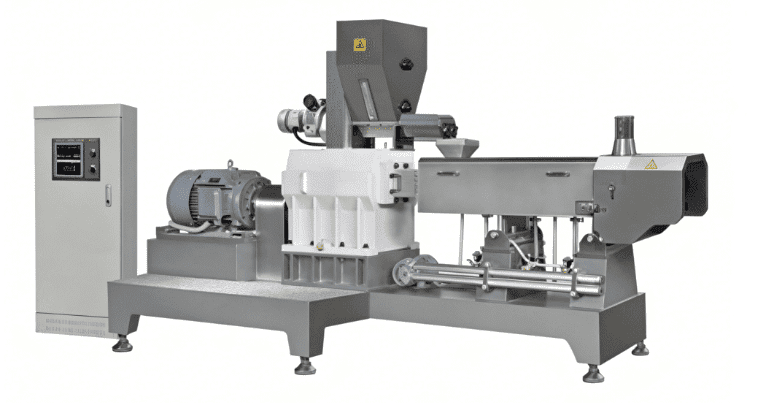
1. Feeding System
The feeding system is responsible for delivering raw materials into the extrusion chamber at a controlled and consistent rate. It usually consists of a hopper, feeding screw, and feeding motor.
The hopper stores prepared raw materials, such as corn flour, rice flour, wheat flour, starch, and other ingredients. The feeding screw transports these materials into the extrusion barrel.
A stable feeding rate is essential because inconsistent feeding can cause fluctuations in extrusion pressure, temperature, and product quality.
For large-scale production, manufacturers often use automatic feeding systems to reduce manual labor and improve production stability.
2. Extrusion Screw
The extrusion screw is one of the most important components of a food extruder. It is installed inside the barrel and rotates continuously to transport, compress, mix, and process raw materials.
As the screw rotates, it pushes materials forward while generating mechanical energy and shear forces. Depending on the screw design, the materials undergo different processing stages, including conveying, compression, mixing, cooking, and extrusion.
The screw structure has a direct influence on product expansion, texture, density, and processing capacity.
Different products require different screw configurations. For example:
- Puffed snacks require suitable compression and cooking conditions to achieve good expansion.
- Pet food requires sufficient mixing and cooking to improve digestibility and product structure.
- Textured soy protein requires appropriate shear force and temperature to develop a fibrous structure.
Food extruders generally use single-screw or twin-screw configurations, depending on production requirements.
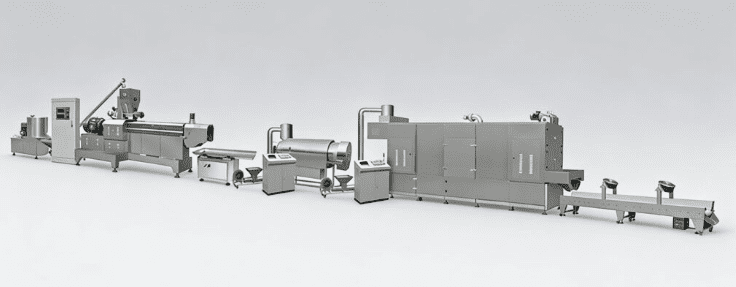
3. Extrusion Barrel
The extrusion barrel is the main housing surrounding the screw. It provides a closed processing space where raw materials are transported, mixed, compressed, and cooked.
The barrel is generally manufactured from high-strength, wear-resistant metal to withstand high temperatures, pressure, and friction during continuous operation.
Many modern extruders use segmented barrels, making maintenance and replacement easier. Some machines also feature cooling or heating systems to control the temperature in different processing zones.
The barrel and screw work together to create the required processing conditions for different food products.
4. Heating and Temperature Control System
Temperature control plays an important role in food extrusion. The heating system helps raise the temperature of raw materials and supports starch gelatinization, protein modification, and other physical and chemical changes.
Depending on the machine design, heating may be provided by electric heaters, steam, or other heating methods. In many modern extruders, temperature is also controlled through friction generated during screw rotation.
Temperature sensors monitor the processing conditions inside different barrel sections, snack extruder machine while the control system adjusts heating or cooling to maintain the required temperature.
Accurate temperature control helps improve product expansion, color, texture, and consistency.
5. Die Head and Molding System
The die head is installed at the outlet of the extrusion barrel. It is responsible for shaping the cooked material as it leaves the machine.
When high-temperature, high-pressure material passes through the die openings, the sudden pressure drop causes moisture to evaporate rapidly. This produces the characteristic expansion of many extruded foods.
Different die designs can produce different product shapes, including:
- Round and cylindrical snacks
- Ring-shaped snacks
- Star-shaped snacks
- Tube-shaped products
- Flat and strip-shaped products
By changing the die design, manufacturers can produce a wide variety of products using the same extruder.
The die opening size and shape also influence the final product dimensions and appearance.
6. Cutting System
The cutting system is generally installed near the die outlet. Its primary function is to cut continuously extruded materials into products of the required length.
It commonly consists of cutting blades, a rotating cutter holder, and a driving motor.
The cutter speed can be adjusted according to the extrusion speed and desired product dimensions. Faster cutting produces shorter products, while slower cutting produces longer pieces.
For example, puffed corn snacks may require short, uniform pieces, while certain pet food products need specific lengths to suit different animal sizes.
A properly adjusted cutting system helps ensure consistent product appearance and reduces material waste.
7. Driving System
The driving system provides the mechanical power needed to operate the extruder. It generally consists of an electric motor, gearbox, coupling, and transmission components.
The motor generates rotational power, while the gearbox adjusts the rotational speed and increases the torque required by the extrusion screw.
A stable driving system is essential for maintaining continuous production. If the motor or gearbox is improperly selected, the machine may experience insufficient torque, excessive energy consumption, or unstable operation.
Manufacturers should select a suitable motor power and transmission configuration according to raw material characteristics, production capacity, and extrusion requirements.
8. Electrical Control System
The electrical control system is responsible for monitoring and controlling the operating conditions of the entire food extruder.
A modern control system generally includes a control cabinet, PLC, touchscreen interface, temperature sensors, frequency converters, and other electrical components.
Operators can use the control panel to adjust important parameters, such as:
- Feeding speed
- Screw rotational speed
- Processing temperature
- Cutter speed
- Heating and cooling conditions
Some advanced machines also feature automatic alarms, overload protection, and real-time operating data monitoring.
An intelligent control system makes the extrusion process easier to manage and helps improve production consistency.
9. Cooling and Lubrication System
The cooling and lubrication systems help maintain the machine’s operating stability and extend the service life of important components.
The cooling system prevents excessive temperatures in areas such as the barrel, motor, and gearbox. Depending on the machine design, water cooling or other cooling methods may be used.
The lubrication system supplies oil or grease to moving components, including bearings and gearbox parts, reducing friction and mechanical wear.
Regular inspection of cooling and lubrication systems is necessary to prevent equipment failures and maintain long-term production efficiency.
10. Machine Frame and Supporting Structure
The machine frame provides structural support for all major components. It is usually made of heavy-duty steel to ensure sufficient strength and stability during operation.
The frame supports the motor, gearbox, extrusion barrel, feeding system, and other components.
A stable frame reduces vibration and helps maintain the correct alignment of the screw and barrel. This is particularly important for industrial food extruders operating continuously under high loads.
How Do These Components Work Together?
All the components of a food extruder work together to complete the extrusion process. Although the exact processing sequence varies depending on the machine model, the general working principle is relatively similar.
The basic process includes the following steps:
Step 1: Raw Material Feeding
Prepared raw materials enter the hopper and are transported into the extrusion barrel through the feeding system.
Step 2: Conveying and Mixing
The rotating screw moves the materials forward while mixing different ingredients and distributing moisture evenly.
Step 3: Compression and Cooking
As the materials move through the barrel, pressure, temperature, and mechanical shear increase. The ingredients undergo cooking and structural changes.
Step 4: Extrusion and Shaping
The cooked material is forced through the die head, where it takes on the required shape.
Step 5: Cutting
The cutting system divides the continuously extruded material into pieces of the desired length.
Step 6: Subsequent Processing
The finished extruded products are transferred to additional equipment for drying, baking, frying, seasoning, cooling, or packaging, depending on the product requirements.
How to Maintain the Main Components of a Food Extruder
Proper maintenance is essential for ensuring the long-term performance of a food extruder. Regular inspection can reduce unexpected downtime, prevent equipment damage, and improve production efficiency.
Here are several important maintenance recommendations:
1. Clean the Feeding System Regularly
Remove residual raw materials from the hopper and feeding screw after production. This helps prevent material accumulation, contamination, and blockages.
2. Inspect the Screw and Barrel
Check the screw and barrel regularly for wear, scratches, deformation, and material buildup. Replace worn components when necessary to maintain stable extrusion performance.
3. Check the Heating System
Inspect heating elements, temperature sensors, and electrical connections to ensure accurate temperature control.
4. Maintain the Cutting Blades
Keep cutting blades clean and sharp. Replace damaged blades to ensure uniform product sizes.
5. Inspect the Gearbox and Lubrication System
Check gearbox oil levels and lubrication conditions according to the manufacturer’s maintenance schedule.
6. Check Electrical Components
Inspect cables, motors, control panels, and protective devices regularly. Always disconnect the power supply before carrying out electrical maintenance.
Conclusion
A food extruder is a complex piece of processing equipment consisting of several interconnected systems. Its main components include the feeding system, extrusion screw, barrel, heating system, die head, cutting system, driving system, electrical control system, cooling and lubrication systems, and machine frame.
Each component performs a specific function, and their coordinated operation determines the final product quality and production efficiency.
For food manufacturers planning to establish a puffed snack, breakfast cereal, pet food, or other extruded food production line, understanding these components is an important step in selecting the right equipment.
When purchasing a food extruder, it is important to consider not only production capacity and machine price but also screw design, material quality, temperature control accuracy, automation level, and after-sales service. Choosing a suitable extruder can help manufacturers achieve stable production, reduce operating costs, and develop a wider range of high-quality extruded products.
Add a clear title and introduction focus