
مقدمة
With the rapid growth of the pet food industry, dog food products have become increasingly diverse. Today’s dog owners are paying more attention to nutritional value, ingredient quality, taste, texture, and digestibility. dog food machines As a result, dog food manufacturers are adopting different processing methods to produce products that meet the needs of dogs at different life stages and with different dietary requirements.
So, what are the main processing methods for dog food? How do these methods differ in terms of production technology, equipment, product characteristics, and nutritional value? Understanding these methods can help manufacturers choose the right production process and develop competitive dog food products.
This article introduces several common dog food processing methods and explains their production procedures, advantages, and applications.
1. Extrusion Processing
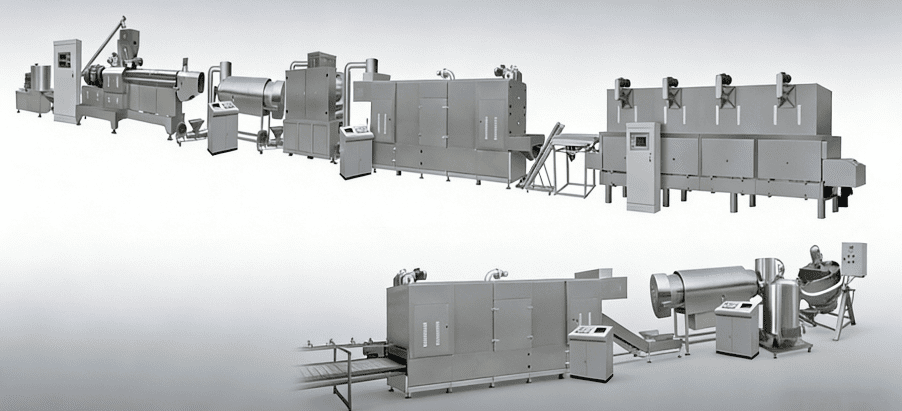
Extrusion is one of the most widely used methods in modern dog food manufacturing. It is commonly used to produce dry dog food in various shapes, sizes, and formulations.
The extrusion process uses a combination of heat, moisture, pressure, and mechanical shear to cook and shape raw materials. After processing, the products are cut into different shapes and dried to achieve the desired moisture content.
Main Processing Steps
- Raw material preparation: Select ingredients such as corn, wheat, rice, meat meal, fish meal, animal protein, vitamins, and minerals.
- Grinding: Grind the raw materials into a uniform powder to improve mixing and processing efficiency.
- Mixing: Combine different ingredients according to the nutritional formula.
- Conditioning: Add water and steam to adjust moisture and temperature before extrusion.
- Extrusion: Feed the mixture into an extruder, where heat, pressure, and mechanical force cook the ingredients.
- Shaping and cutting: Force the cooked mixture through a die and cut it into kibble of different shapes and sizes.
- Drying: Remove excess moisture using a continuous dryer.
- Coating: Apply oils, fats, flavorings, or nutritional ingredients to improve palatability.
- Cooling and packaging: Cool the finished dog food before weighing and packaging.
Advantages of Extrusion Processing
- High production efficiency and suitability for continuous industrial manufacturing.
- Flexible product shapes and sizes.
- Good control over product density, texture, and expansion.
- Suitable for large-scale production.
- Relatively easy to automate.
- Can produce floating, porous, or dense kibble structures depending on formulation and processing conditions.
Extrusion processing is particularly suitable for manufacturers producing commercial dry dog food on a large scale.
2. Baking Processing
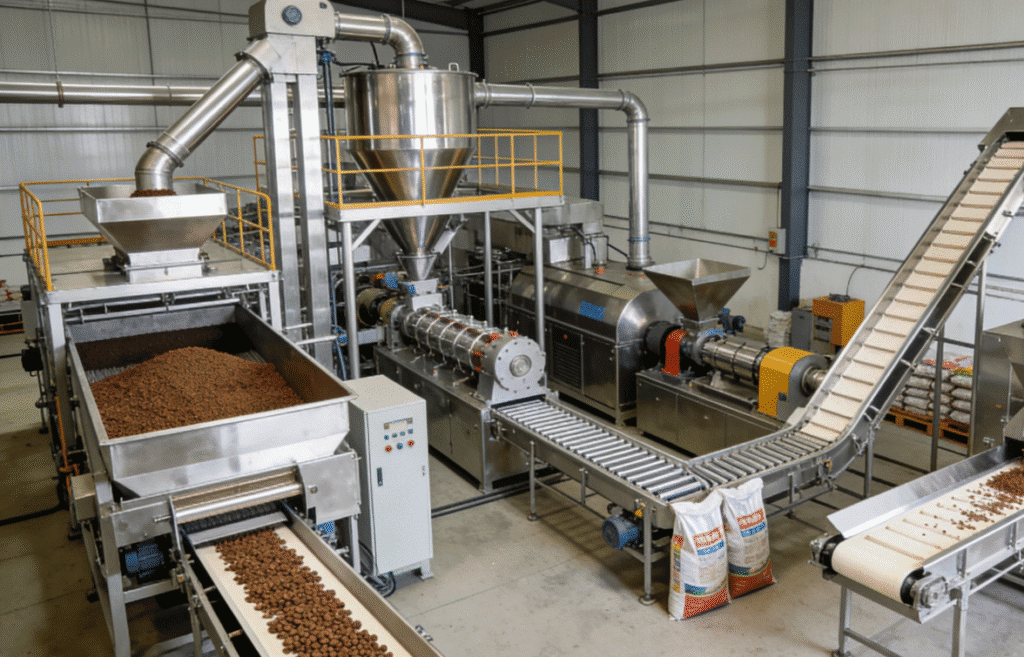
Baking is another important dog food processing method. Unlike extrusion, which relies on pressure and mechanical shear, baking mainly uses hot air to cook and shape the product.
This method is commonly used to manufacture dog biscuits, baked kibble, and other crunchy pet food products.
Main Processing Steps
- Ingredient preparation: Prepare flour, meat ingredients, fats, eggs, vitamins, and other nutritional components.
- Grinding and mixing: Process the ingredients into a uniform mixture.
- Dough preparation: Add water and other necessary liquids to form a workable dough.
- Shaping: Use molding machines, rollers, or cutting equipment to create the desired product shapes.
- Baking: Place the shaped products into an industrial oven and bake them under controlled temperature conditions.
- Cooling: Allow the baked products to cool gradually.
- Inspection and packaging: Check product appearance, texture, moisture, and quality before packaging.
Advantages of Baking Processing
- Produces a distinctive baked aroma and crunchy texture.
- Allows manufacturers to create different biscuit shapes and sizes.
- Suitable for premium baked dog treats and biscuits.
- Offers flexibility in product formulation.
- Can create products with a different texture from conventional extruded kibble.
However, baking may require longer processing times than extrusion, and manufacturers must carefully control temperature and baking duration to ensure uniform quality.
3. Freeze-Drying Processing
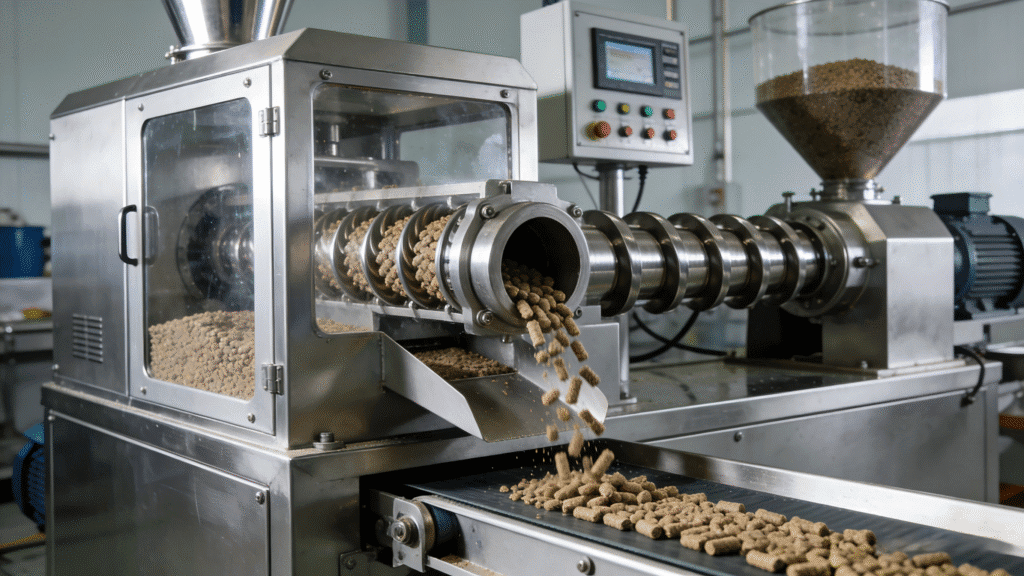
Freeze-drying is a specialized processing method increasingly used in premium pet food manufacturing.
The basic principle is to freeze the ingredients and then remove most of their moisture through sublimation under vacuum conditions. dog food machines During sublimation, ice changes directly into water vapor without passing through the liquid stage.
This process helps preserve the original structure and many quality characteristics of the ingredients.
Main Processing Steps
- Raw material selection: Select suitable meat, fish, organs, vegetables, or other ingredients.
- Preparation: Clean, trim, cut, and portion the ingredients.
- Pre-freezing: Freeze the prepared materials to a sufficiently low temperature.
- Vacuum freeze-drying: Place the frozen materials inside a freeze dryer and remove ice through sublimation.
- Moisture control: Continue drying until the target moisture level and water activity are achieved.
- Quality inspection: Check moisture, water activity, microbial safety, and product appearance.
- Packaging: Package the finished products in moisture-resistant packaging to prevent moisture absorption.
Advantages of Freeze-Drying
- Helps preserve ingredient structure and flavor.
- Produces lightweight products.
- Provides a long shelf life when properly processed and packaged.
- Suitable for meat-based and raw-inspired pet food products.
- Offers opportunities for premium product development.
The main disadvantages are high equipment investment, energy consumption, and relatively long processing times. Therefore, freeze-drying is generally more suitable for high-value pet food products.
4. Wet Dog Food Processing
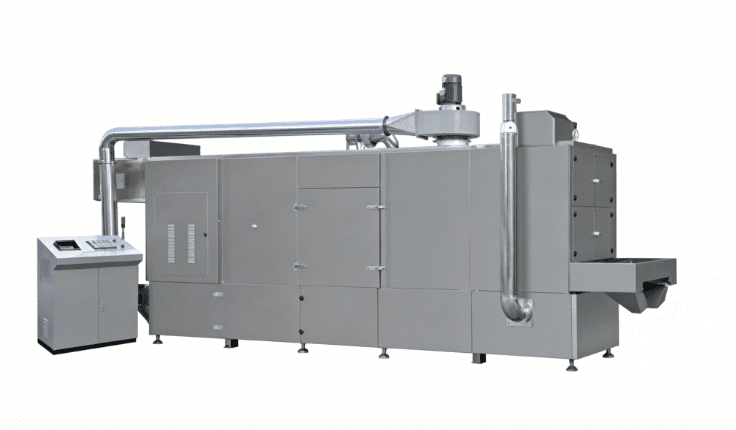
Wet dog food is generally produced in the form of canned food, pouches, trays, or meat-based meals containing a high proportion of moisture.
Compared with dry dog food, wet food usually has a softer texture and higher water content. It is often made from meat, animal by-products, broth, vegetables, vitamins, and minerals.
Main Processing Steps
- Raw material preparation: Select fresh or frozen meat, fish, organs, and other ingredients.
- Grinding and mixing: Grind the ingredients and combine them according to the product formula.
- Cooking: Cook the mixture using suitable heating equipment.
- Filling: Transfer the prepared mixture into cans, pouches, or trays.
- Sealing: Seal the containers to prevent contamination.
- Sterilization: Apply a validated thermal sterilization process appropriate for the product and packaging.
- Cooling: Cool the containers under controlled sanitary conditions.
- Inspection and packaging: Check package integrity, product quality, and labeling before storage and distribution.
Advantages of Wet Dog Food Processing
- Produces products with high moisture content.
- Can provide appealing aromas and textures.
- Suitable for dogs that prefer soft food.
- Allows manufacturers to develop different meat combinations and recipes.
- Convenient for portion-controlled packaging.
Commercial wet dog food generally requires strict control of thermal processing, sealing, and packaging integrity to achieve microbiological safety and shelf stability.
5. Cold-Pressed Dog Food Processing
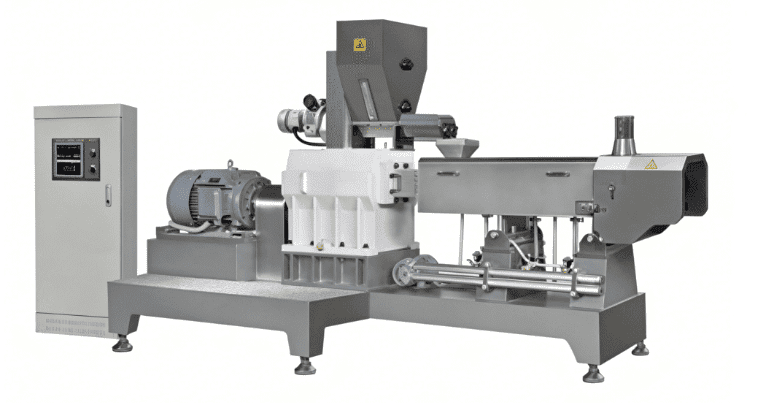
Cold-pressed dog food is produced by compressing a prepared mixture of ingredients into pellets under controlled processing conditions, generally using lower temperatures than conventional extrusion.
The objective is to form compact products while limiting exposure to high processing temperatures. However, the actual temperature and processing conditions depend on the equipment and formulation.
Main Processing Steps
- Ingredient selection: Choose meat meals, grains, vegetables, oils, and nutritional additives.
- Grinding: Grind ingredients to achieve a suitable particle size.
- Mixing: Blend all ingredients evenly.
- Moisture adjustment: Add an appropriate amount of moisture to improve binding and pellet formation.
- Pressing: Use a specialized cold-pressing machine to compress the mixture into pellets.
- Drying: Reduce moisture to the required level if necessary.
- Cooling: Cool the pellets before packaging.
- Packaging: Use suitable packaging materials to protect the finished products.
Advantages of Cold-Pressed Processing
- Produces dense and compact pellets.
- Offers an alternative to conventional extruded dog food.
- Allows manufacturers to develop different pellet sizes.
- Can be used for specialized product positioning.
It is important to note that cold pressing does not automatically guarantee better nutritional quality. Ingredient selection, microbial control, processing conditions, and final product testing remain essential.
6. Air-Dried Dog Food Processing
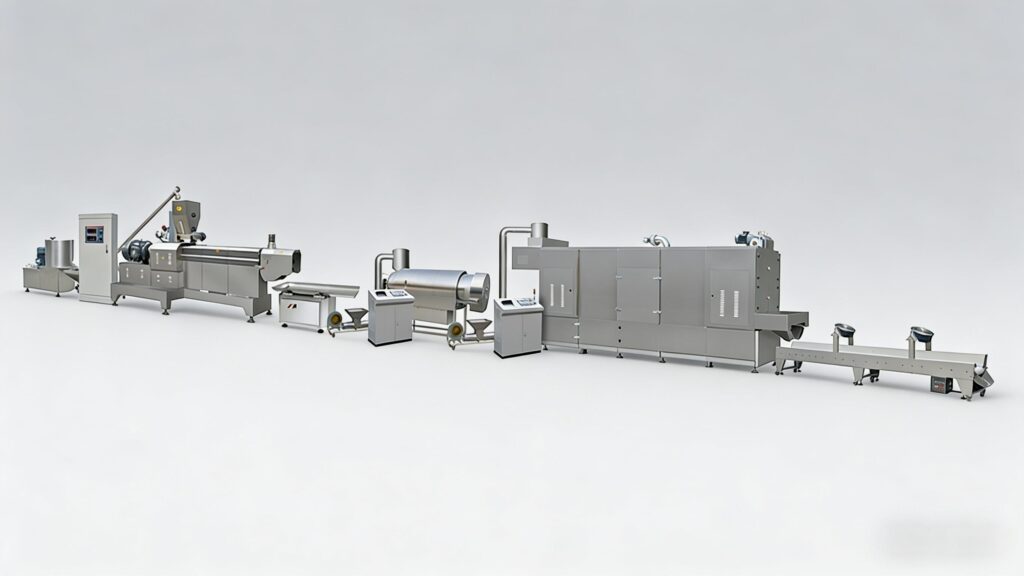
Air-drying is another processing method used in premium dog food manufacturing. It removes moisture from ingredients through controlled airflow and temperature over a certain period.
Compared with freeze-drying, air-drying generally uses warmer drying conditions and does not require a vacuum freeze-drying system.
Main Processing Steps
- Raw material preparation: Select meat, fish, organs, and other suitable ingredients.
- Cutting and grinding: Cut ingredients into uniform pieces or grind them according to the product design.
- Mixing: Combine ingredients to achieve the required nutritional composition.
- Forming: Shape the mixture into strips, pieces, or other product forms.
- Air-drying: Place the products in a controlled drying system to gradually remove moisture.
- Cooling: Cool the dried products to prevent condensation during packaging.
- Inspection: Check moisture content, water activity, texture, and microbiological quality.
- Packaging: Pack the finished products in moisture-resistant packaging.
Advantages of Air-Drying
- Produces products with concentrated flavors.
- Does not require freeze-drying equipment.
- Suitable for meat-based dog food and treats.
- Can produce products with different textures.
- Offers opportunities for premium and differentiated pet food products.
The drying temperature, airflow, humidity, and processing time must be carefully controlled to ensure uniform drying and food safety.
7. Comparison of Different Dog Food Processing Methods
Different processing methods are suitable for different product categories. dog food machines Manufacturers should consider investment costs, production capacity, nutritional requirements, target consumers, and product positioning before choosing a process.
| Processing Method | Main Products | Key Characteristics |
|---|---|---|
| Extrusion | Dry dog food kibble | High efficiency, flexible shapes |
| Baking | Dog biscuits and baked kibble | Crunchy texture, baked aroma |
| Freeze-drying | Freeze-dried meat and complete meals | Low moisture, premium positioning |
| Wet processing | Canned food and pouches | High moisture, soft texture |
| Cold pressing | Pressed dog food pellets | Dense structure, alternative processing |
| Air-drying | Air-dried dog food and treats | Concentrated flavor, reduced moisture |
8. How to Choose the Right Dog Food Processing Method
Choosing the right processing method is an important decision for dog food manufacturers. Different production technologies require different equipment, investment budgets, and operating conditions.
Here are several important factors to consider.
1. Product Positioning
First, determine what type of dog food you want to manufacture.
If you plan to produce conventional dry kibble for supermarkets and pet stores, extrusion is usually a practical choice.
If you want to produce premium dog biscuits, baking may be more appropriate.
If your target market focuses on premium meat-based products, freeze-drying or air-drying may offer more suitable production options.
2. Investment Budget
Different processing methods have different equipment and operating costs.
For example, a complete extrusion production line may include grinders, mixers, conditioners, extruders, dryers, coating machines, coolers, and packaging machines.
Freeze-drying requires specialized vacuum freeze-drying equipment, which can involve substantial initial investment.
Therefore, manufacturers should evaluate equipment costs, energy consumption, labor requirements, maintenance, and expected production capacity.
3. Production Capacity
Production capacity directly affects equipment selection.
Small businesses may begin with a compact production line, while larger manufacturers may need automated equipment with higher output.
It is also important to consider future expansion when planning the factory layout.
4. Nutritional Requirements
The processing method should match the nutritional goals of the finished product.
Manufacturers need to consider the effects of heat, pressure, moisture, and drying on proteins, fats, vitamins, and other nutrients.
A properly designed formulation and validated processing procedure are essential for producing nutritionally balanced dog food.
5. Product Safety and Quality Control
Regardless of the processing method, dog food manufacturers must establish strict quality control procedures.
Important inspection points include:
- Raw material quality and supplier management.
- Ingredient weighing and formulation accuracy.
- Processing temperature and time.
- Moisture content and water activity.
- Microbiological safety.
- Packaging integrity.
- Nutritional composition and product consistency.
A reliable quality management system helps reduce production risks and ensures that products meet applicable regulations.
9. Essential Equipment for a Dog Food Production Line
For manufacturers planning to produce commercial dog food, equipment selection is closely related to the chosen processing method.
A typical extruded dry dog food production line may include:
- Raw material grinder
- Powder mixer
- ناقل المسمار
- Steam conditioner
- Single-screw or twin-screw extruder
- Automatic cutting machine
- Multi-layer drying machine
- Vacuum or drum coating equipment
- Cooling conveyor
- Weighing and packaging machine
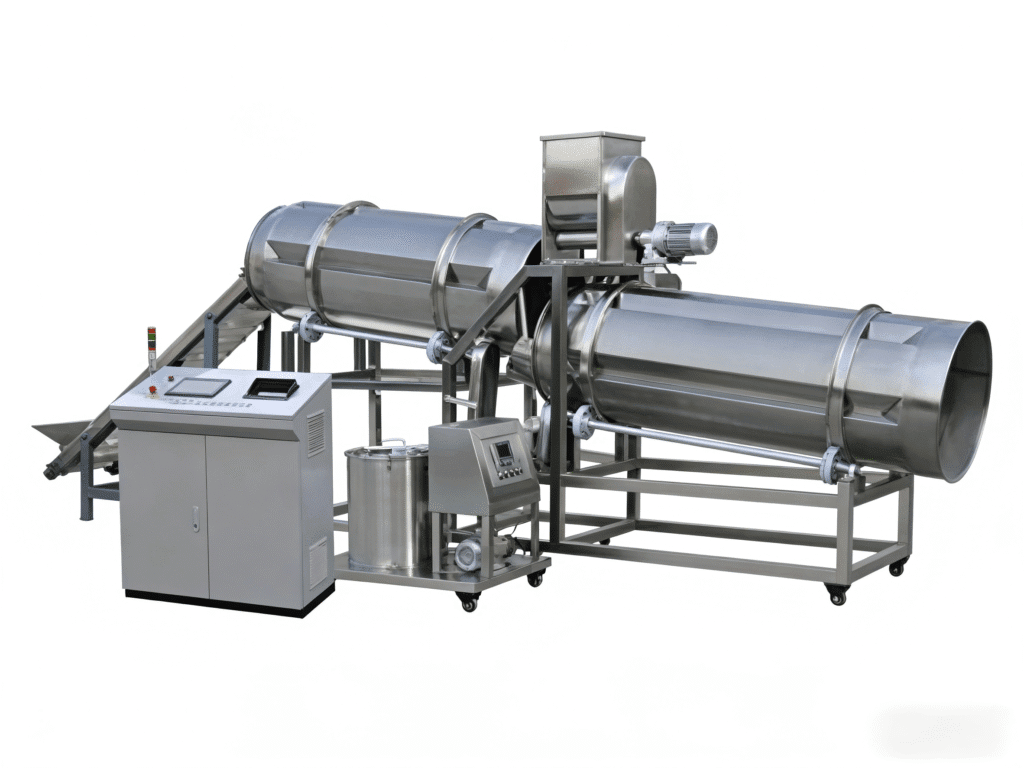
Each machine performs a specific function in the production process. The equipment configuration should be selected according to the formulation, product shape, required capacity, and factory conditions.
Conclusion
There are several major dog food processing methods, including extrusion, baking, freeze-drying, wet processing, cold pressing, and air-drying. Each method has its own production principles, equipment requirements, advantages, and suitable applications.
Among these methods, extrusion is widely used for commercial dry dog food because of its high production efficiency, flexible product design, and suitability for automated manufacturing. Baking is suitable for biscuits and crunchy products, while freeze-drying and air-drying provide additional opportunities in the premium pet food market.
For manufacturers planning to enter the dog food industry, understanding these processing methods is the first step toward selecting suitable equipment and developing a competitive product.
By combining appropriate raw materials, scientific formulations, reliable processing equipment, and strict quality control, manufacturers can produce safe, nutritious, and appealing dog food products that meet the changing needs of the global pet food market.


