
Unveiling the Matrix: A Deep Dive into the Sophisticated World of Fish Feed Manufacturing
For most aquarists and aquaculture professionals, fish feed is a simple commodity—a can or bag of pellets that sustains life in water. Fish feed making machine We scrutinize the ingredient list, the protein percentage, and the pellet size, but rarely do we consider the profound engineering and complex chemistry that transform raw, often terrestrial, materials into a stable, nutritious, and water-resistant aquatic diet. The journey from farm to fish tank is a saga of high-temperature physics, nutritional biochemistry, and precision engineering. This article aims to pull back the curtain on the modern fish feed mill, revealing a process that is far more sophisticated than mere mixing and baking.
Part 1: The Foundation – Why Fish Feed is Uniquely Complex
Before delving into the “how,” it is crucial to understand the “why.” The fundamental challenge of aquatic feed design stems from the environment in which it must function: water.
1.1 The Leaching Problem: Unlike terrestrial animal feed, fish feed is submerged in an aqueous medium. Water is a potent solvent, and water-soluble nutrients—most notably vitamins, minerals, and certain amino acids—begin to dissolve the moment the pellet hits the water. Fish feed making machine A poorly manufactured pellet can lose over 50% of its water-soluble vitamins within the first minute, rendering it nutritionally deficient long before the fish consumes it. The race against leaching dictates every subsequent step of the manufacturing process.
1.2 The Buoyancy Conundrum: Fish species occupy different strata of the water column. Catfish are benthic (bottom-feeders), while trout are mid-water column, and many marine species like cobia are surface feeders. The feed must be engineered to have a specific buoyancy—sinking fast, sinking slowly, or floating—to match the natural feeding behavior of the target species. This is not a trivial matter; it requires precise control over the pellet’s density and porosity.
1.3 Digestibility and Palatability: Fish, particularly cold-water species like salmon, have relatively short digestive tracts. The feed must be highly digestible to ensure nutrient absorption in a limited time. Furthermore, since fish “taste” with the water flowing over their gills, Fish feed making machine the feed must release attractants like amino acids (e.g., betaine, taurine) and nucleotides in a controlled manner to stimulate feeding behavior.
1.4 Structural Integrity: A pellet must be hard enough to survive transportation and handling in bulk systems, yet soft enough for the fish to eat without expending excessive energy. It must not disintegrate into a cloud of fine particles (fines) that pollute the water and go uneaten, but it must also break down appropriately in the fish’s digestive system.
These unique challenges have driven the fish feed industry to adopt and refine a manufacturing process known as بثق الطهي, a technology that sets it apart from simple mash or pellet production used for land animals.
Part 2: The Raw Materials – Sourcing the Building Blocks of Nutrition
The quality of the final product is inextricably linked to the quality and composition of its raw ingredients. A modern fish feed mill is a symphony of sourcing, with ingredients arriving from all corners of the globe.
2.1 The Protein Core:
- Fishmeal: Historically the gold standard, fishmeal provides a highly digestible, balanced amino acid profile, essential fatty acids, and palatability factors. It is produced by cooking, pressing, drying, and grinding whole fish or fish trimmings. Sustainability concerns have driven the industry to reduce its reliance on wild-caught fishmeal, but it remains a critical component, especially in marine and starter diets.
- Plant Proteins: The quest for sustainability has led to a massive increase in the use of plant-based proteins.
- Soybean Meal: The most common plant protein, it has a good amino acid profile but requires processing to remove anti-nutritional factors like trypsin inhibitors.
- Corn Gluten Meal: A by-product of corn processing, it is high in protein but deficient in the essential amino acid lysine.
- Wheat Gluten: Provides both protein and binding properties.
- Other Sources: Rapeseed (canola) meal, pea protein, and sunflower meal are also used, each with its own nutritional strengths and weaknesses.
- Novel Proteins: The frontier of feed ingredients includes single-cell proteins from bacteria or yeast, insect meal (from black soldier fly larvae), and feather meal. These are promising but often face challenges with scalability, cost, and palatability.
2.2 The Energy Sources:
- Fish Oil: The primary source of the essential long-chain omega-3 fatty acids (EPA and DHA), crucial for fish health, growth, and, in the case of salmon, their characteristic pink flesh. Like fishmeal, its sustainability is a major focus.
- الزيوت النباتية: Oils from soy, rapeseed, and palm are used as energy-dense substitutes for fish oil. However, they lack EPA and DHA and are high in omega-6, which can alter the fish’s fatty acid profile.
- Carbohydrates: Cereals like wheat, corn, and tapioca are used as lower-cost energy sources and binders. Fish have a limited ability to digest complex carbohydrates, so their inclusion levels must be carefully managed.
2.3 The Micro-Ingredients: The Secret Sauce
This is where nutritional precision is achieved. These components, added in minute quantities, make the difference between mere survival and optimal health and growth.
- Vitamin Premix: A custom-blended powder containing all the fat-soluble (A, D, E, K) and water-soluble (B-complex, C) vitamins. Vitamin C (ascorbic acid) is particularly unstable and is often used in a coated form (e.g., ethyl cellulose) to protect it during processing and storage.
- Mineral Premix: Provides essential macro-minerals (calcium, phosphorus) and trace minerals (zinc, copper, selenium, iodine). The bioavailability of phosphorus from plant sources is a key consideration.
- Amino Acid Supplements: Crystalline amino acids like lysine and methionine are added to “balance” the amino acid profile of the plant-based proteins, ensuring no single amino acid becomes a limiting factor for growth.
- Attractants and Palatability Enhancers: Betaine, nucleotides, and synthetic forms of key amino acids are added to make the feed irresistible, especially in diets low in fishmeal.
- Pigments: For salmonids and ornamental fish, carotenoid pigments like astaxanthin and canthaxanthin are added. These are not produced by the fish themselves and must be obtained from their diet to achieve the desired red/pink flesh or vibrant colors.
- Binders: Lignosulfonates, gelatin, or specific gums are sometimes added to enhance pellet durability.
- Antioxidants: Compounds like ethoxyquin (though increasingly controversial), BHT, and BHA, or natural ones like tocopherols (Vitamin E), are essential to prevent the oxidation of fats, which leads to rancidity and loss of fat-soluble vitamins.
Part 3: The Manufacturing Process – A Step-by-Step Deconstruction
The transformation of this diverse list of raw materials into a uniform, stable pellet is a continuous, multi-stage process centered on the extruder.
Step 1: Receiving and Storage
Ingredients arrive in bulk (silos, tankers) or bags. Fish feed making machine They are tested for quality parameters like protein, moisture, and contaminants (e.g., aflatoxins in grains). Proper storage is critical to prevent spoilage and cross-contamination.
Step 2: Grinding – The First Homogenization
The various raw materials are weighed according to a computer-formulated “recipe” and conveyed to a hammer mill or roller mill. Grinding is a critical step for two reasons:
- It increases the surface area of the particles, which improves water penetration and cooking efficiency during extrusion.
- It creates a uniform particle size distribution, which is essential for producing a homogenous pellet and preventing “segregation” of ingredients. A fine, consistent grind ensures that the micro-ingredients are evenly distributed throughout the mash, preventing nutrient hotspots or deficiencies.
Step 3: Mixing – Creating the Masterbatch
The ground ingredients are then transferred to a massive, horizontal ribbon mixer. This is where the macro-ingredients (meals, grains) are blended with the micro-ingredients (vitamin and mineral premixes). Mixing time is precisely controlled—too short and the blend is inhomogeneous; too long and the delicate premix particles can segregate due to differences in density. The output is a uniform, dry powder known as the “mash.”
Step 4: Conditioning – The Prelude to Cooking
The dry mash is fed into a “conditioning” chamber, where it is met with two key additions:
- Live Steam: Injected directly into the mash, the steam heats the mixture to typically 80-95°C (176-203°F). This heating begins the gelatinization of the starch present in the cereal components.
- Water: Added to achieve the optimal moisture content for extrusion, usually between 20-30%.
Conditioning is a vital pre-cooking step. It makes the mash pliable, reduces the mechanical energy needed in the extruder, and begins to de-nature proteins and gelatinize starch, which improves digestibility.
Step 5: Extrusion – The Heart of the Process
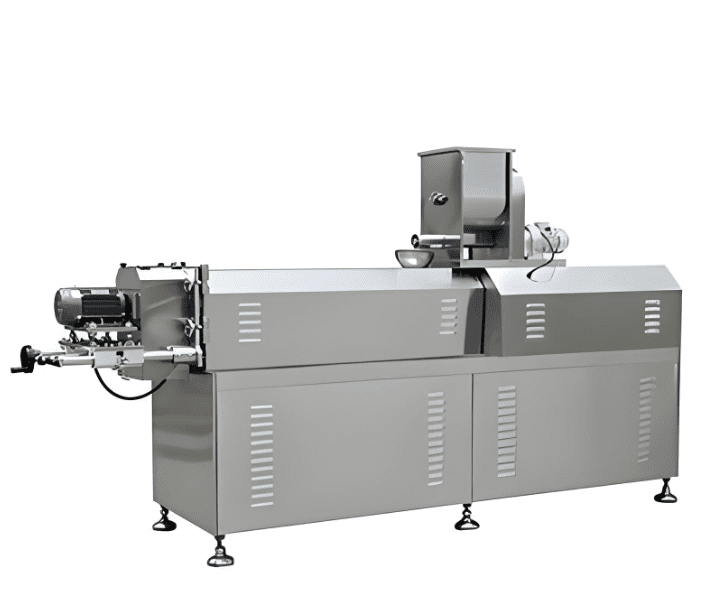
The conditioned mash is now fed into the extruder, a machine that is part pressure cooker, part dough mixer, and part shaping tool. An extruder consists of a long, hardened steel barrel containing a rotating screw(s) that conveys, mixes, cooks, and pressurizes the material.
The process inside the extruder can be broken down into distinct zones:
- منطقة التغذية: يدخل الهريس الرطب والدافئ إلى الطارد.
- Compression Zone: The screw flight depth decreases, or a restriction is placed in the barrel, forcing the material to compress. The combination of intense mechanical shear from the screw and the high temperature from the external steam jackets cooks the mixture thoroughly. The starch granules swell and rupture, fully gelatinizing. The proteins unfold and cross-link. This creates a viscous, plastic-like dough.
- منطقة القياس: The cooked dough is pushed under immense pressure (up to 40 atmospheres) towards the die plate at the end of the barrel. The die plate is a thick steel disk with precisely machined holes that define the shape and size of the final pellet.
The Magic of Expansion: As the superheated, pressurized dough exits the die holes into the ambient air pressure, the phenomenon of “flash evaporation” occurs. The superheated water trapped inside the dough instantly vaporizes, causing the pellet to expand dramatically, like popcorn. This expansion is the single most important factor controlling the pellet’s density and, therefore, its buoyancy.
Controlling Buoyancy: By manipulating the recipe (starch level), extruder parameters (shear, temperature), and die design, manufacturers can create:
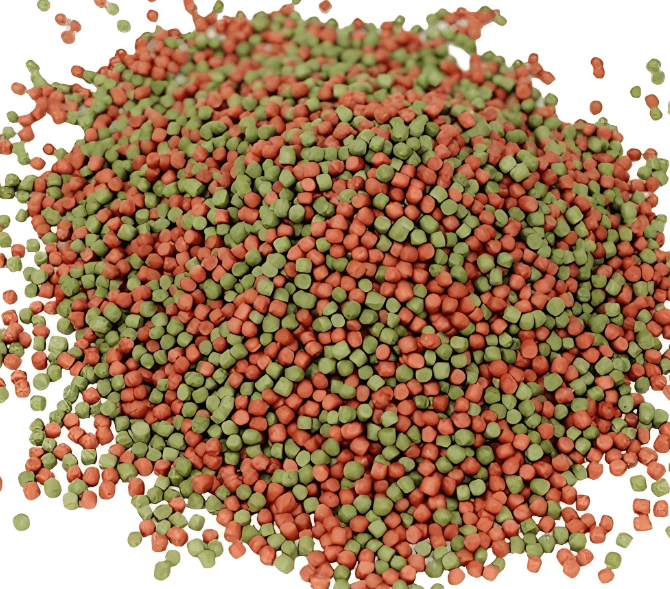
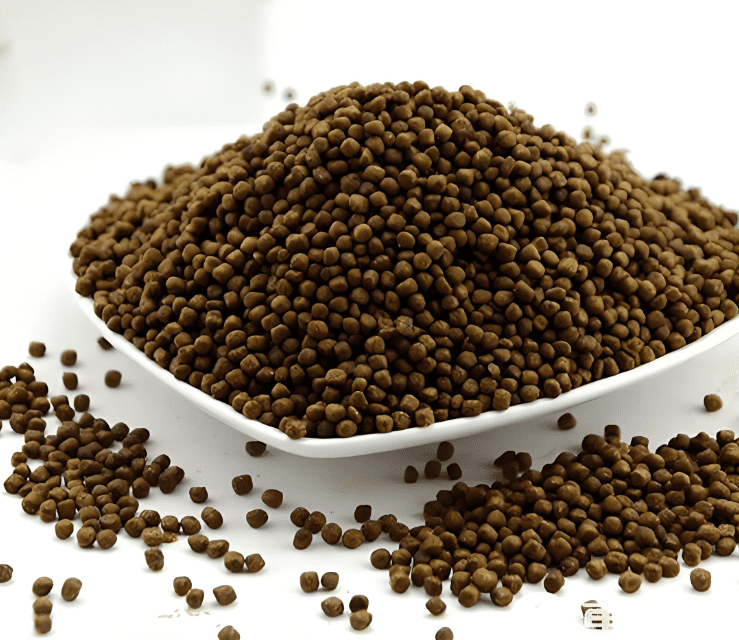
- Sinking Pellets: High density, low expansion. Achieved by reducing starch, increasing fat, and/or using a cutter that compresses the pellet as it exits the die.
- Slow-Sinking Pellets: Medium density.
- Floating Pellets: Low density, high expansion. Require a high starch content and sufficient thermal and mechanical energy to achieve the necessary expansion. They will float only after being dried to a very low moisture content (<10%).
Step 6: Drying – Removing the Water We Added
The newly extruded pellets are soft, moist, and fragile, with a moisture content of around 20-25%. They must be dried to below 10% to achieve shelf-stability and the required hardness. This is done in a multi-pass dryer, often a vertical tower where hot air (typically 90-120°C / 194-248°F) is forced through a cascading curtain of pellets.
Drying is a delicate balance. It must be rapid enough to prevent microbial growth but gentle enough to avoid “case hardening”—where the outside of the pellet forms a hard shell, trapping moisture inside and leading to mold during storage. The drying process can take anywhere from 15 to 30 minutes.
Step 7: Fat Coating – The Final Infusion
The drying process renders the pellet porous. This porosity is exploited in the next critical stage: post-extrusion fat coating. The dried, cool pellets are tumbled in a large,Fish feed making machine rotating drum while liquid fat (fish oil, plant oil, or a blend) is sprayed onto them via high-pressure nozzles.
This “vacuum coating” or “top dressing” is a game-changer. It allows for the inclusion of high levels of fat (often 20-40%) without compromising the pellet’s structural integrity during extrusion (adding high fat internally acts as a lubricant and prevents proper starch gelatinization). More importantly, it protects the fat-soluble vitamins and the sensitive omega-3 fatty acids from the high heat and shear of the extruder barrel, significantly improving their retention. The porous pellet acts like a sponge, sucking the oil into its core.
Step 8: Cooling and Screening
After fat coating, the pellets are cooled to near ambient temperature to prevent condensation and caking in the storage bag. They are then passed over vibrating screens to remove any undersized pellets (“fines”) and oversized clumps. The fines are recycled back to the grinder or mixer, minimizing waste.
Step 9: Packaging and Storage
The finished feed is packaged in multi-layer plastic bags, often with an inner liner for moisture barrier and an outer layer for strength. For bulk aquaculture, it is loaded directly into tanker trucks or sealed totes. The storage environment must be cool, dry, and dark to prevent nutrient degradation, particularly the oxidation of fats.
Part 4: Quality Control – The Unseen Guardian of Nutrition
A modern feed mill is a fortress of quality control (QC). QC is not a single step but a philosophy integrated throughout the process.
- المكونات الواردة: Every batch of raw material is sampled and analyzed for key nutrients and contaminants.
- الشيكات قيد المعالجة: The mash is checked for particle size and homogeneity. During extrusion, operators constantly monitor temperature, pressure, and motor load. The pellets are checked for density (sink/float test), durability (using a tumbling can called a “Holmen tester”), and size.
- Finished Product Analysis: Samples from every production batch are sent to an in-house or third-party laboratory for proximate analysis (protein, fat, fiber, ash, moisture), ensuring they meet the guaranteed analysis on the label. More advanced labs will test for vitamin and mineral levels, amino acid profile, and stability of fats (Peroxide Value, Anisidine Value).
Part 5: Specialized Feeds – Pushing the Technological Envelope
The basic extrusion process is adapted and refined to create specialized feeds for different segments of the industry.
5.1 Aquarium Feeds:
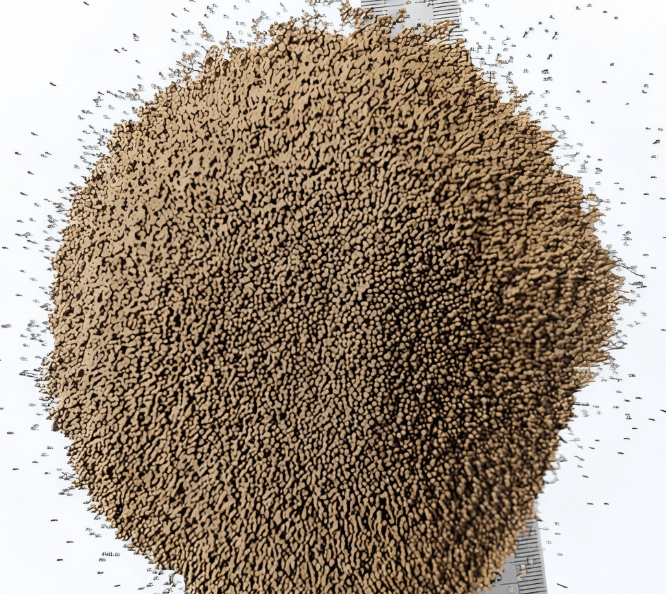
- Micro-Diets: Producing extremely small, nutrient-dense pellets for fry and small tropical fish requires specialized micro-dies and precise cutting.
- Gel Diets: A alternative to extrusion, where ingredients are bound by a hydrocolloid (e.g., alginate, carrageenan) into a soft, moist gel. These are excellent for preventing leaching and are often used for sensitive species like jellyfish or seahorses.
- Color-Enhancing Feeds: Contain high levels of specific carotenoids and are often more heavily stabilized with antioxidants to preserve the vibrant pigments.
5.2 Larval and Weaning Diets:
The production of feeds for fish larvae, which start life feeding on live prey like rotifers and artemia, is the pinnacle of feed technology. These “micro-particulate” diets must be incredibly small (50-400 microns), highly water-stable, and immensely palatable to convince the larvae to transition from live food.
5.3 Functional Feeds: “Pharma-Food” for Fish
This is the cutting edge. These feeds contain additives beyond basic nutrition, designed to address specific health challenges.
- Vaccine Delivery: Vaccines can be incorporated into the feed, offering a stress-free alternative to manual injection.
- Immune-Stimulants: Ingredients like beta-glucans (from yeast) and mannan-oligosaccharides (MOS) are added to prime the fish’s immune system.
- Probiotics and Prebiotics: To promote a healthy gut microbiome and improve digestive efficiency.
The manufacturing of these feeds requires extreme care to ensure the bio-active ingredients survive the processing and are evenly distributed.
Part 6: The Future of Fish Feed Manufacturing
The industry is not standing still. Key trends shaping its future include:
- Precision Nutrition and Digitalization: Using AI and machine learning to formulate least-cost rations in real-time based on fluctuating ingredient prices and specific customer requirements. Sensors on extruders will auto-adjust parameters for perfect quality.
- Sustainable Ingredient Innovation: The race is on to commercialize and scale new ingredients like algal oils (as a direct source of EPA and DHA, bypassing the fish), single-cell proteins, and insect meal to create a truly circular economy for aquaculture.
- Advanced Processing Techniques: Technologies like low-temperature extrusion, fermentation of ingredients to pre-digest them, and novel coating technologies to further enhance nutrient retention are under continuous development.
- Customization and On-Demand Production: Small-scale, modular feed mills could allow local farmers to produce custom feeds tailored to their specific species, life stage, and local environmental conditions.
The humble fish pellet is a marvel of modern food technology. It is a carefully engineered delivery system designed to overcome the unique challenges of the aquatic realm. The process of cooking extrusion, coupled with sophisticated nutritional science and rigorous quality control,Fish feed making machine transforms a list of disparate ingredients into a life-sustaining, water-stable, and highly digestible food source. The next time you sprinkle flakes into an aquarium or watch a feeding frenzy at a fish farm, remember the incredible journey of precision, heat, and pressure that created each and every pellet. It is a testament to human ingenuity in our quest to sustainably nourish the life within our planet’s waters.