
مقدمة
Floating fish feed is one of the most important innovations in modern aquaculture. Unlike sinking pellets, which can be lost in the pond bottom before fish consume them, floating feed allows farmers to directly observe feeding activity and adjust rations accordingly . The technology behind this buoyancy is not a simple matter of adding air pockets or lightweight fillers. It is a highly engineered process called extrusion cooking, in which a combination of moisture, heat, pressure, and mechanical shear transforms a dense powder blend into a porous, low-density pellet that floats on water .
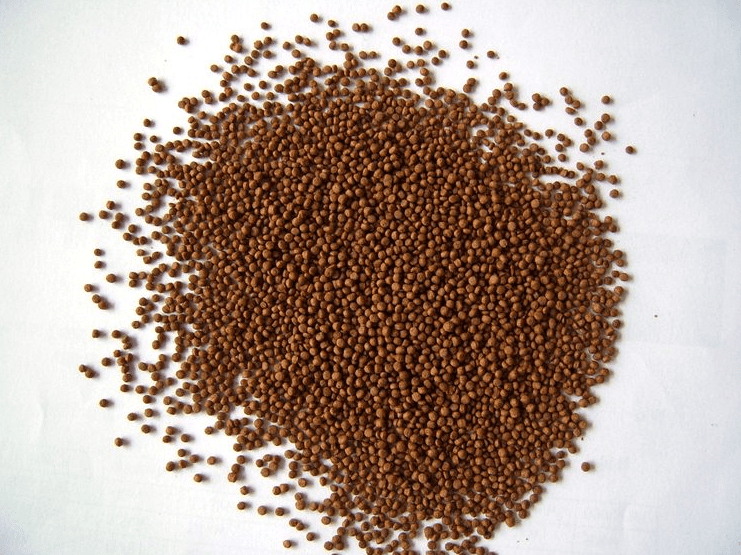
This article examines the industrial methods used to manufacture floating fish feed, from raw ingredient selection to the final packaging step.
Raw Materials
The formulation of floating fish feed begins with a careful balance of protein sources, starch, lipids, vitamins, and minerals. According to historical patent formulations, a typical blend may include ground yellow corn (0–45%), ground wheat (5–30%), defatted soy meal (10–60%), fish meal (15–60%), and various supplements such as brewers yeast, dried whey, and vitamin-mineral premixes .
The starch component is critical for floatability. During extrusion, starch undergoes الهلامية, a process in which the starch granules absorb water and swell, creating the structural matrix that traps expanding steam . Without sufficient gelatinizable starch, the pellets will not puff properly and will fail to float.
Common starch sources include corn, wheat, tapioca, and sago. Research on Malaysian mahseer feed found that tapioca and sago starches performed as well as maize starch in producing floating extrudates, offering potential cost reductions for feed producers . In West African studies on catfish feed, cassava chips proved to be an ideal starch source for low-cost floating feed production using locally built single-screw extruders .
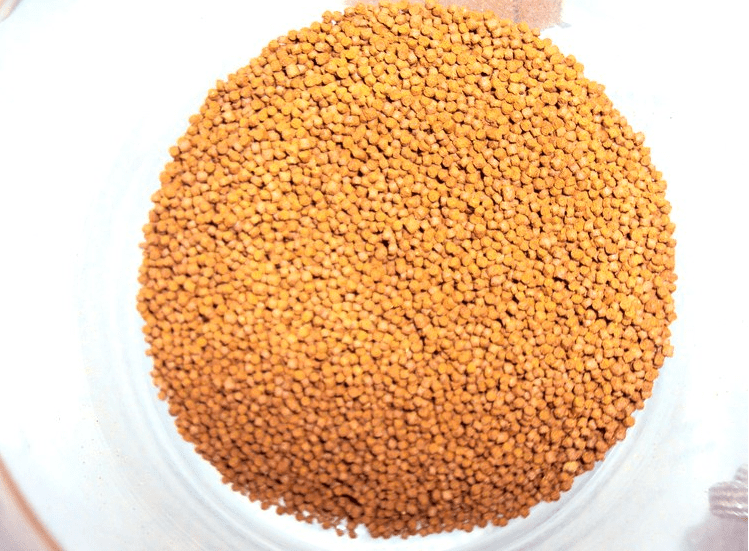
The Manufacturing Process
Grinding and Mixing
The process begins with grinding the raw ingredients to a uniform particle size. Particle size significantly affects the physical quality of the final pellets. Research on African catfish feed found that a 1 mm particle size favored the production of granules with low density (approximately 0.45 kg/L) and high floatability (approximately 94%) . The ground ingredients are then dry-blended with vitamin and mineral premixes to ensure a nutritionally complete mixture.
Preconditioning
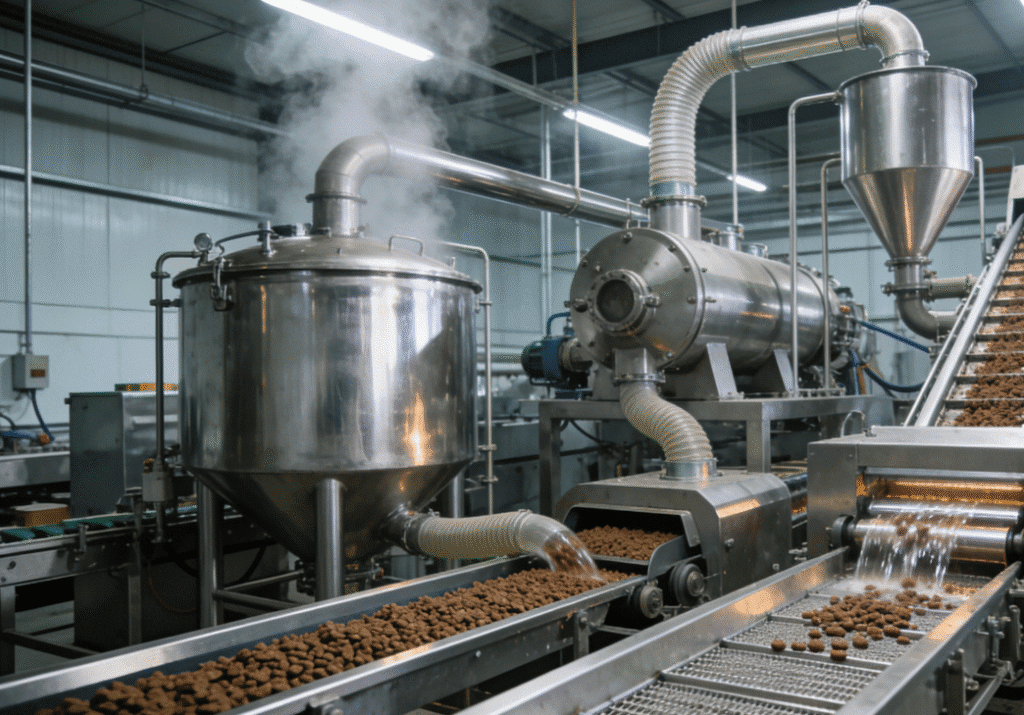
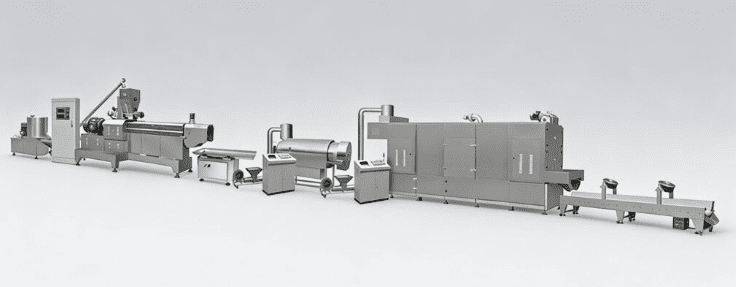
The blended powder is fed into a preconditioner, a high-speed mixing chamber where water and steam are injected into the dry ingredients . The goal of preconditioning is to supply the extruder barrel with an evenly moistened and preheated mix, which allows for more efficient heat transfer through friction in the extruder and reduces wear on the equipment .
Moisture content during preconditioning is a critical parameter. Studies on low-starch floating feed containing Clostridium autoethanogenum protein (CAP) found that 28% moisture content produced better physical quality than 32% . In West African catfish feed trials, the optimum moisture content for extrusion of floating extrudate was between 27.5% and 30% . Moisture contents below 20% led to jamming during extrusion, while levels above 35% allowed smooth extrusion but with reduced floatability .
Extrusion Cooking
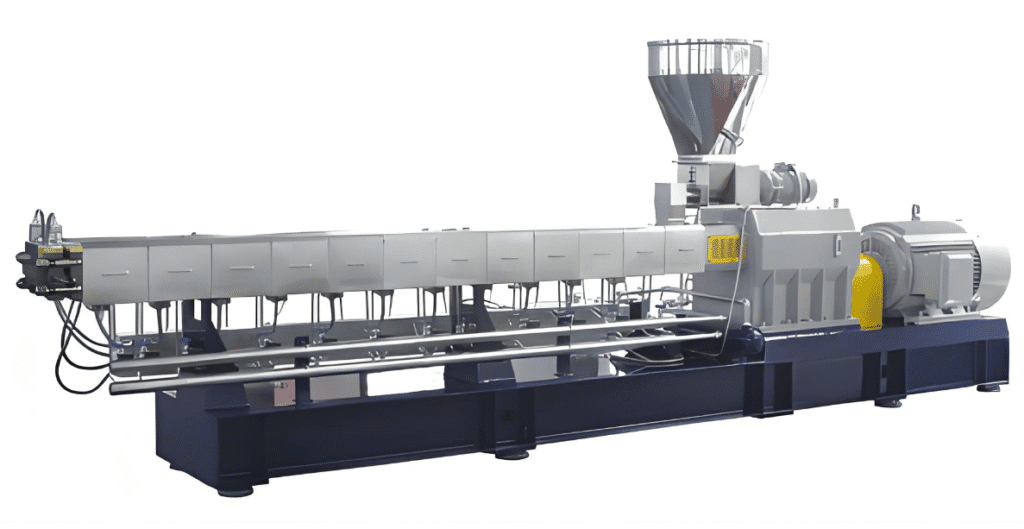
The preconditioned mixture enters the extruder barrel, where it undergoes intense thermal and mechanical processing. The material is conveyed by one or more rotating screws through a heated barrel, subjecting it to increasing levels of shear, temperature, and pressure .
Temperature in the extruder barrel typically ranges from 80°C to 150°C, depending on the formulation and desired product characteristics. Studies on trout feed used barrel temperature profiles of 80–100–120°C with a die temperature of 160°C . Research on CAP-containing feed found that die temperature (120–150°C) did not have a significant impact on physical quality, suggesting some flexibility in this parameter .
Screw speed is another key variable. Higher screw speeds generally increase specific mechanical energy (SME) and can affect expansion and density. For CAP-containing low-starch feed, a screw speed of 300 rpm was recommended over 200 rpm . In the West African catfish study, extrusion without added oil in the blend favored the production of extrudate with increased floatability .
Die and Expansion
When the cooked, pressurized material is forced through the يموت at the end of the extruder barrel, the sudden drop in pressure causes superheated water in the material to flash into steam . This rapid vaporization expands the pellet dramatically, creating a porous, honeycomb-like internal structure. The soft, warm pellets expand to several times their original size and emerge with low density—a prerequisite for floating .
The die design itself influences product characteristics. Modern aqua extruders feature die plates with multiple restricted openings that create the necessary pressure drop across the die . Commercial systems such as the Famsun Twin-Screw Aqua Extruder produce uniformly gelatinized pellets with gelatinization above 95% and expansion-coefficient variance of ≤ 0.1, ensuring consistent pellet quality .
Drying and Cooling
After extrusion, the hot, moist pellets must be dried and cooled to a stable moisture content. Freshly extruded pellets emerge with high moisture content and must be dried to approximately 12–14% moisture to prevent fungal activity during storage . Commercial operations use vertical or horizontal dryers that bring air at controlled temperatures into intimate contact with the pellets . The temperature imparted to pellets after extrusion cooking assists the removal of moisture by the air drying process .
Oil Coating
Lipids, particularly fats and oils, are often applied as a surface coating after drying rather than incorporated into the extrusion mix. This is because high internal fat levels can interfere with starch gelatinization and reduce expansion, ultimately compromising floatability . In the West African catfish study, the required oil was added as a coating of the extrudate after the extrusion process . This approach allows higher energy density in the final feed without sacrificing the physical properties that enable floating.
Conclusion
The manufacture of floating fish feed is a sophisticated multi-stage process that harnesses the principles of thermodynamics, fluid mechanics, and polymer science. From the careful selection of starch sources to the precise control of preconditioning moisture and extruder screw speed, every step is engineered to produce a pellet that is nutritionally complete, water-stable, and—above all—buoyant. The extrusion process not only creates the physical structure required for floatability but also improves nutritional value by gelatinizing starch, denaturing proteins, and destroying anti-nutritional factors . The next time you observe pellets bobbing on the surface of an aquaculture pond, consider the remarkable series of transformations—gelatinization, pressurization, flash evaporation, and expansion—that brought them there.