
الخداع الذهبي: كشف معمق عن إنتاج النودلز الفورية الصغيرة المقلية
Introduction: The Ubiquity of a Modern Marvel
In the pantheon of modern convenience foods, few items hold as universal and unshakeable a position as the instant noodle.Instant noodle making machine A staple in dorm rooms, a savior during late-night work sessions, a budget-friendly meal for billions, and a culinary icon in its own right, the humble instant noodle is a testament to human ingenuity in the pursuit of quick, cheap, and shelf-stable sustenance. The global instant noodle market is a behemoth, with over 120 billion servings consumed annually, a figure that underscores its profound penetration into every corner of the world.
Yet, for most consumers, the journey from raw ingredient to the perfectly formed, quick-cooking noodle block in their hands is a mystery shrouded in cellophane. We see the flashy packaging, the tantalizing pictures of steaming bowls, and the little seasoning packets promising gustatory delight. But what happens inside the factories, particularly the smaller-scale operations that supply local and regional markets? This article is a deep dive into the world of small-scale fried instant noodle production—a realm of complex food science, precise engineering, economic pressures, and often, unsettling compromises.
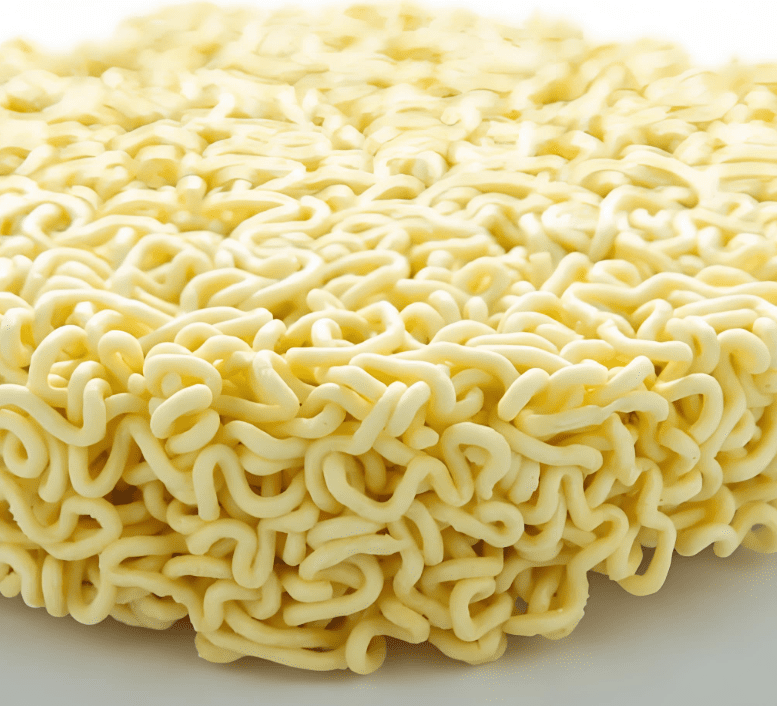
While large multinational corporations operate with multi-million dollar budgets, state-of-the-art automation, and stringent quality control, the smaller players navigate a different landscape. They are the agile, often family-owned or privately-funded enterprises that cater to specific regional tastes, compete on razor-thin margins, and operate under a different set of constraints and priorities. To understand them is to understand not just how instant noodles are made, but how a global food system adapts, cuts corners, and sometimes, conceals uncomfortable truths behind a facade of convenience and flavor.
This exposé will guide you through the entire production process, from flour to foil packet, pulling back the curtain on the machinery, the chemistry, the ingredients, and the hidden costs of producing one of the world’s most affordable meals.
Chapter 1: The Raw Materials – A Foundation of Compromise
The story of an instant noodle begins not in the factory, but in the fields and refineries that supply its core components. The quality and sourcing of these raw materials are the first and most critical area where cost-saving measures are implemented, especially in smaller-scale operations.
1.1 The Heart of the Matter: Wheat Flour
The primary ingredient is wheat flour. However, not just any flour will do. Instant noodles require a strong flour with a high protein content (typically 11-13%), Instant noodle making machinewhich is essential for forming a strong, elastic gluten network. This network gives the noodle its structure and allows it to withstand the intense processes of steaming and frying without disintegrating.
- The Ideal vs. The Reality: Large manufacturers often use specially milled, high-grade bread flours. Smaller factories, in a bid to reduce costs, frequently opt for lower-protein, all-purpose flour or blend in cheaper, inferior grades. This immediately compromises the noodle’s final texture, often resulting in a less resilient, sometimes mushy or brittle noodle block. They may also use flour with a higher ash content (more bran particles), which can impart a slightly greyish hue to the final product and reduce its shelf life.
- The “Freshness” Fallacy: Flour is a living product; it ages and oxidizes. Large companies have the turnover to ensure flour is used quickly. Smaller outfits might store flour for longer periods in less-than-ideal conditions (e.g., high humidity), leading to rancidity and the need for more additives to mask off-flavors.
1.2 The Secret to Texture: The Alkaline Agent (Kansui)
What gives instant noodles, particularly the “ramen” style, their characteristic yellow color, firm bite, and distinctive, slightly slippery texture is kansui. Originally, kansui was alkaline water sourced from specific lakes in Mongolia, but today it is a precise blend of food-grade alkaline salts, Instant noodle making machineprimarily sodium carbonate (E500) and potassium carbonate (E501).
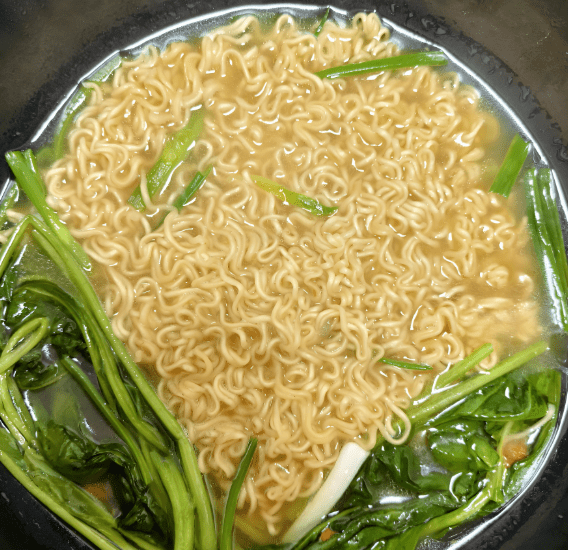
- The Chemical Dance: The alkaline environment created by kansui strengthens the gluten network further, gives the noodles their signature color by reacting with flavonoids in the flour, and alters the starch to make it less soluble, preventing the noodles from becoming too sticky when cooked.
- The Small-Scale Gamble: The precise ratio of these salts is a closely guarded secret for major brands, crucial for achieving a consistent taste and mouthfeel. Smaller producers often use pre-mixed, commercial-grade kansui blends. To cut costs, these blends can be impure or unbalanced. An excess of potassium carbonate can impart a unpleasant soapy or bitter aftertaste, a common complaint with cheaper noodle brands.
1.3 The Preservation and Processing Aids: The Additive Cocktail
This is where the ingredient list becomes a litany of E-numbers, and where small-scale production reveals its most controversial side. The goal is to create a product that can survive on a shelf for months, sometimes years, and that has a consistent, appealing texture.
- The Stabilizers and Thickeners: Guar gum (E412), xanthan gum (E415), and carboxymethyl cellulose (CMC) (E466) are ubiquitous. They help bind water, improve dough pliability, and provide a smoother, more uniform texture. In small quantities, they are harmless. However, in cheaper noodles, they are often used in higher proportions to compensate for the lower quality of the base flour, essentially creating texture through chemistry rather than ingredient quality.
- The Acidity Regulators: These, such as sodium phosphates (E339), are used to control the pH of the dough, ensuring the kansui works effectively and consistently.
- The Antioxidants: This is critical. The frying process immerses the noodles in hot oil, making them highly susceptible to oxidation and rancidity. To prevent the noodles from developing off-flavors and odors, synthetic antioxidants are added to the dough. The most common are Tertiary Butylhydroquinone (TBHQ) (E319) and Butylated Hydroxyanisole (BHA) (E320). While approved for use within strict limits, the heavy reliance on these chemical preservatives is a direct consequence of the need for extreme shelf-life. Smaller factories, with less sophisticated packaging, may even exceed recommended levels to ensure their product doesn’t spoil before sale, raising health concerns among nutritionists.
Chapter 2: The Anatomy of Production – A Step-by-Step Dissection
The transformation of this simple mixture of flour, water, and chemicals into a durableInstant noodle making machine, quick-cooking noodle block is a marvel of food engineering. In a small-scale factory, this process is often a patchwork of semi-automated and manual steps.
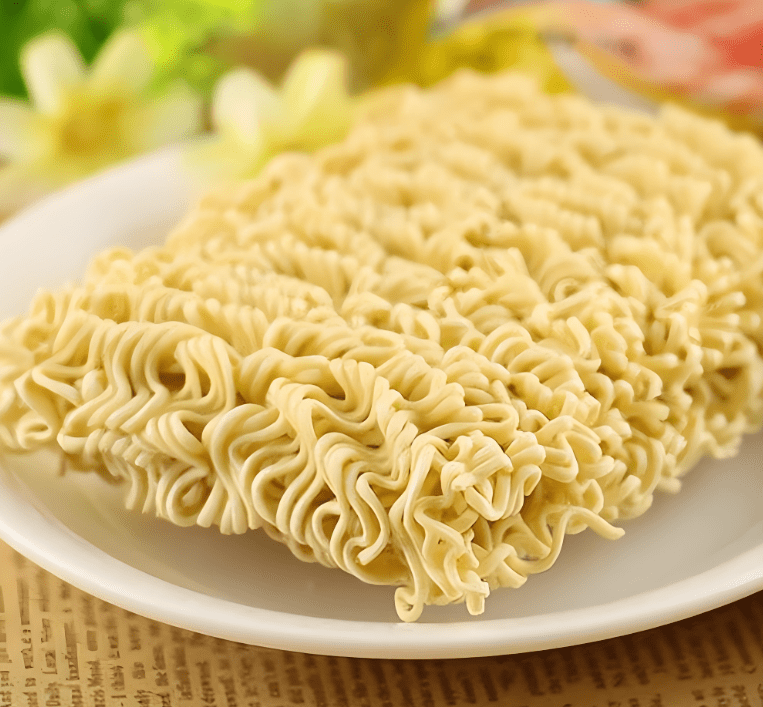
2.1 Dough Mixing and Kneading: The Birth of a Noodle
The precise amounts of flour, water, kansui solution, and the cocktail of additives are fed into a large, industrial mixer. This is not gentle stirring; it’s a violent, mechanical kneading process that can last 15-20 minutes. The goal is to hydrate the flour completely and develop the gluten network as thoroughly as possible.
- The Water Factor: The temperature and mineral content of the water are crucial. It must be precisely controlled. In smaller setups, water filtration may be basic, leading to inconsistencies. The mixing itself generates heat, which can denature the proteins if not managed. Many small factories lack advanced temperature-control systems in their mixers, leading to batch-to-batch variations in dough quality.
2.2 Sheeting and Compound Slabbing: Forging the Noodle Shape
The mixed dough is a crumbly, cohesive mass. It is then passed through a series of large, heavy rollers. The first set presses it into a thick, uneven sheet. This sheet is then folded and passed through again and again, a process called “compound slabbing.” This repeated compression further aligns the gluten strands, creating a layered, coherent structure that is essential for the noodle’s final texture. Finally, the dough is rolled out into a thin, continuous sheet of precise thickness.
2.3 Slitting: Creating the Individual Noodles
The thin, continuous dough sheet is then fed into a “slitter.” This is a machine equipped with a series of parallel, grooved rollers. As the sheet passes through, it is cut into the familiar thin, wavy strands. The width and wave pattern of the slitters determine the noodle style—thin, thick, wide, etc. The waves are not just for aesthetics; they increase the surface area, which is critical for both the subsequent steaming and frying stages, allowing for more efficient heat and oil transfer.
2.4 Steaming: The First Cooking
The raw, slit noodles are now conveyed through a steam tunnel. This is a critical stage of partial gelatinization. The steam heats the noodles, causing the starch granules within to absorb water and swell, beginning the cooking process. This step:
- Sets the noodle’s shape.
- Deactivates enzyme activity that could cause spoilage.
- Makes the noodle more pliable for molding.
The time and temperature of steaming are precisely controlled. Under-steaming, a risk in factories rushing throughput, results in a noodle that is too dense and won’t cook properly later. Over-steaming makes the noodles too soft and sticky, causing them to clump irreversibly.
2.5 The Crucial Crossroads: Frying vs. Air-Drying
This is where the two primary types of instant noodles diverge.
- Fried Noodles: The method we are focusing on. The steamed noodles are molded into a block and then plunged into a bath of hot oil.
- Air-Dried Noodles: A more expensive, slower process where the noodles are dried with hot air. They are generally considered healthier but have a different, often less “instant” texture.
Chapter 3: The Deep Fry – The Engine of Instantaneity and Its Dark Secrets
The frying process is the absolute core of the traditional instant noodle. It is what makes them “instant.” It is also the most chemically and logistically complex part of the operation, and a major source of concern.
3.1 The Science of Flash-Frying
The noodle blocks are conveyed into a long, continuous fryer filled with oil maintained at a temperature between 150-160°C (300-320°F). The fry is incredibly brief, typically only 60-120 seconds. In this short, intense burst of heat, several transformative events occur simultaneously:
- Rapid Water Evaporation: The intense heat instantly turns the internal moisture into steam. Instant noodle making machine this steam explodes outward, creating a porous, honeycombed microstructure full of tiny cavities and tunnels throughout the noodle block.
- Starch Gelatinization Completion: The heat fully cooks the starch, setting the noodle’s structure.
- امتصاص النفط: As the water violently exits, it leaves a vacuum. Hot oil is immediately sucked into these microscopic pores, coating the starch and protein structures. This oil layer is what makes the noodle hydrophobic and shelf-stable, as it prevents moisture from re-entering and spoiling the product.
The result is a noodle block that is, in essence, both cooked and preserved. When boiling water is added, it rapidly penetrates these oil-coated pores, rehydrating the starch and cooking the noodle from the inside out in minutes.
3.2 The Oil Itself: The Biggest Secret
The type and quality of the oil used for frying is the single most important factor determining the nutritional profile, flavor, and safety of the final product. This is where small-scale production faces its greatest ethical and practical challenges.
- The Ideal Oils: Palm oil is the undisputed king of the instant noodle industry, accounting for over 80% of global use. It is cheap, stable at high temperatures, has a neutral flavor, and is semi-solid at room temperature, which helps the noodle block maintain its structural integrity. Other common oils include soybean oil and canola oil.
- The Reality of Small-Batch Frying: A small factory does not have the capital to constantly replace its massive frying vat with fresh oil. The oil is a major operational cost. Therefore, the oil is used continuously, filtered, and “topped up” with fresh oil to maintain volume. This practice, known as “turnover,” is standard, but the rate of turnover is key.
- The Danger of Degradation: As oil is heated, cooled, and reheated, it undergoes chemical breakdown. It oxidizes and polymerizes, forming:
- Polar Compounds: These are toxic byproducts of oil breakdown. Most countries have legal limits for polar compounds in frying oil (typically around 24-27%). In a well-run facility, oil is discarded before reaching this point. In a cost-cutting small factory, the oil may be used far beyond its safe life. Testing for polar compounds requires equipment and diligence that may be lacking.
- Trans Fats: While the partial hydrogenation of oils—a primary source of artificial trans fats—has been largely phased out, the repeated heating of oils at high temperatures can still create trans fats naturally. The longer the oil is used, the higher the trans fat content can become.
- Acrolein and Other Aldehydes: Further degradation produces these volatile compounds, which are not only responsible for the rancid, unpleasant smell of old oil but are also considered potential health hazards.
The oil in a small-scale fryer is a dynamic, living chemical soup. Its quality directly correlates to the quality—and safety—of the noodle. Instant noodle making machine A cheap noodle is almost invariably fried in old, degraded oil, absorbing its harmful compounds and off-flavors, which must then be masked by heavy-handed seasoning.
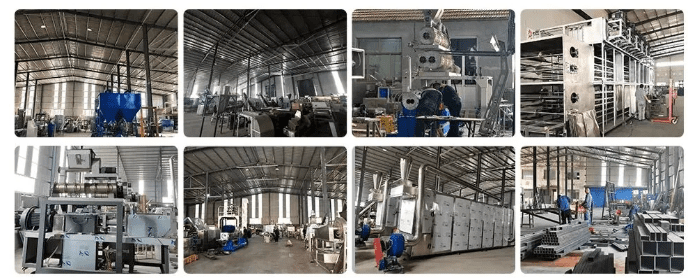
3.3 Molding and Cooling
After their brief, violent oil bath, the noodle blocks are ejected from the fryer. They pass through a molding device that gives them their classic round or square shape while they are still pliable. They then travel on a cooling conveyor, allowing the hot oil on their surface to solidify and the structure to set completely. They are now brittle, shelf-stable, and ready for packaging.
Chapter 4: The Flavor Facade – Engineering Taste and Aroma
A plain, fried noodle block is bland and unappealing. The magic—and the illusion—is completed by the seasoning packets. This is where food science becomes a form of alchemy, creating powerful, crave-worthy flavors from a minimal set of inexpensive ingredients.
4.1 The Powder Packet: The Workhorse
This is the primary flavoring agent, typically a fine, free-flowing powder.
- The Salt and MSG Foundation: The base is always salt and Monosodium Glutamate (MSG). MSG is the flavor enhancer par excellence, providing the savory “umami” taste that forms the backbone of the flavor profile. Despite public misconception, MSG is generally recognized as safe, but its heavy use is a hallmark of cheap, processed foods, allowing producers to use less of the actual, more expensive flavor ingredients.
- The Flavor Carriers: Maltodextrin and glucose are used as carriers and bulking agents. They are cheap, add weight to the packet, and help the powder flow without clumping.
- The “Natural Flavors” Enigma: This term on an ingredient list is a catch-all that can hide a multitude of sins. While it can mean extracts from real foods (e.g., mushroom, chicken), it often refers to flavors created by “reaction flavors.” This is a process where amino acids and sugars are heated together (the Maillard reaction) under controlled conditions to create the savory, roasted, or meaty notes desired. A “beef flavor” may contain little to no actual beef, but rather a chemical replica perfected in a lab. This is a perfectly legal and safe way to create intense flavors for pennies.
- Spices and Dehydrated Vegetables: You will see specks of garlic, onion, green onion, and chili. While they provide visual authenticity and some texture, they often contribute a minor part of the overall flavor compared to the potent synthetic or reaction-based flavors.
4.2 The Oil Packet: The Flavor Amplifier
Many packets include a small sachet of flavored oil. This is crucial because many flavor compounds are fat-soluble. When added to hot water, this oil disperses, carrying these fat-soluble flavors throughout the broth and coating the noodles, creating a richer, more authentic mouthfeel.Instant noodle making machine This oil is often the same palm oil used for frying, infused with garlic, chili, or other “natural flavors.”
4.3 The Liquid Sauce Packet: Complexity and Color
For more complex, soup-style noodles (like many Korean or Japanese varieties), a liquid or paste sauce packet is included. This contains soy sauce, fermented pastes (e.g., doenjang, miso), vinegar, or sweeteners like high-fructose corn syrup. These provide depth, acidity, and sweetness, balancing the salty, umami punch of the powder.
The creation of these seasoning blends is the most proprietary aspect of a noodle company’s business. For a small producer, the goal is to create the most impactful flavor for the lowest possible cost, which almost always means a heavy reliance on MSG, yeast extracts (another source of umami), and artificial or “natural” flavorings to mimic the taste of expensive meat or seafood stocks.
Chapter 5: Packaging – Sealing in the Shelf Life
The final, cooled noodle blocks and their accompanying seasoning packets are funneled into the iconic plastic or foil-lined styrofoam cups, or the laminated plastic bags. This stage is highly automated, even in smaller factories.
- The Packaging Material: The primary enemy is oxygen and moisture. The packaging is a multi-layered laminate, often consisting of polypropylene, aluminum foil, and polyester. This creates a formidable barrier against the elements. The seams are heat-sealed with absolute precision. Any micro-tear or imperfect seal is an invitation for spoilage and rancidity.
- Nitrogen Flushing: This is a critical step. Before the final seal, the air inside the package is evacuated and replaced with pure nitrogen gas. Nitrogen is inert and prevents oxidation of the fats in the noodle. This, combined with the antioxidants in the noodle itself, is what allows for that astonishingly long shelf life of 6-12 months or more. A small factory with faulty gas-flushing equipment will produce noodles that go rancid quickly.
Chapter 6: The Human and Environmental Cost – The Unseen Price of Convenience
Behind the efficient machinery and clever food science lies a reality of labor, waste, and environmental impact that is often overlooked.
6.1 The Factory Floor
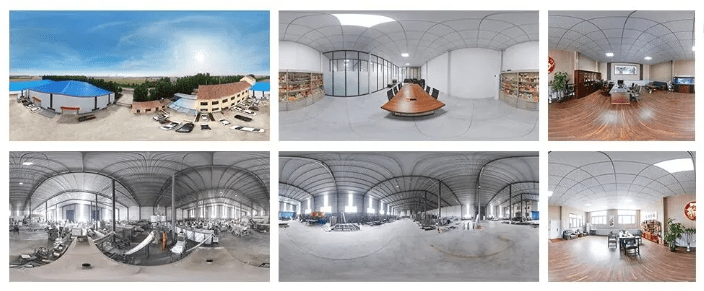
A small-scale instant noodle factory is a loud, hot, and humid place. The constant roar of machinery, the heat emanating from the steamers and fryers, Instant noodle making machine and the pervasive smell of oil and seasoning are omnipresent. Workers, often in low-wage regions, perform repetitive tasks: monitoring machines, clearing jams, boxing finished products. Safety standards may be lax compared to multinational corporations, with risks of burns from hot oil or steam, repetitive strain injuries, and exposure to high levels of noise and airborne flour dust, which can be a respiratory irritant and explosion hazard.
6.2 The Environmental Footprint
The environmental cost of instant noodles is significant.
- Palm Oil Dilemma: The industry’s reliance on palm oil is a major driver of deforestation and habitat destruction in Southeast Asia and other tropical regions. While small factories are not the primary drivers, they are part of the demand chain that fuels this industry.
- Oil Waste: The disposal of spent frying oil is a challenge. In best-case scenarios, it is collected for biodiesel production or industrial uses. In worse cases, it can be dumped improperly, contaminating soil and water sources.
- Packaging Waste: The multi-layered, plastic-and-foil packaging is notoriously difficult to recycle. Billions of these packages end up in landfills or as litter each year, contributing to the global plastic pollution crisis. The styrofoam cups are particularly problematic.
Chapter 7: The Health Implications – Decoding the Nutritional Black Hole
Instant noodles are a dietary staple for many, but their nutritional profile is a cause for serious concern among health professionals.
- High in Calories, Low in Nutrition: They are primarily a source of refined carbohydrates and fat, with very little protein, fiber, vitamins, or minerals. They are the definition of “empty calories.”
- Sodium Bomb: A single serving of instant noodles can contain 800-1,800 mg of sodium, primarily from the seasoning packet. This is a significant portion of the WHO’s recommended maximum daily intake of 2,000 mg. Regular consumption is linked to hypertension, heart disease, and stroke.
- Saturated Fats: The palm oil used for frying is high in saturated fats, which can raise LDL (“bad”) cholesterol levels.
- The Hidden Hazards: As discussed, the potential for harmful compounds from degraded frying oil (polar compounds, trans fats) and the heavy reliance on chemical additives (TBHQ, MSG) create a “chemical soup” that, while deemed safe in isolation, has unknown long-term effects when consumed regularly as part of a complex diet. The “full” feeling after eating instant noodles is not satiety but often a physical reaction to the high salt and MSG load, followed by a rapid blood sugar spike and crash from the refined carbs.
The small-scale production of fried instant noodles is a testament to human ingenuity in the face of economic and logistical challenges. It is a process that efficiently transforms a handful of cheap ingredients into a durable, transportable, and universally palatable food product. The engineering involved, from the gluten development to the flash-frying and nitrogen flushing, is remarkable.
However, this convenience comes at a cost. The revelations are clear: the reliance on low-grade raw materials, the chemical cocktail of additives and preservatives, the gamble with degraded frying oil, the creation of hyper-palatable yet nutritionally void flavor profiles, and the significant environmental footprint paint a picture that is far less appetizing than the one on the package.
Understanding this process is not necessarily a call to completely abandon instant noodles. For millions, they remain an essential, affordable source of calories. Rather, it is a call for informed consumption. It is an encouragement to see past the marketing and recognize this product for what it is: a heavily processed, emergency food, not a dietary foundation. For the small-scale producers, the path forward lies in embracing greater transparency, investing in better ingredients and oil management practices, and innovating towards healthier alternatives, such as air-drying or using better-quality oils.
The next time you peel back the foil lid on a cup of noodles or tear open a seasoning packet, you are not just preparing a quick meal. You are holding the end product of a complex, globalized, and often compromised system. Instant noodle making machine It is a system built not on nourishment, but on the relentless pursuit of convenience and cost. Knowing what lies beneath the golden, wavy surface empowers you to make that choice with your eyes wide open.