
مقدمة
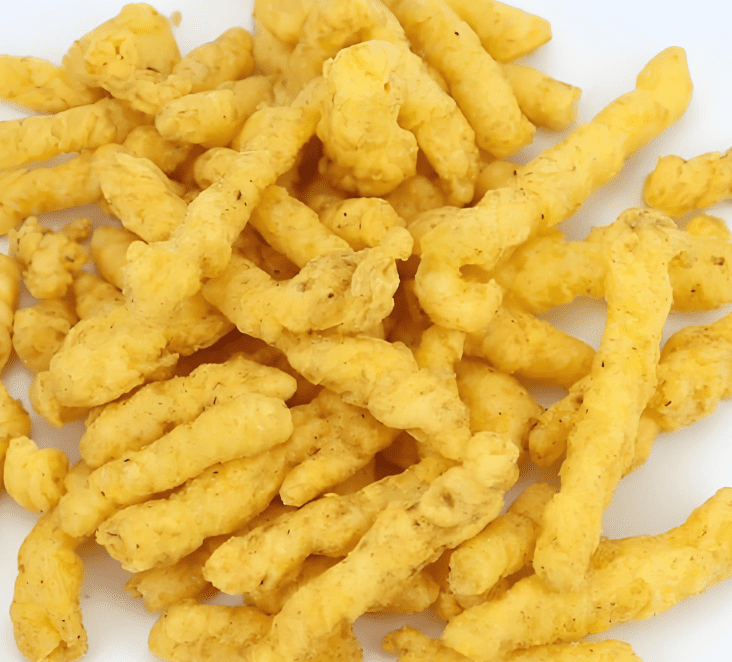
Kurkure is a popular crunchy snack known for its unique shape, crispy texture, and bold seasoning. Its distinctive appearance and satisfying crunch make it a favorite among snack lovers in many markets.
But have you ever wondered how Kurkure is made? Behind every bite is a carefully controlled industrial process involving raw material preparation, extrusion cooking, shaping, drying or frying, seasoning, and packaging. By understanding these production steps, we can gain a deeper insight into the technology behind modern extruded snacks.
This article takes a closer look at the manufacturing process of Kurkure and explains how raw ingredients are transformed into a light, crunchy, and flavorful snack.
1. Raw Material Selection and Preparation
The first step in manufacturing Kurkure-style snacks is selecting and preparing the raw materials.
Depending on the product formulation and market, the main ingredients may include cornmeal, rice flour, edible starches, and other cereal-based ingredients. kurkure manufacturing Water is added to achieve the appropriate moisture level for processing. Seasonings, edible oil, and flavoring ingredients are generally applied or incorporated at different stages of production.
The raw materials must meet established quality standards. Their particle size, moisture content, starch characteristics, and consistency can significantly affect the extrusion process and the final product’s texture.
Before production, the dry ingredients are weighed and blended according to a specified formulation. Consistent mixing helps ensure uniform processing and product quality.
2. Mixing and Moisture Conditioning
After the ingredients are prepared, they are transferred to a mixing system.
Water is added in a controlled quantity to adjust the moisture content of the mixture. This step is important because moisture influences the behavior of starch during extrusion cooking.
If the mixture contains too little moisture, processing may become unstable. If it contains too much, the product may not expand properly or may require additional drying.
The mixture is blended until the ingredients are evenly distributed. In some production systems, a conditioning stage allows moisture to spread more uniformly through the material before it enters the extruder.
3. Extrusion Cooking: The Key Manufacturing Stage
Extrusion cooking is one of the most important technologies used in producing Kurkure-style snacks.
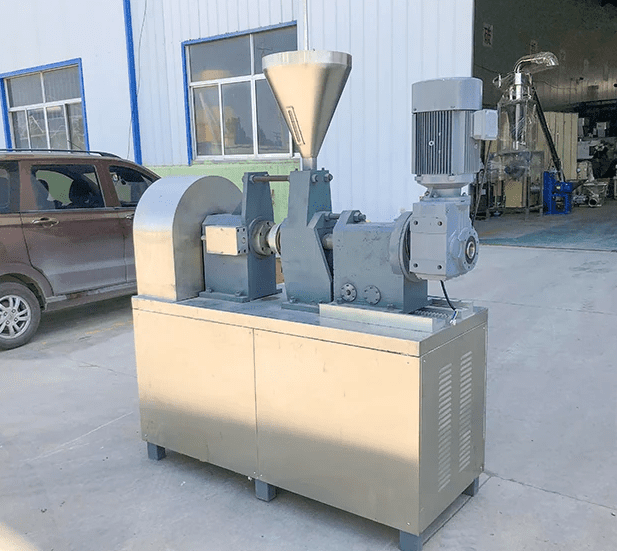
The conditioned mixture enters an industrial extruder, where rotating screws convey the material through a heated barrel. As the material moves forward, it experiences a combination of heat, pressure, mechanical shear, and mixing.
These conditions cause significant physical and structural changes in the starch-based ingredients. The starch gelatinizes, the material becomes a cohesive dough-like mass, and its flow properties change.
At the end of the extruder, the material passes through a specially designed die. kurkure manufacturing The die opening and the extrusion system determine the basic shape of the emerging product.
When the hot material exits the die, the sudden pressure drop allows some of the moisture to vaporize rapidly. This can create expansion and a porous internal structure, depending on the formulation and processing conditions.
The result is an irregular, ridged, or curled snack shape with the potential to develop a light, crispy texture.
The exact formulation, screw configuration, temperature profile, and operating parameters used for branded Kurkure products are proprietary. Therefore, a general description of extruded snack production should not be mistaken for a verified specification of the company’s production line.

4. Cutting and Shape Formation
As the extruded material emerges from the die, a cutting mechanism separates it into individual pieces.
The shape of the final snack depends on several factors, including die design, the flow characteristics of the material, expansion behavior, and the cutting system.
For Kurkure-style snacks, the characteristic irregular and curled appearance is an important part of the product’s identity.
Manufacturers must control the extrusion rate and cutting speed to maintain consistent product dimensions. Excessively large or small pieces may affect processing efficiency, seasoning coverage, packaging, and consumer experience.
5. Drying or Frying
After extrusion and shaping, the snack must reach the appropriate moisture content to develop and maintain its desired texture.
Depending on the specific product and manufacturing system, this may involve drying, frying, or a combination of processing stages.
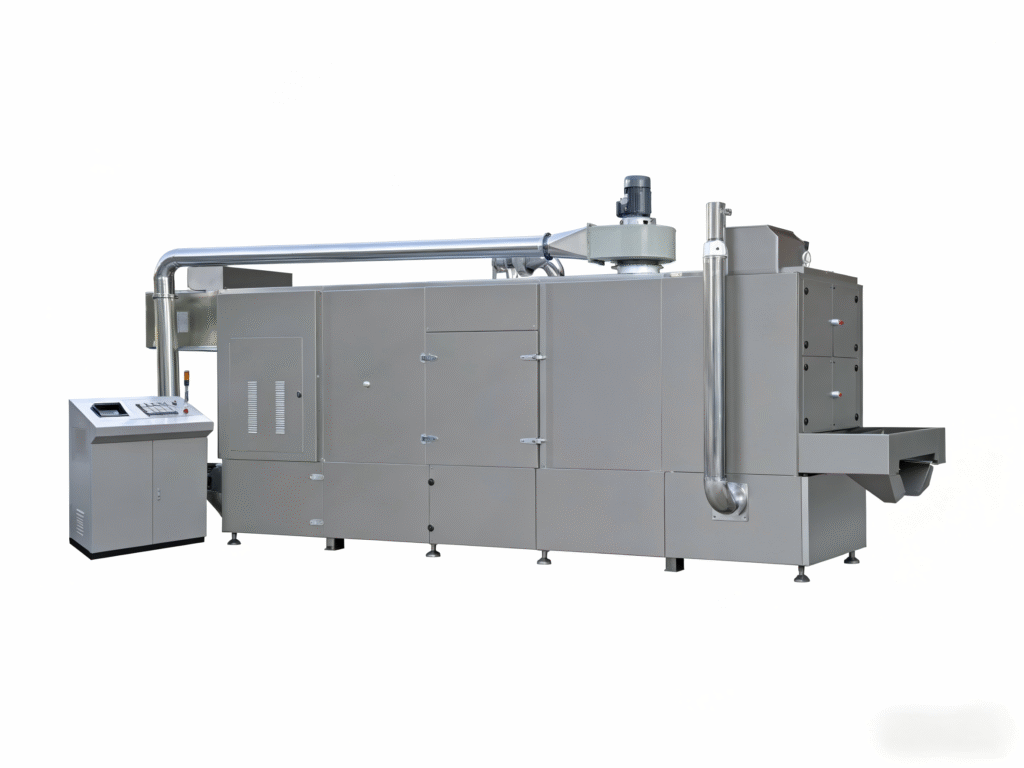
التجفيف: Hot air removes excess moisture from the extruded pieces. Controlled drying helps develop the desired crispness and improves the product’s stability during storage.
Frying: In products made using a frying process, the shaped pieces pass through hot edible oil. Heat and moisture removal contribute to the final texture, while the oil can also affect flavor and fat content.
These methods are not interchangeable in every production line. kurkure manufacturing The actual process used for a particular Kurkure product should be confirmed through reliable product-specific manufacturing information rather than assumed from the snack’s appearance.
Temperature, residence time, moisture content, and processing uniformity all influence the final product. Inadequate processing may leave the snack too soft, while excessive heat may cause darkening, undesirable flavors, or other quality defects.
6. Seasoning and Flavor Development
Once the snack has reached the required texture, flavoring ingredients are added.
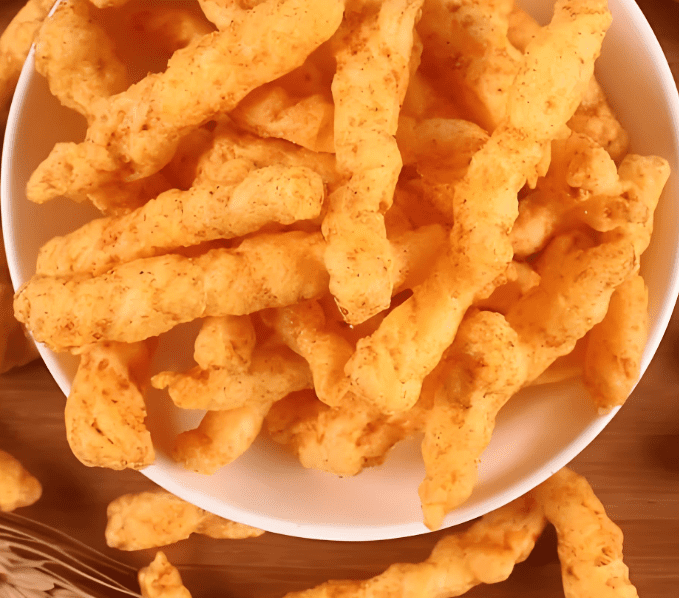
Depending on the production system, seasoning may be applied in a rotating drum or another coating machine. A controlled amount of edible oil or another suitable coating medium may help the seasoning adhere to the snack surface.
Seasoning blends can contain ingredients such as salt, spices, herbs, flavorings, and acidity regulators, depending on the specific product formulation and local food regulations.
The characteristic flavor of a branded snack comes from its particular seasoning recipe and the way the flavor components interact with the base product.
Uniform coating is essential. Too little seasoning may produce a weak flavor, while excessive or uneven coating can create inconsistent taste and increase material waste.
The exact seasoning formula used in Kurkure is proprietary and should not be inferred from generic snack recipes.
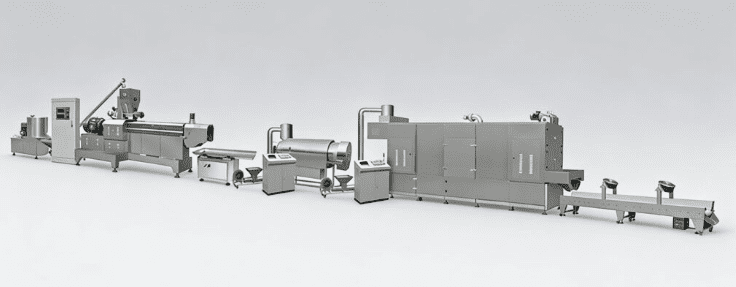
7. Cooling and Quality Inspection
Before packaging, the finished snacks may pass through a cooling stage to stabilize their temperature and reduce the risk of moisture condensation inside the package.
The production team then performs quality checks to ensure that the snacks meet established specifications.
Typical quality-control checks for extruded snacks include:
- Appearance: Checking color, shape, and surface condition.
- Texture: Evaluating crispness and crunch.
- Moisture content: Confirming that the product is sufficiently dry.
- Flavor: Checking seasoning consistency and detecting undesirable tastes.
- Foreign material control: Using appropriate inspection and detection systems.
- Weight control: Ensuring that packages contain the declared quantity.
Food manufacturers also implement sanitation programs, traceability systems, allergen controls where applicable, and preventive food-safety procedures.
These controls help protect consumers and maintain consistent product quality.
8. Automated Packaging
Packaging is the final stage of the manufacturing process.
The cooled snacks are transferred to an automated weighing and packaging system. A typical line may use a multihead weigher to portion the product before it enters a vertical form-fill-seal machine.
The machine forms bags from packaging film, fills them with the measured snack quantity, and seals the packages.
Packaging materials must provide suitable protection against moisture, oxygen, physical damage, and other factors that could reduce product quality. The specific barrier requirements depend on the formulation, distribution conditions, and intended shelf life.
Finished packages are checked for seal integrity, weight accuracy, coding, and label compliance before being packed into cartons and prepared for distribution.
9. Is Kurkure Made Through a Complicated Industrial Process?
Although the basic production sequence may appear straightforward, industrial snack manufacturing requires precise coordination among several systems.
Raw material properties affect extrusion behavior. Extrusion conditions influence expansion and shape. Drying or frying determines moisture removal and texture. Seasoning affects flavor consistency, while packaging helps preserve freshness.
A small change in moisture content, temperature, screw speed, or processing time can influence the finished product. For this reason, manufacturers rely on standardized formulations, automated equipment, trained operators, and continuous quality monitoring.
Modern extrusion technology makes it possible to produce large quantities of snacks with relatively consistent shape, texture, and flavor.
10. Is Kurkure Unhealthy?
The manufacturing process alone does not determine whether a snack is healthy or unhealthy. Its nutritional profile depends on the ingredients, processing method, serving size, and overall diet.
Some extruded snacks contain substantial amounts of sodium, refined starch, or fat, depending on their formulation. Consumers should check the nutrition label for serving size, energy, total fat, saturated fat, sodium, and other relevant nutrients.
It is also important to distinguish between verified manufacturing information and unsupported claims. Extrusion cooking is a widely used food-processing technology; the fact that a snack is extruded does not, by itself, prove that it contains harmful substances or is unsafe to eat.
Food safety depends on appropriate ingredient sourcing, process control, hygiene, regulatory compliance, and product testing.
Conclusion
The production of Kurkure-style snacks combines food formulation, extrusion technology, moisture control, flavor development, and automated packaging.
The general manufacturing sequence can be summarized as follows:
Raw material preparation → Mixing and conditioning → Extrusion cooking → Cutting and shaping → Drying or frying, as applicable → Seasoning → Cooling and inspection → Packaging.
Each stage contributes to the snack’s distinctive appearance, crispy texture, and strong flavor.
Although the exact formulation and production parameters of branded Kurkure products are not fully public, the underlying principles of extruded snack manufacturing help explain how cereal-based ingredients can be transformed into a commercially produced crunchy snack.
Understanding this process also demonstrates why modern snack production requires not only specialized machinery but also careful quality control, food-safety management, and consistent process engineering.


