
مقدمة
Fried instant noodles remain a global staple due to their long shelf life, low cost, and satisfying texture. For a small entrepreneur, this product offers a clear path to market—but only with the right preparation. Unlike fresh or air-dried noodles, fried instant noodles require specific oil management, steam conditioning, and packaging equipment. Jumping in without a solid plan leads to rancid product, high oil absorption, and regulatory trouble. Instant noodle making machine Here are the critical steps to prepare before investing in a small fried instant noodle production line.
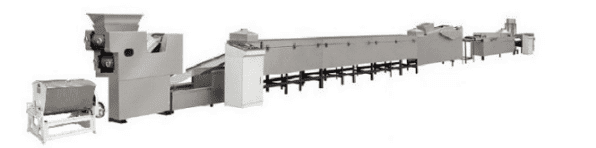
1. Understand the Fried Instant Noodle Production Process
You cannot plan equipment or layout without knowing the core steps. Fried instant noodles are made by:
- Mixing flour, water, salt, alkali (kansui), and often starches or gums.
- Sheeting and compounding to form a dough sheet.
- Slitting the sheet into noodle strands.
- Steaming the strands to gelatinize starch.
- Cutting and shaping into a round or square block.
- Deep-frying in hot oil (typically palm oil) to dehydrate and set the shape.
- Cooling to stabilize the oil.
- Packaging with a seasoning sachet.
Each step affects texture, oil content (typically 15–20%), and shelf life. Your preparation must account for every stage.

2. Conduct Market Research & Product Positioning
Small producers cannot compete with giants like Nissin or Indomie on price or volume. Instead, find a gap.
- Analyze local demand: Who buys instant noodles? Students, workers, campers, or convenience stores? Do they prefer spicy, savory, or mild flavors?
- Define your niche: Consider premium ingredients (organic flour, non-hydrogenated oil), regional flavors (local chili, curry, seafood), Instant noodle making machine or healthier claims (lower fat, air-fried hybrid, high protein).
- Study competitors: What shelf price point exists? What packaging size? A 60g block may be standard, but 40g snack-size or 90g jumbo could be your entry.
- Seasoning differentiation: The noodle is just a carrier. Unique seasoning blends (powder + oil + flake sachets) create brand loyalty.
3. Secure a Compliant Production Facility
Fried noodle production generates heat, steam, oil vapor, and waste. A home kitchen will not work.
- Space requirements: You need separate zones for raw material storage (flour, oil, seasonings), dough preparation, steaming/frying (with ventilation), cooling, packaging, and finished goods storage.
- Ventilation & fire safety: The frying line produces oil-laden hot fumes. Install industrial exhaust hoods, fire suppression systems (specifically for oil fires), and explosion-proof lighting.
- Utility capacity: You need high electrical draw (motors, conveyor, exhaust fans), natural gas or propane (for steam boiler and fryer heating), and ample water for dough mixing and cleaning. Three-phase power is essential.
- Drainage & grease traps: Wash-down floors must slope to drains. Grease traps are required to prevent oil from entering municipal sewage.
4. Source Ingredients & Establish Quality Control
The economics of instant noodles depend on bulk, consistent raw materials.

- Flour: Use high-protein wheat flour (typically 10–12% protein) for chewy texture. Test each batch for protein content and water absorption.
- Alkali solution (Kansui): A mixture of sodium carbonate and potassium carbonate. It gives noodles yellow color, firm bite, and alkaline flavor. Instant noodle making machine Prepare or buy pre-mixed powder.
- Frying oil: Refined palm olein is standard due to its oxidative stability and neutral flavor. Never reuse oil beyond safe limits (monitor free fatty acids and total polar compounds). Arrange for used oil disposal or biodiesel buyer.
- Seasoning ingredients: Dehydrated vegetables (spring onion, carrot), protein hydrolysates, powdered broths, spices, and oil sachets. Store in low-humidity, pest-proof conditions.
- Testing: Plan to test incoming flour for moisture and protein, oil for free fatty acids, and finished noodles for moisture (<10%) and water activity (<0.6) to prevent mold.
5. Choose the Right Small-Scale Equipment
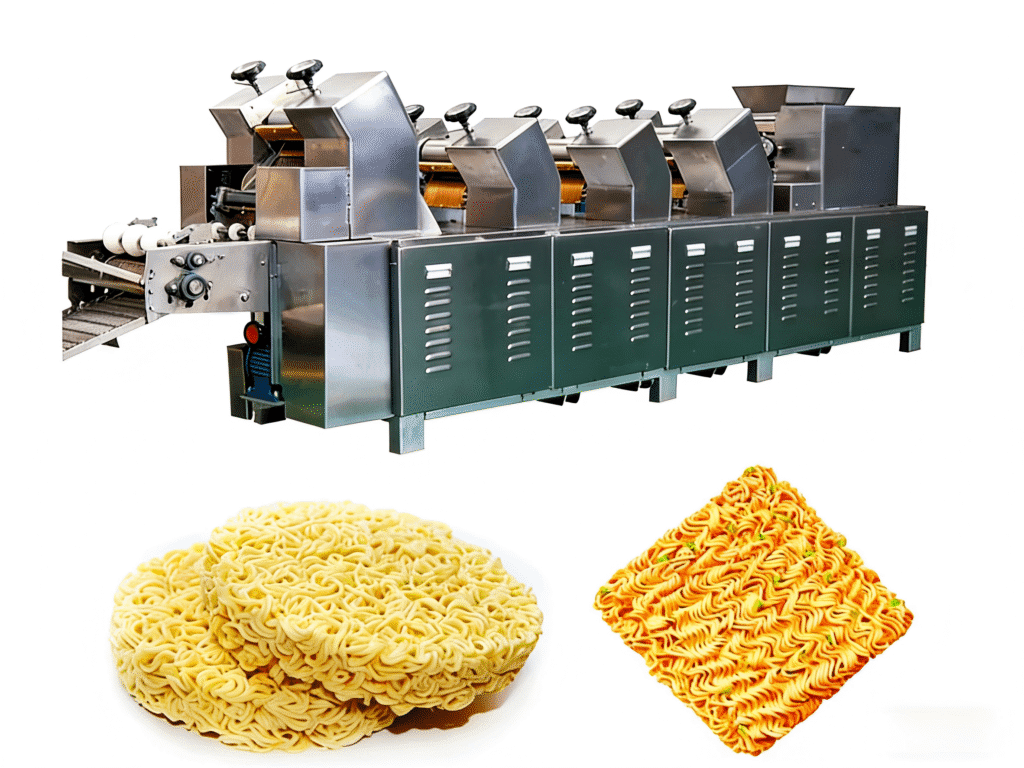
For a small plant (e.g., 50–200 kg per hour), you can buy compact, semi-automatic lines. Avoid over-engineering.
| Equipment | Function | Key Considerations |
|---|---|---|
| Dough mixer | Combine flour, water, alkali | Horizontal, heavy-duty, stainless steel |
| Compound sheeter | Form and reduce dough sheet | Roller gap adjustable; two-stage |
| Slitting rolls | Cut sheet into noodle strands | Consistent width (0.8–1.2 mm typical) |
| Steaming box | Gelatinize starch (90–100°C) | Continuous steam conveyor, even heat |
| Cutting & shaping device | Form noodle block into mold | Single or double-bowl former |
| Deep-fryer | Dehydrate and set shape (140–160°C) | Oil circulation, filtration, temperature control |
| Cooling conveyor | Cool fried noodles to ambient | Mesh belt with ambient or forced air |
| Packaging machine | Seal noodle block + sachet(s) | Vertical form-fill-seal with sachet feeder |
Advice: Buy a complete small noodle line from a reputable manufacturer (e.g., from China, Taiwan, or India). Used lines exist but verify that the fryer and steam box are not corroded. Expect to invest $20,000–$60,000 USD for a basic new small line.
6. Develop a Food Safety & Quality Assurance (QA) System
Fried instant noodles are low-risk for bacteria (due to low water activity) but high-risk for oil oxidation (rancidity) and physical hazards (metal fragments).
- HACCP plan: Identify critical control points. For noodles, typical CCPs are steaming (time/temperature to gelatinize) and frying (oil temperature and residence time to reduce moisture below 10%).
- Oil management: Monitor total polar compounds (TPC). Discard oil when TPC exceeds 24% (regulatory limit in many countries). Filter oil daily.
- Foreign body control: Install magnets on flour lines and metal detectors before packaging.
- Shelf-life testing: Accelerated aging at 60°C (for 2–4 weeks) simulates 6–12 months. Check for off-flavors (rancidity), color change, and packaging seal integrity.
- Cleaning schedule: Deep-clean fryer oil lines, steam box, and sheeting rolls every shift. Flour residue can attract pests.
7. Navigate Licensing, Labeling & Legal Compliance
Food laws cover instant noodles strictly, as they are a high-consumption, shelf-stable product.
- Business license & food establishment permit: Register with local health department and food safety authority (e.g., FDA in the US, EFSA in Europe, CFDA in China).
- Label requirements: Must include product name, net weight, ingredient list (descending order), allergen declaration (wheat, often soy from oil or seasonings), nutrition facts, storage instructions, and manufacturer details. For fried noodles, specify oil type (e.g., “palm olein”).
- Oil use regulations: Some jurisdictions restrict hydrogenated oils (trans fats) or require used oil disposal documentation.
- Liability insurance: Instant noodles can pose choking risk (especially for children) or allergen cross-contamination. Product liability insurance is mandatory.
8. Plan Your Go-to-Market & Logistics
Small producers often succeed by serving local channels first.
- Packaging options: Single block with seasoning sachet (polypropylene bag), multi-pack (5 or 10 blocks), or cup/bowl (adds cost but higher margin). Use high-barrier film to prevent oil oxidation.
- Distribution: Start with local mini-marts, school canteens, university shops, and online marketplaces. Offer free samples to store owners. Consider a simple branded cart for street or market vending.
- Pricing: Calculate cost per block (raw materials + oil absorption + packaging + labor + overhead). A typical small producer’s cost is $0.08–0.15 per block; sell wholesale at $0.20–0.30 and retail at $0.40–0.70.
- Seasoning sachet sourcing: You can make dry powder blends yourself (requires industrial grinder/mixer) or buy pre-made sachets from a co-packer. Oil sachets require a liquid filling machine.
9. Test Before Full Production
Do not scale until you have validated your process.
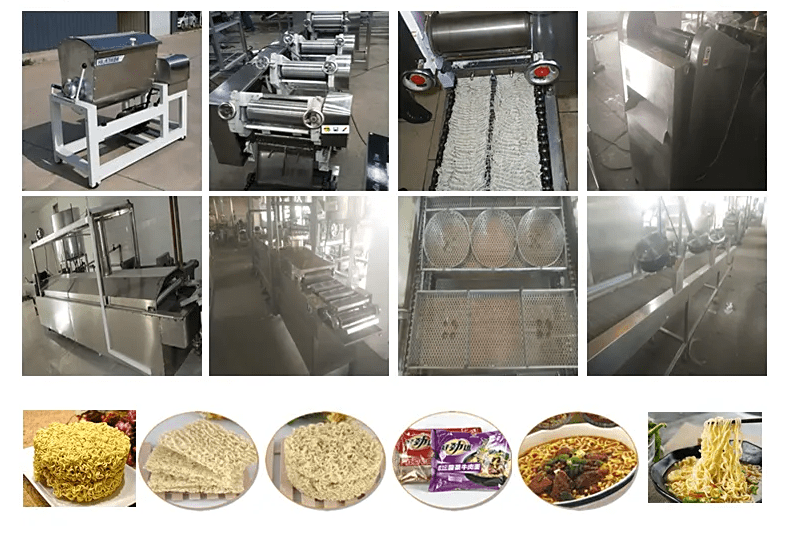
- Bench test: Make 5 kg of dough, fry in a small pot, document oil absorption, texture, and color.
- Small pilot run: Run your line for one full shift (e.g., 200 kg). Measure yield, broken noodle rate, oil consumption per kg, and packaging speed.
- Sensory panel: Ask at least 10 people to taste your noodles (rehydrated in boiling water for 3 minutes) and rate texture, flavor, and overall acceptance.
- Regulatory sample testing: Send finished product to an accredited lab for moisture, fat, peroxide value, and microbiological counts.
Conclusion
Starting a small fried instant noodle processing plant is a capital-intensive but achievable venture if you prepare systematically. Instant noodle making machine Master the process steps first, then secure a compliant facility, reliable ingredients, and the right small-scale line. Oil management, ventilation, and labeling law are the three most underestimated challenges. Solve those before your first fry, and you will have a product that travels well, stores easily, and keeps customers coming back for more. If you are interested in the instant noodle making machine, you can contact me , i will give you good advice and solutions .
1.Will you help us with the installation ?
Yes , We will send engineers to install and debug the equipment, and assist in training your staff.
2.Are you a factory or trading company?
We are a factory.
3.What certificate do you have?
We have ISO and CE certificate.
4.How long is the warranty period?
All of our machines have one year warranty.
5.What’s the main market of your company?
Our customers all over the world.
6.How much production capacity of your company one year?
This depends on your needs.