
مقدمة
With the rapid growth of the global pet food industry, the demand for high-quality cat food is increasing. More and more cat owners are paying attention to nutritional balance, ingredient quality, palatability, and food safety. Among the different types of cat food available on the market, extruded dry cat food has become one of the most popular choices because of its convenient storage, long shelf life, and diverse nutritional formulations.

But have you ever wondered how commercial extruded cat food is manufactured? What raw materials are used, what machines are required, and how does the entire production process work?
In fact, producing high-quality extruded cat food involves several important stages, including raw material preparation, grinding, mixing, conditioning, extrusion, drying, oil coating, cooling, and packaging.
This article provides a detailed introduction to the complete extruded cat food processing process and the equipment required at each stage.
1. Raw Material Selection and Preparation
Raw material selection is the foundation of extruded cat food production. The nutritional composition and quality of the ingredients directly influence the final product’s nutritional value, taste, texture, and processing performance.
Unlike dogs, cats are obligate carnivores and have specific nutritional requirements. Therefore, cat food formulations generally place considerable emphasis on animal-derived protein and essential nutrients.
Common raw materials include:
Animal protein ingredients
- Chicken meal
- Fish meal
- Meat meal
- Poultry meal
- Other suitable animal protein sources
Cereal and starch ingredients
- Corn flour
- Wheat flour
- Rice
- Other suitable starch sources
Fat ingredients
- Chicken fat
- Fish oil
- Vegetable oils
Nutritional additives
- Vitamins
- Minerals
- Taurine
- Amino acids
- Other functional nutritional ingredients
Before processing, manufacturers should inspect all raw materials to ensure they meet the required quality standards. Moisture, freshness, nutritional composition, contamination, and storage conditions should all be checked.
The formulation should be developed according to recognized feline nutritional requirements and the intended product category.
2. Raw Material Grinding
After raw material preparation, ingredients that require particle size reduction are transported to a grinding machine.
A hammer mill is commonly used in commercial cat food production. It uses high-speed rotating hammers to crush raw materials into smaller particles.
Grinding is important because it helps improve the uniformity of subsequent mixing and supports stable extrusion.
The main benefits include:
- Reducing raw material particle size.
- Improving ingredient mixing uniformity.
- Increasing the surface area of ingredients.
- Improving moisture absorption.
- Supporting consistent extrusion performance.
The grinding fineness should be selected according to the formulation and the requirements of the extruder.
If the particles are too large, the finished cat food may have an uneven structure. If the materials are excessively fine, energy consumption and dust generation may increase.
Therefore, manufacturers should choose appropriate grinding screens and regularly inspect the grinding equipment.
3. Ingredient Mixing
After grinding, different ingredients are transported to a mixing machine.
The purpose of mixing is to combine all raw materials evenly according to a predetermined formulation.
For example, a cat food mixture may contain animal protein sources, cereal ingredients, fats, vitamins, minerals, amino acids, and other nutritional additives.
Uniform mixing is particularly important because nutritional ingredients must be distributed consistently throughout the finished product.
The mixing process generally includes the following steps:
- Weigh each ingredient according to the formulation.
- Feed the ingredients into the mixer.
- Mix the materials for an appropriate period.
- Add liquid ingredients or water when required.
- Transfer the mixture to the conditioning or extrusion stage.
For large-scale factories, automatic batching and weighing systems can improve ingredient accuracy and reduce manual operations.
4. Conditioning and Moisture Adjustment
Before entering the extruder, the mixed materials may pass through a conditioning system.
During conditioning, steam and water are added to adjust the temperature and moisture content of the mixture.
This process helps soften the raw materials and prepares them for extrusion cooking.
Proper conditioning provides several advantages:
- Improves material plasticity.
- Promotes starch gelatinization.
- Supports protein transformation.
- Improves extrusion stability.
- Helps reduce unnecessary mechanical stress on the extruder.
The conditioning temperature, moisture level, and residence time should be adjusted according to the formulation and equipment configuration.
Insufficient conditioning may lead to uneven cooking and unstable product expansion. Excessive moisture may reduce expansion and increase the drying workload.
Therefore, manufacturers should establish suitable conditioning parameters through production testing.
5. Extrusion: The Core Process of Cat Food Manufacturing
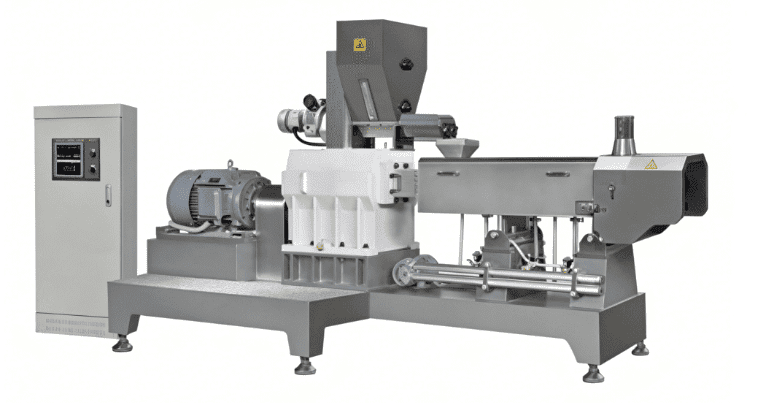
Extrusion is the most important stage in the production of extruded dry cat food.
The conditioned mixture enters the extruder, where it is exposed to heat, pressure, moisture, and mechanical shear.
As the material moves forward through the screw system, it undergoes cooking and structural changes. Starch gelatinization and protein denaturation occur under controlled processing conditions.
When the cooked material passes through the die, the sudden pressure reduction causes expansion, forming the characteristic porous structure of extruded cat food.
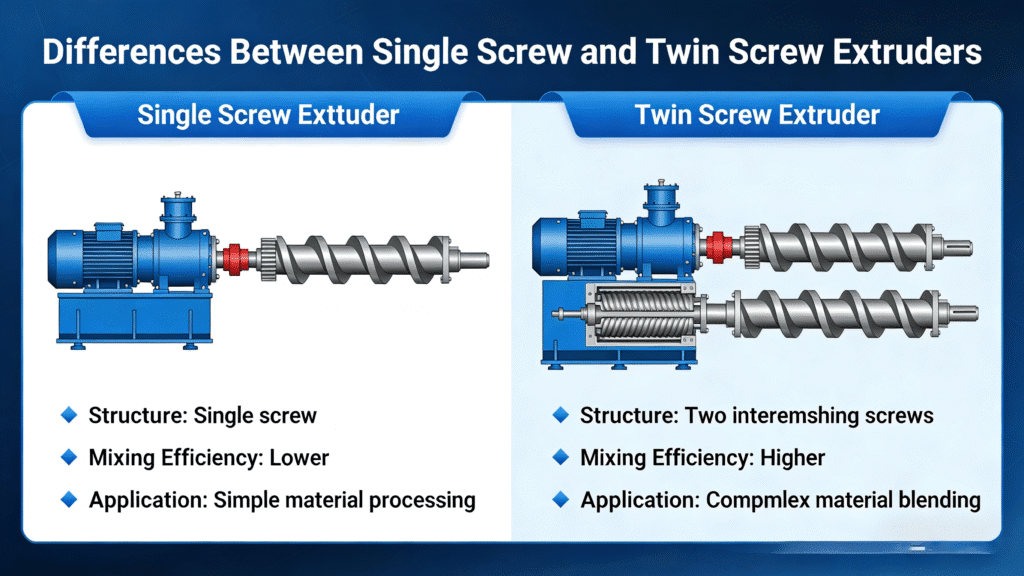
There are two main types of extruders used in pet food manufacturing.
Single-screw extruder
A single-screw extruder has a relatively simple structure and is suitable for certain standard formulations and production requirements.
It can be a practical choice for manufacturers with straightforward product specifications and limited investment budgets.
Twin-screw extruder
A twin-screw extruder offers greater flexibility when processing complex formulations and different raw materials.
Its advantages include:
- More flexible material handling.
- Improved mixing performance.
- Better control over processing conditions.
- Greater adaptability to different formulations.
- More consistent processing under suitable operating conditions.
For commercial cat food manufacturers, twin-screw extrusion is often an attractive option when product diversity and processing flexibility are important.

6. Cutting and Shaping
After extrusion, the continuous material passes through the die and is cut into individual pieces by a rotating cutting system.
By adjusting the cutter speed, blade structure, and die openings, manufacturers can produce cat food pellets in different shapes and sizes.
Common shapes include:
- Round pellets.
- Small fish-shaped pieces.
- Triangular pellets.
- Star-shaped pieces.
- Ring-shaped pellets.
- Customized shapes.
Different pellet sizes can be developed for different product positioning and feeding preferences.
For example, smaller pellets may be suitable for kittens, while adult cat food may use different sizes and structures.
Uniform pellet size is important because it helps ensure consistent drying, coating, and packaging performance.
7. Drying the Extruded Cat Food
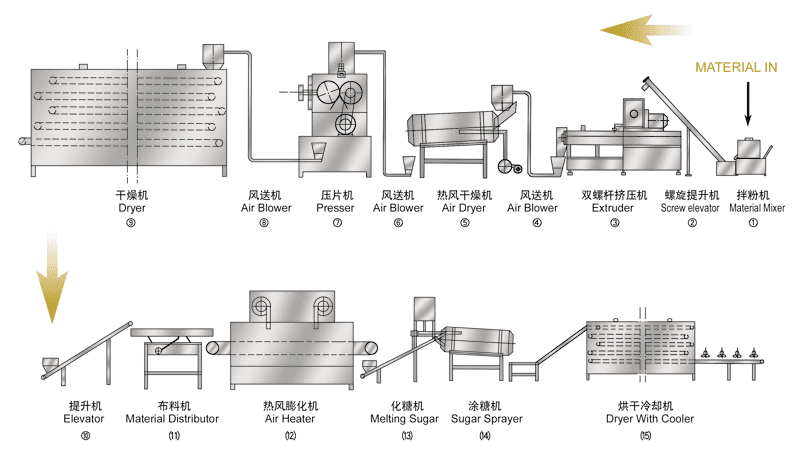
Freshly extruded cat food usually contains a relatively high moisture content and must be dried before further processing.
A multi-layer belt dryer is commonly used in commercial cat food production lines.
The pellets are transported through several drying layers while hot air circulates around them, gradually removing excess moisture.
Several factors influence drying efficiency.
Drying temperature: The temperature should be controlled according to pellet size, formulation, and initial moisture content.
Drying time: Larger and denser pellets generally require longer drying periods.
Air circulation: Uniform hot air distribution helps prevent uneven moisture removal.
Material distribution: An excessively thick product layer can reduce airflow through the pellets and cause inconsistent drying.
For many conventional dry cat food products, final moisture content is commonly around 8%–10%. However, the appropriate specification depends on the formulation, water activity, packaging, and storage requirements.
Manufacturers should monitor both moisture content and water activity to establish appropriate product stability and shelf-life specifications.
8. Oil Spraying and Flavor Coating
After drying, cat food enters the coating stage.
During this process, oils, fats, palatants, and other permitted nutritional ingredients are applied to the surface of the pellets.
This stage is particularly important because cats can be selective about food flavors and textures. Proper coating helps improve palatability and product acceptance.
Common coating ingredients include:
- Chicken fat.
- Fish oil.
- Animal fats.
- Meat-based palatants.
- Other approved nutritional additives.
A rotating coating drum is commonly used to distribute liquid ingredients evenly across the pellets.
For manufacturers requiring more advanced coating performance, vacuum coating equipment can help introduce oils and flavor ingredients into the porous structure of the pellets.
The amount of coating material should be carefully controlled to avoid excessive surface oil, uneven coating, or packaging difficulties.
9. Cooling
After coating, the cat food pellets need to be cooled before packaging.
The cooling machine reduces product temperature by circulating air through the finished pellets.
Proper cooling is important for several reasons:
- Stabilizing the pellet structure.
- Preventing condensation inside packaging.
- Improving packaging performance.
- Reducing the risk of moisture-related deterioration.
- Preparing the product for final inspection.
The cooling environment should be clean and appropriately controlled to prevent contamination and moisture absorption.
10. Screening and Quality Inspection
Before packaging, cat food usually passes through a vibrating screening machine.
The screening system separates qualified pellets from broken pieces, excessive powder, and other unwanted particles.
This improves product appearance and consistency.
Manufacturers should also conduct quality inspections throughout the production process.
Important quality indicators include:
- Moisture content.
- Water activity.
- Crude protein.
- Crude fat.
- Crude fiber.
- Ash content.
- Pellet size and appearance.
- Microbiological safety.
- Foreign material contamination.
For cat food, particular attention should also be paid to essential nutrients such as taurine and other nutrients required for feline health.
Metal detection equipment can be installed before packaging to identify potential metal contamination.
11. Automatic Packaging
Packaging is the final stage of extruded cat food manufacturing.
After inspection, qualified products are transported to an automatic weighing and packaging machine.
The machine weighs the specified quantity of cat food, fills the bags, and seals them.
Common packaging specifications include:
- Small retail packages.
- Medium-sized household bags.
- Large family-size packages.
- Bulk packaging for distributors.
Packaging materials should provide suitable protection against moisture, oxygen, and external contamination.
Since cat food contains fats that can deteriorate through oxidation, suitable packaging barrier properties are particularly important.
Manufacturers should also ensure that product labels meet the requirements of their target markets, including ingredient declarations, nutritional information, feeding instructions, batch identification, and shelf-life information.
12. Complete Equipment Required for Extruded Cat Food Production
A commercial extruded cat food production line generally includes the following machines:
| Equipment | Main Function |
|---|---|
| Hammer mill | Grinding raw materials |
| Automatic batching system | Weighing and feeding ingredients |
| خلاط | Mixing different ingredients |
| Conditioner | Adjusting moisture and temperature |
| Twin-screw extruder | Cooking and shaping cat food |
| Cutter | Producing uniform pellets |
| Multi-layer dryer | Removing excess moisture |
| Oil spraying machine | Applying fats and flavor ingredients |
| آلة التبريد | Reducing product temperature |
| Vibrating screen | Removing broken pellets and powder |
| Metal detector | Detecting metal contamination |
| Packaging machine | Weighing, filling, and sealing bags |
The exact configuration depends on production capacity, formulation, automation requirements, and investment budget.
Small manufacturers may choose a compact production line, while large factories generally require automated systems with continuous material handling.
13. Important Factors Affecting the Quality of Extruded Cat Food
Although modern equipment can improve manufacturing efficiency, the quality of extruded cat food still depends on several important factors.
Raw Material Quality
High-quality raw materials provide the foundation for nutritious cat food. Manufacturers should establish strict supplier evaluation and incoming material inspection procedures.
Nutritional Formulation
Cats have specific nutritional requirements. Formulations should provide appropriate levels of protein, fats, amino acids, vitamins, and minerals.
Extrusion Temperature and Moisture
Improper extrusion conditions may result in insufficient cooking, excessive expansion, poor pellet structure, or nutrient degradation.
Drying Conditions
Uneven drying can cause inconsistent moisture levels and affect product stability.
Coating Uniformity
Uneven oil and flavor distribution may negatively affect product palatability and appearance.
Hygiene and Food Safety
Raw material storage, equipment cleaning, pest control, and contamination prevention should be managed throughout the production process.
14. How to Improve the Efficiency of Cat Food Manufacturing
For commercial manufacturers, production efficiency directly affects operating costs and business profitability.
The following methods can help improve the overall production process:
- Select suitable production equipment: Match machine capacity to actual production requirements.
- Use automatic feeding systems: Reduce manual handling and improve ingredient consistency.
- Optimize extrusion parameters: Establish suitable temperature, moisture, and screw speed settings.
- Improve drying efficiency: Optimize airflow, temperature, and conveyor speed.
- Automate the coating process: Improve coating uniformity and reduce ingredient waste.
- Establish preventive maintenance: Reduce unexpected equipment failures.
- Monitor production data: Record processing parameters and finished product quality to identify opportunities for improvement.
Manufacturers should also conduct regular production trials when changing formulations or introducing new cat food products.
Conclusion
The processing of extruded cat food involves a series of carefully controlled operations, including raw material preparation, grinding, mixing, conditioning, extrusion, cutting, drying, oil coating, cooling, screening, and packaging.
Among these stages, extrusion and drying play particularly important roles in determining the final product’s structure, texture, moisture content, and processing stability.
For manufacturers planning to invest in a commercial cat food factory, choosing suitable processing equipment and establishing a scientifically designed production process are essential.
A complete and well-integrated cat food production line can improve manufacturing efficiency, reduce labor costs, and support the production of different pellet shapes, sizes, and nutritional formulations.
By combining high-quality ingredients, advanced extrusion technology, efficient drying equipment, and strict quality management, manufacturers can produce competitive extruded cat food products and meet the growing demands of the global pet food market.


