Anatomy of a Powerhouse: Demystifying the Construction of a Twin-Screw Extruder
The twin-screw extruder is a marvel of precision engineering, transforming raw materials into an endless array of products—from breakfast cereals and pet food to bioplastics and pharmaceuticals. extruder machine Its exceptional functionality stems from a sophisticated and modular construction. This article unveils the key components that make this machine a continuous processing titan.
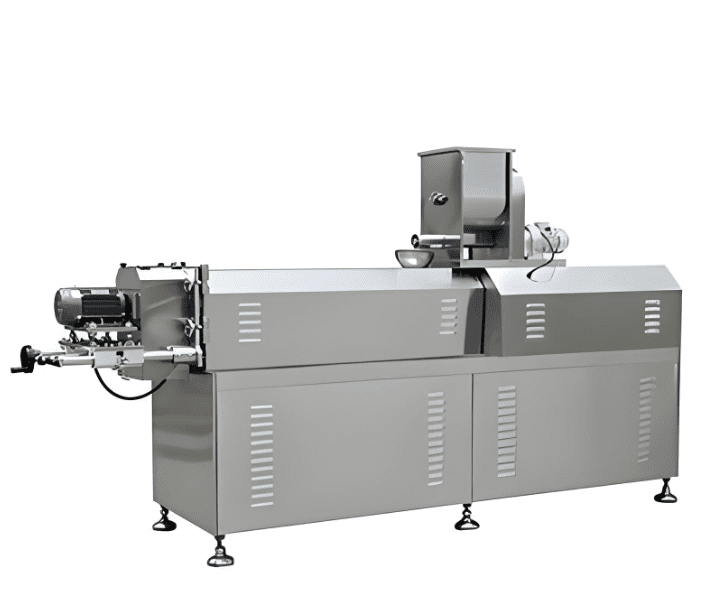
At its core, a twin-screw extruder is built around several integrated systems: the Drive System, the Processing Section (Barrel and Screws), the Feeding System, the Die & Cutting Assembly, and the Control System.
1. The Drive System: The Heart of Power
- Function: Provides the rotational force (torque) and controls the speed (RPM) of the twin screws.
- Key Components:
- Main Motor: A high-power electric motor (often AC or DC drive) acts as the primary power source.
- Gear Reducer: A robust, precision gearbox reduces the motor’s high speed to the desired low-speed, high-torque output required for the screws. It is the machine’s most critical mechanical component, built to withstand immense stresses.
- Thrust Bearing Assembly: Located after the gearbox, extruder machine this assembly absorbs the massive axial (backward) forces generated by the pressure build-up inside the barrel, preventing the screws from being pushed back into the gearbox.
2. The Processing Section: Where Transformation Happens
This is the operational core of the extruder, consisting of the screws and the barrel.

A. The Twin Screws: The Engine Room
- Design: Two parallel, intermeshing screws mounted on splined shafts. They are predominantly co-rotating (both rotate in the same direction) for efficient self-wiping and mixing.
- Modularity: The most defining feature. Screws are not single pieces but are assembled from individual screw elements slid onto the shafts. This allows for infinite configuration.
- Conveying Elements: Have a deep, open flight to gently transport material forward.
- Kneading Blocks: The workhorses of mixing and shear. These staggered, disc-like elements generate intense mechanical energy, mixing, shearing, and heating the product. Their staggering angle (forward, neutral, or reverse) controls mixing intensity and pressure profile.
- Special Elements: Include reverse-pitch elements (to create backflow and fill sections) and mixing gears for distributive blending.
B. The Barrel: The Contained Vessel
- Structure: A long, thick-walled, hardened steel cylinder split into multiple barrel segments, bolted together. This modularity allows for customization of length and function.
- Barrel Liners: The inner surface is often lined with wear-resistant, bi-metallic alloys to withstand abrasion from processing materials.
- Heating/Cooling Jackets: Each barrel segment has an external jacket for precise temperature control via electric heater bands and/or fluid (water or oil) circulation channels.
- Venting Ports: Specific barrel segments feature open ports for:
- Feed Ports: Introduction of main ingredients and liquid injectors (water, steam, oil).
- Devolatilization Ports: For removing steam or volatile components, often under vacuum.
3. The Feeding System: Precision Metering
- Function: Ensures a consistent, controlled, and accurate supply of raw materials into the extruder throat.
- Components:
- Main Feeder: Typically a loss-in-weight (LIW) feeder for the major ingredient (e.g., flour), providing gravimetric accuracy critical for process stability.
- Liquid Feed Pumps: Meter and inject precise amounts of water, steam, oils, or molten ingredients directly into the barrel.
- Minor Ingredient Feeders: Additional feeders (volumetric or LIW) for additives, extruder machine flavors, or colors.
4. The Die & Cutting Assembly: Giving Final Form

- Function: Shapes the cooked, plasticized mass and cuts it to size.
- Die Plate: A thick, precision-machined metal disc mounted at the end of the barrel. Its orifices or slot define the product’s 2D shape (rings, pellets, sheets, stars).
- Cutter: A high-speed rotating knife assembly positioned flush against the die face. The cutter speed determines the product’s length.
5. The Control System: The Brain & Nervous System
- Function: Integrates, monitors, and automates all machine functions for consistent, repeatable operation.
- Components:
- PLC (Programmable Logic Controller): The central computer that runs the process logic.
- HMI (Human-Machine Interface): The touchscreen operator panel for setting parameters (screw speed, temperatures, feed rates), viewing trends, and managing recipes.
- Sensors: A network of sensors (for temperature, pressure, motor load, weight) provides real-time feedback for closed-loop control.
The twin-screw extruder is not a simple machine but a configurable, continuous processing platform. Its true genius lies in the synergy between its modular construction (screw and barrel elements) and its integrated subsystems. By understanding this anatomy, engineers can precisely configure the machine—tailoring the intensity of shear, heat, pressure, and mixing—to unlock its vast potential for product innovation across countless industries.